


When you’re facing a legal dispute in Georgia, it’s easy to assume that a long courtroom battle is the only way forward. But for many civil cases, from business contract disputes in Alpharetta to family conflicts in Forsyth County, settling out of court is often the smarter, more strategic path.
Opting for a settlement is not about giving up; it’s about taking charge. It’s a proactive decision to control the outcome, keep legal costs in check, and resolve the issue on your own terms rather than leaving a critical decision in the hands of a judge or jury.
Why Settling Out of Court Is a Strategic Advantage
When you choose to settle, you're stepping into the driver's seat. A courtroom verdict can be a gamble, but a settlement lets you and the other party craft an agreement that genuinely meets your specific needs.
This is especially true in sensitive family law matters, like working out child custody in Roswell or dividing marital assets in Cumming. A collaborative, out-of-court solution can often preserve important family relationships in a way a contentious trial simply can't.
Taking Control of Costs and Timelines
Litigation is expensive. Court fees, discovery costs, and mounting attorney hours can drain your finances and your emotional energy. Settling helps you sidestep these escalating costs and the immense stress that comes with a prolonged legal fight.
This isn't just true for individuals; it's a reality for major corporations, too. In fact, recent data shows that class action settlements hit over $5.2 billion globally, and a staggering 76% of that total came from U.S. cases alone. These numbers show just how powerful the financial motivation is to avoid the risk and expense of a trial.
A settlement isn’t a sign of weakness. It’s a calculated decision that prioritizes certainty, efficiency, and your resources over the high-stakes gamble of a courtroom battle.
For business owners in places like Johns Creek and Marietta, this kind of control is vital. A quiet, confidential settlement can protect a company’s reputation and keep sensitive financial details from becoming public record, something that almost always happens in court proceedings.
Courtroom Litigation vs. Out-of-Court Settlement
Deciding how to proceed can feel overwhelming. To make it clearer, let's compare the two paths side-by-side. This table breaks down the fundamental differences between taking your case to trial and resolving it through a settlement.
| Factor | Courtroom Litigation | Out-of-Court Settlement |
|---|---|---|
| Control | Low; outcome decided by a judge or jury. | High; parties craft their own agreement. |
| Cost | High; includes court fees, attorney hours, expert witnesses. | Lower; avoids most trial-related expenses. |
| Timeline | Long and unpredictable; can take months or years. | Fast and efficient; can be resolved in weeks. |
| Privacy | Public record; proceedings and documents are open. | Confidential; terms are kept private. |
| Outcome | Uncertain; an "all or nothing" verdict is common. | Predictable; you agree to a known outcome. |
| Relationships | Adversarial; often damages relationships permanently. | Collaborative; can help preserve relationships. |
As you can see, the benefits of settling are compelling. You gain control over the process, protect your privacy, and save significant time and money.
Ultimately, choosing to settle empowers you to close a difficult chapter with confidence and move on. To get a better sense of what a full-blown courtroom process involves, you can learn more about the litigation process in our detailed guide.
Building the Foundation for a Successful Negotiation
A successful settlement isn’t won when you shake hands on the final deal. It's built on the groundwork you lay long before you talk to the other party. Thinking about settling a case out of court means you first have to build a solid foundation. This is all about gathering your facts, truly understanding your legal position, and getting ready to state your case clearly and professionally.
This starts with getting your paperwork in order. If you're in a business contract dispute in Alpharetta, that means pulling together the signed agreement, every relevant email, all invoices, and anything that documents performance or lack thereof. For a family law case in Forsyth County, you'll need financial statements, property deeds, tax returns, and any texts or emails about custody or support. When you have this evidence organized, your arguments are based on hard facts, not just raw emotion.
Define Your Best and Worst-Case Scenarios
With your documents lined up, it’s time to be honest about your goals. One of the most critical tools in any negotiation is figuring out your Best Alternative to a Negotiated Agreement (BATNA). This isn't your dream outcome. Instead, it’s what you’ll do if the talks completely fall apart. Will you actually go to trial? Will you just walk away from the deal?
Knowing your BATNA gives you real leverage and a firm point where you know it’s time to walk away. It stops you from taking a bad deal that’s actually worse than your next best option. On the flip side, you also need to understand your worst-case scenario. What’s the absolute most you could lose if a judge in Fulton County ruled against you? Thinking through both of these extremes gives you a realistic settlement range to work within.
Calculating the True Cost of Litigation
An out-of-court settlement is almost always a cost-benefit analysis. The "cost" of taking a case to court goes way beyond what you pay your attorney. You have to factor in court filing fees, the high price of expert witnesses, deposition costs, and the huge amount of your own time spent away from your business or family.
Beyond that, think about the emotional and reputational damage. A public court fight can burn bridges in business and drag private family matters into the light. When you add up these tangible and intangible costs, a reasonable settlement offer suddenly starts to look a lot more appealing.
The graphic below breaks down the core strategic advantages you gain by preparing to settle.
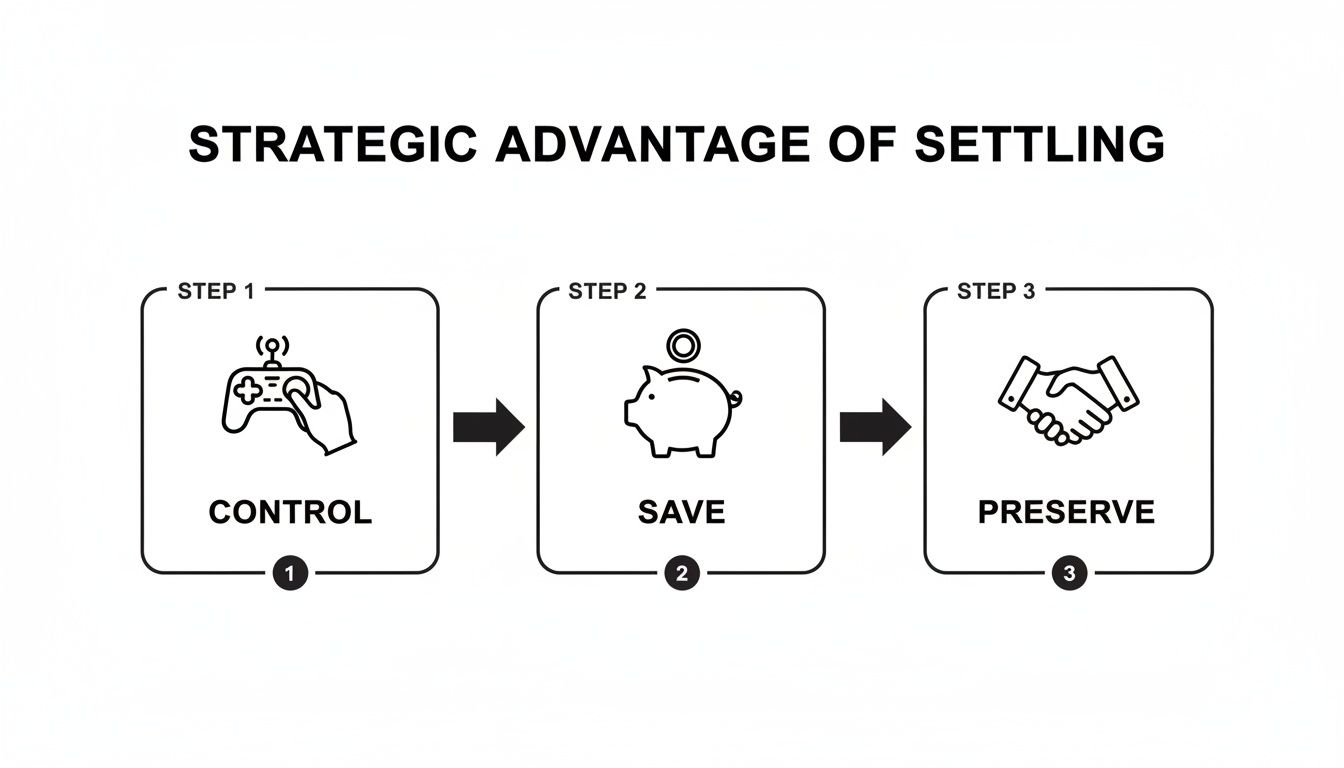
This process really highlights how settling lets you control the outcome, save resources, and keep important relationships intact, things that litigation would almost certainly destroy.
Articulate a Clear and Professional Position
Once you have your evidence organized and your goals defined, you can draft your opening position. This needs to be a clear, straightforward summary of the facts, the core issue, and what you’re proposing as a resolution. It is crucial to avoid accusatory language or emotional outbursts.
For instance, instead of saying, "You completely breached our contract and destroyed my project," try a more factual approach: "The agreement signed on May 1st specified a delivery date of July 15th. The materials arrived on September 20th, which caused a project delay and led to documented financial losses of X dollars."
A position grounded in facts and presented with professional calm is far more persuasive than an argument fueled by anger. The goal is to open a productive dialogue, not to win a shouting match.
This calm, evidence-based approach sets a constructive tone right from the start. It shows the other side that you are serious, prepared, and focused on finding a logical and fair way forward, which is the whole point of settling a dispute effectively.
Mastering Negotiation And Mediation In Georgia
Once you’ve done your homework and prepared your case, it’s time to engage with the other side. In Georgia, this usually means one of two things: direct negotiation or formal mediation. While both are aimed at reaching a settlement outside of court, they are very different processes. Understanding how to navigate them is crucial for a good outcome.

Direct negotiation is just what it sounds like, a conversation between you and the other party, or between your attorneys. Success here really boils down to clear and calm communication. The objective isn't to "win" by bulldozing the other person, but to find a resolution that both sides can live with.
Proven Strategies for Effective Negotiation
Good negotiation is an art, a blend of standing your ground while knowing when to be flexible. Instead of starting with rigid demands, try framing your ideas around interests you both share. For instance, in a business partnership dispute in Roswell, both partners have a shared interest in protecting the company’s reputation, even if they can't agree on who owns what.
Here are a few core strategies that work time and again:
- Listen More Than You Talk: Pay attention to what the other party is saying, not just what you want to say next. When you understand their real concerns, you often find unexpected room for compromise.
- Focus on Interests, Not Positions: A "position" is a hard demand, like, "I need $100,000." An "interest" is the why behind it, like needing the money to cover specific business losses. When you address the underlying interests, you open up far more solutions.
- Keep It Professional: Emotions can sink negotiations fast. Stick to the facts and keep your tone respectful, even when you disagree. This is especially true in sensitive family law cases, like those involving child custody in Forsyth County.
The Role of a Neutral Mediator In Georgia
When talking directly isn't working, mediation provides a structured way forward. A mediator is a neutral third party, often a seasoned attorney or retired judge, trained in resolving disputes. They don't make decisions for you; their job is to help you have a productive conversation. Here in Georgia, courts in Fulton and Forsyth counties will often order parties into mediation before they’ll even let a case go to trial.
A good mediator helps both sides:
- Cut through the noise to identify the real issues.
- Explore creative solutions you might not have thought of.
- Communicate better by translating emotional arguments into practical terms.
This is clear in heated inheritance disputes in Cumming, where a mediator can help feuding siblings look past old grievances to divide property fairly. It can preserve family relationships that a court battle would almost certainly destroy.
Mediation gives you a confidential, controlled space to work things out. You keep control over the final agreement, which is something you lose the moment a judge or jury takes over.
This approach works. Research shows that in countries with common law systems like ours, settlement rates are incredibly high, over two-thirds of civil cases resolve without a trial. That’s a world away from rates below 15% in other nations. For anyone facing a dispute in Georgia, this should be encouraging. Settling is not just possible; it’s the most likely outcome.
When to Choose Mediation Over Negotiation
Direct negotiation can be great for simpler issues where both sides can still communicate respectfully. However, mediation is often the smarter move if:
- Communication has completely broken down.
- There's a significant power imbalance between you and the other party.
- The legal or financial issues are complex, like in a high-asset divorce.
Ultimately, both negotiation and mediation are powerful tools for staying out of the courtroom. The trick is to pick the right one for your situation and prepare diligently. For more specific advice on getting ready, you can check out our guide on how to prepare for mediation.
Drafting an Enforceable Settlement Agreement
Getting to a verbal agreement is a fantastic milestone, but the job is only halfway done. To truly put a dispute to rest, that handshake deal needs to become a formal, written, and legally binding document. This settlement agreement is the final word, and if it isn't put together correctly, you could find yourself right back at square one.
A solid agreement leaves zero room for interpretation. It must use clear, precise language to spell out every single detail of the resolution, from payment amounts and deadlines to the specific actions each party has promised to take. The whole point is to shut the door on any future arguments about what was agreed upon.
Key Components of a Rock-Solid Agreement
While every dispute is unique, a strong settlement agreement is built on a few non-negotiable pillars. These clauses are what give the document its strength and make it enforceable under Georgia law.
Before you even start, it’s a good idea to familiarize yourself with the essential elements of contract law. These principles are the foundation that ensures your agreement will hold up if it's ever challenged in court.
To make sure your agreement is comprehensive, we've outlined some of the most critical clauses to include.
Essential Clauses in a Georgia Settlement Agreement
| Clause | Purpose | Example Application |
|---|---|---|
| Release of Claims | This is the core of the deal. Both parties agree to drop all current and future legal claims related to this specific dispute. | A former employee agrees not to sue for wrongful termination in exchange for a severance package. |
| Payment Terms | If money is involved, this section must be exact: total amount, payment method, due dates, and penalties for late payment. | A contractor agrees to accept $5,000 paid in two installments on the 1st of the next two months to settle a payment dispute. |
| Confidentiality | This clause prevents either party from discussing the terms of the settlement with others, protecting privacy and reputations. | Two business partners in Alpharetta agree to keep the financial details of their separation private. |
| No Admission of Liability | A standard provision stating that settling the case is not an admission of guilt or wrongdoing by anyone involved. | A company in a contract dispute agrees to a settlement without admitting fault. |
Each of these clauses works together to create a document that not only resolves the immediate issue but also protects everyone from future conflict.
A confidentiality clause, for example, is often crucial. Parties usually want to move on without the details of their dispute becoming public knowledge. We have a detailed guide explaining what should be included in a nondisclosure agreement that can offer more insight.
The Dangers of Using Generic Templates
It’s tempting to head online and download a generic settlement template to save a few dollars. People here in Cumming and Dawsonville do it all the time, but it’s a massive risk. These one-size-fits-all forms rarely account for the specific facts of your case or the nuances of Georgia law.
Frankly, a poorly written agreement can be worse than having no agreement at all. Vague language can be twisted, important protections can be left out, and you might end up with a document that a judge in Fulton or Forsyth County simply won't enforce.
A settlement agreement isn't just a formality; it's the legal armor that protects your resolution. A small investment in professional legal drafting now can save you from enormous costs and complications later.
Having an experienced attorney draft or at least review your agreement is the final, crucial step. A lawyer ensures the language is airtight, your rights are fully protected, and the document will stand up to scrutiny. It's the only way to get the peace of mind that comes with knowing the dispute is truly over.
Knowing When to Bring in a Civil Litigation Attorney
Trying to handle a minor disagreement by yourself can be empowering, but knowing the right time to call a lawyer is one of the most important strategic decisions you’ll make. While you might be able to negotiate a simple issue directly, the stakes get much higher in complex civil disputes. That’s when the guidance of an experienced attorney becomes essential.
Going it alone in a serious legal matter can lead to a bad outcome with consequences that stick around for years. Deciding to hire a lawyer isn’t admitting defeat; it’s a smart, proactive step to protect your interests. For individuals and businesses in communities like Johns Creek and Marietta, having a professional advocate on your side takes the emotion out of the equation and makes sure your case is presented clearly and forcefully. An attorney brings an objective viewpoint, basing your strategy on Georgia law, not gut reactions.
High-Stakes and Complex Scenarios
Some situations just flat-out require legal representation. Trying to settle these types of cases without a lawyer is like trying to find your way through a dense forest without a map, the risk of making a critical mistake is just too great.
You should always have an attorney if you're facing scenarios like these:
- High-Asset Divorce: When a marriage involves significant assets like businesses, real estate holdings, or investment portfolios in Alpharetta or Cumming, an attorney is crucial for ensuring a fair and complete division of property.
- Complex Business Litigation: Disputes over partnership agreements, intellectual property rights, or contracts with multiple parties demand a deep understanding of corporate and contract law.
- Significant Contract Disputes: If a broken contract has major financial fallout or threatens your business's survival, you need legal counsel to enforce your rights and limit the damage.
In these situations, a lawyer does more than just offer advice. They can conduct formal discovery to get to the facts, give you a real assessment of your case's strengths and weaknesses, and handle all the back-and-forth with the other side. This professional buffer keeps negotiations focused on the facts, not feelings.
The Strategic Value an Attorney Provides
An experienced civil litigation attorney levels the playing field, especially if the other party has already hired a lawyer. They know the procedural rules of courts in Forsyth and Fulton counties, understand how to draft proposals that hold up legally, and can spot holes in the other side’s arguments that you’d likely miss.
This strategic edge is becoming even more important with new trends like third-party litigation funding. This evolving practice can change settlement dynamics significantly. The global litigation funding market, currently valued at $17.5 billion, is projected to explode to $67.2 billion by 2037. This trend lets people pursue or defend a case without paying all the costs upfront, which often adds pressure on everyone to reach a fair settlement faster. You can explore more about this market and its impact on how cases are resolved.
An attorney's main job in a settlement negotiation is to get you a favorable outcome that is legally protected. They transform a personal fight into a professional resolution, making sure the final agreement is clear, enforceable, and truly the end of the matter.
Ultimately, hiring an attorney is an investment in your own peace of mind. They make sure any settlement you sign isn't just a quick fix but a complete and final resolution that fully protects your interests under Georgia law. Without that professional oversight, you risk signing an agreement with hidden loopholes or unintended consequences that could drag you right back into court down the road.
Common Questions About Settling Civil Disputes in Georgia
When you're facing a civil dispute, questions are bound to come up. Whether it's a business disagreement brewing in Alpharetta or a family matter in Forsyth County, understanding how a settlement works can help you make clear, confident decisions. Here are a few answers to some of the questions we hear most often from clients looking to settle a case out of court in Georgia.
How long does settling a case out of court take in Georgia?
The timeline for an out-of-court settlement can vary quite a bit. It really depends on the complexity of the case and how willing everyone is to cooperate. A more straightforward issue, like a simple unpaid invoice, might get wrapped up in just a few weeks of negotiation. On the other hand, more involved matters like a high-asset divorce or a multifaceted business dissolution can easily take several months. Still, this is almost always significantly faster than the years a case can spend working its way through the court system.
Is a settlement agreement legally binding?
Yes, absolutely. Once a settlement agreement is properly drafted and signed by all parties, it becomes a legally binding contract. If one party doesn't hold up their end of the bargain, the other can take legal action to enforce the terms of that agreement. If the settlement resolves a lawsuit that’s already been filed, the agreement can be submitted to the court and incorporated into a final order, giving it the full weight of a court order.
What happens if we only agree on some issues?
That's perfectly fine, and it's often a smart strategy. You can sign a partial settlement agreement to resolve the matters you've already agreed upon. This narrows the focus of the dispute, letting you concentrate your time and resources on the few issues that remain. For instance, in a divorce, you might agree on how to divide all property except for the family business. A partial settlement locks in that property division, saving you the expense of litigating those points.
Can I settle a case after a lawsuit is already filed?
Yes, and it happens all the time. It’s very common for cases to settle after a lawsuit has been filed, sometimes even on the courthouse steps just before a trial begins. The litigation process itself often pushes the parties toward a resolution. The formal discovery phase, with its depositions and document requests, forces both sides to lay their cards on the table. This often shines a light on the real strengths and weaknesses of each position, making a reasonable middle ground look much more appealing than the risk and cost of a trial.
Settling after a lawsuit begins doesn't mean you've wasted time or money. It often means the legal process worked exactly as it should, providing the clarity needed to reach a sensible and informed resolution.
How much does it cost to settle out of court?
The cost of settling a case is almost always less than taking it to trial. While you'll still have attorney’s fees for things like negotiation and drafting the agreement, you sidestep the most significant expenses that come with full-blown litigation. These avoided costs often include court filing fees, high-cost expert witness fees, deposition costs for court reporters, and the immense number of attorney hours required for trial preparation. By choosing to settle, you are making a proactive financial decision to resolve the matter efficiently. For answers to other frequently asked questions about general legal processes, you may find additional resources helpful.
Navigating the complexities of a civil dispute requires clear guidance and a steady hand. At Miles Hansford Law Firm, we provide the experienced counsel you need to resolve conflicts effectively and move forward with confidence. To discuss your case, please visit https://mileshansford.com.