


Feeling wronged by a company in Cumming, GA can leave you feeling frustrated, ignored, and powerless. When phone calls and emails lead nowhere, the thought of taking legal action can feel like the only option left. But suing a company in Georgia is a serious, strategic process. It requires more than just frustration; it demands strong evidence, a clear legal basis, and a deep understanding of the procedures in Forsyth County and Fulton County courts. Before you take that step, it's crucial to calmly assess your position and build a solid foundation for your claim.
If you’re facing a business dispute in Cumming or Alpharetta, don’t navigate it alone. The first step is understanding your legal options. Schedule a consultation with our experienced litigation attorneys to protect your rights and interests.
Why This Matters in Cumming: Should You Sue a Company?
Deciding to sue a company is a significant commitment. Lawsuits in North Georgia demand time, financial resources, and emotional energy, so this is not a decision to be made lightly. For business owners and residents from Johns Creek to Suwanee, the real work begins long before you ever set foot in a courthouse.
Your first job is to get organized and build the foundation of your case. A calm, strategic evaluation of your situation is critical.
Initial Claim Assessment for Georgia Disputes
Before moving forward, use this checklist to gauge the strength of your potential lawsuit. This is how we begin to analyze cases for clients in Cumming, Alpharetta, and surrounding communities.
| Consideration | Why It Matters for a Cumming, GA Lawsuit | Your Next Actionable Step |
|---|---|---|
| Written Contract | A signed agreement is your most powerful evidence. Forsyth and Fulton County courts rely heavily on the written terms agreed to by both parties. | Locate the original contract and any addendums. Carefully review the obligations, breach clauses, and any specified remedies for disputes. |
| Provable Damages | You must prove a specific, quantifiable financial loss. Vague claims of "stress" or "inconvenience" are rarely sufficient to win a lawsuit in Georgia. | Calculate your exact losses: money paid, costs to hire another company to fix the problem, lost profits. Gather all invoices, receipts, and bank statements. |
| Statute of Limitations | Georgia law sets firm deadlines for filing lawsuits (e.g., 6 years for written contracts, 4 years for oral agreements). Missing this window bars your claim. | Determine the exact date the breach or incident occurred. Confirm the specific statute of limitations for your type of claim with an attorney. |
| Company's Ability to Pay | A court judgment is worthless if the company is bankrupt or has no assets. It's a hollow victory. | Perform a business search on the Georgia Secretary of State's website. Look for signs of financial distress or dissolution. |
This checklist helps you think like an attorney, focusing on the practical elements that determine whether a case is worth pursuing in the local court system.
Collect All Relevant Documents
Every successful lawsuit is built on a mountain of proof. You cannot simply tell a judge you were wronged; you must show them. Before even considering a lawsuit, gather every piece of paper and digital file related to your dispute.
- Contracts and Agreements: The signed contract is the rulebook for your business relationship and what a Forsyth County judge will examine first.
- Emails and Text Messages: Digital communications are powerful. A simple text can establish a timeline, and an email can contain a critical admission from the other party.
- Invoices and Receipts: These documents prove what you paid and when, establishing the clear financial damages in your case.
- Photographs and Videos: Visual evidence is incredibly persuasive. If you're dealing with a botched construction job in Milton or defective materials delivered in Dawsonville, photos are essential.
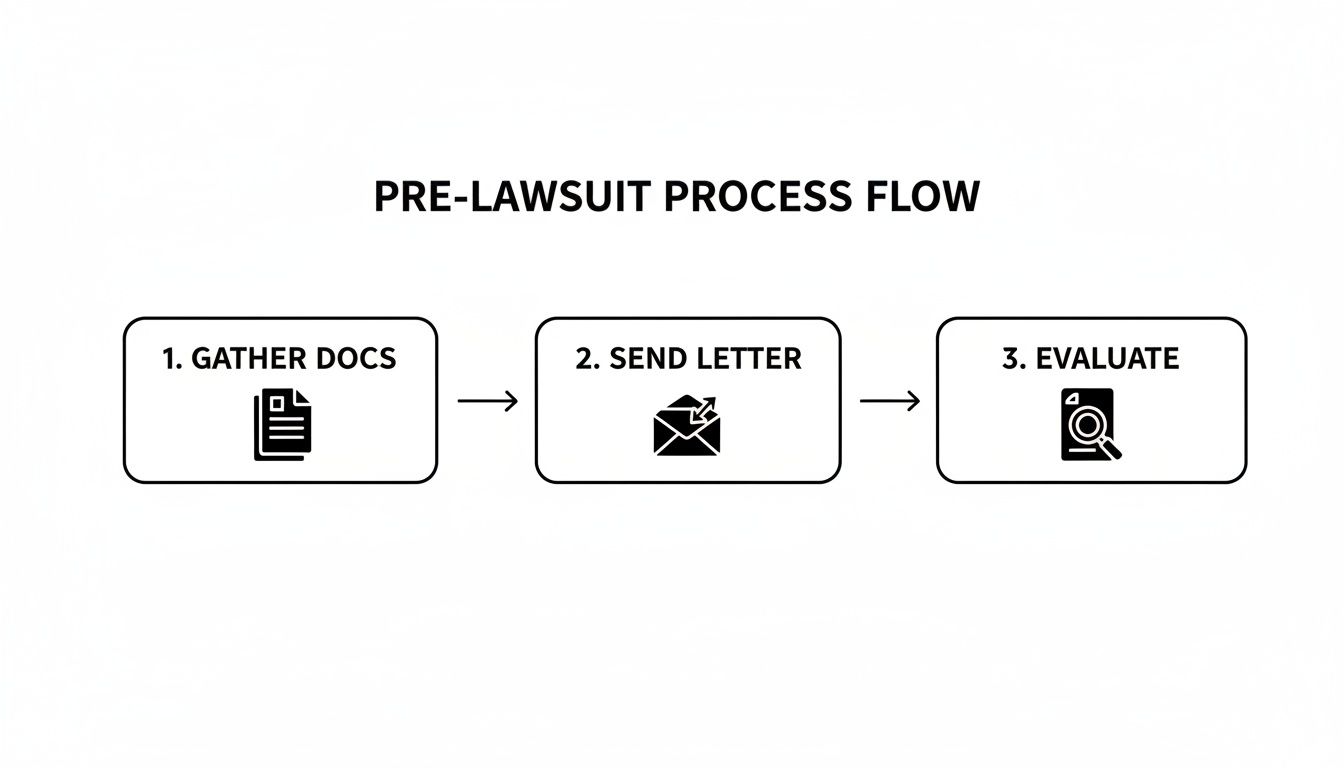
As this shows, the process is methodical. Solid documentation and a formal demand are crucial steps you must take before a lawsuit is even on the table.
The Legal Process Breakdown: How to Sue a Company in Georgia
Filing a lawsuit is more than just paperwork; it’s a series of strategic steps. Here’s a breakdown of the process.
Step 1: The Formal Demand Letter
Before filing in Forsyth County Superior Court or Fulton County Superior Court, it is almost always best practice to make one final, formal attempt to resolve the issue. In Georgia, this is done with a demand letter.
This is not just another angry email. A demand letter, especially from a law firm, is a formal legal document that:
- Clearly and professionally lays out the facts of your dispute.
- References your legal grounds for a claim, such as breach of contract.
- Demands a specific outcome, like a refund of $10,000 or completion of services.
- Sets a firm deadline for a response before you initiate a lawsuit.
A well-crafted demand letter signals you are serious and have retained legal counsel. We have resolved countless disputes for clients from Roswell to right here in Cumming at this stage, saving everyone the time and expense of litigation.
Even if the company ignores your letter, you have created a crucial piece of evidence. You can now show the court you acted in good faith to resolve the problem before taking up its time. This initial phase is about being prepared, not aggressive.
Step 2: Determining Your Legal Claim and Damages
To sue a company in Cumming, GA, you must shift from feeling wronged to identifying how you were legally wronged. Georgia courts don't award damages for bad service alone. You must show the company had a legal duty, breached that duty, and caused you measurable financial harm.
- Breach of Contract: The most common claim. This occurs when one party fails to uphold their end of a deal. You must prove a valid contract existed, the other party broke it, and you suffered financial loss as a result.
- Negligence: This applies when a company's carelessness directly causes you harm. For example, a commercial driver from a Dawsonville-based company causes an accident, or a Roswell store fails to clean a spill, leading to an injury.
- Fraud or Misrepresentation: This is more serious and involves a company intentionally lying to gain an unfair advantage. Proving fraud requires showing they made a false statement they knew was false, you relied on that lie, and it cost you money.
- Property Damage: If a company's actions damage your property, you can sue for repair costs or the diminished value of your property. This is different from a family law case involving equitable division in Georgia, but the principle of calculating value is just as important. For specialized cases, you might consider Hiring a Diminished Value Lawyer in Georgia.
Calculating your damages is the next critical step. In Georgia, damages are meant to make you "whole" again.
- Direct Damages: The most obvious losses. If you paid a Cumming roofer $15,000 for a faulty roof, your direct damages include the cost to hire someone else to fix it.
- Consequential Damages: The ripple-effect losses. If that leaky roof destroyed $10,000 of equipment in your Alpharetta office, those lost profits could be consequential damages.
- Punitive Damages: These are rare and designed to punish a defendant for egregious behavior like intentional fraud. The standard for proving punitive damages in Forsyth and Fulton County courts is extremely high.
You can learn more by reading our guide on how to handle breach of contract situations.
Step 3: Filing the Lawsuit and Serving the Complaint
Once the decision is made, your attorney will draft a "Complaint." This legal document tells the story of your lawsuit: who you are, who you're suing, the legal grounds for your case, and the relief you are seeking from the court.

This Complaint is filed with the Clerk of Court. If suing a business in Cumming, you'll file at the Forsyth County Courthouse. For companies in Alpharetta or Johns Creek, you’ll file at a Fulton County courthouse. After paying a filing fee, your lawsuit officially begins.
Next is "Service of Process." You must formally notify the company they are being sued. This isn't optional. Proper service is a constitutional requirement.
- Sheriff's Service: The local Sheriff's Department can deliver the lawsuit.
- Private Process Server: A court-certified professional serves the documents.
- Acknowledgement of Service: The company's lawyer agrees to accept the lawsuit.
Once served, the company typically has 30 days to file an "Answer" in a Georgia Superior or State court. If they fail to do so, you may win by default.
Our Strategy: Navigating the Forsyth and Fulton County Courts
Filing a lawsuit in the wrong court is a costly mistake that can get your case dismissed. Understanding jurisdiction and venue in North Georgia is one of the most important strategic decisions you will make.
Choosing the Right Court for Your Cumming, GA Lawsuit
You cannot just file at the nearest courthouse. Georgia law has specific rules:
- Venue: You generally must sue a company where its registered office is located. If you live in Cumming but the company is based in Alpharetta, the proper venue is likely Fulton County, not Forsyth County. Filing in the wrong county is a common error that leads to immediate motions to dismiss.
- Magistrate Court (Small Claims): For disputes of $15,000 or less, Magistrate Court in Forsyth or Fulton County is the right venue. It is faster and less formal. It’s ideal for homeowners in Milton with small contractor disputes or a business in Johns Creek collecting an unpaid invoice.
- State and Superior Courts: For claims over $15,000, your case will be heard in State or Superior Court. These are the venues for serious civil litigation, from major breach of contract claims to complex business disputes. A business dissolution in Alpharetta would go to Fulton County Superior Court, while a major contract lawsuit against a Cumming corporation would be filed in Forsyth County State or Superior Court. These courts involve formal rules and complex procedures, making experienced legal guidance essential. Learn more about what litigation entails.
Discovery, Mediation, and Trial

Once filed, the case enters discovery, where both sides exchange evidence. This is often where cases are won or lost.
- Interrogatories (Written Questions): We might ask an Alpharetta-based company to identify every person involved in a disputed project.
- Requests for Documents: In a Cumming construction case, we would demand all blueprints, emails, and change orders.
- Depositions (Sworn Testimony): We question witnesses under oath to lock in their story. We help our clients how to prepare for a deposition.
Before trial, the defendant may file a motion to have the case thrown out. Litigators must be skilled at mastering the motion to dismiss format.
The vast majority of civil lawsuits in Georgia (over 90%) are resolved before trial, often through mediation. Forsyth and Fulton courts strongly encourage mediation, where a neutral third party helps both sides negotiate a settlement. This is your chance to resolve the case on your terms, avoiding the risk and expense of trial.
If a settlement isn’t reached, the case proceeds to trial, a formal process of presenting evidence to a judge or jury for a final verdict.
What to Expect in Forsyth and Fulton County Courts
We are in the Forsyth County Superior Court and the North Fulton courts on a regular basis. This isn't just about knowing the directions to the courthouse; it’s about understanding the local legal culture.
We know how specific judges run their courtrooms. We have working relationships with the clerks and many of the attorneys on the other side of cases from Canton to Sandy Springs. This local insight allows us to build legal strategies that are not only strong on paper but also effective in practice right here in our community courts. Our approach is based on years of hands-on litigation experience throughout North Georgia, giving you a realistic, protective, and strategic path forward.
Why Choose Miles Hansford for Your Cumming, GA Lawsuit
When you decide to sue a company, you need a local advocate who understands the legal terrain of North Georgia. At Miles Hansford, our firm is deeply rooted in the Cumming and Alpharetta communities. We don't just have an office here; we live and work here.
Our goal is to protect your interests. We start by listening to understand what a successful outcome looks like for you. Whether it’s a breach of contract in Alpharetta, a partnership dispute in Johns Creek, or a construction conflict in Dawsonville, we prioritize negotiation but are always prepared for trial. Our experienced litigators are ready to fight for you in the courtroom when a fair settlement isn't possible.
Choosing Miles Hansford means you get sophisticated legal skill with the personal attention and local knowledge of a community-based practice. We are here to help you move forward with confidence. Speak with a family law and business litigation attorney today to get started.
FAQ: Common Questions About Suing a Company in the Cumming, GA Area
Q: How much does it cost to sue a company in Cumming, GA?
A: The cost varies based on case complexity. You'll have court filing fees for Magistrate, State, or Superior Court in Forsyth County, plus costs for service and discovery. Attorney fees may be hourly or on a contingency basis. A consultation is the best way to understand the potential costs for your specific situation.
Q: How long does a lawsuit take in Forsyth County?
A: A simple case in Forsyth County Magistrate Court could resolve in a few months. However, a complex breach of contract lawsuit in Superior Court can easily take a year or more due to extensive discovery, motion practice, and court backlogs. There is no guaranteed timeline, but an experienced attorney can provide a realistic estimate.
Q: What is the statute of limitations for suing a company in Georgia?
A: Georgia law sets strict deadlines. For a breach of a written contract, you generally have six years from the date of the breach. For oral contracts or damage to personal property, the window is typically four years. If you miss this deadline, your claim will almost certainly be barred, regardless of its merit.
Q: Can I sue a company in small claims court in Alpharetta, GA?
A: Yes. If your claim is for $15,000 or less, you can file in Magistrate Court, often called small claims court. For disputes in Alpharetta, the North Fulton Annex handles these cases. This process is faster and less formal, making it a good choice for smaller disputes with local businesses from Roswell, Milton, or Johns Creek.
Q: Do I really need a lawyer near me to sue a company?
A: While you can represent yourself, especially in small claims court, it is risky. The legal system has complex procedural rules that can easily derail a case. An attorney who practices daily in Forsyth and Fulton County courts protects you from these pitfalls and ensures your arguments are presented effectively to maximize your chances of a successful outcome.
Q: What are the first steps if I think I have a case against a company?
A: The very first step is to gather all your documentation—contracts, emails, invoices, and photos. Then, schedule a consultation with a local litigation attorney in the Cumming or Alpharetta area. They can assess the strength of your claim, explain your options, and guide you on the best path forward, which often starts with a formal demand letter.
The stakes in litigation are high. Recent data shows the top 10 class-action settlements surpassed $70 billion, with thousands of cases filed annually, highlighting that legal action is a powerful tool. Read a full report about global class action trends to understand the landscape.
When you are ready to hold a company accountable, the experienced litigation attorneys at Miles Hansford are here to protect your interests. Schedule a consultation to discuss your case and learn your options.