


The moment you discover a spouse’s infidelity is devastating. Your world is turned upside down, and the flood of questions about what happens next can be overwhelming. If you are facing this painful reality in Cumming, GA, you need calm, direct answers from a legal team that understands both the emotional toll and the strategic complexities of your situation. At Miles Hansford, we are here to provide that clarity.
While Georgia is a no-fault divorce state, it is critical to understand that adultery can still have a dramatic impact on your case in Forsyth County and Fulton County courts. Do not make any decisions until you understand your rights. Schedule a consultation with our Cumming family law attorneys today.
Why Adultery Matters in Your Cumming Divorce
Discovering an affair is a deeply personal and painful betrayal. It leaves you feeling lost, angry, and completely unsure of what to do next. For those of us in Cumming, Alpharetta, and throughout North Georgia, the first question is almost always: "What does this mean for my divorce?" We are here to offer clarity during this difficult time, acknowledging your emotional pain while helping you build a protective legal path forward. The choices you make now, especially in the first few days, will shape the outcome of your case.

While you can always file for a no-fault divorce in Georgia on the grounds that the marriage is "irretrievably broken," adultery is also one of the state's thirteen fault-based grounds for divorce. This is a critical distinction that can have significant consequences in Forsyth County Superior Court and North Fulton courts.
How Infidelity Impacts Your Georgia Divorce
Proving your spouse committed adultery in a Cumming, GA courtroom isn't just about validating the emotional betrayal you feel. It carries real legal weight and can directly influence several key aspects of your divorce settlement.
Here’s what you need to know:
- Alimony: Under Georgia law, a spouse who is proven to have committed adultery that caused the separation can be legally barred from receiving any alimony. This is a powerful factor in both negotiations and final court decisions.
- Property Division: Georgia divides assets through "equitable division," meaning a judge divides property fairly, which doesn't always mean a 50/50 split. If your spouse spent significant marital funds on the affair—for things like gifts, trips, or supporting their new partner in Johns Creek or Suwanee—a judge may award you a larger share of the marital estate to make up for this "marital waste."
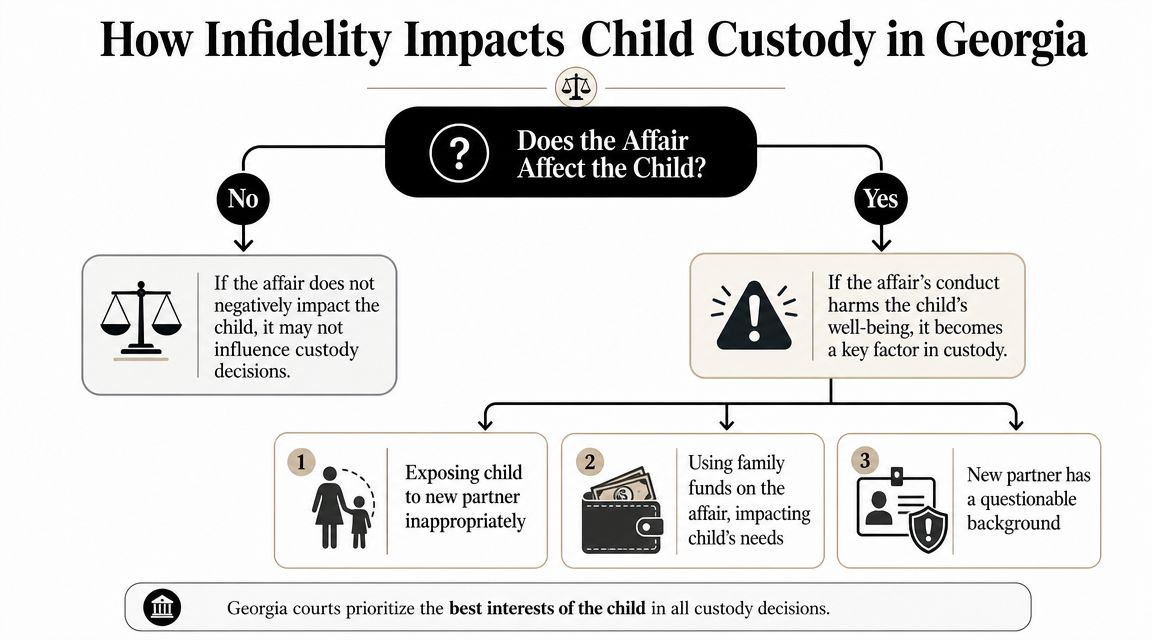
- Child Custody: While an affair on its own doesn't automatically mean a parent will lose custody, the court's primary concern is always the "best interests of the child." If conduct related to the affair, like exposing the children to an inappropriate new partner or neglecting parental duties, has harmed the children, it can strongly influence a judge's custody and parenting plan decisions.
For our clients in Cumming, Milton, and Dawsonville, understanding how these local legal rules apply is the first step toward taking back control. Your focus should be on protecting your parental rights, your finances, and your children.
The Legal Process Breakdown: Adultery in a Georgia Divorce
It’s one of the first questions we hear from clients in our Cumming and Alpharetta offices: "If Georgia is a no-fault divorce state, why does my spouse's affair matter?" It's a valid question, and the answer is absolutely critical for your strategy. While you can file for divorce simply because the marriage is "irretrievably broken," proof of infidelity can be presented in court and dramatically impact a judge's final decisions on finances and property.
Adultery as a Bar to Alimony in Georgia
Under Georgia law (O.C.G.A. § 19-6-1(b)), adultery carries a very direct and potent consequence: it can completely block the unfaithful spouse from receiving alimony. This isn’t a mere suggestion for the judge; it’s a legal standard. If you can prove that your spouse’s affair is what caused your separation, a judge in Forsyth or Fulton County Superior Court can rule that they are not entitled to any spousal support, no matter their financial situation. This makes proving the affair a powerful part of your divorce strategy.
Marital Waste and Unequal Property Division in Cumming
Beyond alimony, adultery often leads to what the courts call "marital waste" or "dissipation of assets." This is a legal term for when one spouse uses marital funds for non-marital purposes—in this case, to fund an affair.
Think about what that actually looks like:
- Expensive gifts for the new partner.
- Secret vacations and trips.
- Rent for an apartment in Roswell or Sandy Springs.
- Hotel bills, fancy dinners, and other costs of the affair.
That is your family's money being spent without your knowledge or benefit. In a North Georgia divorce, a judge can rectify this. Because Georgia uses an equitable division standard, a judge has the power to award you a larger share of the remaining marital property to compensate for the money your spouse wasted. This is precisely why it's so important to meticulously track and document these kinds of expenses. You can learn more by reading our guide on Georgia's status as a no-fault divorce state and its implications.
How an Affair Can Impact Child Custody in Cumming, GA
For many parents in Cumming, GA, discovering a spouse's affair brings an immediate, gut-wrenching fear: "What does this mean for my children?" Will a judge decide I’m an unfit parent? Will I lose custody?
When it comes to child custody, whether you’re in Forsyth County or Fulton County, Georgia courts are guided by one primary principle: the “best interests of the child.”
The court understands that good people can make poor choices. An affair, on its own, doesn't automatically mean a parent will lose custody. The judge’s focus isn’t on the act of infidelity itself, but on how the behavior surrounding it directly impacts the children's well-being.
When Infidelity Crosses the Line in Custody Cases
An affair becomes a critical factor in a custody battle when a parent's actions demonstrate poor judgment that could harm a child. Judges across North Georgia, from Cumming to Roswell and Milton, will look closely at the specific circumstances.
Your spouse's affair will likely become a central issue if their conduct involves:
- Inappropriate Exposure: Bringing a new partner around the children too quickly or in an unsuitable way, causing confusion and emotional distress.
- Neglect of Parental Duties: Prioritizing the affair over the children's needs, such as missing school events, leaving children with unvetted babysitters, or being emotionally unavailable.
- Misuse of Marital Funds: Spending family money on the affair—money that should have gone toward the kids' school fees, activities, or basic needs in your Cumming household.
- The New Partner’s Background: If the person your spouse is involved with has a troubling history, such as criminal charges or substance abuse issues, the court will take that very seriously as a potential danger to the children.
Protecting your children and your rights as a parent is the most important thing you can do. This means documenting these specific behaviors—not just the existence of the affair. Our attorneys can help you present these facts to the court in a clear and compelling way. Learn more in our overview of Georgia child custody laws and how they are applied in local courts.
A Strategic Approach to Proving Infidelity in Cumming
The emotional weight of suspecting infidelity is one thing; proving it in a Forsyth or Fulton County court is an entirely different legal challenge. This is where your divorce strategy shifts from reacting to pain to proactively building a strong case. For any evidence to be useful, it must be both convincing and, just as importantly, obtained legally.
Building Your Case in Cumming and Alpharetta
The most powerful evidence usually falls into a few key categories. An experienced attorney can help you determine what’s needed for your situation, whether you’re navigating a high-asset divorce in Alpharetta or a custody dispute in nearby communities like Johns Creek or Milton.
Common forms of admissible evidence include:
- Digital Communications: Text messages, emails, or social media messages where the affair is discussed. It is vital to preserve these legally.
- Financial Records: Credit card statements showing unexplained hotel rooms, expensive gifts, or dinners can serve as compelling proof of marital waste.
- Photographic or Video Evidence: Photos or videos of your spouse with their partner in a public setting can help establish the relationship.
- Witness Testimony: Testimony from someone with firsthand knowledge of the affair—like a friend, a neighbor, or a private investigator—can be incredibly persuasive.
While resources like Digital Footprint Check's guide can offer insight, you must always balance this with what is legally permissible.
The Legal Lines You Cannot Cross
It is absolutely critical that you do not break the law to obtain evidence. A judge will throw out illegally obtained evidence, and you could even face criminal charges, severely damaging your case.
This means you cannot:
- Hack into your spouse’s email or social media accounts.
- Install spyware or tracking software on their personal phone or computer.
- Illegally record their private conversations.
Every piece of evidence must be gathered legally. This is why working with an experienced Cumming family law attorney is so important. We guide you on the proper methods and, if needed, engage licensed private investigators who know Georgia's legal boundaries. Remember, your own digital footprint matters, so it's wise to be mindful of social media during divorce.
What to Expect in Forsyth and Fulton County Courts
Navigating the court system is intimidating, but knowing what to expect can reduce anxiety. At Miles Hansford, we are in the Forsyth County Superior Court and Fulton County Superior Court regularly. We understand the local procedures, from filing initial motions to navigating temporary hearings and mediation requirements.
Georgia has a 30-day minimum waiting period for any divorce. Temporary hearings are often scheduled early in a contested case to decide on immediate issues like temporary custody, child support, and who stays in the marital home. The orders issued at these hearings can set the tone for the rest of your case, making strong initial representation crucial. Whether your case is resolved through mediation, as many are in North Georgia, or proceeds to trial, our team is prepared to protect your interests at every step.
Why Choose Miles Hansford as Your Cumming Divorce Attorney
Finding out your spouse has been unfaithful is more than a personal crisis—it’s devastating. For our clients in Cumming, Alpharetta, and throughout North Georgia, we know this betrayal brings a unique kind of pain, anger, and confusion. Our role is to provide strong legal strategy balanced with real understanding, protecting you from more distress. Our firsthand, local knowledge becomes your advantage.
Betrayal is trauma. The shaking, the sleepless nights, the racing mind—these are not weakness; they are wounds. Your legal team must understand this.
This isn't just a legal case; it's a fight for your future. We know how to use evidence of adultery to pursue the best possible outcomes, whether that means securing a stronger settlement in mediation or making a compelling case at a temporary hearing in front of a Forsyth County judge.
While national divorce rates have been declining for years—the CDC recently reported a rate of 2.4 divorces per 1,000 people, down from 4.0 in 2000—infidelity is still one of the most common reasons marriages end. For families here in the metro Atlanta area, this means the legal fallout from cheating remains as significant as ever. You can see the data behind these trends in the CDC's marriage and divorce statistics.
Every person's story is different, but the need for calm, protective, and strategic legal help is universal. We are dedicated to providing that level of service. Speak with a family law attorney at our firm today to protect your rights.
Frequently Asked Questions About Infidelity and Divorce in Georgia
Q: How long does a divorce involving infidelity take in Cumming, GA?
A: In Georgia, there is a mandatory 30-day waiting period after filing. An uncontested divorce in Forsyth County may resolve in 60-90 days. However, if adultery is contested and affects alimony or property division, the case can take six months to over a year, depending on the complexity and the Forsyth County Superior Court schedule.
Q: Can I get more assets if my spouse cheated in Georgia?
A: Possibly, yes. Georgia is an equitable division state, meaning assets are divided fairly, not necessarily 50/50. If your spouse wasted marital funds on the affair (e.g., gifts, trips, rent), a Forsyth or Fulton County judge can award you a larger portion of the marital estate to compensate for this "marital waste."
Q: Does adultery guarantee I won't have to pay alimony in an Alpharetta divorce?
A: If you can prove your spouse's adultery was the cause of the separation, Georgia law (O.C.G.A. § 19-6-1) allows a judge to bar them from receiving alimony. This is a powerful legal standard in Alpharetta and throughout Fulton County, making proof of the affair a critical strategic element for protecting your finances.
Q: What kind of proof of adultery do I need for a Forsyth County court?
A: You need legally obtained evidence. This can include text messages from a shared device, joint bank statements showing suspicious spending, photos taken in public places, or testimony from a licensed private investigator. It is crucial to work with an attorney to ensure all evidence is admissible in Forsyth County Superior Court.
Q: Will my spouse's affair automatically affect child custody in Cumming, GA?
A: Not automatically. The court's standard is always the "best interests of the child." However, if the behavior surrounding the affair endangered the child—such as neglect, exposing them to an inappropriate new partner, or using family funds meant for their care—a Cumming judge will absolutely consider it when creating the parenting plan.
Q: Should I move out of the house if I discover my spouse is cheating?
A: This is a critical strategic decision. Moving out of the marital home, especially if you have children, could impact future decisions on child custody and who gets the house. Before making any sudden moves in Cumming or Alpharetta, you must speak with a family law attorney to understand the potential legal consequences.
Q: Do I have to prove my spouse cheated to get a divorce in Georgia?
A: No. You can always file for a no-fault divorce in Georgia by stating the marriage is "irretrievably broken." This allows you to end the marriage without proving fault. However, presenting evidence of the affair can be a powerful strategic tool for negotiating alimony and property division in your favor.
As you navigate this challenging time, remember that emotional support can also be beneficial. Some find that resources like Penticton couples therapy can provide valuable guidance for processing such life-altering events, even if you are moving forward alone.
The stakes are high when infidelity is part of your divorce. You need a calm, strategic, and protective legal partner to guide you. The attorneys at Miles Hansford Law Firm have the local experience in Forsyth and Fulton County courts to protect your rights, your assets, and your family's future. Schedule your consultation today to understand your options and take the first step toward rebuilding your life with confidence.