


A DUI arrest in Cumming, GA, can throw your world into chaos. Amid all the confusion and anxiety, one of the first and most pressing questions we hear is, "Is a DUI a felony in Georgia?" The fear of a felony conviction can be overwhelming, impacting your family, career, and freedom. The attorneys at Miles Hansford are here to provide calm, direct answers and a strategic path forward.
While most first-time DUI offenses in Cumming are charged as misdemeanors, certain circumstances can instantly escalate the charge. This turns a serious situation into a potentially life-altering one, with far more severe penalties on the table. Understanding this distinction is the first step toward protecting your future. If you are facing a DUI charge in Forsyth County or surrounding areas, schedule a consultation to speak with a family law and criminal defense attorney who can protect your rights.
Why This Matters in Cumming
In Georgia, a DUI can become a felony based on your prior history or the specific events of the arrest itself. For most people facing a first or second DUI in places like Johns Creek or Milton, the charge will likely remain a misdemeanor. However, that’s never a guarantee. Understanding the line prosecutors in Forsyth County and Fulton County draw between the two is the critical first step in building a defense.
A felony conviction brings penalties that can follow you for the rest of your life, including mandatory prison time and the loss of fundamental civil rights, like the right to vote or own a firearm. Prosecutors in the Forsyth County Superior Court are trained to look for specific "aggravating factors" that justify a felony charge.
These triggers typically include:
- The number of prior DUI convictions you have within a specific timeframe.
- Whether the DUI incident resulted in serious injury to another person.
- If the incident tragically caused a fatality.
A DUI officially crosses the line into felony territory in Georgia if it's your fourth conviction within ten years. It can also become a felony on the very first offense if the incident resulted in serious injury or the death of another person. While nationwide statistics from sources like SafeHome.org show that hundreds of thousands are arrested for suspected DUIs each year, the vast majority of first and second offenses are handled as misdemeanors.
To help you see the difference more clearly, here’s a quick breakdown of how these charges are typically categorized in Georgia.
Georgia DUI Charges at a Glance: Misdemeanor vs. Felony in Cumming, GA
This table offers a clear, scannable comparison of what typically constitutes a misdemeanor DUI versus a felony DUI under Georgia law, helping you quickly assess the situation you might be facing in Cumming or Alpharetta.
| Factor | Misdemeanor DUI | Felony DUI |
|---|---|---|
| Number of Offenses | 1st, 2nd, or 3rd DUI within 10 years. | 4th or subsequent DUI within 10 years. |
| Injury to Others | No serious injury occurred. | Caused "serious bodily injury" to another person. |
| Fatality | No fatality occurred. | Caused the death of another person (Vehicular Homicide). |
| Child Endangerment | Typically a separate misdemeanor for each child under 14 in the car. | Can become a felony if it's the 4th DUI offense, even with no injury. |
| School Bus | Passing a stopped school bus while loading/unloading. | Not typically a felony on its own, but combined with other factors it can be. |
It's important to remember that this is a general guide. The specific facts of your case and the prosecutor’s discretion in counties like Forsyth and Fulton play a huge role in the final charges.
The Misdemeanor Foundation
Before any DUI can be a felony, it must first meet the basic requirements of a standard DUI charge. In Georgia, this means you were operating a vehicle while being "less safe" to drive due to alcohol or drugs, or you had a Blood Alcohol Concentration (BAC) of 0.08% or higher (0.02% for drivers under 21, and 0.04% for commercial drivers). Most initial arrests in Roswell, Suwanee, and Canton start from this point.
Even a standard misdemeanor has serious consequences that shouldn't be underestimated. For a deeper look at what to expect from these initial charges, we have a complete guide on whether DUIs are usually misdemeanors. A simple charge can quickly snowball into a felony if certain aggravating factors are present.
Legal Process Breakdown: The Scenarios That Turn a DUI into a Felony
Most of the time, a first or second DUI arrest in Georgia is charged as a misdemeanor. While still a serious matter, a misdemeanor is a completely different world from a felony. The line between the two is very clear under Georgia law, and crossing it brings life-changing consequences.
Prosecutors in Forsyth, Fulton, and other North Georgia counties are trained to spot the specific circumstances that elevate a DUI to a felony. It doesn't happen by accident. Generally, there are three situations that will trigger a felony charge:
- Having several prior DUI convictions (Habitual Violator)
- Causing a Serious Injury by Vehicle
- Causing a death (Vehicular Homicide)
This chart gives a clear visual of how an arrest can lead down one of two very different paths.
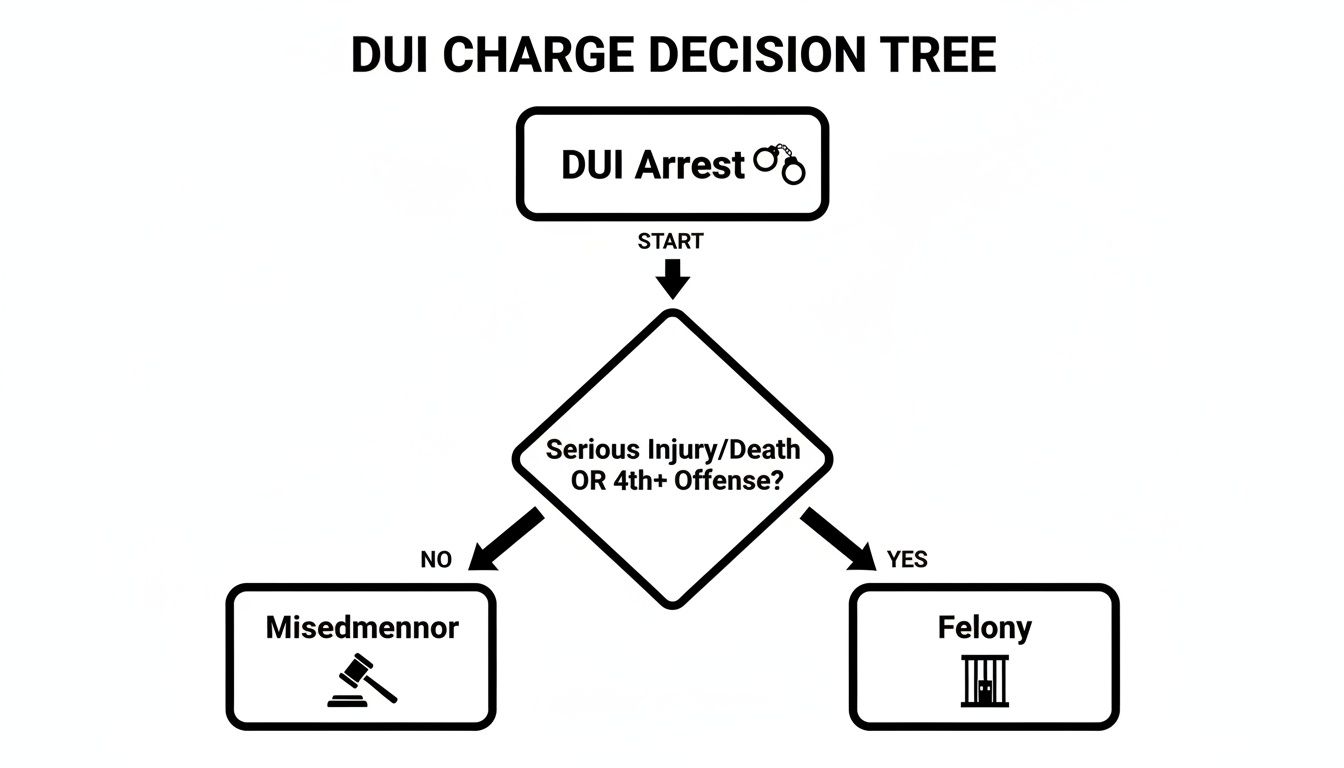
As you can see, the game changes entirely when multiple offenses, serious injury, or a fatality are involved.
1. Repeat Offenses and the 10-Year Lookback Period
The most frequent path to a felony DUI is through prior convictions. If you are arrested for your fourth DUI within a 10-year "lookback period," Georgia law considers you a “Habitual Violator,” and that charge will be a felony.
It’s crucial to understand how that 10-year window is measured: it runs from the dates of your previous arrests to the date of your current arrest. This detail can make or break a case in Forsyth County Superior Court. A felony conviction for being a Habitual Violator comes with a mandatory prison sentence of one to five years, and you must serve at least 90 days of that time behind bars.
2. Serious Injury by Vehicle
A DUI can become a felony from the very first offense if the incident causes a "serious injury" to another person. This could be anyone—a passenger in your car, someone in another vehicle, or even a pedestrian. The charge is called Serious Injury by Vehicle.
The legal definition of "serious injury" includes injuries that:
- Deprive a person of a body part (like an arm or leg)
- Render a limb or organ useless
- Cause significant, permanent disfigurement
- Result in organic brain damage
A conviction for Serious Injury by Vehicle is a felony that carries a punishment of one to fifteen years in prison. Because real, lasting harm was done to a victim, prosecutors in places like Alpharetta and Cumming will pursue these cases aggressively.
3. Vehicular Homicide
The most devastating charge is, without a doubt, Vehicular Homicide. If an impaired driver causes an accident that results in someone's death, they will face this felony charge, even if it's their first-ever DUI offense.
The penalties are incredibly harsh, often involving three to fifteen years in prison for each person killed. The legal and emotional weight of these cases is immense. For anyone in the North Atlanta area, the difference between a misdemeanor and a felony is profound, involving mandatory prison time and the permanent loss of civil rights, like the right to vote or own a firearm. While statistics often show younger drivers are in more fatal crashes, these felony enhancements frequently apply to repeat offenders, a fact that prosecutors are well aware of when building their case. You can learn more about the criminal defense statistics that shape prosecution strategies from this analysis.
The Strategy Section: DUI with Child Endangerment in Alpharetta and Cumming
Driving after drinking is a serious mistake, but doing so with a child in the vehicle puts you in a far more dangerous legal position. Georgia law is especially harsh when it comes to protecting children, and a DUI arrest with a child passenger creates a complicated legal storm, particularly for those in communities like Cumming and Alpharetta.
Many people mistakenly believe this charge is automatically a felony. While that's not the case, Georgia's Child Endangerment law—found in O.C.G.A. § 40-6-391(l)—adds a critical twist: you face a separate, individual DUI charge for each child under the age of 14 in your car.
This single rule can have devastating results. Imagine being pulled over in Johns Creek or Milton with your two young children. That one traffic stop instantly turns into three separate misdemeanor charges: one for the underlying DUI and one for each child. Each charge carries its own potential penalties that can be stacked.
This isn't just a criminal issue; it can have an immediate and catastrophic impact on child custody matters. A DUI Child Endangerment charge is powerful evidence that can be used against you in a divorce or custody case, potentially leading to emergency orders in Forsyth County or Fulton County courts that restrict your parenting time.
The stakes could not be higher. Prosecutors in our local courts, from Dawsonville to Sandy Springs, see these cases as an extreme threat to a child’s well-being and pursue them aggressively. Do not agree to custody terms without representation.
What begins as a lapse in judgment can quickly spiral into a battle for your parental rights. A Child Endangerment charge gives the other parent tremendous leverage in a divorce or custody dispute. It can be used to demand supervised visitation or even to suspend your parenting time entirely. This is why you need a legal team experienced in both criminal defense and family law. You can learn more about a case involving a Georgia woman charged with DUI and child endangerment in a related article. Protect your parental rights by calling our office today.
What to Expect in Forsyth or Fulton County Courts
A felony DUI conviction in Forsyth or Fulton County is much more than a legal problem. It casts a permanent shadow over your future, affecting nearly every part of your personal and professional life. For those of us living in communities like Cumming, Milton, and Suwanee, a felony conviction truly changes everything.
Unlike a misdemeanor, a felony DUI conviction in Georgia leaves you with a permanent criminal record that can never be expunged or sealed. This record will follow you for the rest of your life, easily accessible to anyone who runs a background check.

Severe Penalties and Collateral Damage
The immediate legal penalties are harsh. A fourth DUI within ten years comes with a prison sentence of one to five years. A conviction for Serious Injury by Vehicle can mean spending up to 15 years behind bars. But the collateral damage is often just as life-altering.
With a felony on your record, you lose some of your most fundamental civil rights. You will forfeit your right to:
- Vote while incarcerated or on probation/parole.
- Own or possess a firearm for life.
- Serve on a jury in Georgia.
Professionally, many career doors slam shut. A felony conviction can make it nearly impossible to get or keep professional licenses for jobs in healthcare, education, real estate, and finance. In competitive job markets like Alpharetta and Roswell, many employers simply won't consider an applicant with a felony record.
The drunk driving epidemic drains $58 billion annually from the U.S. economy. While recent data shows an 8.1% decline in alcohol-impaired driving deaths, reflecting stricter enforcement, these figures underscore the intense pressure on prosecutors to secure convictions. For individuals charged with a DUI in Georgia, these statistics highlight the serious public safety concerns that drive prosecution decisions. You can review the full findings about drunk driving's economic impact on FinanceBuzz.com.
Finding housing can also become a struggle. On a personal level, the conviction often leads to strained family relationships and the daily stress of navigating life with a permanent criminal record. Beyond legal penalties, a court can mandate alcohol education programs or intensive treatment. Understanding how does rehab work can be a crucial step for many.
When your freedom, rights, and future are on the line, facing a felony DUI charge is not a situation to handle alone. An aggressive and strategic defense isn't an option; it's a necessity.
How to Navigate the DUI Court Process in Cumming, GA
Finding yourself caught in the Georgia legal system after a DUI arrest is incredibly intimidating. The process feels like a maze of critical deadlines and court appearances, where one wrong move could change your life. Knowing what to expect in local courts, whether it's the Cumming Municipal Court or the Fulton County Superior Court, is your first line of defense.

From the moment of your arrest, a clock starts ticking. You have just 30 calendar days to appeal the automatic suspension of your Georgia driver's license. This is a separate civil matter, but if you miss this deadline, you will lose your driving privileges before you even get your day in court.
Your first court date is the arraignment. This is where you officially hear the charges and enter a plea. This hearing is a pivotal moment, whether your case starts in a municipal court in Alpharetta or Johns Creek or a state court in Forsyth County. Pleading guilty right away closes your case, but it also leaves you with a permanent conviction.
After the arraignment, the real legal work begins. Your defense team will immediately:
- Demand Discovery: We demand all of the state's evidence against you—police reports, body camera videos, and breath or blood test results.
- File Pre-Trial Motions: We thoroughly review every piece of evidence to challenge procedural mistakes or illegally obtained evidence, such as an unlawful traffic stop.
- Negotiate with Prosecutors: Armed with the facts, we communicate with the prosecutor to point out weaknesses in their case and work toward getting charges reduced or dismissed.
In Georgia, a powerful defense hinges on a deep, practical knowledge of local court procedures. Knowing how to prepare for court and what to expect during each stage is essential. You can learn more by preparing for court when facing a DUI charge in Georgia.
If your DUI is charged as a felony, your case will be "bound over" to a Superior Court. A case starting in Cumming, for example, would be transferred to the Forsyth County Superior Court. One originating in Roswell or Sandy Springs would likely head to the Fulton County Superior Court. Navigating this system absolutely requires an attorney with specific experience handling felony litigation in North Fulton courts.
Why Choose Miles Hansford
When you are facing a potential felony DUI in Cumming, GA, the stakes are incredibly high. The choice of your legal representation can make all the difference. You need a team that truly understands the local landscape—how prosecutors in Cumming, Alpharetta, and throughout North Georgia think, prepare, and argue their cases.
At Miles Hansford, our team includes former prosecutors. This isn’t just a talking point; it's a fundamental part of our strategic approach.
We have practical, first-hand experience from the other side of the courtroom in places like Forsyth and Fulton County. We know the prosecution's playbook. This unique background allows us to anticipate their tactics, scrutinize their evidence for weaknesses, and build a proactive defense.
We don’t just react to the case against you; we actively challenge it. That experience helps us identify procedural mistakes, question the administration of field sobriety tests, and dispute the accuracy of breath or blood evidence.
We understand the stress and uncertainty that come with a serious charge. From an arrest in Alpharetta to a felony hearing in Forsyth County Superior Court, our goal is to provide calm, protective, and strategic guidance. Our firm is a trusted choice for clients facing their toughest legal challenges across North Georgia, from Dawsonville to Sandy Springs. If you are confronting a serious DUI charge and don't know where to turn, your next step should be speaking with an attorney who knows how to fight for you.
Do not wait to get the experienced defense you need. Call us today to schedule your confidential consultation and protect your future.
FAQ: Answering Your Questions About Felony DUI in Cumming, GA
After a DUI arrest in North Georgia, your mind is likely racing with urgent questions. We hear them every day from good people in a tough spot. To help you find clarity, we've answered a few of the most common questions we get from clients in Cumming and Alpharetta.
Q: Can a first DUI be a felony in Georgia?
A: Yes, but it is rare. A first-offense DUI in Cumming or Alpharetta is almost always a misdemeanor. However, it can be charged as a felony from the start if the incident results in a "Serious Injury by Vehicle" or a fatality (Vehicular Homicide), as defined by Georgia law. In these specific tragic situations, the charge is immediately elevated.
Q: What is the 10-year lookback period for a DUI in Forsyth County?
A: Georgia’s 10-year “lookback period” is a critical detail in DUI cases. It is calculated from the date of arrest for any prior DUIs to the date of arrest for the new one. If you have three prior DUI convictions within that 10-year window, a fourth arrest in Forsyth County will be automatically treated as a felony, triggering significantly harsher penalties.
Q: Will I automatically go to prison for a felony DUI in Cumming, GA?
A: A felony DUI conviction in Georgia does carry a mandatory minimum prison sentence. For a fourth DUI in 10 years, the sentence is generally one to five years in prison, and you must serve at least 90 days. However, a strategic defense attorney will aggressively explore every possible sentencing alternative to fight for a better outcome and minimize any time spent in custody.
Q: Can a felony DUI charge be reduced to a misdemeanor in Fulton County?
A: It is possible, but it is never easy and requires a highly strategic legal defense. A primary goal is often to get charges reduced by challenging the evidence—from the legality of the initial traffic stop in Milton or Johns Creek to the accuracy of breathalyzer results. By filing pre-trial motions and negotiating with Fulton County prosecutors, we create opportunities for charge reduction.
Q: How does a DUI affect my child custody case in Cumming, GA?
A: A DUI, especially with a child endangerment charge, can have a devastating impact on your parental rights. A judge in Forsyth County Superior Court may see it as evidence of poor judgment, which can be used to modify custody, require supervised visitation, or award the other parent primary custody. It is critical to have an attorney who understands both criminal defense and family law.
When you’re facing a felony charge, your entire future is on the line. The legal team at Miles Hansford Law Firm includes former prosecutors who know exactly how to build a defense that protects your rights. Schedule your consultation by visiting https://mileshansford.com.