


In Georgia, a DUI is both a moving violation and a criminal offense. A first-offense conviction can bring a fine of $600 to $1,000, jail time of 90 days to 12 months with a mandatory minimum of 72 hours, at least 30 days of community service, and a license suspension of up to three years with a possible limited permit after 12 months.
If you were stopped in Alpharetta, Cumming, Johns Creek, or Milton and you're now searching is a DUI a moving violation, you're probably not asking an academic question. You're trying to figure out whether this is "just traffic court" or something that can affect your license, your job, your insurance, and your future. In North Georgia, it's both. That's why people charged in Fulton County or Forsyth County often feel blindsided. They expected one case. They have two legal battles moving at the same time.
Answering the Question After a DUI Arrest in Alpharetta
A DUI arrest in Alpharetta often starts like any other traffic stop. Blue lights. A few questions. Maybe field sobriety tests on the roadside. Then the situation shifts fast, and what felt like a traffic matter turns into something much more serious.
If you're asking is a DUI a moving violation in Georgia, the direct answer is yes. But stopping there misses the problem. A Georgia DUI is treated as a moving violation for driving-record and license purposes, and it is also prosecuted as a criminal case that can lead to jail time, fines, and a lasting record.
Why that answer matters in Alpharetta
In practice, that means your case isn't limited to one courtroom issue. In Alpharetta and the broader North Fulton area, a DUI charge can affect:
- Your driving privileges: The moving-violation side affects your record and license status.
- Your criminal exposure: The court case can involve probation, custody time, fines, and other conditions.
- Your day-to-day life: Work travel, professional licenses, background checks, and family responsibilities can all be disrupted.
Across most U.S. jurisdictions, DUI is treated this same way. It is commonly handled as a serious moving violation in DMV and insurance systems while also being prosecuted as a criminal offense, with only rare exceptions in a few states or narrow underage contexts, as discussed in this overview of DWI and moving violation treatment.
Practical rule: If you treat a Georgia DUI like a regular ticket, you can lose ground before your defense even starts.
What people usually get wrong
The most common mistake is thinking the court date is the only deadline that matters. It isn't. The second mistake is talking too freely because they think they can clear things up later. That usually doesn't help.
A better first step is to understand exactly what happens after arrest and how the license issue and the criminal case move separately. This guide on what to do after a DUI arrest is a useful starting point if you're trying to get organized after an arrest in Alpharetta, Cumming, Roswell, Sandy Springs, Suwanee, Dawsonville, or Canton.
If your charge is pending in North Fulton courts or headed into a county court in Fulton County or Forsyth County, early decisions matter. Schedule a consultation and speak with a family law attorney isn't the right fit here, but the urgency is similar. You need a clear legal plan quickly, because the first few steps can shape everything that follows.
The Two Fronts of a Georgia DUI Charge
A Georgia DUI charge works like a fight on two fronts. One front is about your right to drive. The other is about the criminal accusation itself. People in Alpharetta, Cumming, and throughout North Georgia often focus on only one of them at first, and that can be costly.
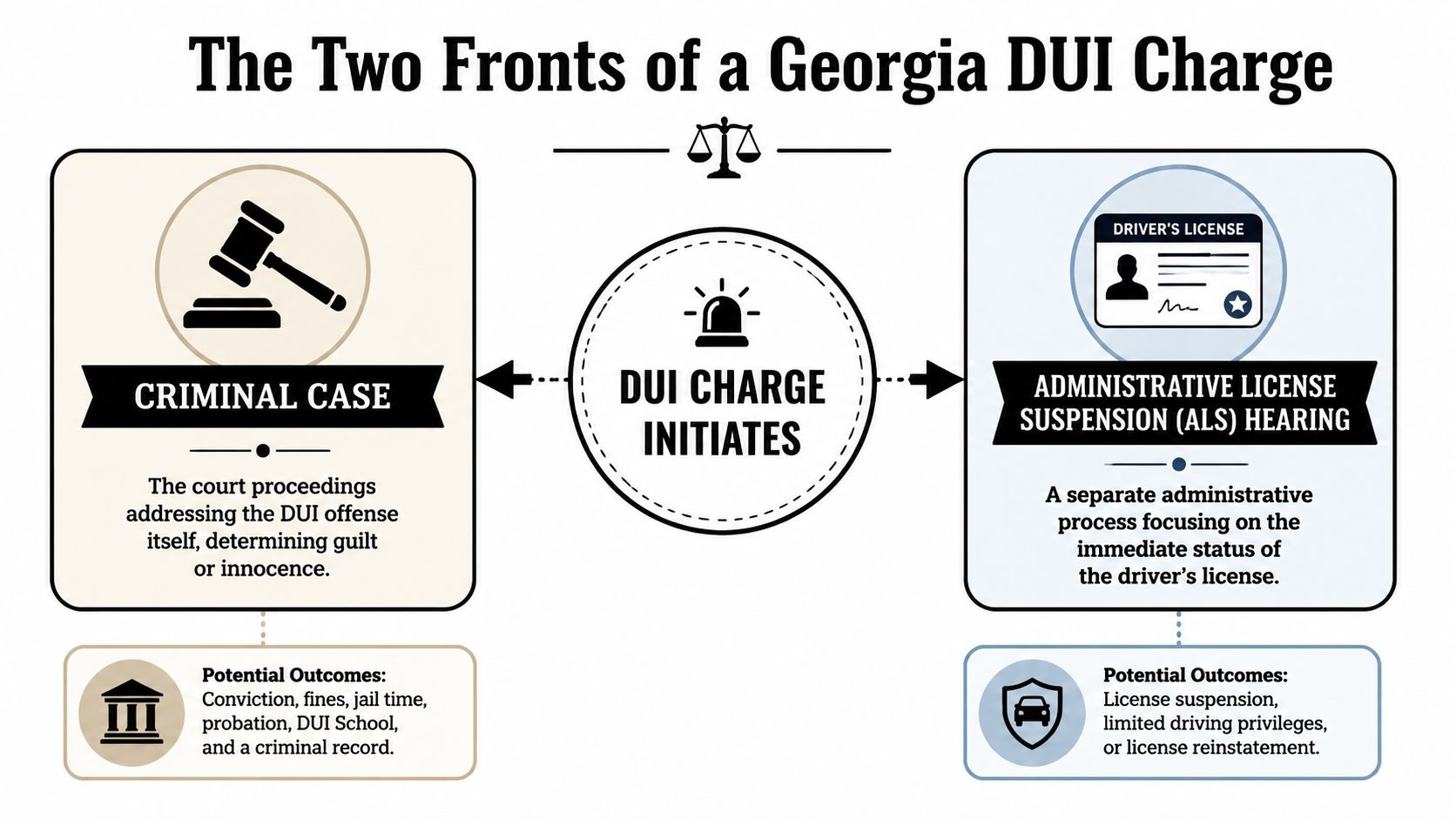
The administrative side
The reason a DUI is treated as a moving violation isn't just semantics. It affects how the offense shows up on your driving history and how state agencies treat it. According to the University of Wisconsin-Green Bay's risk management guidelines, an OWI or DUI is explicitly counted as a moving violation on a driver's record for a two-year review period, confirming its administrative treatment under traffic-law frameworks and its visibility on a driving record accessible to DMVs through the UW-Green Bay moving violations guidance.
That administrative classification has practical consequences. It can affect eligibility to drive, insurance treatment, and employment situations where a driving record matters. For many people in Alpharetta, Johns Creek, Milton, and Roswell, that part of the case hits first because they still need to get to work, school, medical appointments, or parenting exchanges.
For a closer look at this side of the case, review license suspension after DUI.
The criminal side
Separate from the license issue, the state prosecutes the DUI as a criminal matter. That case can proceed in a local court depending on where the arrest occurred and how the charge was filed. In the North Fulton area, that may mean a municipal court on the front end and then a county-level court process if the case advances.
Here is the simplest explanation:
| Front | Main issue | What is at stake |
|---|---|---|
| Administrative | Your privilege to drive | Suspension, record impact, permit questions |
| Criminal | The DUI accusation | Conviction, jail exposure, fines, court conditions |
A DUI case can feel confusing because both tracks start from the same arrest, but they don't serve the same purpose and they don't always move on the same timeline.
If you're trying to build your own understanding before talking with counsel, a basic overview of Georgia DUI laws can help provide context. What matters most, though, is recognizing that one arrest can trigger two separate proceedings, and both need attention from the start.
Penalties for a DUI Moving Violation in North Georgia
The morning after a DUI arrest in Alpharetta or Cumming, the first question is usually about jail or fines. That matters, but it is only part of the problem. In North Georgia, a DUI can hit on two levels at once. The court can punish the charge, and the license consequences can disrupt work, school, childcare, and daily life before the criminal case is resolved.
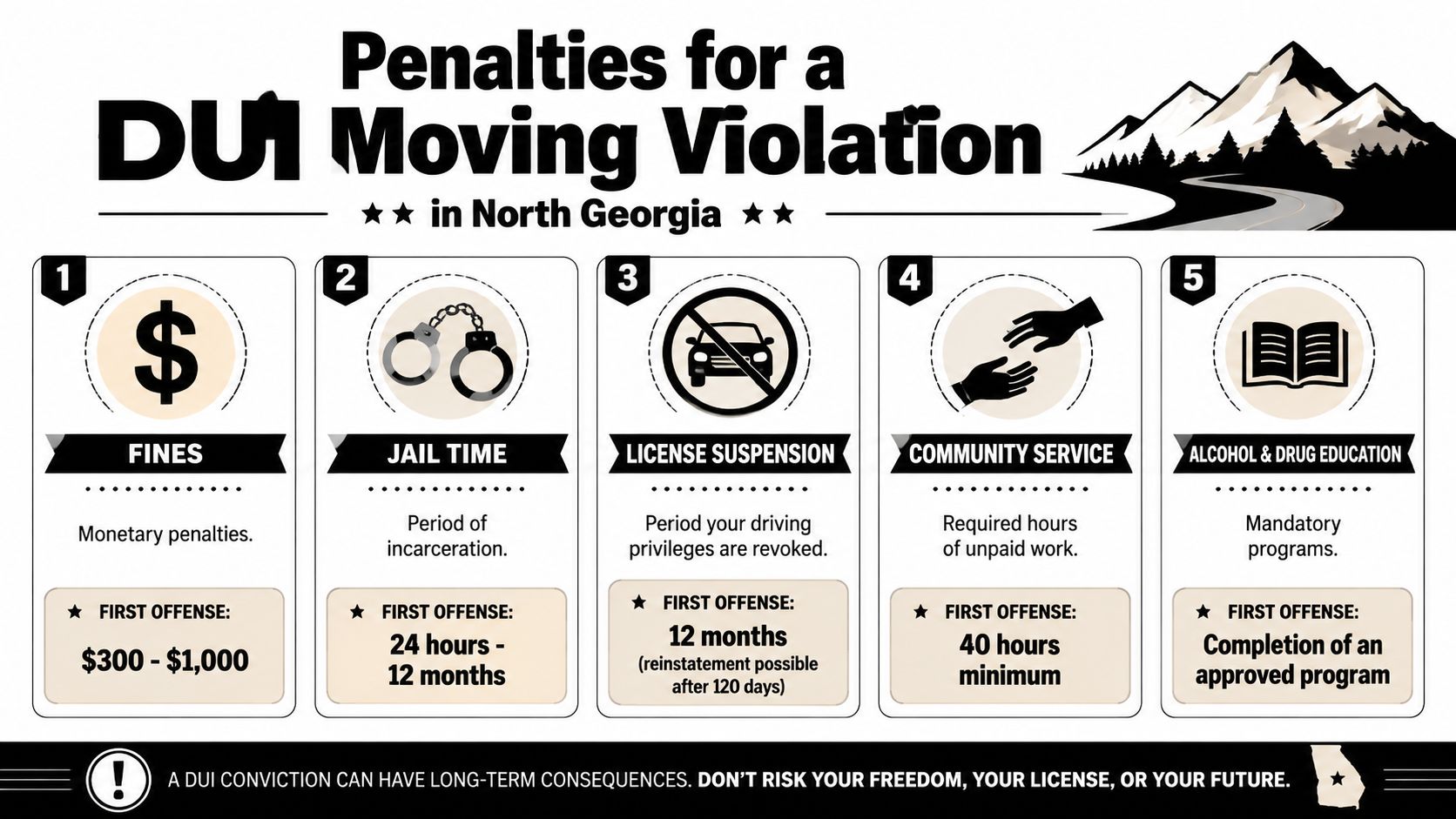
Criminal penalties under Georgia law
Georgia treats DUI as far more than an ordinary traffic offense. A first conviction can bring jail exposure, fines, community service, probation terms, DUI school, and a suspended license. As noted in this overview of Georgia DUI moving violation penalties, even a first offense can carry mandatory jail time and other court-ordered conditions.
For repeat cases or cases with aggravating facts, the stakes rise fast. Judges in Fulton County and Forsyth County can impose longer jail terms, higher fines, stricter probation conditions, and longer periods without full driving privileges. What matters in practice is not just the statute. It is how the local court applies it, what the prosecutor is asking for, and whether the defense gets out in front of the evidence early.
What the penalty looks like outside the courtroom
A DUI sentence does not stay neatly inside a court file.
For many people, the first practical damage shows up in transportation. If your license is suspended or restricted, every routine trip gets harder. That includes getting to work in Alpharetta, making a parenting exchange in Cumming, or covering medical appointments for a family member.
Insurance is usually next. A DUI conviction can push premiums up sharply or trigger underwriting problems. Georgia does not use Florida's FR44 filing system, but drivers trying to understand how insurers treat alcohol-related driving cases can see the bigger picture through Select Insurance Group's FR44 answers.
Employment and professional licensing issues can follow. Commercial drivers, healthcare workers, teachers, and anyone subject to background screening often face a second layer of consequences that does not depend on what the judge considers fair.
Why the "moving violation" label can cause bad decisions
Calling DUI a moving violation is not wrong, but it is incomplete. That label can make people underestimate what they are facing. In real life, the case has the traffic aspect, the criminal aspect, and the separate license problem that often needs attention on a short deadline.
That is why I tell clients to measure exposure in three categories at once:
- Court penalties: jail, fines, probation, classes, and community service
- License consequences: suspension periods, permit issues, and interruptions to daily driving
- Collateral damage: insurance cost, work restrictions, school access, and professional fallout
A good defense strategy has to address all three. Waiting to "see what happens" usually gives the state an advantage and can cost you options on the license side.
Some cases also raise a different question entirely. If you need to understand when a DUI can become more serious than a misdemeanor, this explanation of when a Georgia DUI may be charged as a felony is a useful place to start.
Navigating the DUI Legal Process in Alpharetta
After a DUI arrest in Alpharetta, individuals often want a clean checklist. They need to know what happens first, what can't wait, and where the case is likely to go. That clarity matters because uncertainty leads to bad decisions.
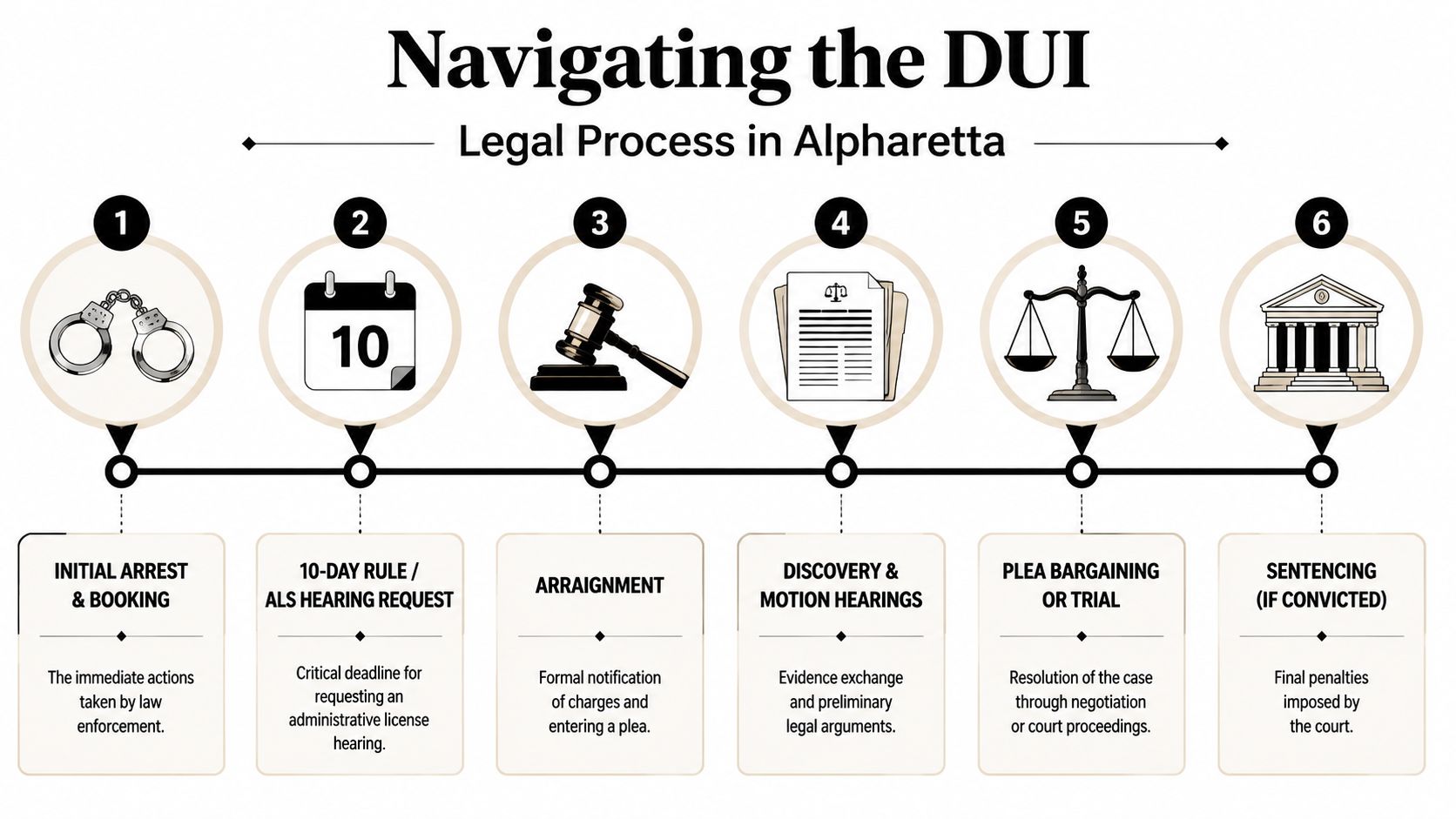
The first days after arrest
Right after arrest, the paperwork can make it seem like everything belongs to one case file. It doesn't. There is the license-related side and there is the criminal prosecution side. You need to identify both immediately and respond with intention.
A useful working roadmap looks like this:
- Read every document carefully: Citation, bond paperwork, notice of suspension issues, and court date details all matter.
- Track every deadline: Missing an early deadline can weaken your options before the merits of the case are even addressed.
- Preserve your own evidence: Save receipts, messages, ride details, and anything else that may help establish timeline or context.
Court appearances in the local system
An Alpharetta arrest may start in a city court setting, while other cases move through county-level courts depending on the charge posture and procedural path. A Forsyth County arrest often puts the case on a different local track than a North Fulton arrest, even though the legal issue is similar.
In practical terms, defendants in Forsyth County and Fulton County should expect local differences in scheduling, filing practices, and courtroom procedure. That's true in many kinds of Georgia cases. For example, in family law matters, local courts handle Georgia no-fault divorce laws, the 30-day minimum waiting period in Georgia, equitable division in Georgia, child custody standards in Georgia, parenting plans required by Georgia courts, mediation requirements, and temporary hearings through county-specific procedures in the Forsyth County Superior Court and Fulton County Superior Court. DUI cases also demand that same kind of local awareness, even though they arise in a different practice area.
In North Georgia courts, knowing the law matters. Knowing the local process matters just as much.
Investigation, motions, and resolution choices
After the first appearance, the case usually turns to evidence. The defense reviews the stop, video, testing process, officer observations, and any scientific records that may be relevant. That's where many of the meaningful issues surface.
From there, a case may move toward negotiated resolution or trial. The right path depends on the strength of the evidence, the procedural history, and the client's broader risks outside the courtroom.
For readers trying to understand how education or diversion-style programming is discussed in other jurisdictions, DUI programs in Orange County offer general background on how post-charge programming can fit into impaired-driving cases elsewhere. Georgia practice is local and fact-specific, so don't assume another state's approach will apply in Alpharetta or Cumming.
Building a Strategic Defense Against Your DUI Charge
A DUI arrest isn't the same thing as a proven case. The state still has to justify the stop, support the arrest, and present evidence that holds up under scrutiny. A careful defense starts by slowing the case down and testing each piece of it.

Where strong defenses often begin
In North Georgia, a strategic review usually starts with the basics. Why was the vehicle stopped? What did the officer observe? Does the video match the report? Was the testing procedure followed the way it should have been?
Those questions matter because DUI cases often look stronger on paper than they do after close review.
- The stop itself: If the legal basis for the stop is weak, that can affect everything that followed.
- Roadside testing: Field sobriety exercises are often challenged because medical conditions, fatigue, anxiety, footwear, lighting, and roadway conditions can affect performance.
- Chemical testing records: Breath and blood evidence should be examined carefully, including maintenance, handling, and procedure issues where applicable.
What works and what doesn't
What works is disciplined case analysis. That means getting the video, reading the reports line by line, comparing statements, and looking for gaps between what the officer concluded and what the evidence shows.
What doesn't work is relying on hope, internet myths, or the idea that "first offenders always get a break." Local courts in Alpharetta, Cumming, Roswell, Milton, and Canton see DUI cases regularly. Judges and prosecutors expect preparation.
The best defense strategy usually isn't flashy. It's detailed, local, and built from the actual record instead of assumptions.
Why local knowledge changes the approach
A lawyer who regularly works in North Fulton and Forsyth County settings knows where procedure matters, which arguments need strong factual support, and when negotiation is realistic. That doesn't guarantee a result, and no honest lawyer should suggest otherwise.
It does mean the case can be evaluated the right way. In some files, the pressure point is the stop. In others, it's the testing process. In others, it's the prosecution's ability to prove impairment clearly and consistently. The strategy has to fit the facts.
Why Choose Miles Hansford for Your DUI Defense
If you're facing a DUI in Alpharetta, Cumming, Forsyth County, or Fulton County, local judgment matters. Court culture matters. Procedure matters. The right defense isn't generic, and it shouldn't be built from a template that could be filed anywhere in the country.
Miles Hansford serves clients across the North Atlanta area, including Johns Creek, Milton, Roswell, Sandy Springs, Suwanee, Dawsonville, and Canton. The firm handles criminal defense and DUI matters with the practical perspective that comes from broad courtroom experience and a one-on-one approach. That includes insight from former prosecutors who understand how charging decisions, negotiations, and evidentiary issues are often viewed from the other side.
For a person looking for a lawyer near me after a DUI arrest, the key question is whether the attorney understands the local system well enough to protect both the short-term and long-term interests at stake. That means the license issue, the court process, the evidence, the collateral fallout, and the best timing for each move.
If you need steady guidance in North Georgia, schedule a consultation, speak with a family law attorney isn't the right phrase for this situation, but the same principle applies. Get informed advice before you make statements, accept conditions, or assume the case will work itself out. Call today if you need help making a prompt, strategic decision.
Local DUI Questions for Alpharetta and Cumming Residents
Q: Is a DUI a moving violation in Alpharetta, GA?
A: Yes. In Georgia, a DUI is treated as a moving violation for driving-record and license purposes, but it is also a criminal offense. If your arrest happened in Alpharetta or nearby North Fulton courts, you need to evaluate both sides of the case quickly instead of treating it like an ordinary ticket.
Q: Does a first DUI in Cumming go through Forsyth County courts?
A: Often, yes, though the exact court path depends on where the arrest occurred and how the case is filed. In Cumming and greater Forsyth County, local procedure and scheduling can differ from North Fulton practice, which is one reason county-specific legal guidance matters early.
Q: Can a DUI affect my license even before the criminal case is finished?
A: Yes. That's one of the most important parts of the dual-track system. The license side can move separately from the criminal case, which is why people in Alpharetta, Cumming, Johns Creek, and Milton need to review deadlines and paperwork immediately after arrest.
Q: Is a lawyer necessary for a first DUI in Forsyth County?
A: Generally, yes. Even a first offense carries meaningful exposure and can affect your record, license, employment, and insurance. A defense lawyer can assess the stop, testing, local court procedure, and resolution options in a way that self-representation usually can't.
Q: Can a DUI be reduced to something else in Fulton County or Forsyth County?
A: Sometimes, but it depends on the facts, the evidence, and the prosecution's view of the case. There is no automatic reduction available because it's a first offense. The quality of the defense work and the actual weaknesses in the file are what matter.
Q: What should I do right after a DUI arrest in North Georgia?
A: Preserve documents, avoid making casual statements about the case, and get legal advice fast. For DUI help near me in Alpharetta, Cumming, Roswell, or Sandy Springs, choose someone who understands both the license track and the criminal track.
If you were arrested for DUI in Alpharetta, Cumming, Forsyth County, or Fulton County, Miles Hansford Law Firm can help you assess the charge, protect your license, and build a defense grounded in the realities of North Georgia courts. Schedule a consultation, speak with an attorney who knows the local system, and take the next step before early deadlines narrow your options.