


A DUI arrest can make the next few hours feel blurry. You may have been stopped in Cumming, booked, released, and handed paperwork that doesn't make much sense yet. What matters right now is simple. In Georgia, a DUI usually creates a fast-moving threat to your driver's license that is separate from what happens later in court.
If you live in Cumming, Alpharetta, Johns Creek, Milton, Suwanee, Dawsonville, Roswell, Sandy Springs, Canton, or elsewhere in North Georgia, the first mistake to avoid is waiting. The criminal case may be filed in a local court, but your ability to keep driving can be affected much sooner. If you need to protect your license suspension DUI case and your options in Forsyth County or Fulton County, act before the deadline closes.
Arrested for DUI in Cumming GA? Your License is at Immediate Risk
If you were arrested for DUI in Cumming or Alpharetta, you're probably worried about work, school drop-offs, court dates, and how you'll get anywhere if your license is suspended. That reaction is normal. The most urgent issue, though, usually isn't the final court outcome. It's the deadline to protect your driving privileges before an automatic administrative suspension takes hold.

In Georgia, people often focus on the criminal charge and miss the first practical battle. That's how they lose the chance to challenge the suspension. If you've just been released from jail, it can also help to understand the early release process itself. A practical outside overview is Express Bail Bonds' Colorado DUI bail guide, which gives a useful general picture of how the immediate aftermath of a DUI arrest can unfold.
The 30-day rule in Georgia
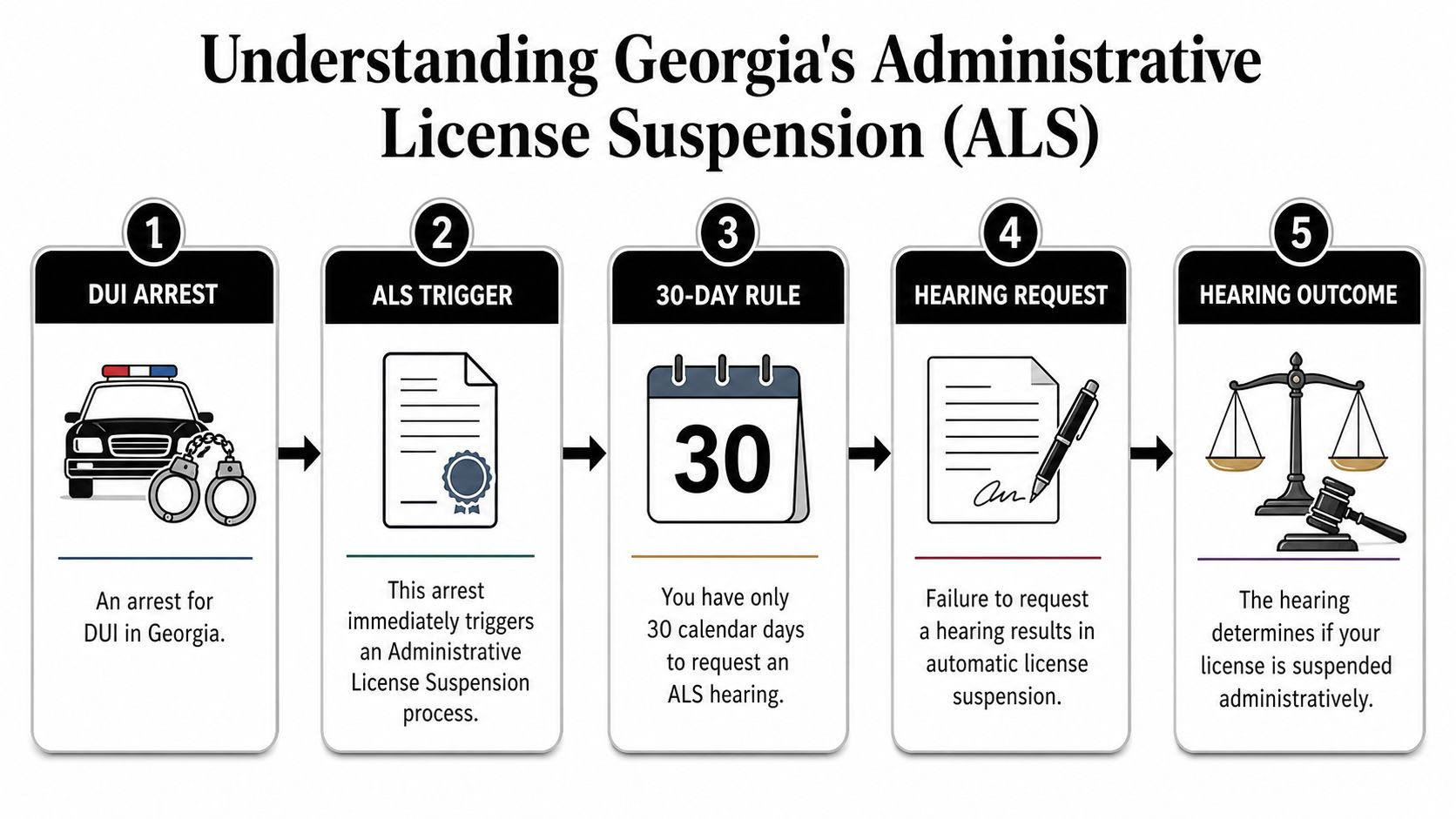
The key deadline is short. In Georgia, you generally have 30 days from the arrest to take action on the administrative side of the case. If you miss that window, the suspension issue gets much harder to fix later.
That deadline matters whether the arrest happened near downtown Cumming, on GA 400 heading toward Alpharetta, or in North Fulton courts territory after a stop in Roswell or Sandy Springs. Waiting to see what happens in criminal court is usually the wrong move because the state treats the license issue as its own process.
Practical rule: Treat the first month after a DUI arrest as your license-protection window, not as time to "see how things play out."
What to do in the first day or two
Start with the documents you were given at the arrest or release. Keep the citation, any temporary permit paperwork, and any notice connected to chemical testing. Small details on those pages often drive the next legal step.
Then get legal guidance focused on Georgia DUI procedure, not generic online advice. A useful starting point is what to do after a DUI arrest, especially if you're trying to sort out what needs immediate attention and what can wait a few days.
Use this short checklist immediately:
- Save every paper: Put the citation, bond paperwork, and any DDS-related notice in one folder.
- Write down the facts: Record where you were stopped, what the officer said, whether testing was requested, and whether you refused or submitted.
- Stop talking about the case casually: Conversations with friends, texts, and social posts can create avoidable problems.
- Schedule a consultation quickly: The right first move depends on whether this is a test case, a refusal case, or a case with procedural errors.
When seeking a DUI lawyer in Cumming or Alpharetta because you're scared of losing your license, that urgency is justified. The first decision can shape everything that follows.
Understanding Georgia's Administrative License Suspension (ALS)
A Georgia DUI creates two separate cases. One is the criminal prosecution in court. The other is the Administrative License Suspension, often called the ALS, handled through the driver's license system rather than the criminal court itself.
That split is why people get blindsided. They assume that if they can negotiate or beat the criminal charge in Forsyth County or Fulton County, the license issue will automatically disappear. It often doesn't work that way.
Think of it as two tracks
The criminal case asks whether the state can prove DUI in court. The ALS case asks whether the state can suspend your driving privileges based on the arrest and testing issues. Those tracks run at the same time, but they don't answer to each other in a clean or automatic way.
A simple way to picture it:
| Track | Main forum | Main issue |
|---|---|---|
| Criminal case | Local court such as a Forsyth County or North Fulton court | Guilt, defense issues, possible plea or trial |
| ALS case | Georgia driver's license administrative process | Whether your license is suspended after the arrest |
Why Georgia takes ALS so seriously
The state treats impaired driving as a major public-safety issue because the crash risk is well documented. Nationally, about 30% of all traffic crash fatalities involve drunk drivers, and a driver with a 0.08 BAC is about 4 times more likely to crash than a sober driver, according to NHTSA's drunk driving data. That is one reason Georgia, like every state, uses immediate administrative license action separate from the criminal case.
Refusal cases and test cases aren't the same
The trigger for the ALS process often depends on whether you refused a state chemical test or submitted and produced a result that led to the administrative action. Those are not identical cases, and they shouldn't be defended the same way.
Refusal cases often turn on the implied consent warning, timing, wording, and what the officer requested. Test cases can involve different questions, including procedure and the reliability of the state's evidence. If your arrest involved a refusal issue, this overview of Georgia's implied consent law and chemical test refusal is worth reading closely.
The biggest misunderstanding I see is this: people think "my court date is later, so I have time." On the license side, that assumption can cost you your right to drive.
How to Request Your ALS Hearing in Cumming or Alpharetta
The clock starts the day of the arrest, not the day of court.
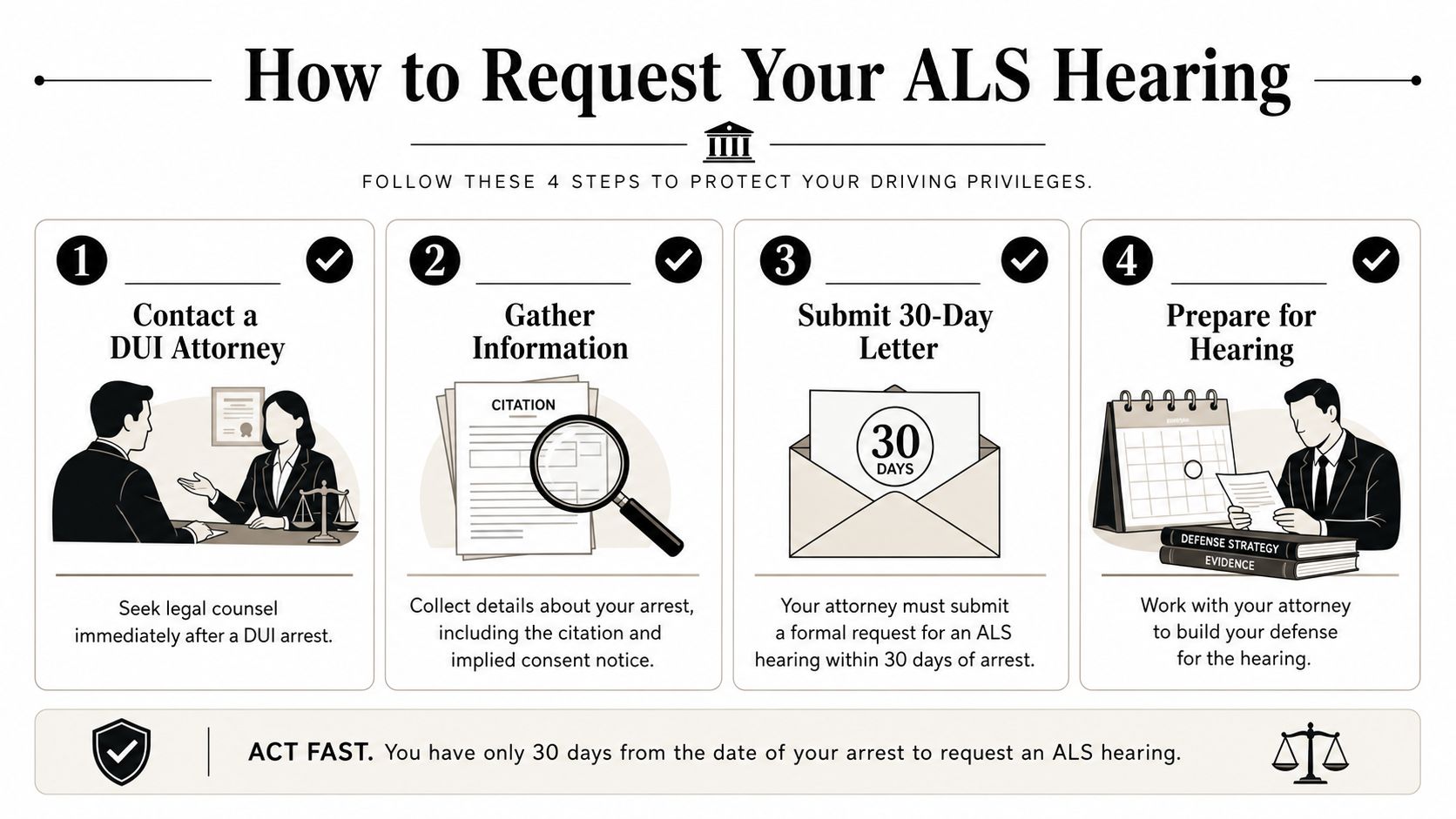
In Georgia, the administrative side of a DUI moves fast. If you were arrested in Cumming, Alpharetta, or nearby, the first job is protecting your ability to drive before the 30-day window closes. Miss that deadline, and the license problem often gets much harder to fix.
The hearing request has to match the case
An ALS request is not just a formality. It is an early strategic choice in the first front of the case.
The right approach depends on what happened after the stop. A refusal case raises different issues than a case involving a breath test, blood draw, or a warrant. The arrest paperwork usually shows where the pressure points are, but only if it is reviewed carefully and in order.
The practical question becomes: do you request the ALS hearing and preserve that fight, or do you consider another route allowed by Georgia law, such as an ignition interlock option, if that better protects your day-to-day life? That decision should be based on your work demands, your prior record, your commuting reality, and whether the administrative hearing may help expose weaknesses that matter in the criminal case too.
A practical sequence that protects your options
Start with the paper you were given at or after release. Small details matter here.
Collect every document from the arrest.
Gather the citation, DDS paperwork, implied consent notice, temporary permit information, bond paperwork, and any towing or jail release records.Confirm the exact arrest date.
The deadline is tied to that date. Guessing wrong by even a day can cost you the hearing.Identify the state's testing theory.
Refusal, breath, blood, or a warrant-based sample each create different legal issues. If your case involves breath evidence, review how breath tests can be challenged in Georgia DUI cases because the license case and the criminal case often overlap.Prepare the ALS request before the deadline expires.
Waiting to "see what happens in court" is one of the most common mistakes. Court comes later. The license deadline does not.Choose the path that fits your real life.
A person driving daily from Cumming to Alpharetta has different risks than someone working from home in Dawsonville. The best choice is not always the most aggressive one first. It is the one that protects mobility without giving up a useful defense.
Decision point: A fast filing helps only if it is the right filing. The wrong administrative choice can limit options you may have wanted to keep.
Local reality in Forsyth and North Fulton
In Forsyth County and North Fulton, losing the ability to drive affects almost everything at once. Work, school pickup, medical appointments, probation reporting, and court appearances all become harder. That is why the ALS decision should be made with local logistics in mind, not just the charge on the ticket.
I tell people this early because it changes how they respond. The DUI is a two-front war. One front is the criminal case in court. The other is the administrative license case, and that front starts first. If you handle the ALS issue correctly and on time, you give yourself a better chance to protect your license and build useful ground for the rest of the case.
Strategies to Fight Your License Suspension in North Georgia
An ALS hearing is not a box-checking exercise. It is one of the few early moments in a Georgia DUI case where the state's version of events can be tested before the criminal case is fully developed. In Cumming, Alpharetta, and the surrounding North Georgia area, that can make a real difference.
The strongest defense strategy usually starts with this question: what had to happen for the suspension to be lawful, and what part of that sequence is vulnerable?
Where ALS cases often become defendable
Some defenses focus on the stop itself. If the officer lacked a valid basis to stop your vehicle, the entire chain of evidence can come under pressure. Other defenses focus on what happened after the stop, including whether the officer properly handled implied consent, whether the request for testing was legally sound, and whether the evidence lines up with the paperwork.
Common pressure points can include:
- The traffic stop: Whether the officer had a lawful reason to pull you over in the first place.
- The arrest sequence: Whether probable cause developed legally before the arrest and testing request.
- The implied consent warning: Whether it was given correctly and at the right time.
- The state's records: Whether the reports, videos, and testimony match each other.
- The testing evidence: Whether breath or blood evidence can be challenged on procedure or reliability grounds.
If your case involves breath evidence, this discussion of why breath tests are not as ironclad as once thought may help you understand why lawyers don't just accept the machine's number at face value.
The hearing can help the criminal case too
Even when the immediate goal is to save your license, the ALS hearing can serve a second purpose. It can expose weaknesses in the officer's memory, preserve testimony, and reveal issues that matter later in Forsyth County State Court or in a Fulton County DUI prosecution.
That matters because early testimony tends to lock people into details. If those details shift later, the defense may have useful impeachment material. If the officer is vague or inconsistent early, that can shape plea negotiations or trial strategy.
A poor strategy is doing nothing and hoping the criminal case somehow fixes the license problem. A better strategy is using the ALS fight as both shield and flashlight. It protects your ability to drive when possible, and it illuminates the state's case before the larger court battle unfolds.
Life After Suspension Hardship Licenses and Reinstatement
Sometimes a driver wins the ALS fight. Sometimes the case moves into damage control. Either way, the next question is practical. How do you keep life moving in Forsyth County or Fulton County if your license has been suspended, and what does it take to get fully reinstated?
If you keep your license
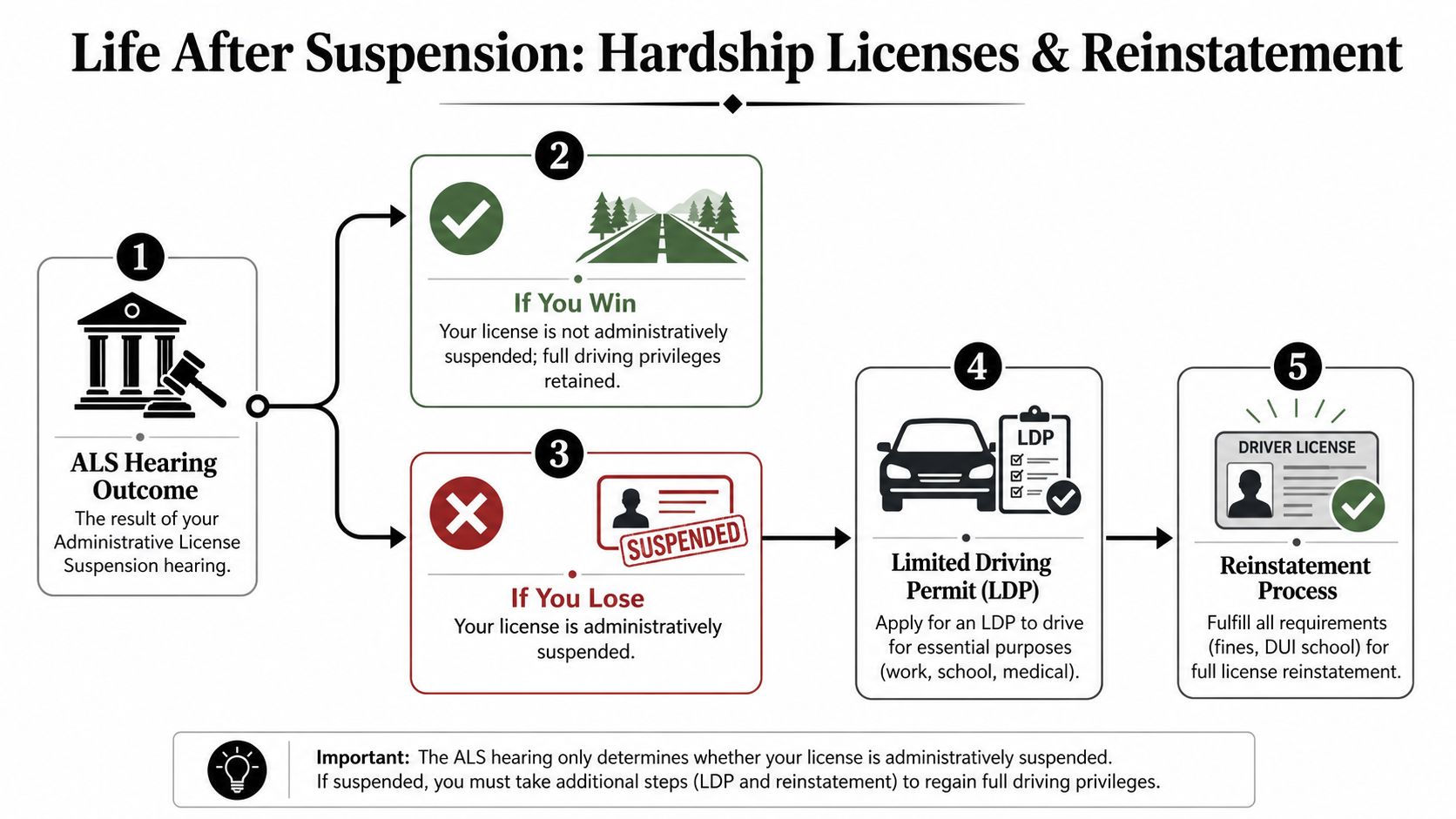
When the administrative suspension is avoided, the immediate pressure eases, but the case isn't over. You still have to defend the criminal prosecution and protect against later licensing consequences tied to any conviction. Keeping your license early gives you room to work, care for family, and prepare the rest of the case without the same transportation crisis.
For many people in Cumming and Alpharetta, that breathing room matters almost as much as any courtroom development. It keeps the case from disrupting every part of daily life at once.
If the suspension goes into effect
If the suspension stands, the next issue is whether you may qualify for a limited driving option and what reinstatement steps will be required later. Eligibility depends on the type of suspension and the facts of the case. Some drivers are surprised to learn that the path forward can be very different depending on whether the case involved a refusal or another administrative basis.
The practical checklist often includes several moving parts:
- Driving permit analysis: Determine whether a limited or hardship-style driving option is available in your situation.
- Required programs: Complete any DUI-related education or risk reduction requirements that apply.
- Insurance follow-up: Prepare for any insurance filings or proof requirements tied to reinstatement.
- Reinstatement process: Confirm what DDS will require before full privileges are restored.
Getting reinstated is rarely a single step. It is usually a sequence, and missing one requirement can delay the return of full driving privileges.
A useful outside resource for the broader process is Georgia driver's license reinstatement from Georgia DUI Schools. It's a helpful overview of the kinds of program and reinstatement issues drivers commonly face after a suspension.
Think in terms of timelines, not hopes
A driver in Forsyth County who needs to commute to Suwanee may focus first on whether any limited driving privilege is available. A driver in Fulton County may be more focused on completing every reinstatement requirement cleanly so there is no further delay. Those are different goals, and they should be approached differently.
The mistake is assuming the suspension just ends and everything returns automatically. In many DUI cases, a person has to complete the right steps in the right order before DDS restores full privileges.
Why Choose Miles Hansford for Your DUI Case in Cumming
A DUI in North Georgia is local in all the ways that matter. The stop may have happened in Cumming. The court process may unfold in Forsyth County or in North Fulton courts. The officer, prosecutor, hearing issues, and scheduling realities all depend on where the case was made. That is why a license suspension DUI defense should never be handled like a generic online form problem.
Local courts shape local strategy
A driver facing a DUI near Cumming needs counsel who understands how a case develops in and around Forsyth County. A professional arrested after dinner in Alpharetta needs advice grounded in Fulton County practice, not broad national commentary. The same is true for people coming from Johns Creek, Milton, Roswell, Sandy Springs, Dawsonville, Canton, or Suwanee.
Local knowledge matters because the administrative side and the criminal side affect each other in practical ways. Hearing timing, document handling, officer testimony, and court calendars all shape the best next move. A lawyer who regularly works in these systems can spot issues sooner and avoid preventable mistakes.
Former prosecutor insight matters in DUI defense
The firm's background includes former prosecutors. That matters in a DUI case because prosecutors and officers usually build these cases in patterns. If you know how the state is likely to frame probable cause, implied consent, testing evidence, and plea positions, you can challenge the case more efficiently and more strategically.
That doesn't mean promising an outcome. No honest lawyer should do that. It means understanding the pressure points on both fronts of the case. The administrative hearing isn't isolated from the criminal defense strategy, and the criminal defense strategy shouldn't ignore what happened early on the license side.
A good DUI defense in Cumming isn't only about court. It's about protecting mobility, identifying leverage early, and making decisions that still make sense months later.
When you require a DUI attorney in Cumming or Alpharetta because you cannot afford to lose your ability to drive, the right time to act is now. Once the deadline passes, options narrow.
FAQ About DUI License Suspension in Forsyth and Fulton County
Q: How long do I have to request an ALS hearing after a DUI arrest in Georgia?
A: In Georgia, you usually have 30 days from the date of arrest to address the administrative license issue. Miss that deadline in Cumming, Alpharetta, Forsyth County, or Fulton County, and the suspension can go into effect without your side being heard.
Q: Is the DUI court case the same as the license suspension case in Georgia?
A: No. The ALS case and the criminal DUI case are separate proceedings with separate consequences. You can be in a position where the court case is still pending while your driving privileges are already in trouble, which is why both fronts need attention right away.
Q: Can I keep driving in Cumming or Alpharetta after a DUI arrest?
A: Maybe. The answer depends on what paperwork the officer gave you, whether the case involves a test refusal or a test result over the legal limit, and whether action is taken before the deadline expires. Options can exist early in the case, but waiting usually closes them off.
Q: What if I refused the chemical test?
A: Refusal cases usually create tougher license consequences, and the details matter. The wording of the implied consent notice, when it was read, what you said, and what the officer documented all deserve close review. In my experience, refusal cases are won or lost in the specifics, not in broad arguments.
Q: Can an ALS hearing help my criminal DUI defense too?
A: Yes. The ALS hearing provides an early chance to question the officer under oath and examine the basis for the stop, arrest, implied consent procedure, and license suspension. That testimony can shape negotiations and motion strategy later in the criminal case in Forsyth County or Fulton County.
Q: If my license is suspended, can I get a hardship permit?
A: Possibly. Eligibility turns on why the suspension was imposed and your driving history. Limited driving relief is available in some cases, while other suspensions bring tighter restrictions. That answer should be evaluated immediately after arrest, because the wrong early decision can limit what is available later.
Q: Do I need a local lawyer for a DUI license suspension case?
A: Local experience can make a real difference. A lawyer who regularly handles DUI cases in Cumming, Alpharetta, Forsyth County, and Fulton County will know how these license issues and court schedules interact in practice, and how to avoid preventable mistakes during the first month.
If you were arrested for DUI and are worried about losing your license, speak with a lawyer before the administrative deadline passes. Miles Hansford Law Firm represents clients in Cumming, Alpharetta, Forsyth County, Fulton County, and across North Georgia. The first job is to protect your ability to drive while building a defense for the separate criminal case.