


Meta Title: Living Will vs Will in Cumming GA | Miles Hansford
Meta Description: Living will vs will in Cumming, GA. Learn how Georgia documents work, what controls, and when to update your estate plan in Forsyth County.
Suggested URL Slug: /living-will-vs-will-cumming-ga
Schema Recommendations:
- Attorney
- LegalService
- FAQPage
Internal Link Suggestions:
A medical emergency rarely gives a family time to get organized. A parent in Cumming is taken to the hospital after a sudden collapse. An adult child is calling siblings from Johns Creek and Dawsonville. A spouse is trying to answer questions from doctors while also wondering what happens to the house, the accounts, and the children if things get worse.
That's usually when people discover they've been using living will and will as if they mean the same thing. They don't.
In Georgia, these documents solve different problems. One helps guide medical decisions if you can't speak for yourself. The other directs what happens to your property after death. If you're in Cumming, Alpharetta, Milton, Roswell, Suwanee, Sandy Springs, Canton, or elsewhere in North Georgia, getting this distinction right can spare your family confusion at exactly the wrong time.
Families already dealing with divorce, remarriage, blended family issues, or high-value property have even more reason to be precise. A document that works in one scenario may do nothing in another.
Planning for the Unexpected in Cumming GA Your Family's Future
A family in Cumming often starts this process after a scare. A difficult diagnosis. An unexpected surgery. A call from a hospital on an ordinary weekday. The first fear is medical. The second is practical. Who makes decisions, and what paperwork controls?
That anxiety is understandable. Individuals aren't avoiding planning because they don't care. They're avoiding it because the terms feel confusing, and every online article seems to blur together. One source talks about medical wishes. Another talks about inheritance. A third drifts into trusts without explaining what applies right now.
A better starting point is simple. A living will protects your voice during incapacity. A will protects your instructions after death. Those are separate jobs, and families in Forsyth County need both concepts handled clearly if they want to avoid conflict later.
For households caring for aging parents, children, or a spouse with health concerns, practical planning tools can help organize conversations before you meet with counsel. One useful outside resource is Family Caregiving Kit's guide to estate planning, especially for families trying to gather documents and identify decision-makers.
Why this matters in Cumming
Local families often have more than one pressure point at once:
- Blended family concerns: A remarriage can create tension between a current spouse and adult children.
- Minor children at home: Parents need to think about guardianship, not just assets.
- Property and business interests: Families in Cumming and Alpharetta may own homes, investment accounts, or closely held business interests that shouldn't be left to assumptions.
- Medical decision confusion: Hospitals need clear direction. Families do too.
Practical rule: If your loved ones would have to guess what you want, your plan isn't finished.
Living Will vs Will A Clear Comparison for Georgians
The cleanest way to understand living will vs will is this. A living will addresses healthcare when you're alive but unable to communicate. A last will and testament addresses property and family instructions after death. As MP Estate Planning explains, a living will governs medical care decisions and becomes effective only when the individual is incapacitated and unable to communicate, while a will governs post-death distribution of assets and becomes effective exclusively after death.
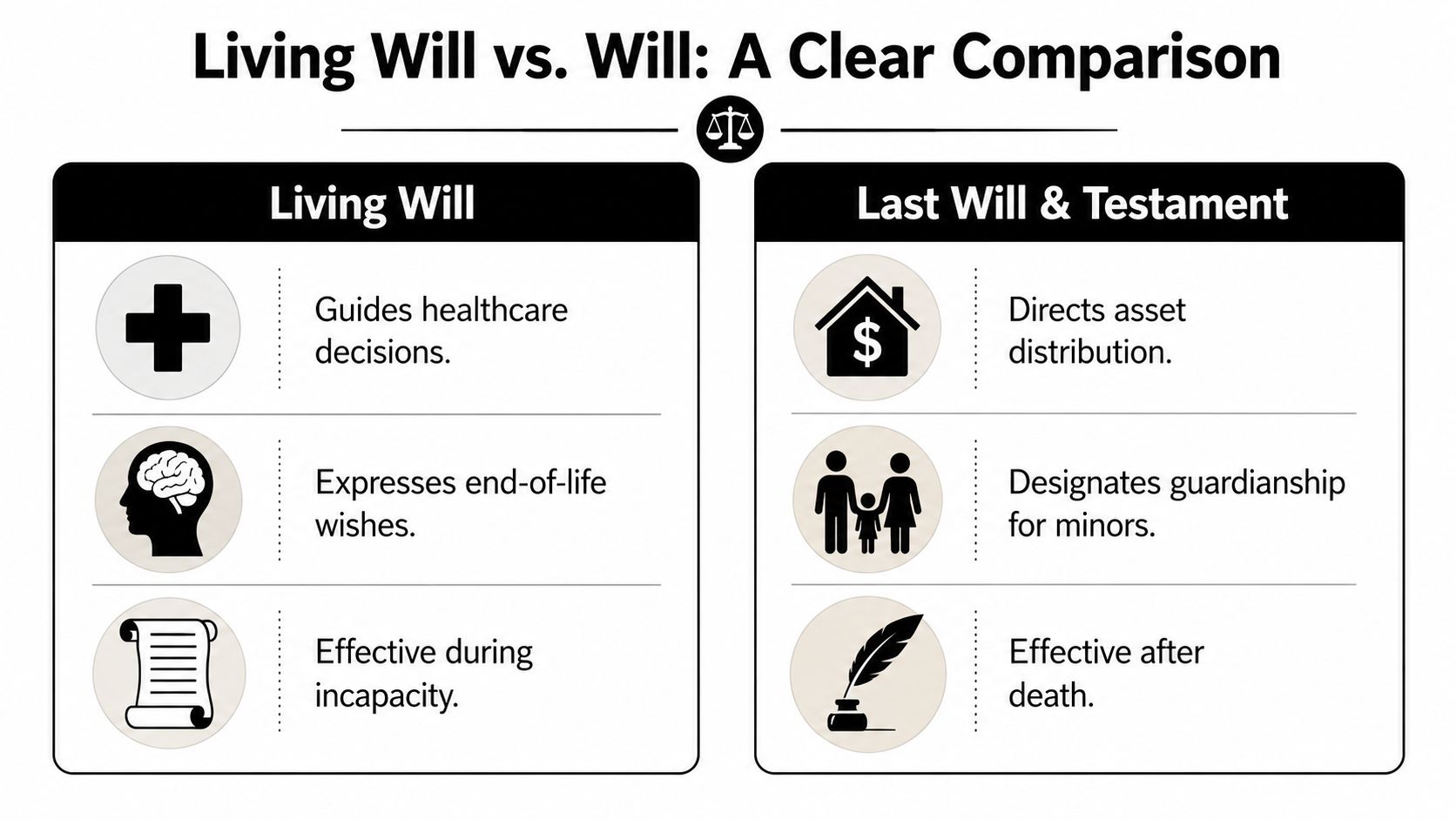
Living Will vs Will at a Glance in Georgia
| Feature | Living Will (Advance Directive) | Last Will and Testament |
|---|---|---|
| Primary purpose | Guides healthcare decisions | Directs asset distribution after death |
| When it matters | During incapacity | After death |
| Main subject | Medical treatment preferences | Property, beneficiaries, executor, guardianship |
| Can it name a guardian for children | No | Yes |
| Can it pass assets | No | Yes |
| Court involvement | Not a probate document | Goes through probate |
The practical difference families miss
People in Alpharetta, Johns Creek, and Milton often ask which document is more important. That's the wrong question. They aren't substitutes.
A living will is about treatment choices. A will is about your estate. If you only sign one, you leave a major gap. If you sign both but don't coordinate them with powers of attorney, you may still leave your family with uncertainty.
For readers sorting through end-of-life planning terms, this guide to choosing end-of-life legal documents is a helpful plain-English companion to the legal distinctions discussed here.
A quick Georgia-focused takeaway
In Cumming and Alpharetta, the issue usually isn't whether someone has heard of these documents. It's whether the documents match real life.
- Parents need a will if they want to nominate a guardian for minor children.
- Adults with strong healthcare preferences need a living will so those wishes are written down.
- Most families need both, plus supporting documents that let someone act when bills must be paid or medical decisions must be made.
The right question isn't "Which one should I choose?" It's "Which problem am I trying to solve?"
Understanding Your Living Will in Cumming GA
A spouse is in the hospital at Northside Forsyth. An adult child is driving in from Alpharetta. The doctors need direction now. If no one is clear on who has authority to speak and what treatment instructions already exist, stress turns into conflict very quickly.

A living will helps prevent that problem. In Georgia, it records your wishes about life-sustaining treatment if you cannot communicate for yourself. It is a medical directive, used during incapacity. It does not control who receives property after death, and it does not replace the other documents a family usually needs.
What a living will actually does in Georgia
A living will addresses treatment choices in end-of-life circumstances. That can include whether you want life support continued, withheld, or withdrawn in the situations covered by Georgia law. It gives doctors and your family written guidance at the point when emotions are high and time is short.
For a plain-English explanation of how a Georgia living will works, start there. The key practical point is simpler. This document speaks to medical care. Your will speaks after death. Your financial power of attorney speaks to money and property during incapacity. Those jobs should not be mixed up.
The control question families often miss
The main issue is not whether a living will is important. It is which document controls in the moment.
In Georgia, treatment decisions and incapacity planning work best when the living will is coordinated with an advance directive for health care and a durable financial power of attorney. The living will states your treatment wishes. Your health care agent, if one is named, is the person authorized to speak with doctors and make decisions within the authority you gave. Your financial agent handles bills, accounts, and property matters. A last will and testament does none of that during your lifetime.
That division matters in real families. If your living will says you do not want certain life-prolonging treatment, your medical team will look at that written instruction. If decisions must still be made about care options, placement, records, or consent, the health care agent is usually the person expected to act. If the mortgage is due while you are incapacitated, the financial power of attorney is the document that lets someone pay it.
What works in practice
A living will is strongest when it is part of a coordinated plan, not a stand-alone form.
- Use clear treatment instructions. Vague language leaves too much room for disagreement in the hospital.
- Name the right health care agent. Choose someone who can stay calm, ask questions, and follow your wishes even under family pressure.
- Pair it with a durable financial power of attorney. Medical instructions do not let anyone access accounts, deal with insurance, or manage property.
- Make the documents available. Your agent, close family members, and physicians should know they exist and how to find them.
- Review after major life changes. Remarriage, divorce, a diagnosis, or conflict among adult children can change who should be in charge.
A living will by itself leaves gaps. I see that problem most often in blended families and in households caring for aging parents. One relative believes the written instruction settles everything. Another assumes the oldest child has authority. Georgia law favors the documents, not assumptions.
Why this matters in Cumming and Forsyth County
Families in Cumming often carry several responsibilities at once. They are raising children, helping parents, running a business, or commuting into Fulton County. Incapacity planning gets delayed because no one expects the emergency room call this month.
The cost of delay is practical, not theoretical. Without coordinated documents, the person at the bedside may not be the person with legal authority. The person who can pay bills may not be the person talking to doctors. A well-drafted living will, backed by the right powers of attorney, gives your family a clear chain of command when they need it most.
Your Last Will and Testament Securing Your Legacy in Alpharetta
A father dies unexpectedly in Alpharetta. His wife can pay the mortgage because she is on the account, but no one has legal authority to transfer the rental property, collect funds owed to his business, or carry out his written wishes until the probate court recognizes the will and appoints the executor. That is the job of a last will and testament under Georgia law.

What a will can do that a living will cannot
A will controls what happens after death. It directs who receives probate assets, names the person responsible for handling the estate, and lets parents nominate a guardian for minor children.
A living will does none of that. It addresses medical treatment while you are alive but unable to speak for yourself. The durable financial power of attorney also stops at death. That point causes real confusion for families. During incapacity, an agent under a power of attorney may handle bills, contracts, and property matters. After death, that agent's authority ends, and the executor named in the will takes over if the probate court approves the appointment.
For parents, the guardianship issue is often the most urgent part of the will. If you do not name your choice, relatives may agree, or they may not. If they do not, the court decides with limited guidance from you.
What families in Alpharetta should pay attention to
A useful will is specific and coordinated with the rest of the plan.
- Executor selection: Choose someone who can meet deadlines, gather records, communicate with beneficiaries, and handle conflict if it arises.
- Clear gift language: Vague instructions create delays and arguments. Specific wording gives the executor something the court can enforce.
- Guardianship nominations: Parents should name primary and backup guardians.
- Coordination with beneficiary designations: A will does not override every asset. Retirement accounts, life insurance, and some jointly held property usually pass by beneficiary form or title.
- Coordination with trusts and powers of attorney: If you have a trust, business interests, or real estate in more than one county, the will should fit that larger structure.
If you want a Georgia-specific explanation of signing rules, executor duties, and common drafting mistakes, this guide on how to create a will in Georgia is a practical place to start.
Probate in Fulton County and Forsyth County
A will does not avoid probate on its own. It gives instructions. The probate court gives legal authority to act.
That distinction matters in Alpharetta and throughout North Georgia. Some families assume the person holding the original will can immediately access accounts, sell property, or distribute belongings. They cannot. In Fulton County or Forsyth County, the executor usually must file the will with the probate court and receive formal authority before taking those steps.
The timing and cost depend on the assets involved, whether the paperwork is complete, and whether anyone contests the will. A well-prepared estate plan usually makes that process cleaner. It does not make the court process disappear.
Common mistakes
The problems I see are usually practical, not exotic legal issues.
- A family assumes the living will covers property and children.
- An old will still names a former spouse or ignores children from a later marriage.
- The named executor lives far away, is in poor health, or is not organized enough to finish the job.
- The will says one thing, but beneficiary designations send key assets somewhere else.
- No one understands which document controls. A healthcare directive governs treatment decisions during life. A financial power of attorney governs financial decisions during life. A will governs probate matters after death.
That last point is where many online articles fall short. Georgia families need documents that work in sequence, with no gap in authority between incapacity planning and estate administration.
How These Documents Work Together as Your Shield
A medical crisis rarely arrives in an orderly way. A spouse is in Northside Forsyth after a stroke. An adult child is trying to talk with doctors, keep the mortgage current, and figure out who can sign what. In that moment, the difference between a living will, a healthcare power of attorney, a financial power of attorney, and a will becomes very real.
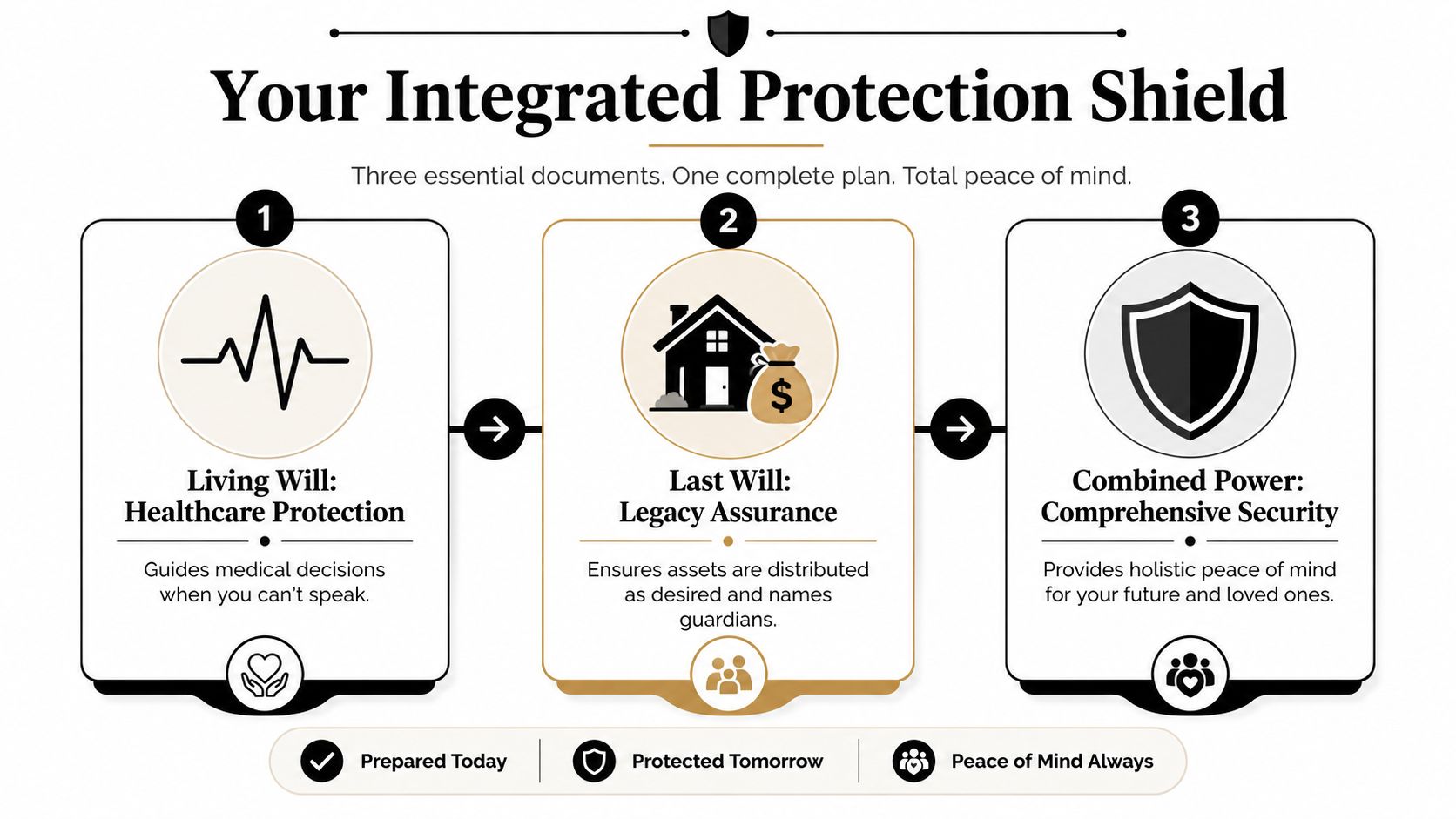
The documents work in sequence, not in competition
Georgia families often ask which document matters more. That is usually the wrong question. Each document takes over at a different point, and problems start when one stage of authority is missing.
During incapacity, the living will speaks to end-of-life treatment preferences. The healthcare power of attorney names the person who can make medical decisions when the patient cannot. The financial power of attorney lets someone handle money, property, and day-to-day obligations while the person is still alive. After death, the will directs probate property, names the executor, and can nominate a guardian for minor children.
The control question matters. If a person is alive but cannot communicate, the will does not control. If that person has died, the financial power of attorney stops. Families lose time and create conflict when they rely on the wrong document at the wrong moment.
A practical Georgia example
Consider a family in Cumming with a home, retirement accounts, two children, and one spouse who handles most of the finances.
If that spouse is hospitalized and cannot make decisions, the immediate legal authority usually comes from the healthcare power of attorney and financial power of attorney. The living will guides care if end-of-life decisions have to be made. The will stays on the shelf because no probate estate exists yet.
If the spouse later dies, the order changes. The agent under the power of attorney no longer has authority to pay bills, move money, or deal with property just because they handled those tasks during incapacity. The executor named in the will must step in through the probate process, and only after the court gives that authority.
That handoff is where many plans fail.
Which document controls in common conflicts
Under Georgia law, these documents should be drafted to work together, but they do not all answer the same question.
- Life support and end-of-life choices: The living will states the person's treatment instructions.
- Medical decisions not covered by written instructions: The healthcare agent usually acts.
- Banking, contracts, bills, and property management during life: The financial agent under a power of attorney usually acts.
- Probate assets after death: The executor named in the will acts after appointment by the probate court.
- Assets with a beneficiary designation or joint owner: Those usually pass outside the will.
This is the part generic articles often miss. The will does not override a beneficiary form. A living will does not let someone access accounts. A financial power of attorney does not stay effective after death. For families deciding whether a trust should be part of the plan too, this explanation of wills and trusts gives useful context.
Where a shield still has gaps
I see four practical weak points again and again in North Georgia families.
One, the healthcare documents are signed, but no financial power of attorney exists. The family can talk with doctors but cannot deal with the mortgage, insurance, or business operations.
Two, the will is current, but beneficiary designations are not. That can send retirement funds or life insurance to the wrong person and leave the will powerless to fix it.
Three, the same person is named for every job without asking whether that person is suited for each role. The best healthcare agent is not always the best executor, and the best executor is not always the best trustee or financial agent.
Four, blended family issues are ignored. A parent may want to provide for a current spouse, protect children from a prior relationship, and avoid a fight between the two. That usually requires tighter drafting and, in some cases, a trust rather than a will alone.
A sound Georgia estate plan answers three separate questions clearly. Who makes medical decisions. Who handles financial decisions during incapacity. Who takes over after death.
What a working plan usually includes
For many families in Cumming, Alpharetta, and surrounding communities, the shield includes these pieces working together:
- Living will: Written instructions for end-of-life care.
- Healthcare power of attorney: A named person to make medical decisions when needed.
- Financial power of attorney: Authority for financial and property matters during incapacity.
- Last will and testament: Directions for probate assets, executor appointment, and guardian nominations for minor children.
The goal is not more paperwork. The goal is no gap in authority when your family is under pressure.
The Legal Process in Forsyth and Fulton County
Good intentions don't create valid documents. Execution matters. Storage matters. Knowing which court handles what matters too.
Signing requirements that matter in Georgia
A will must satisfy formal requirements to be legally valid. As MetLife explains in its discussion of wills and probate, wills are subject to mandatory probate court proceedings, and to be legally valid in Georgia, a will must be signed by the testator and two competent witnesses who are not beneficiaries. The same source notes that a living will operates outside the probate system and must be signed by a competent individual and two witnesses, with its primary function being to guide healthcare professionals.
That means execution isn't a casual step. If witnesses are chosen poorly or the signing process is mishandled, your family may inherit avoidable problems.
A practical process for North Georgia families
For families in Cumming, Alpharetta, and surrounding communities, the safest process usually looks like this:
- Identify the actual decisions first. Choose your healthcare agent, executor, and guardian candidates before drafting.
- Review family law concerns. Divorce, separation, legitimation, child support obligations, or a pending custody matter can change the right structure.
- Sign correctly. Use proper witnesses and follow Georgia formalities carefully.
- Store accessibly. Tell trusted people where originals are kept.
- Review after major life events. Marriage, divorce, births, deaths, and health changes often justify updates.
What to expect in Forsyth County and Fulton County courts
If a person dies with a will, probate issues usually move through the appropriate local probate court process. Families in Cumming often deal with Forsyth County procedures. Families in Alpharetta may encounter Fulton County processes depending on residence and asset location.
If your planning intersects with active family court issues, local context matters there too. Families may already be navigating Georgia no-fault divorce rules, the 30-day minimum waiting period in Georgia, equitable division questions, parenting plans required by Georgia courts, temporary hearings, or mediation expectations in Forsyth County Superior Court and Fulton County Superior Court. Those issues don't change what a living will or will is, but they absolutely affect how and when a family should update them.
Child-related concerns deserve special attention. Georgia child custody standards focus on the best interests of the child, and parenting plans are required in custody matters. If you're a parent in Cumming or Alpharetta, your estate plan should not ignore an existing custody order or an ongoing modification case.
Why Choose Miles Hansford for Your Estate Plan in North Georgia
Families rarely come in with only one issue. A parent in Alpharetta may need a will, but also need to think about a recent divorce. A family in Cumming may be updating healthcare directives while handling a custody order, a legitimation question, or a property division concern from a prior marriage.
That combination is common in North Georgia. It's also why careful planning matters more than generic forms.
Local strategy matters
Forsyth County and Fulton County families need advice that fits the courts and the facts on the ground. That includes understanding how probate issues intersect with Georgia family law statutes, how parenting plans affect family structure, and when temporary orders, mediation, or equitable division issues should trigger a review of an estate plan.
A protective approach usually means asking better questions:
- Who should make medical decisions if your first choice can't serve?
- Does your will reflect your current spouse, children, and obligations?
- Would your plan still make sense after a custody change or remarriage?
- Are you leaving behind clarity, or leaving your family to interpret your intent?
For blended families and parents
Legal judgment matters most. Blended families, high-asset households, business owners, and parents with active custody concerns often need more than standard paperwork. They need documents that work together and language that anticipates conflict before it starts.
If you're in Cumming, Alpharetta, Johns Creek, Milton, Suwanee, Dawsonville, Roswell, Sandy Springs, or Canton, the goal is straightforward. Protect your family. Reduce uncertainty. Put authority in the right hands before a crisis exposes the gaps.
Frequently Asked Questions About Georgia Wills and Directives
Q: Do I need both a living will and a will in Cumming, GA?
A: Usually, yes. In Georgia, the two documents do different jobs. A living will addresses medical decisions during incapacity, while a will handles property distribution and guardianship after death. Families in Cumming often need both, especially when minor children, remarriage, or health concerns are involved.
Q: Can a living will control who gets my house in Alpharetta?
A: No. A living will does not pass assets or property after death. If you want to direct who receives your home or other estate assets in Alpharetta or elsewhere in Fulton County, you need a valid will and often broader estate planning review.
Q: Does a will avoid probate in Forsyth County?
A: No. A will directs what should happen, but it is still subject to probate. In Forsyth County, the probate process is where the court validates the will and allows estate administration to move forward under Georgia law.
Q: Can I name a guardian for my children in a living will?
A: No. In Georgia, a living will is for healthcare decisions. If you're a parent in Cumming, Alpharetta, or nearby communities, the document that addresses guardianship for minor children is your last will and testament.
Q: What if I already have a healthcare agent?
A: Your living will may function as a backup rather than the first document used in every medical crisis. That's why Georgia families should coordinate living wills with healthcare powers of attorney so hospitals and loved ones have clear direction.
Q: How often should I review my estate plan in North Georgia?
A: Review it after major life changes. Divorce, remarriage, births, deaths, custody modifications, business changes, or a significant medical diagnosis are all good reasons for a Georgia family to revisit wills, directives, and powers of attorney.
Q: How do family law issues affect estate planning?
A: They can affect it substantially. Georgia no-fault divorce, equitable division, parenting plan requirements, child custody standards, temporary hearings, and mediation can all change who should serve in key roles and how your documents should be drafted.
If you're in Cumming, Alpharetta, Forsyth County, Fulton County, or surrounding North Georgia communities and you're unsure which documents you need, schedule a consultation with Miles Hansford Law Firm. Speak with a family law attorney and estate planning counsel who can help you protect your parental rights, clarify who controls in a crisis, and put a practical plan in place. Call today before a medical event, custody dispute, or probate issue forces your family to make decisions without clear guidance.