


Meta Title: LLC vs Corporation in Cumming, GA for Small Business
Meta Description: Compare LLC vs corporation in Cumming, GA. Learn Georgia costs, taxes, and compliance issues for small businesses in Forsyth and Fulton County.
Suggested URL Slug: /llc-vs-corporation-small-business-cumming-ga
Schema Recommendations: Attorney, LegalService, FAQPage
Internal Link Suggestions:
- https://www.mileshansford.com/how-to-choose-a-business-structure/
- https://www.mileshansford.com/business-and-corporate-law/llc-creation/
- https://www.mileshansford.com/business-and-corporate-law/corporate-formation-and-governance/
Starting a business in Cumming, GA often begins with a simple idea and quickly turns into a serious legal decision. You pick a name, line up a lease, talk to a bank, and then hit the question that affects nearly everything that follows: should you form an LLC or a corporation?
For small business owners in Forsyth County, Alpharetta, Johns Creek, Milton, Suwanee, Roswell, Sandy Springs, Dawsonville, and Canton, this isn't just paperwork. The wrong structure can create tax inefficiency, unnecessary compliance work, and avoidable risk. The right one can protect your home, savings, and long-term business value.
Choosing Your Business Structure in North Georgia
A lot of North Georgia entrepreneurs start in the same place. They want liability protection, they want clean tax treatment, and they don't want to spend their first year buried in formalities that don't help them serve customers.

That instinct is common for a reason. Small businesses, defined by the SBA as those with fewer than 500 employees, predominantly favor simpler structures: 73% operate as sole proprietorships, followed by partnerships and LLCs, which are a dominant structure for those seeking liability protection with tax simplicity according to business structure statistics summarized here.
Why the choice matters in Cumming and Alpharetta
In Cumming and Alpharetta, many businesses aren't chasing venture capital or preparing for a public offering. They're service firms, family-owned operations, practices, contractors, consultants, and growth-minded local companies. Those businesses usually need a structure that is:
- Protective: It should separate business risk from personal assets.
- Practical: It should fit day-to-day operations in Forsyth County and Fulton County.
- Scalable: It should allow a later tax election or restructuring if the company grows.
The usual starting point
For most small businesses, the question isn't whether to stay informal. It's whether to form an LLC now, or start with a corporation because of ownership, investor, or tax goals.
If you're still weighing the first step, this business structure overview from Miles Hansford can help frame the options: https://www.mileshansford.com/how-to-choose-a-business-structure/
Local counsel matters: A structure that works for a solo consultant in Cumming may be the wrong fit for a multi-owner company in Alpharetta planning outside investment.
Liability Protection The Shield for Your Personal Assets
The first reason business owners form either an LLC or a corporation is straightforward. They want a legal barrier between business liabilities and personal assets.
If the business is sued, defaults on a contract, or faces a debt problem, that barrier is what may protect your house, personal bank account, and personal vehicle from claims aimed at the company. Lawyers often call this limited liability or the liability shield. Business owners usually put it in simpler terms: "Will this problem stay in the business, or can it reach me personally?"
How LLCs and corporations protect you
On this point, LLCs and corporations are closer than many people assume.
Both structures create a separate legal entity. The business can sign contracts, own property, incur debt, and face claims in its own name. In practical terms, that means a customer dispute, lease claim, or vendor lawsuit should generally be directed at the company rather than at the owner personally.
That said, the protection isn't automatic just because you filed paperwork.
What breaks the shield
Owners lose protection when they treat the company as an extension of themselves instead of as a separate business. Common trouble spots include:
- Mixing funds: Paying personal bills from the business account or depositing business revenue into a personal account.
- Signing carelessly: Using your own name instead of the business name on contracts.
- Undercapitalizing the business: Starting operations without enough resources to meet ordinary obligations.
- Ignoring entity rules: Failing to maintain the basic records and governance expected for the structure you chose.
An LLC often gives small businesses more room to operate without heavy formalities. A corporation can be just as protective, but it usually requires more discipline in governance and documentation.
Liability protection is not insurance
Entity choice and insurance work together. They don't replace each other.
An LLC or corporation may help keep a claim at the business level. Insurance may provide a source of defense and coverage when that claim arrives. For Georgia business owners reviewing coverage, this overview of General Liability insurance gives a useful practical baseline.
A business entity protects the owner from many business obligations. Insurance helps pay for the problem. You usually need both.
The North Georgia reality
In Cumming, Alpharetta, and across Forsyth and Fulton County, many disputes start with ordinary business issues. A commercial lease disagreement. A client claiming defective work. A contract fight between co-owners. A premises injury claim. The owners who are best positioned in those situations usually did two things early: they formed the right entity and they respected that entity after formation.
For a solo owner or closely held company, that often points toward an LLC because it delivers the core liability shield without forcing a board, annual shareholder meetings, or layered corporate process. For a business with multiple investors, formal equity planning, or stock-based growth goals, the corporation may still be the better vehicle.
LLC vs Corporation Tax Differences in Georgia
A Forsyth County owner can make a costly mistake here by comparing entity names instead of tax treatment. An LLC is a state-law entity. S corporation status is a federal tax election. A corporation starts as a C corporation for tax purposes unless it properly elects S corporation treatment. An LLC can also elect S corporation taxation if it qualifies.
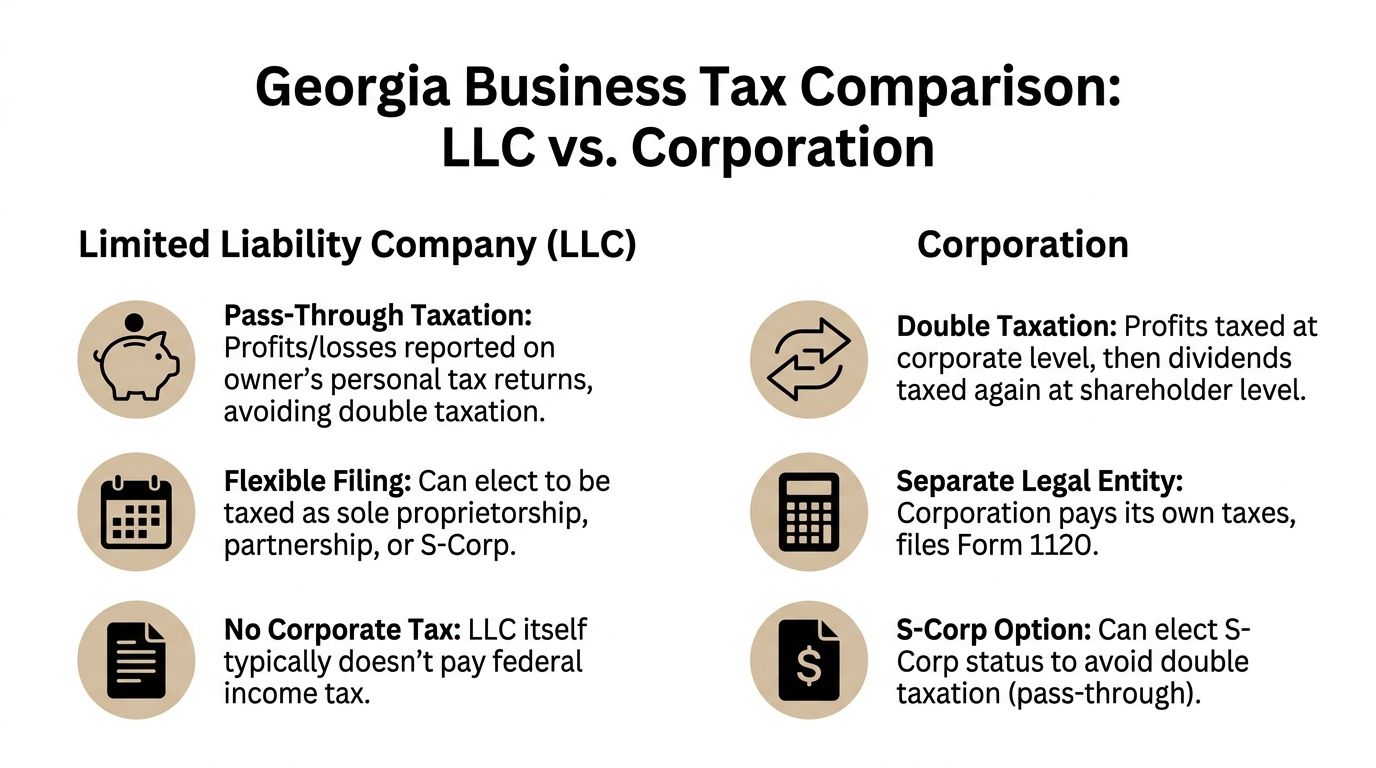
| Feature | LLC (Limited Liability Company) | Corporation (C-Corp default) | S-Corp (Tax Election) |
|---|---|---|---|
| Core tax treatment | Usually pass-through taxation | Corporate taxation | Pass-through taxation |
| Entity-level tax concern | Typically no federal income tax at entity level by default | Corporate profits taxed at the entity level, then dividends can be taxed again | Avoids double taxation if election is valid |
| Owner compensation issue | Net earnings generally exposed to self-employment tax under default treatment | Wages paid to employees through payroll | Owners working in the business take reasonable salary, with distributions handled differently |
| Flexibility | Can elect different tax treatment | More rigid as a corporation unless S election is made | Tax savings potential, but more payroll and compliance work |
| Best fit | Simplicity and flexible ownership | Businesses seeking stock-based growth or investor structure | Profitable owner-operated businesses that can support payroll compliance |
Default LLC taxation
For many small businesses in Cumming and Alpharetta, default LLC taxation is the cleanest starting point. Income usually passes through to the owners' personal returns, which avoids the classic C corporation problem of taxing profits at the company level and then taxing dividends again if money is distributed.
That simplicity has real value in Georgia.
Owners of closely held businesses often care less about theoretical tax efficiency and more about whether the structure fits the way the company operates. If the business has one or two owners, uneven income in the first few years, and no outside investor pressure, default LLC taxation often keeps the tax side easier to manage while the company is still stabilizing.
C corporation taxation
A C corporation is a separate taxpayer. The company pays tax on its profits. Shareholders can then owe tax again on dividends. The result is often less attractive for local service businesses that plan to distribute earnings rather than reinvest them for long periods.
Georgia adds another layer because the state taxes corporate income and also taxes owners on their personal returns. The Georgia Department of Revenue corporate income tax overview explains the state framework that applies to corporations doing business here.
That does not make C corporation treatment a bad choice. It makes it a choice that should be tied to the business plan. If a company expects to seek outside investors, issue stock broadly, retain earnings for growth, or fit a more traditional startup capital model, the corporation may still be the better structure despite the added tax friction.
The S corporation election
The S election is often where Georgia owners can improve tax efficiency, but only if the books are clean and payroll will be handled correctly. Analysts at Wolters Kluwer discuss S corp vs LLC differences and benefits and note that owner-operators may reduce self-employment tax exposure by taking a reasonable salary through payroll and the remaining profit as distributions.
That potential savings gets attention fast. The extra compliance is what owners tend to underestimate.
Once an LLC elects S corporation taxation, the business usually needs payroll processing, quarterly payroll filings, better bookkeeping discipline, and a defensible reasonable-compensation position. For a profitable owner-operated company in Alpharetta or Cumming, that may be worthwhile. For a new business with uneven revenue, it can create more cost and risk than benefit.
If you are still deciding whether to form an LLC and keep the option to make that election later, our page on Georgia LLC creation services walks through the formation side of that decision.
When the S election works well
The S election often fits businesses that have settled into steady profit and can support payroll without strain.
Good indicators include:
- Consistent earnings: Profit is recurring, not tied to one unusually strong month or quarter.
- Active owner involvement: The owner works in the business and can justify a market-based salary.
- Clean administration: Bookkeeping, payroll, and tax filings are already under control or can be handled properly.
- Cash flow room: The business can absorb payroll costs and related compliance work without squeezing operations.
When default LLC taxation is usually better
Default LLC taxation often makes more sense early.
If revenue is inconsistent, profits are modest, or every available dollar is going back into equipment, hiring, or working capital, the S election may not produce enough savings to justify the extra administration. I regularly see owners focus on the possibility of tax savings while ignoring payroll setup costs, accountant fees, and the risk of setting an unreasonable salary.
That is where the Georgia-specific analysis matters. The right answer is rarely the structure with the best label. It is the structure that leaves the owner with the best after-tax result after compliance costs, accounting costs, and the operational demands in Forsyth County.
A practical Georgia framework
For many North Georgia businesses, the best sequence is simple. Start with an LLC. Let the business produce stable numbers. Then review whether an S election improves the net result after added compliance costs.
That approach works well for many contractors, consultants, family businesses, and professional practices in Cumming and Alpharetta. A company with a real stock issuance plan, investor expectations, or long-term retained earnings may be different. Those businesses should examine corporation status earlier, with the tax consequences and governance burden reviewed together rather than in isolation.
Formation Steps and Costs for a Cumming Business
A Cumming business owner can file an entity in a day and still spend months correcting the setup if the ownership terms, governing documents, or tax elections were handled loosely. The state filing is the easy part. The expensive part is cleaning up a structure that was formed without a plan.
What you file in Georgia
An LLC is formed by filing Articles of Organization with the Georgia Secretary of State. A corporation is formed by filing Articles of Incorporation.
Georgia generally charges the same state filing fee to form either entity, and both require annual registration to stay in good standing. The filing fee rarely decides the issue for a small business in Forsyth County. Cost differences often emerge later, in document drafting, payroll setup, recordkeeping, and the time required to keep the company organized.
One Georgia-specific point often gets missed. LLCs have a publication requirement after formation. Corporations do not. That cost is usually modest, but it is still one more step to complete and one more deadline to track.
Step-by-step for an LLC
For many closely held businesses in Cumming and Alpharetta, an LLC is the more practical starting point because the setup is straightforward and the internal structure can be customized for the owners.
- Choose an available name. Check availability, but also confirm the name works for contracts, banking, and branding.
- File the Articles of Organization. That creates the entity with the state.
- Designate a registered agent. Use a reliable person or service that will receive legal and state notices.
- Draft the operating agreement. Georgia does not require you to file it, but lenders, partners, and future disputes will expose whether it was done properly.
- Complete the publication requirement. This step is unique enough that owners often miss it.
- Apply for an EIN and open business accounts. Separate finances from day one.
- Address tax setup early. If the business may elect S corporation taxation later, coordinate that decision with your accountant instead of guessing.
Business owners who want legal help with the setup can review these Georgia LLC creation services.
Step-by-step for a corporation
A corporation requires more formal setup at the front end, and that is often appropriate if the company expects multiple investors, stock issuances, or a governance structure that fits outside expectations.
- File the Articles of Incorporation
- Appoint the initial registered agent
- Adopt bylaws
- Name directors and officers
- Issue stock and document ownership properly
- Prepare initial organizational consents or minutes
- Set up tax and banking accounts consistent with the corporate records
Those steps are not paperwork for its own sake. They create the record trail that supports the corporation's ownership structure and internal authority.
Local cost planning in Forsyth and Fulton County
Owners often focus on the filing fee because it is easy to compare. That is usually the smallest number on the list.
A better budgeting approach is to ask what this entity will cost to maintain over the next three to five years in Cumming, Alpharetta, and the surrounding North Georgia market. For a single-owner service business, an LLC may keep the legal and administrative burden lower at the start. For a business that expects outside capital, multiple classes of ownership, or formal shareholder arrangements, the corporation may justify its added structure.
The early budget should account for:
- State formation fees
- Annual registration fees
- Registered agent fees, if a service is used
- The LLC publication cost
- Operating agreement or bylaws drafting
- Ownership documentation
- Tax registrations
- Payroll setup if the tax plan requires it
- Cleanup costs if the entity is formed first and structured later
I see the same mistake regularly in North Georgia. Owners file online, get the entity approved, and assume they are done. Then a partner dispute, bank request, insurance issue, or tax question exposes the documents that were never prepared in the first place.
Many formation problems start after the state approves the filing. The trouble usually comes from missing ownership terms, weak governance documents, or tax elections that were never coordinated with the business plan.
Managing Your Business Governance and Compliance
Choosing a business entity is not just about how you start. It's about how you will operate six months from now, and five years from now.

LLC governance in daily practice
An LLC gives owners wide latitude to define management in the operating agreement. The company can be member-managed or manager-managed. That matters if one owner is active and another is passive, or if the business wants authority concentrated in a manager rather than spread across all members.
For many small businesses, that flexibility is the main draw. The structure fits the way local companies operate.
Corporate governance is more formal
A corporation has a clearer hierarchy. Shareholders own the company. Directors handle higher-level governance. Officers run day-to-day operations. The structure is familiar to banks, investors, and experienced counterparties, but it carries more maintenance.
LLCs offer superior operational flexibility with no required board of directors or annual meetings, unlike corporations which enforce bylaws and shareholder votes. This difference can reduce administrative time by 40-60 hours annually for a small business, according to NFIB compliance surveys as summarized in this Georgia governance comparison.
What that means in real life
If you're running a small business in Cumming, Johns Creek, or Suwanee, that time burden is not abstract. It means more internal records, more formal approvals, and more chances to fall out of good standing if governance gets ignored.
A corporation often makes sense if those formalities serve a business purpose. They are far less attractive when they exist only because someone assumed a corporation sounded more serious than an LLC.
For businesses that do need that structure, this internal resource addresses corporate formation and governance work in more detail: https://www.mileshansford.com/business-and-corporate-law/corporate-formation-and-governance/
Formality is not a virtue by itself. It only helps when it matches the ownership structure, growth plan, and risk profile of the business.
Which Is Right for You A Decision Checklist
Most small business owners don't need an abstract debate. They need a decision they can use.
An LLC is usually the stronger fit if
- You are the only owner or one of a small number of owners. Local service businesses often fall here.
- You want flexibility in management. You don't want a board and recurring shareholder formalities.
- You value simple operations. The company needs to run cleanly without layers of internal procedure.
- You may elect S corporation taxation later. That can preserve flexibility while leaving room for tax planning.
This is common for consultants, practices, trades, agencies, family-run companies, and other closely held businesses in Cumming, Alpharetta, Milton, and Roswell.
A corporation may be the better fit if
A corporation usually earns its keep when the ownership model is more complex than a standard local business.
Consider it more seriously if:
- You plan to raise money from outside investors
- You expect to issue stock
- You want a more traditional capital structure
- You are building for growth that may require institutional expectations
Those are not everyday facts for most Main Street businesses, but they are real for some startups and expansion-focused ventures in North Atlanta.
Hidden costs deserve more attention now
A lot of older LLC vs corporation articles assume compliance stays cheap and stable. Business owners in Georgia should not make that assumption.
Recent trends show states raising LLC fees and compliance requirements. For example, Georgia's Business Occupation Tax hikes and new federal Beneficial Ownership Information (BOI) filing rules (effective 2024 with fines up to $10k) add hidden costs that must be considered when choosing a structure according to this LLC vs corporation compliance overview.
That doesn't automatically push a business toward a corporation. It does mean owners should stop treating entity choice as a one-time filing decision. Compliance obligations now deserve a place in the initial analysis.
A practical framework for North Georgia owners
If you want a straightforward answer, use this checklist:
| Your situation | Likely fit |
|---|---|
| Solo owner, service business, no outside investors | LLC |
| Two or more owners needing flexible management | LLC |
| Profitable owner-operated company evaluating payroll tax planning | LLC with possible S election |
| Business seeking stock-based investor structure | Corporation |
| Company likely to need rigid ownership mechanics | Corporation |
For business owners who are specifically comparing the tax trade-offs between an LLC and an S election, this outside explainer on LLC vs S Corp for Small Business is a useful supplemental read alongside legal advice.
Partner with Miles Hansford for Strategic Business Counsel
Entity choice affects liability exposure, tax posture, ownership control, and future disputes. Business owners usually feel that pressure because they know the decision matters, but they don't want to pay for the same work twice.
A lawyer's job here isn't just to file forms. It is to align the legal structure with how the business will operate in Cumming, Alpharetta, Forsyth County, Fulton County, and the surrounding North Georgia market.
Miles Hansford Law Firm advises businesses on entity selection, LLC creation, corporate formation, governance, and related dispute risks. That kind of legal work is most useful at the front end, before ownership terms, tax elections, and governance documents start pulling in different directions.
If you're choosing between an LLC and a corporation, the strongest next step is a focused legal and tax planning conversation before filing. That helps you avoid a structure that looks fine on paper but creates friction in practice.
Frequently Asked Questions About Georgia Business Entities
Q: Is an LLC better than a corporation for most small businesses in Cumming, GA?
A: Often, yes. An LLC is usually the better fit for small owner-operated businesses that want liability protection with fewer formalities. A corporation may make more sense if the business expects outside investors, stock issuance, or a more rigid ownership structure.
Q: Can I start as an LLC in Georgia and later elect S corporation taxation?
A: Yes. Many Georgia businesses do exactly that. They form an LLC for legal flexibility, then evaluate an S corporation tax election later if profits become consistent enough to justify payroll and added compliance.
Q: Do LLCs and corporations cost the same to form in Georgia?
A: The initial state filing fee is the same, but they are not identical in total setup cost. Georgia LLCs also have a one-time newspaper publication requirement, while corporations generally avoid that specific expense.
Q: Does forming an LLC protect my personal assets from every business problem?
A: No structure protects against every risk. LLCs and corporations can provide a liability shield, but owners still need to keep business and personal affairs separate, sign documents correctly, and maintain the entity properly.
Q: Why would a small business choose a corporation in Alpharetta or Fulton County?
A: A corporation can be the right fit if the company plans to issue stock, attract outside investors, or create a governance model that looks more familiar to institutional stakeholders. It is usually less attractive if simplicity is the main goal.
Q: Do I need a lawyer to form an LLC or corporation in Georgia?
A: Not in every case, but legal guidance is often worth it. The state filing itself is only part of the work. Ownership terms, governance documents, tax elections, and compliance planning are where costly mistakes usually happen.
If you're weighing llc vs corporation for small business in Cumming, Alpharetta, Forsyth County, or Fulton County, schedule a consultation with Miles Hansford Law Firm. Clear entity planning at the start can protect your assets, reduce avoidable compliance burdens, and put your business on firmer legal footing.