


Meta Title: Minority Shareholder Rights in Cumming, GA
Meta Description: Minority shareholder rights in Cumming, GA. Learn how to prove oppression, demand records, and act in Forsyth or Fulton County courts.
Suggested URL Slug: /minority-shareholder-rights-cumming-ga
Internal Link Suggestions:
Schema Recommendations:
- Attorney
- LegalService
- FAQPage
You bought into a business in Cumming, GA or nearby Alpharetta because you believed in the company and trusted the people running it. Now meetings happen without you. Financials suddenly feel hard to get. Distributions stop, but the majority owners seem to be doing just fine. If that sounds familiar, your instincts may be right.
Minority shareholder disputes are stressful because the problem usually starts subtly. You don't get one dramatic announcement. You get delays, excuses, unexplained decisions, and a growing sense that somebody is moving your investment out of your reach. That's when you need a plan, not panic.
For help with minority shareholder rights near me in Forsyth County, Fulton County, Cumming, Alpharetta, Johns Creek, Milton, Suwanee, Dawsonville, Roswell, Sandy Springs, or Canton, the immediate next step is simple. Preserve documents, stop informal arguments, and get legal advice before the record gets worse.
Your Guide to Minority Shareholder Rights in Cumming GA
A minority owner usually comes to a lawyer after weeks or months of second-guessing. You wonder if you're overreacting. You tell yourself maybe the books are late because the accountant is behind, maybe the salary increase was justified, maybe the new shares were necessary. Then the pattern becomes impossible to ignore.
In closely held companies across Cumming and Alpharetta, the pressure point is often control of information. The people in charge decide what gets shared, when it gets shared, and how they frame it. That control can be used properly, or it can be abused to push a minority owner into silence, a cheap buyout, or complete irrelevance.
What you should do first in Cumming GA
Start with discipline.
- Save every communication: Keep emails, texts, meeting notices, cap table updates, payroll records, and accounting messages.
- Write a timeline: List the dates when you were excluded, denied records, removed from management, or surprised by new decisions.
- Stop making verbal demands: Put requests in writing so the paper trail is clear.
- Avoid signing anything under pressure: Buyout offers and consent resolutions often arrive before the full story does.
Practical rule: The shareholder who keeps the best records usually has the stronger position once the dispute reaches lawyers, mediators, or a judge.
Why local court experience matters in North Georgia
A shareholder case doesn't unfold in the abstract. It lands in a real courtroom with local procedures, local judges, and local expectations. That matters in Forsyth County Superior Court and Fulton County Superior Court, where a strong case depends on facts, documents, and a coherent theory of harm.
If you own part of a business in Cumming, Alpharetta, or elsewhere in North Georgia, you need to think strategically from day one. A rushed accusation can hurt you. A well-documented claim can protect your investment, your influence, and your exit options.
Schedule a consultation if you suspect self-dealing, dilution, record withholding, or exclusion from management. Early action preserves evidence and creates options.
Understanding Your Fundamental Rights as a Georgia Shareholder
You find out after the fact that the company issued new shares, approved a major transaction, or changed compensation in a way that strips value from your stake. That is when minority shareholder rights stop being abstract and start becoming evidence.
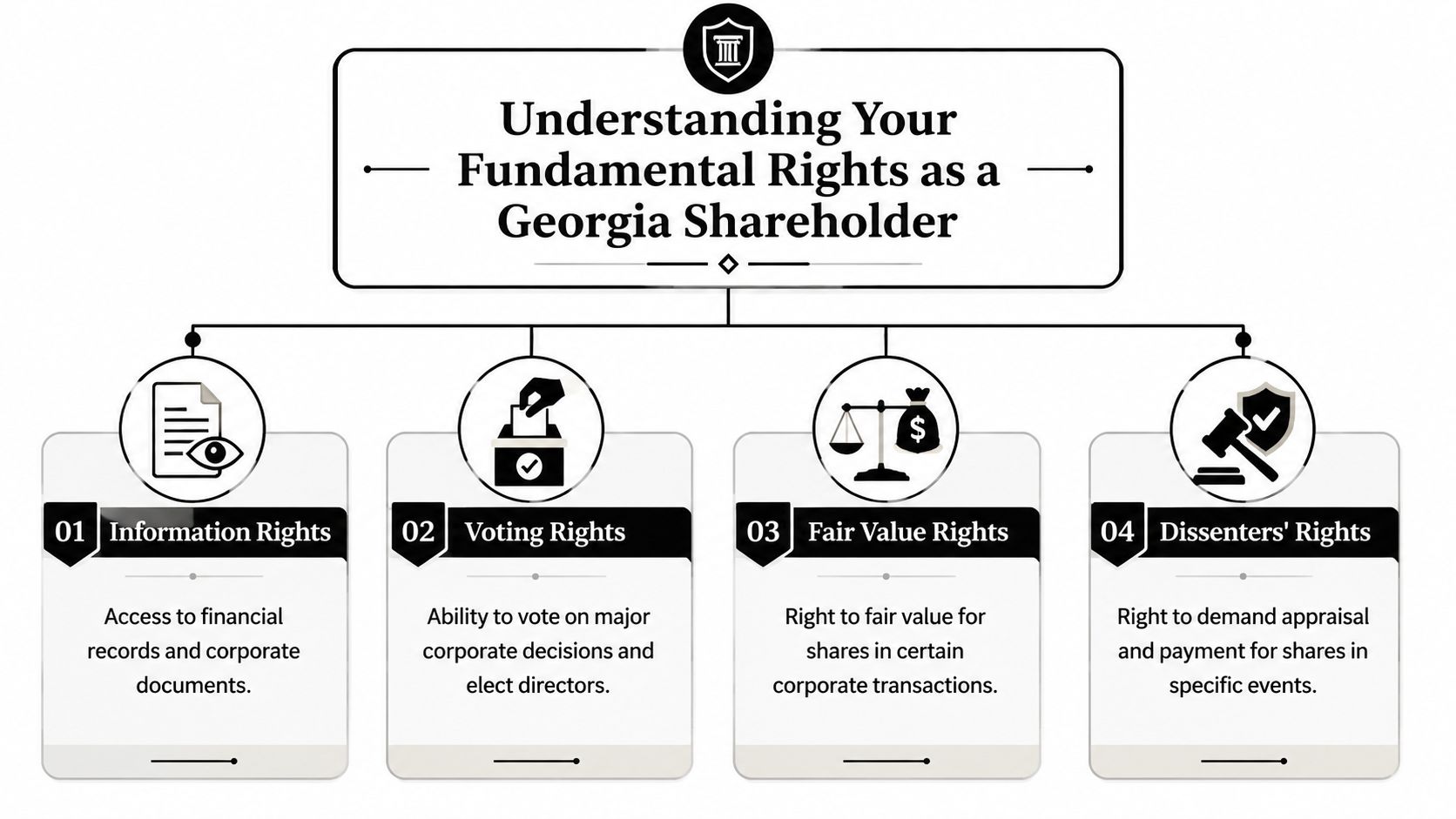
In Georgia, your rights are only as strong as your ability to prove they were violated. In Forsyth or Fulton County, judges want documents, dates, corporate records, and a clear explanation of how the conduct damaged your ownership interest. Start there.
The rights that matter most in Georgia
Four rights usually drive these cases:
| Right | What it protects | What you need to prove |
|---|---|---|
| Information rights | Access to company records and financial information | You made a proper request, the company had the records, and insiders withheld or limited access |
| Voting rights | Participation in major corporate decisions | The company failed to follow bylaws, notice rules, shareholder agreements, or statutory procedures |
| Fair value rights | Protection when your interest is cashed out or affected by major transactions | The valuation was unfair, manipulated, or based on incomplete financial information |
| Dissenters' rights | A path to challenge certain major actions and seek payment for shares | The transaction triggered statutory rights and you followed the required notice and timing rules |
The legal theory behind many of these disputes is fiduciary misconduct. Directors and controlling shareholders cannot treat the company like a personal bank account or freeze out a minority owner for their own benefit. If the facts point to self-dealing, diverted revenue, insider compensation games, or hidden transactions, read more about a breach of fiduciary duty and how that claim fits into a shareholder case.
Information rights usually decide whether you can prove oppression
Record access is not a side issue. It is the foundation of the case.
If you suspect foul play, the first question is simple. What records exist, and what do they show? In a closely held company, the documents that matter most usually include financial statements, general ledgers, tax returns, payroll records, board minutes, shareholder consents, cap table changes, bank statements, and communications about major transactions. A refusal to produce those records can matter on its own. The records themselves often matter even more.
Preemptive protections also deserve close attention. If insiders issued new shares and reduced your percentage ownership, dilution may be part of the problem. This overview of what are preemptive rights gives a useful starting point for understanding how shareholders protect themselves when new shares are offered.
Rights are only useful if you build proof the court can use
A shareholder oppression case is rarely won by saying the majority acted unfairly. You win by showing exactly what happened and tying it to a legal duty.
That means comparing the governing documents to the company's conduct. Check the articles, bylaws, shareholder agreement, meeting notices, written consents, and stock issuance records against the timeline of events. If the company approved a transaction without proper notice, denied inspection without a valid reason, or shifted value to insiders through salary or related-party payments, those details belong in the case file. So do the missing pieces. Missing minutes, unexplained ledger entries, and sudden changes in ownership records often point to the heart of the matter.
Georgia law gives minority owners a real remedy
Georgia law allows a shareholder to seek judicial dissolution in some cases involving illegal, oppressive, or fraudulent conduct by those in control. The point is not to threaten the company for sport. The point is to force a reckoning when controlling owners abuse their position and leave a minority shareholder without a fair internal fix.
Courts in North Georgia focus on concrete harm. Show how the conduct affected your voting power, diluted your equity, blocked your access to records, cut you out of distributions, or reduced the value of your shares. General suspicion is not enough. A documented pattern is.
If you are a minority owner in Cumming, Alpharetta, Johns Creek, or Milton, protect the paper trail and treat every disputed decision like a future exhibit. That is how these cases are built.
Common Squeeze-Out Tactics Used in Alpharetta Businesses
You own a meaningful stake in the company, but the phone stops ringing. Payroll cuts you off. Meetings happen without you. Then a buyout offer shows up at a discount. That is how many squeeze-out disputes start in Alpharetta businesses.

The majority rarely announces a freeze-out. It usually hides inside paperwork, compensation decisions, and informal company moves that are easy to explain away one by one. In court, though, the pattern matters. In Forsyth or Fulton County, these cases are won by proving that the insiders used control to cut you off from value, information, or voting power.
How squeeze-out tactics usually show up
A common first move is terminating the minority owner as an employee. In a closely held company, that does more than eliminate a paycheck. It strips away daily visibility into operations, limits access to records, and weakens your ability to challenge what management is doing in real time.
Another frequent tactic is draining profits through insider compensation. Instead of issuing fair distributions, the controlling owners pay themselves inflated salaries, bonuses, management fees, or consulting payments. The books show lower profit. The insiders still get paid.
Dilution is another classic move. New shares get issued, ownership percentages shift, and the minority owner learns about it after the fact. The dispute usually turns on the documents. Who approved the issuance, what notice was given, what the governing documents required, and what consideration the company received.
Asset shifting is just as serious. I see businesses move customers, equipment, employees, contracts, or revenue into a second entity owned by the same insiders. On paper, the original company weakens. In reality, value has been redirected.
What to look for if you suspect a freeze-out
The warning signs are usually specific, not subtle:
- You stop receiving full financial records. You get summaries instead of general ledgers, bank support, payroll detail, or source documents.
- Important decisions appear in minutes you never saw coming. Notices are late, vague, or missing.
- The cap table changes without a clear explanation. New shares, options, or convertible interests appear after internal conflict starts.
- Insiders begin paying themselves differently. Salary jumps, consulting agreements, or related-party invoices replace profit distributions.
- Business operations shift to another entity. The same people control both sides of the transaction.
- A low buyout offer arrives after you lose access to information. That timing matters.
Proving the tactic matters more than naming it
Calling something a squeeze-out is not enough. You need evidence that a judge can follow.
Start by matching the suspected tactic to a document trail. If you believe profits were diverted, compare tax returns, payroll records, vendor payments, and related-party invoices. If you believe shares were issued improperly, pull the stock ledger, written consents, board minutes, subscription documents, and any emails discussing ownership changes. If assets were moved, trace where contracts, equipment, receivables, and staff went, and when.
Witnesses matter too. The bookkeeper who was told to reclassify payments, the office manager who saw records withheld, or the outside accountant who questioned a transaction can become important pieces of the case.
Why these facts carry weight in Georgia courts
Judges do not care about office politics. They care about proof. A minority shareholder oppression case gets stronger when you can show a sequence: control by insiders, a specific act, a departure from the governing documents or ordinary practice, and measurable harm to your shares or the company.
That is why timing is so important. Preserve emails, meeting notices, draft minutes, cap table versions, payroll changes, and bank-related communications before they disappear. Do not wait for the majority to clean up the record.
If you are dealing with this kind of conduct in Alpharetta, Johns Creek, Milton, or Roswell, get a business litigation attorney focused on protecting your investment and building a case that can hold up in court. The right response is not panic. It is disciplined evidence collection and a strategy built around what you can prove.
How to Enforce Your Rights Legal Remedies in Georgia
You ask for financials after profits drop. Management stalls, then announces a new share issuance, a related-party deal, or a sudden change in officer compensation. At that point, your rights matter only if you can match the remedy to the misconduct and prove it with records a Georgia judge will trust.
Direct claims and derivative claims require different strategies
This choice shapes the entire case.
A direct claim targets harm done to you as an owner. If your voting rights were denied, your shares were diluted, or you were pushed into an unfair buyout, you may have a personal claim.
A derivative claim targets harm done to the company. If insiders diverted revenue, overpaid themselves, or used the business for personal deals, the corporation is the injured party, and you sue on its behalf.
That distinction affects more than labels. It affects standing, pre-suit requirements, settlement pressure, and where the money goes if you win.
| Claim type | Primary harm | Typical example | Likely goal |
|---|---|---|---|
| Direct action | Harm to your ownership interest | Dilution or wrongful exclusion from voting | Personal recovery or equitable relief |
| Derivative action | Harm to the company | Misuse of corporate funds or self-dealing | Recovery for the corporation and governance fixes |
A lot of weak cases fail because the shareholder pleads the wrong theory. If the money was taken from the company, call it what it is and build a derivative case. If the majority targeted your ownership rights directly, pursue a direct claim and ask for relief that fixes your position.
Georgia remedies only work when the proof matches the request
Courts do not hand out broad relief because a minority owner feels frozen out. You need a remedy that fits the facts.
If insiders are about to close a suspect transaction, injunctive relief may be the immediate answer. If records are being withheld, a court order compelling inspection may be the pressure point that exposes the full scheme. If the company has already been damaged by self-dealing or waste, the case may focus on damages, restitution, or governance changes. In the most severe cases, where the relationship is broken and the business cannot be run fairly, a forced buyout or judicial dissolution may become part of the strategy.
The question is practical. What order will stop the bleeding, preserve value, and put you in a position to prove the next layer of misconduct?
Proof in oppression cases is usually built transaction by transaction
Judges in Fulton and Forsyth County want specifics. They want to see who approved the act, what documents support it, how it broke from normal corporate practice, and what it cost you or the company.
That means your case theory should track a set of transactions, not a general feeling that management turned hostile.
For example, if you claim profits were siphoned away, tie the claim to particular vendor payments, officer compensation entries, loan advances, or transfers to related entities. If you claim dilution, identify the exact issuance, the date, the authorizing documents, the consideration paid, and whether corporate formalities were ignored. If you claim exclusion from management to hide misconduct, show the meeting notices you did not receive, the votes taken without you, and the decisions made during that blackout period.
At this juncture, many shareholders either gain ground or lose it. Broad accusations invite broad denials. Specific transactions force explanations.
Use remedies in the right order
Filing suit is not always the first move. It is often the move that has to be prepared first.
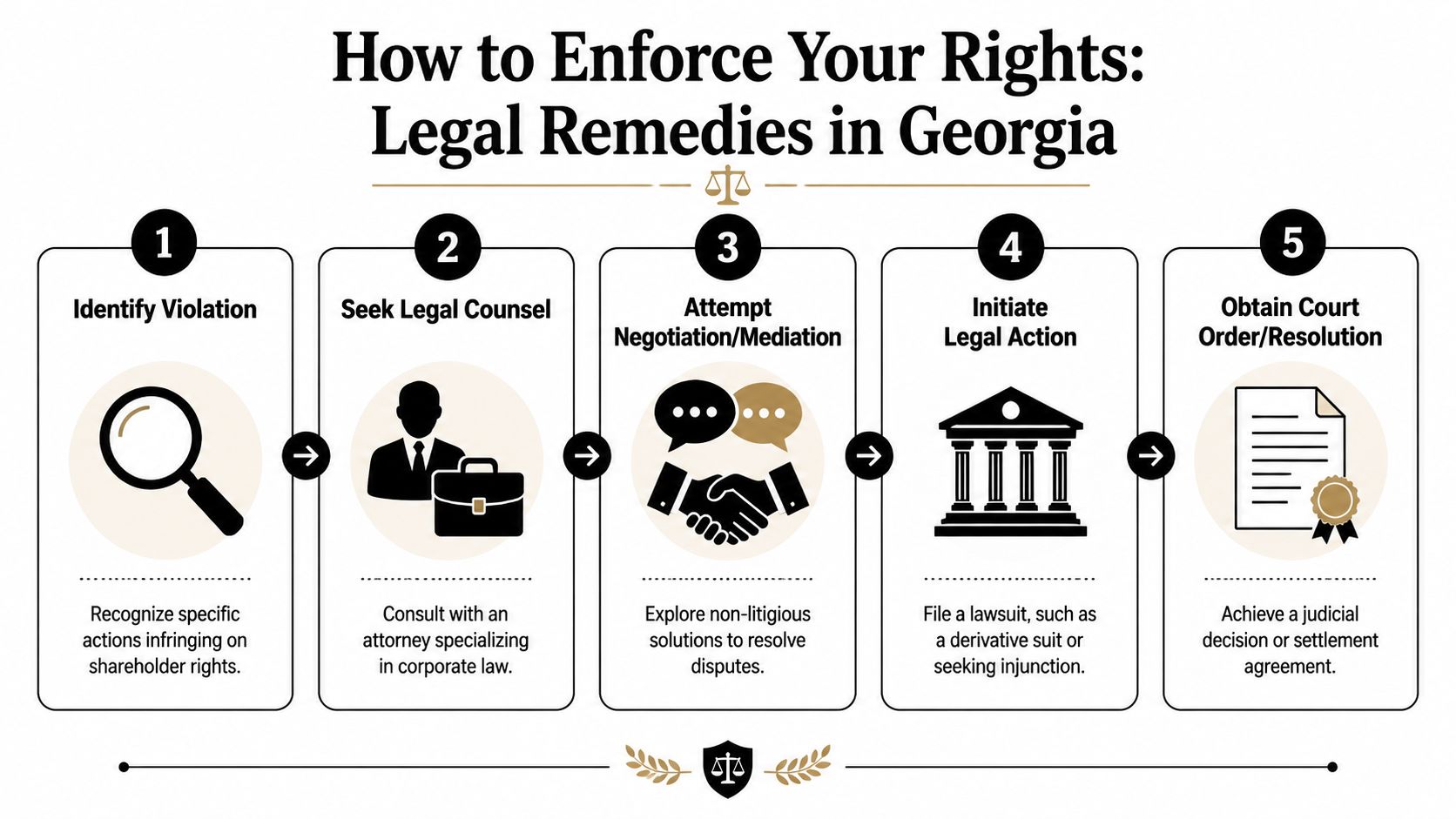
A strong enforcement plan usually works in stages:
- Pin down the remedy you need first. If a sale, transfer, or dilution event is imminent, prepare for emergency relief. If the core problem is concealment, focus first on inspection and document production.
- Frame the case around two or three provable events. Do not dump every grievance into the complaint. Lead with the transactions you can document cleanly.
- Decide whether pressure is better applied in court or in a controlled resolution process. In some closely held business disputes, early mediation can preserve value and stop owners from spending the company into the ground. Georgia business owners should weigh the benefits of alternative dispute resolution in shareholder and business disputes before turning every fight into full-scale litigation.
- Ask for relief that modifies negotiating position. A request for records, a temporary restraining order, or limits on further share issuances can matter more at the start than a broad damages demand.
- Build toward valuation issues early. If the case may end in a buyout, start organizing the financial proof that will drive value, including compensation history, discretionary expenses, related-party payments, and any suppression of distributions.
That is how you enforce shareholder rights in real life. You choose the claim carefully, tie it to documents and witnesses, and ask the court for relief that protects the investment before more value disappears.
Schedule a consultation if you believe the majority is using the company to strip your rights or your equity value. Speed matters, but strategy matters more.
Navigating the Dispute Process in Forsyth and Fulton County Courts
You ask for the books. Management goes quiet. A week later, a key payment hits a related company, the payroll spikes, and nobody will answer a straight question. That is how many shareholder cases start in North Georgia. By the time a minority owner realizes the problem is serious, the actual fight is no longer about suspicion. It is about proof.
Start building proof before you file
In Forsyth County Superior Court or Fulton County Superior Court, the shareholder with the better record usually controls the case early. Judges do not want a family-business feud dressed up as litigation. They want dates, emails, accounting entries, meeting notices, tax documents, and a clear explanation of what the majority did with company money or voting power.
One of the first pressure points is a records demand. Georgia shareholders may have inspection rights, but you need to make the demand correctly and with a proper purpose. This discussion of minority shareholder inspection rights and written demand requirements explains the written-demand process and why form matters.
A good demand does more than ask for records. It tests whether the company intends to cooperate, stall, sanitize, or hide. That response matters in court.
What the court process looks like on the ground
Forsyth and Fulton are both serious business courts, but the tempo can feel different. In Forsyth, closely held company disputes often carry a practical, fact-first rhythm. In Fulton, especially in cases tied to Alpharetta, Roswell, Milton, Sandy Springs, and the broader North Fulton business corridor, the pressure usually comes faster on documents, financial detail, and legal framing.
Expect a dispute to move through several stages:
- Pre-suit positioning: demand letters, preservation notices, and efforts to stop further dilution, transfers, or questionable payments
- Complaint and early motions: the pleadings need to identify the specific acts that harmed your rights or reduced the value of your shares
- Discovery: bank records, QuickBooks files, tax returns, board materials, cap table changes, payroll data, and sworn testimony usually decide whether the case has teeth
- Interim hearings: if money is disappearing or ownership is being altered, early court intervention may matter more than the final trial
- Mediation or trial: many cases resolve after the documents are produced and each side sees the valuation risk clearly
The practical question is simple. Can you show the court something concrete happened, who did it, when they did it, and how it damaged your ownership interest?
Evidence wins these cases, not outrage
Minority owners often come in focused on unfair treatment. That is understandable, but unfair treatment alone is not enough. You need evidence that a judge in Forsyth or Fulton can act on.
Start with the records that usually expose oppression or self-dealing:
- missing or manipulated financial statements
- compensation increases for majority owners without business justification
- related-party transactions
- loans to insiders
- shareholder meeting notices that were never sent or were sent late
- new share issuances that dilute minority ownership
- sudden changes in distributions or access to company information
Then line up witnesses. The office manager who handled bookkeeping, the outside CPA, the payroll processor, and the lender often know where the money moved and who approved it. In many cases, those non-owner witnesses explain the story better than the shareholders do.
Mediation works when you walk in prepared
A weak case hides behind mediation. A strong case uses mediation to force a realistic result. If you can show a clean timeline, specific missing records, questionable payments, and a credible view of value, settlement talks become much more productive.
For some business ownership disputes, alternative dispute resolution can protect company value and narrow the issues before trial. That only works if you prepare as if the case will be tried.
If you are in Cumming, Alpharetta, Dawsonville, Johns Creek, or nearby, do not wait for the majority to clean up the paper trail. Preserve emails, texts, meeting notices, financial reports, and anything showing how the business was run. In shareholder litigation, delay helps the side holding the records.
Preventing Disputes With a Strong Shareholder Agreement
You buy into a closely held company. Business is strong. Then the majority owner stops sharing numbers, changes compensation, issues more shares, and tells you the paperwork gives them that authority. By the time the dispute reaches a lawyer, the actual fight is often over what the agreement failed to say.
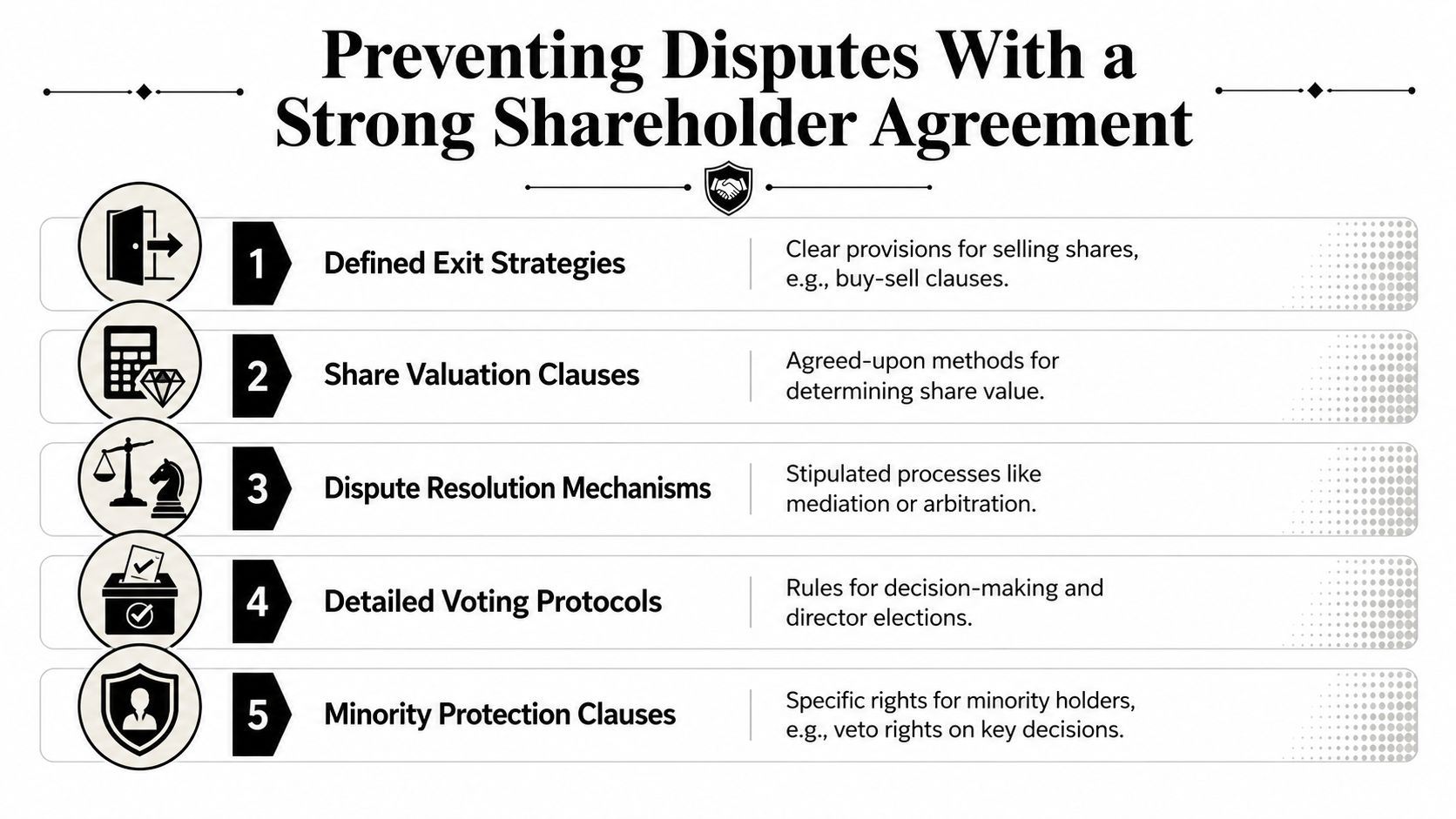
A strong shareholder agreement is a prevention tool, but it is also an evidence tool. In Georgia oppression cases, especially in Forsyth or Fulton County, the written agreement often becomes the roadmap for proving misconduct. If the document clearly requires notice, approval, reporting, valuation, or limits on insider transactions, you have something concrete to enforce. If it stays silent, the majority gets room to argue.
What the agreement needs to cover
A useful agreement should answer the questions that usually trigger litigation:
- Buyout terms: who can force a sale, what events trigger it, and how payment is made
- Valuation rules: who values the company, what method applies, and what happens if experts disagree
- Protected votes: actions that require minority consent, such as issuing new shares, selling major assets, taking unusual debt, or changing owner compensation
- Information rights: what financial statements must be delivered, how often, and by what deadline
- Records access: what documents a shareholder may inspect and the procedure for requesting them
- Restrictions on insider deals: approval rules for loans, leases, payroll changes, and related-party transactions
- Dispute procedures: venue, mediation requirements, fee-shifting, and injunctive relief terms if someone withholds records or violates transfer restrictions
These terms do more than reduce confusion. They create proof.
For example, if the agreement requires quarterly financials and the company stopped sending them, you can document the missed deadlines. If it requires unanimous approval for a new share issuance, the cap table, board minutes, and subscription documents will show whether the majority ignored that requirement. Judges care about paper. A clear contract gives you paper to work with.
Why minority owners should insist on specifics
General promises about fairness or good faith do not protect an investment. Specific duties do. Dates, thresholds, approval requirements, and valuation procedures are what give a minority owner influence before a dispute and evidence after one starts.
That is why a generic form is a mistake. If you are investing real money, use an agreement built for the actual business, the actual ownership split, and the actual ways insiders could freeze you out. If you need the baseline structure, start with this explanation of what a shareholder agreement should cover and then tailor it to the company you are joining.
Use the agreement to test risk before you sign
Read the draft like a future plaintiff's lawyer. Ask simple questions. Can the majority issue more shares without you. Can they raise their own pay. Can they block distributions indefinitely. Can they remove you from management but keep your capital trapped. Can they delay financial reporting until after the money is gone.
If the answer is yes, fix it now.
Once the relationship breaks down, people stop negotiating and start protecting themselves. A strong agreement will not prevent every fight, but it will put you in a far better position to prove a breach, stop further damage, and protect the value of what you own.
FAQ About Minority Shareholder Rights in North Georgia
Q: What counts as a minority shareholder in Georgia?
A: A minority shareholder is generally an owner without control of the company's voting power. In practice, the issue isn't just percentage ownership. It's whether someone else controls decisions, records, distributions, and board action in the business.
Q: Can a minority shareholder force the company to provide records in Cumming or Alpharetta?
A: Yes, in many situations a shareholder can formally demand access to key records if the request states a proper purpose and follows the required procedure. In a dispute headed toward Forsyth County or Fulton County court, that written demand is often the first serious move.
Q: What is shareholder oppression in Georgia?
A: Shareholder oppression usually means those in control act in a way that unfairly harms the minority owner's rights or economic interest. Common examples include exclusion from management, withholding information, self-dealing, or structuring transactions to devalue the minority stake.
Q: Can I sue if the majority diluted my ownership?
A: Often, yes. If insiders issued shares improperly or used the process to reduce your stake unfairly, that may support a direct claim, a fiduciary duty claim, or a request for court intervention depending on the facts and governing documents.
Q: Where would a business dispute be filed in North Georgia?
A: Many cases are filed in Forsyth County Superior Court or Fulton County Superior Court, depending on the company, the parties, and where the dispute belongs legally. Court location affects procedure, timing, and how quickly emergency relief may be heard.
Q: Do most minority shareholder cases go to trial?
A: No, many resolve through negotiation or mediation after the evidence is developed. But settlement only happens on favorable terms when the minority owner has preserved documents, stated clear claims, and shown the majority that delay won't make the problem disappear.
Q: What should I do before confronting the other owners?
A: Collect documents, preserve electronic communications, avoid emotional threats, and get legal advice first. Once the other side knows you're onto the problem, they may change records, close ranks, or push a rushed buyout.
If you believe the people running your company are freezing you out, withholding information, or stripping value from your ownership, get advice before the damage deepens. Miles Hansford Law Firm serves clients in Cumming, Alpharetta, Forsyth County, Fulton County, and across North Georgia. Schedule a consultation, speak with an attorney about your options, and protect your investment with a strategy built for the facts in front of you.