


Meta Title: Motion for Default in Cumming, GA Divorce
Meta Description: Motion for default in Cumming, GA divorce cases. Learn Forsyth and Fulton County default rules, timing, hearings, and next steps.
Suggested URL Slug: /motion-for-default-cumming-ga-divorce/
Internal Link Suggestions:
- How to file for divorce in Georgia
- What documents to prepare when getting a divorce
- How to file a motion to dismiss
- Link internally to pages on contested divorce, child custody, child support, alimony, equitable division, mediation, and temporary hearings
Schema Recommendations: Attorney, LegalService, FAQPage
Silence after a divorce filing can feel worse than a fight. You filed in Cumming, GA, served your spouse, and expected some kind of response. Instead, nothing. No answer, no lawyer, no effort to move the case forward. For many people in Forsyth County and nearby Alpharetta, that silence creates the same fear: Can my spouse stall this out forever?
Usually, no. Georgia family law gives you a path forward when a spouse ignores a properly served divorce case. That path often involves a motion for default, but the timing matters, the paperwork matters, and the court will still expect a legally sound result on issues like custody, support, alimony, and property division. In a no-fault divorce, you still have to prove up the relief you're asking for. A spouse's nonresponse doesn't erase the judge's duty to review the case carefully.
What to Do When Your Spouse Ignores Your Cumming, GA Divorce Filing
You filed for divorce in Cumming, made sure your spouse was served, and then the case went quiet. No Answer. No lawyer. No indication that the other side plans to participate. In Forsyth County, that kind of silence is common enough that it should change your plan, not your confidence.
Start with the court file. Confirm that service was completed correctly and that proof of service is in the record. If service is defective, or if the return has not been entered, the court is not going to treat the case as being in default no matter how long your spouse stays silent.
Next, calculate the response deadline from the date of service and put it on paper. Clients often assume an unanswered divorce automatically turns into a signed final decree. Georgia procedure is not that simple, especially in cases involving children, support, alimony, or property division. In North Georgia family court, there are really two separate stages people confuse all the time. First, your spouse can go into default by failing to answer on time. Later, if the case is prepared correctly, you ask the court for a default judgment. Those are different steps, and the gap between them is where many cases stall.
If you are still getting your footing on the front end of the case, review the filing process here: how to file for divorce in Georgia.
One practical point matters early. Silence can help, but only if your pleadings ask for relief the court can grant and your paperwork supports it.
That is why I tell clients in Forsyth and Fulton County not to treat an unresponsive spouse as a free pass. Judges still review custody terms, parenting plans, child support, alimony, and property requests carefully. A missing spouse does not relieve the filing party of the burden to present a clean, legally supportable final package.
In many Cumming divorce cases, the right next move is a motion tied to default procedure. Timing matters. Sequence matters. File too early, overlook the military service issue, or show up for final hearing without the documents the court expects, and you can lose weeks fixing a problem that was avoidable from the start.
Understanding Default in Georgia Family Law Cases in Alpharetta
Your spouse was served. Weeks pass. Nothing is filed. In Alpharetta cases, that silence often leads people to believe the court will automatically sign whatever they requested. Fulton County does not work that way.
The two stages people confuse
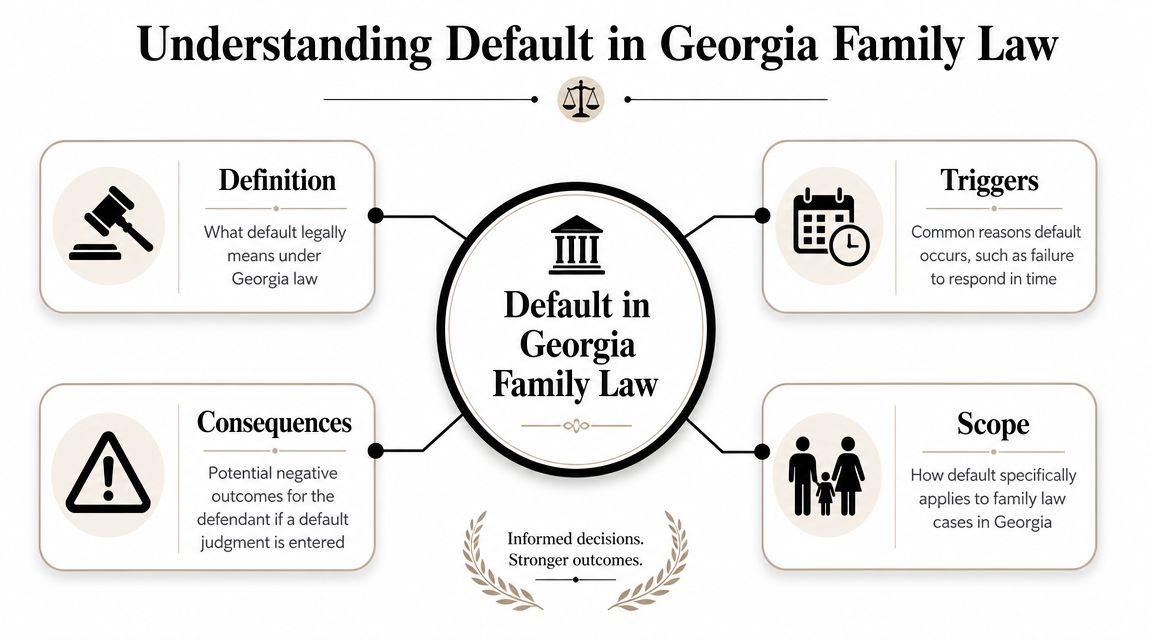
Georgia family law default has two separate stages, and keeping them straight prevents expensive mistakes.
The first stage is automatic default after the answer deadline passes. The second stage is a default judgment, which requires the court to review the requested relief and the supporting paperwork. Federal Rule 55 materials explain the same distinction in plain terms. Entry of default and default judgment are different acts, and the proof required for judgment can change based on the relief sought, military-service questions, and the documents filed with the court under Rule 55 procedure guidance.
That distinction matters even more in divorce cases than in ordinary civil litigation. In a contract case, damages may be the main issue left for the court. In a family law case, the judge still has to decide whether the final terms are legally proper, workable, and fair to the children if children are involved.
How Georgia default fits into a divorce case
In Georgia, a defendant who does not answer within the required time can fall into default, but that does not hand the filing spouse an automatic final decree. In Alpharetta divorces, I treat default as a procedural opening, not a finish line.
What the court usually still examines is the substance of the proposed outcome:
- Grounds for divorce: The court still needs a record supporting the divorce.
- Property division: Silence from the other spouse does not require the judge to approve every property request.
- Custody and parenting time: The child's best interests still control.
- Child support and alimony: The numbers and terms still need legal support.
- Parenting plans and required forms: If children are involved, Fulton County judges expect the paperwork to be complete and usable.
A default puts the filing party in a stronger position. It does not remove the need for proof.
Why this matters in Alpharetta
In Alpharetta, Roswell, Milton, and nearby North Fulton communities, default often shows up in cases where one spouse is avoiding the process rather than formally participating. Sometimes that is a delay tactic. Sometimes it reflects disorganization, denial, or a belief that ignoring the case will stop it. Usually, it does neither.
The practical risk is on both sides. The nonresponsive spouse can lose the chance to raise defenses on time. The filing spouse can also lose momentum if the pleadings are vague, the requested relief is overreaching, or the final hearing packet is incomplete. That is why careful lawyers in Forsyth and Fulton County do not treat default as a free result. They treat it as a narrow procedural advantage that still has to be converted into a judge-ready final case.
The Step-by-Step Guide to the Default Process in Cumming
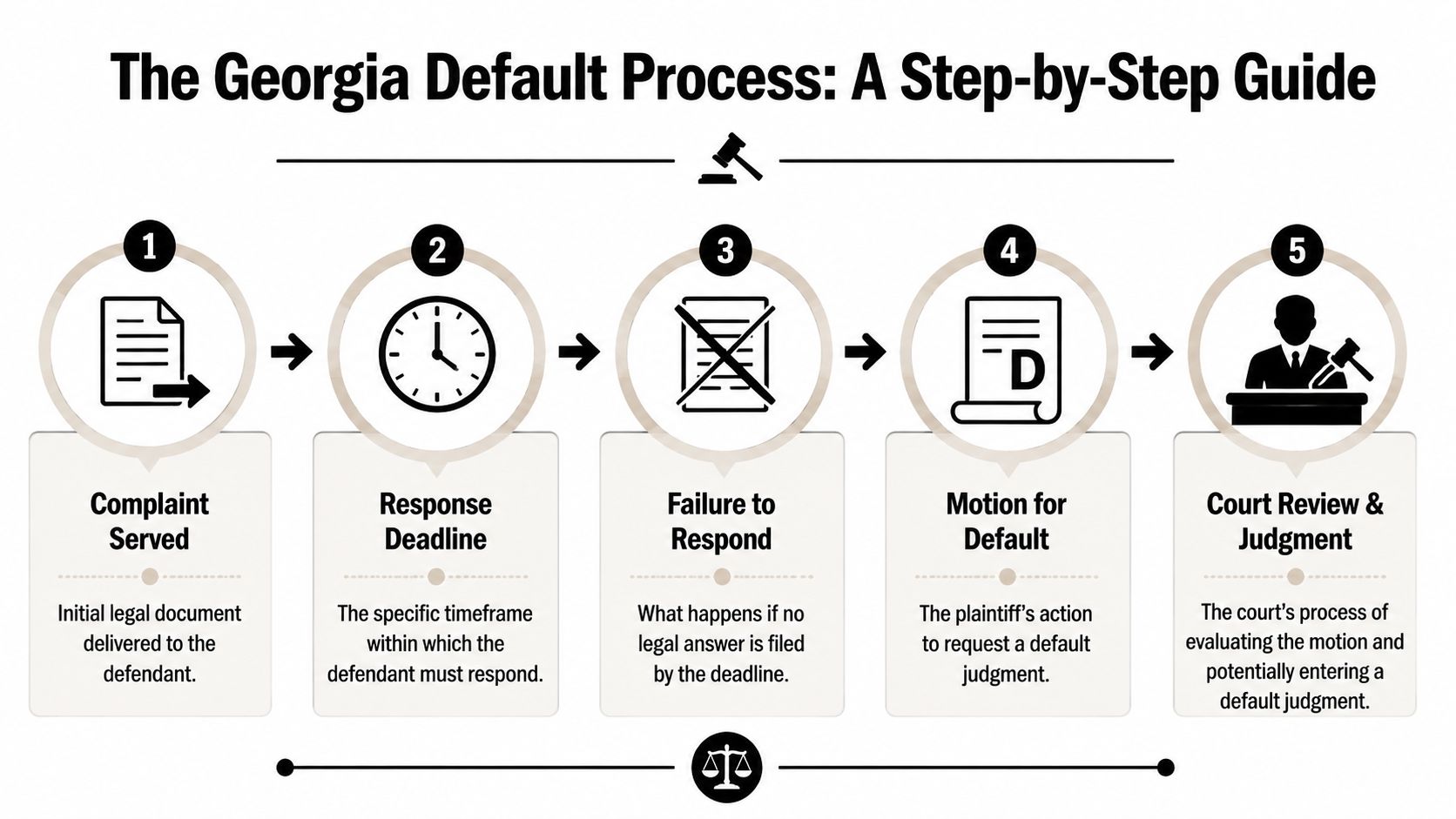
You filed for divorce in Cumming. Your spouse was served. Weeks pass, and nothing comes in from the other side. At that point, the question is not whether the court can punish silence. The question is whether your case is procedurally ready for the two separate steps Georgia law treats differently: automatic default first, default judgment later.
Step one through step three
Start with the date of service and the court file.
Confirm service was completed correctly
Review the return of service, not your recollection of when your spouse said they got the papers. In Forsyth County, a default request built on defective service usually stops before it starts.Identify when the case went into automatic default
In Georgia, a defendant who does not answer within 30 days after service goes into default automatically. That first stage matters, but it does not end the case. It only changes the procedural posture.Count the 15-day period to open default
After automatic default begins, the other spouse usually still has 15 more days to open the default by filing an answer and paying costs. In practice, frustrated filing spouses often move too soon during this period. In Cumming cases, that timing mistake can cost weeks.
The practical rule is simple. Do not ask for final default relief until both windows have run and the clerk's file confirms no timely answer changed the posture of the case.
What the two-stage process looks like in real life
Georgia default procedure causes confusion because people use "default" to mean two different things. The first is automatic default after the initial answer deadline passes. The second is a court order granting relief after the time to open default has also expired and the judge has a proper record to act on.
That distinction matters in family court.
A spouse can be in default and the divorce still may not be ready for a final hearing. Forsyth County judges still expect a clean packet, usable proposed orders, and any child-related forms that apply. If the case involves children, support, property, or alimony, the court needs enough evidence to enter workable terms. Good preparation on the front end helps avoid that bottleneck. It also helps to review the documents to prepare when getting a divorce before asking the court for final relief.
Timing issues that matter in Cumming
The default timeline does not always line up neatly with the rest of a divorce case. Georgia also imposes a waiting period before a divorce can be finalized, and local court calendars add another layer. In one case, the deadlines overlap cleanly and the path is efficient. In another, your spouse is already in default but the hearing date, parenting paperwork, financial disclosures, or proposed final judgment are still not ready.
That is why disciplined lawyers calendar three things separately:
- the date of service
- the answer deadline
- the last day to open default
Then they build the final packet before asking the judge to act.
What usually helps and what usually causes delay
The cases that move best usually have the same features:
| Step | Why it helps |
|---|---|
| Check the service return early | It prevents a late surprise over defective service |
| Review the docket before filing | It catches a late answer, counterclaim, or other filing that changes strategy |
| Prepare final documents before requesting judgment | It shortens the gap between procedural default and final relief |
| Match the request to provable facts | It gives the judge a record the court can sign |
The delays are also predictable:
| Problem | Likely result |
|---|---|
| Filing before the open-default period expires | The motion is premature |
| Assuming silence guarantees every request will be granted | The judge may narrow or reject unsupported terms |
| Arriving at the hearing with missing orders or child-related forms | The case may be continued |
| Ignoring temporary issues while waiting on default | Bills, parenting conflict, or possession disputes continue without a workable order |
In Forsyth and Fulton family cases, default is a procedural advantage, not a shortcut. Used carefully, it can move a stalled divorce toward resolution. Used carelessly, it creates another round of delay.
Required Documents for a Motion for Default in Forsyth County
A default packet in Forsyth County usually rises or falls on paperwork, not courtroom argument. By the time a judge looks at your file, the key question is often simple: can the court safely enter relief on the documents provided?
In Cumming divorce cases, I treat the default packet as a final-hearing packet with extra procedural pieces added. That approach takes more work on the front end, but it avoids the common Forsyth County problem of reaching the hearing date and learning the court still lacks something needed to sign a decree.
The documents the court usually expects
The contents vary by judge, by whether minor children are involved, and by the relief requested. In most Forsyth County family cases, the file should include:
The motion for default or written request for default relief
This tells the court why the case is in default posture and what action you want the judge to take.Proof of service
The return of service matters because default starts with valid service. If service is defective, the rest of the packet does not fix that problem.A sworn affidavit or verified testimony support
The court still needs facts. In an uncontested or default setting, that often means a sworn statement covering jurisdiction, the date of separation, the basis for divorce, and the specific relief requested.Military service affidavit
Before entering default relief, the court typically wants confirmation that the non-responding spouse is not protected by the Servicemembers Civil Relief Act.Proposed final judgment and decree of divorce
A judge in Forsyth County will usually expect a clean proposed order that matches the pleadings and the evidence. If property, debt, support, or name restoration is requested, the proposed decree should address each item clearly.
Documents that are often missing
Missing child-related and financial forms cause many of the delays I see.
If the case involves children, the packet may also need a parenting plan, child support worksheet, child support addendum, and any other county or judge-specific domestic relations forms. If the case involves property division, retirement accounts, or real estate, the proposed final order should be detailed enough for enforcement. Vague language creates trouble later, even if the other spouse never answered.
Forsyth judges also expect the requested relief to match the pleadings. If the complaint asks for one result and the proposed decree grants something broader, the court may refuse to sign until that mismatch is corrected.
A useful reference for building the broader divorce file is this guide on what documents to prepare when getting a divorce.
The practical trade-off is straightforward. Filing fast with an incomplete packet may feel satisfying after weeks of silence from your spouse, but it often leads to a continuance, a rejected proposed order, or another round of corrections. Filing a tighter packet usually gives the court what it needs the first time. In Forsyth County, that is often the difference between procedural default and an actual signed final decree.
From Default to Final Judgment in Fulton County Courts
In Fulton County, default is only the doorway. The key question is whether the court will enter a final decree that matches what you've requested. That is where many people in Alpharetta, Roswell, Sandy Springs, and the broader North Fulton area underestimate the process.
What the judge still examines
A spouse's failure to respond can limit that spouse's ability to contest the case, but it doesn't remove the judge's job. In a default divorce, the court still has to decide whether the requested relief fits Georgia law.
That review is especially important in these areas:
Equitable division of property
Georgia follows equitable division, not automatic equal division. If the requested decree is lopsided, unclear, or unsupported, the judge may ask questions before signing it.Alimony
A defaulting spouse's silence does not guarantee the amount or duration one party requested. The court still looks for a lawful basis in the record.Child custody and parenting time
The controlling standard remains the child's best interests. In Fulton County custody hearings, judges pay close attention to whether the parenting plan is realistic, complete, and child-focused.Child support
Support provisions usually require proper documentation. The court wants figures, worksheets, and an order that can be enforced.
Default does not erase family-court scrutiny
Georgia no-fault divorce law makes dissolution available where the marriage is irretrievably broken, but children change the analysis. If a proposed decree in a default case doesn't adequately address school schedules, holiday parenting time, transportation, decision-making, or support structure, the court may require revisions.
That same caution applies in high-asset divorce matters in Alpharetta and North Fulton. If the requested final decree deals with retirement accounts, business interests, real estate, debt allocation, or alimony in a vague way, the default posture won't save it. The cleaner the order, the more likely the court can act without unnecessary delay.
What to expect in Fulton County and North Fulton courts
Court culture matters. Some judges want a tightly organized final packet. Others focus on whether the requested relief is internally consistent and properly supported. In either setting, these points matter:
| Issue | Court concern |
|---|---|
| Parenting plan | Is it complete and workable for the children |
| Property division | Is the requested division specific enough to enforce |
| Alimony | Is there a clear legal basis in the record |
| Child support | Are the required support materials included |
| Notice and service | Was the spouse properly served throughout the process |
A final hearing in a default divorce is often quieter than a contested hearing, but it isn't casual. The judge is still protecting the integrity of the decree.
Fulton County cases also intersect with mediation and temporary hearing practice. In some divorces, temporary orders already govern custody, support, or use of property before default becomes an issue. In others, mediation may still be expected unless the court excuses it or the case posture makes it unnecessary. Default changes the advantage, but it doesn't make local procedure disappear.
For parties in Alpharetta looking for a "divorce lawyer near me," the practical takeaway is this: a default helps most when the final judgment package has already been built with Fulton County review in mind.
Facing a Default Motion How to Protect Your Rights in North Georgia
You open the mail, see that your spouse is asking the court to move ahead without you, and panic sets in. In Georgia divorce cases, that moment does not always mean the case is lost. It does mean the clock is now working against you, especially in Forsyth and Fulton County family courts where judges expect fast, organized corrective action.
The first thing to understand is the same point that confuses many people in Cumming and Alpharetta. A spouse can be in default before the court enters a final default judgment. Those are two different stages. If your spouse has already asked for default relief, the practical question is whether the case is still in the automatic default stage or whether the court is about to sign final orders on custody, support, property, or the divorce itself. That difference controls your options.
What Georgia courts usually require to open default
After the answer deadline passes and the short grace period closes, opening default usually requires more than an apology. The court generally expects a legally sufficient motion, payment of court costs, an offer to file defensive pleadings right away, and a real showing that there is a defense worth hearing. Georgia courts also look at whether there was providential cause, excusable neglect, or another proper basis to let the case proceed on the merits.
In family law, a "meritorious defense" often means something concrete. A dispute over parenting time. Incorrect income information. Separate property that was treated as marital. A request for alimony that needs evidence. "I do not want the divorce" is usually not enough by itself.
Forsyth County judges tend to respond well to a clean, prompt filing that gives the court a clear path to put the case back on track. Fulton County judges often focus closely on whether the paperwork is complete and whether the requested relief is tied to specific facts. In both places, delay makes the motion harder to win.
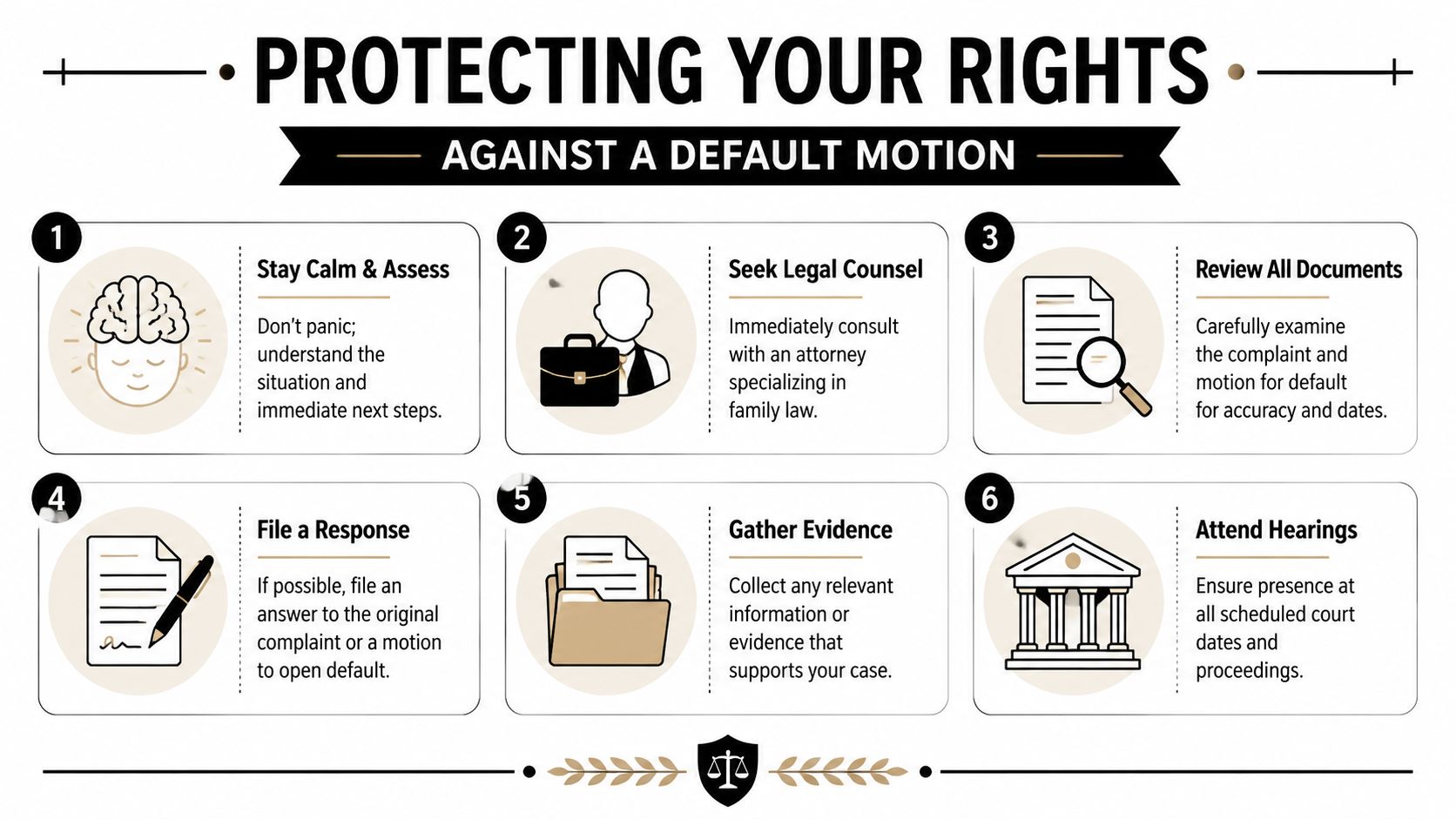
What to do right away
Start with triage. Confirm whether an answer was ever filed, check the service date, and pull the most recent filings from the docket. Many spouses assume they missed everything, when the actual issue is narrower: they missed the answer, but final judgment has not been entered yet.
Then file with purpose:
- Prepare a verified motion or sworn affidavit with specific facts. Judges want dates, circumstances, and a clear explanation for the missed deadline.
- File your answer or other defensive pleading at the same time if possible. That shows the court you are ready to participate now.
- Pay any required costs promptly. Leaving costs unresolved can sink an otherwise decent motion.
- Identify the family law issues that truly need a hearing. Custody, parenting time, child support, alimony, and property division all carry more weight than a general objection.
- Ask for a hearing quickly if local practice calls for one. In some North Georgia courtrooms, a well-timed request matters as much as the motion itself.
Procedure matters here. Filing the wrong motion first can create new problems or waive arguments you should have preserved. For a broader look at careful procedural motion practice, see this guide on how to file a motion to dismiss.
Mistakes that hurt your position
Three patterns show up often in default divorce cases across North Georgia.
- Using broad denials without evidence. Judges need facts they can rely on.
- Explaining the delay but never filing a real response. The court is deciding whether to reopen the case, not just whether your reason sounds sympathetic.
- Waiting until after final orders are entered. Once a divorce decree is signed, the fight usually becomes more expensive, more disruptive, and harder to fix.
I tell clients this often. A default problem is usually won or lost in the quality of the response filed in the next few days. Calm, accurate, technically sound filings get much better results than emotional objections sent after the court has already moved on.
Frequently Asked Questions About Georgia Default Motions
Q: How long before my spouse is in default in a Cumming, GA divorce?
A: In Georgia, a defendant who does not answer within 30 days of service is in default, and there is then a 15-day period to open that default by filing defenses and paying costs, based on Georgia default practice summarized in earlier sections. In Forsyth County Superior Court, the exact service date matters, so the timeline should be calculated from the filed return of service.
Q: Can I get divorced by default in Alpharetta if my spouse never shows up?
A: Often yes, but not automatically. In Fulton County Superior Court, the court still reviews the proposed Final Judgment and Decree of Divorce for compliance with Georgia law. If your case involves custody, child support, alimony, or property division, the judge may require complete supporting documents before signing anything.
Q: Does default mean I automatically get full custody in Forsyth County?
A: No. Georgia child custody decisions still turn on the child's best interests. Even in a default case at Forsyth County Superior Court, the judge will review the parenting plan and the requested custody terms carefully. A missing spouse weakens their position, but it does not remove the court's duty to protect the children.
Q: Do I still need a parenting plan if my spouse is in default in Cumming?
A: Yes. If minor children are involved, Georgia courts generally require a parenting plan. In a Cumming divorce, default does not eliminate that requirement. The court will want a practical plan covering parenting time and decision-making before entering a final custody-related decree.
Q: Will a Fulton County judge divide property exactly as I requested if my spouse defaulted?
A: Not necessarily. Georgia uses equitable division, and Fulton County judges still review whether the requested division is lawful, clear, and enforceable. If the proposal is vague, one-sided on its face, or poorly documented, the judge may require revisions rather than enter the order as drafted.
Q: Can my spouse still fight the case after default in Alpharetta?
A: Sometimes. Before final judgment, a spouse may try to open default if they satisfy Georgia's procedural requirements. In Alpharetta and North Fulton courts, that usually means prompt action, payment of costs, a sworn showing, and a real defense. Waiting usually makes the problem worse.
Q: Do temporary hearings and mediation still matter if default is on the table?
A: Yes. In Georgia family law, temporary hearings often shape custody, possession of property, and support while the divorce is pending. Mediation may also remain part of the case depending on the court's procedures. In both Forsyth County and Fulton County, default changes the advantage, but it doesn't erase local family-court practice.
Q: I'm searching for a family law attorney near me in Cumming or Alpharetta. When should I call?
A: Call as soon as your spouse misses the response deadline or as soon as you learn a default motion has been filed against you. In Cumming, Alpharetta, Johns Creek, Milton, Roswell, or Sandy Springs, early legal advice usually prevents the procedural mistakes that create longer delays and more expensive cleanup.
If you're dealing with an unresponsive spouse, a pending motion for default, or a divorce case that's stalled in Forsyth County or Fulton County, Miles Hansford Law Firm can help you move with clarity. Speak with a family law attorney who understands Cumming, Alpharetta, and North Georgia court practice, and schedule a consultation to protect your rights, your parenting position, and your financial future.