


Meta Title: Motion to Withdraw in Cumming, GA Family Court
Meta Description: Motion to withdraw in Cumming, GA family court. Learn what to expect in Forsyth and Fulton County, protect your rights, and schedule a consultation.
Suggested URL Slug: /motion-to-withdraw-cumming-ga-family-court
Schema Recommendations: Attorney, LegalService, FAQPage
Internal Link Suggestions:
- Divorce filing process in Georgia
- Divorce lawyer in Alpharetta
- How to choose a divorce lawyer
- Child custody in Georgia
- Temporary hearings in Forsyth County
- Parenting plans in Georgia
If your lawyer has filed a motion to withdraw, or if you're considering ending the relationship with your lawyer in the middle of a divorce or custody case, you're probably feeling blindsided. In Cumming, GA, that kind of news can land right in the middle of a temporary hearing, a parenting plan dispute, or a fight over support and property. It feels personal, and it feels dangerous.
It also doesn't mean your case is ruined.
A motion to withdraw is a court request asking the judge for permission to let an attorney step out of an active case. In Georgia family law, that matters because your lawyer usually can't just disappear from a pending matter in Forsyth County Superior Court or Fulton County Superior Court. The court has to be involved. The judge wants to know whether the case can keep moving without unfair harm to you, your children, or the other side.
For clients in Cumming, Alpharetta, Johns Creek, Milton, Suwanee, Dawsonville, Roswell, Sandy Springs, and Canton, the most important first step is simple. Get clear about your deadlines, your next court date, and whether you need to object or replace counsel quickly. When representation is changing and you need a divorce lawyer near me, quick, informed action usually matters more than the reason the relationship broke down.
Understanding a Motion to Withdraw in Your Georgia Family Law Case
A motion to withdraw usually shows up at the worst possible time. Many people receive it while they're already trying to manage a Georgia no-fault divorce, child custody concerns, or a temporary order that affects where the children stay and who pays what. In family court, that timing matters.

In plain terms, a motion to withdraw asks the judge to let the attorney stop acting as counsel of record. Until the judge signs an order, the lawyer is usually still in the case. That's why clients in Cumming and Alpharetta shouldn't assume the representation has already ended just because a motion was filed.
What the motion does and does not mean
A withdrawal motion does not automatically decide your divorce, your custody claim, or your right to seek equitable division under Georgia law. It also doesn't cancel hearings, suspend deadlines, or excuse inaction. Georgia family court keeps moving unless the court orders otherwise.
What it does mean is that the case has reached a transition point. In a family law matter, that can affect:
- Temporary hearings: These often shape the practical status quo while the case is pending.
- Parenting plans: Georgia courts require parenting plans in custody cases, and missing a filing deadline can create avoidable problems.
- Negotiating position: Opposing counsel may press harder if they think you're unrepresented or disorganized.
Practical rule: Treat a motion to withdraw like a warning light, not a final outcome. Check the hearing date, read the certificate of service, and find out whether the court expects you to appear.
Why calm, quick action matters in North Georgia
Family law cases in Forsyth County and Fulton County are emotional, but the court process is procedural. Judges expect parties to keep up with filings, attend hearings, and respond on time even when attorney relationships change. If you're in Cumming, Alpharetta, or nearby communities, the safest move is to get your file, confirm the next setting, and speak with a family law attorney before the gap in representation turns into a bigger problem.
Why This Motion Is a Critical Moment in Your Cumming Divorce
In a North Georgia divorce, a withdrawal motion isn't just paperwork. It can change the rhythm of the case overnight. That's especially true in Cumming, GA, where a divorce may already involve a temporary hearing, mediation pressure, parenting plan negotiations, or arguments over equitable division of the marital estate.
Timing can affect leverage
A case is most vulnerable when one side is organized and the other side is reacting. If your lawyer seeks to withdraw shortly before a hearing in Forsyth County Superior Court, you may have to make decisions about custody, support, possession of the marital home, or document production with very little margin for error. In a contested divorce, that can matter for months.
Georgia's family courts don't pause solely because the attorney-client relationship broke down. Your case may still involve:
- Temporary custody issues tied to Georgia's child custody standards and the best interests of the child
- Support disputes involving child support or alimony
- Property questions governed by Georgia equitable division laws
- Mediation requirements that force the parties to keep negotiating even when trust is low
Judges focus on disruption, not just attorney preference
Courts care about whether withdrawal will unfairly disrupt the case. If a lawyer's exit would leave a parent unprepared for a custody hearing, delay a trial, or create prejudice in a high-conflict matter, that can affect how the judge handles the request. This is one reason clients shouldn't treat the filing as a private dispute between lawyer and client. Once the motion reaches the court, it becomes part of case management.
A practical concern in Cumming divorces is that temporary orders often shape the day-to-day reality while the case is pending. They can influence parenting time, financial stability, and negotiation posture. If representation changes right before those issues are heard, the consequences can stretch far beyond that one hearing date.
The real question is rarely just whether the lawyer wants out. The real question is whether the court believes the case can stay fair and orderly if the lawyer leaves now.
Why this matters in Forsyth County family cases
Forsyth County divorce filings often involve fast-moving practical issues. Parents need school schedules addressed. One spouse may need exclusive use of the house. A business owner may need records organized quickly. If a motion to withdraw lands in the middle of those problems, the risk isn't abstract. The risk is that you lose control of the narrative at a moment when the judge is forming impressions about credibility, cooperation, and preparedness.
That is why clients in Cumming, Dawsonville, Suwanee, and nearby North Georgia communities should act early instead of hoping the problem resolves itself.
Legal and Ethical Grounds for Attorney Withdrawal in Georgia
Some clients assume a lawyer who wants to withdraw is quitting. That's not how the ethics rules treat it. In practice, there are situations where a lawyer must seek withdrawal and other situations where a lawyer may ask for it. The difference matters.
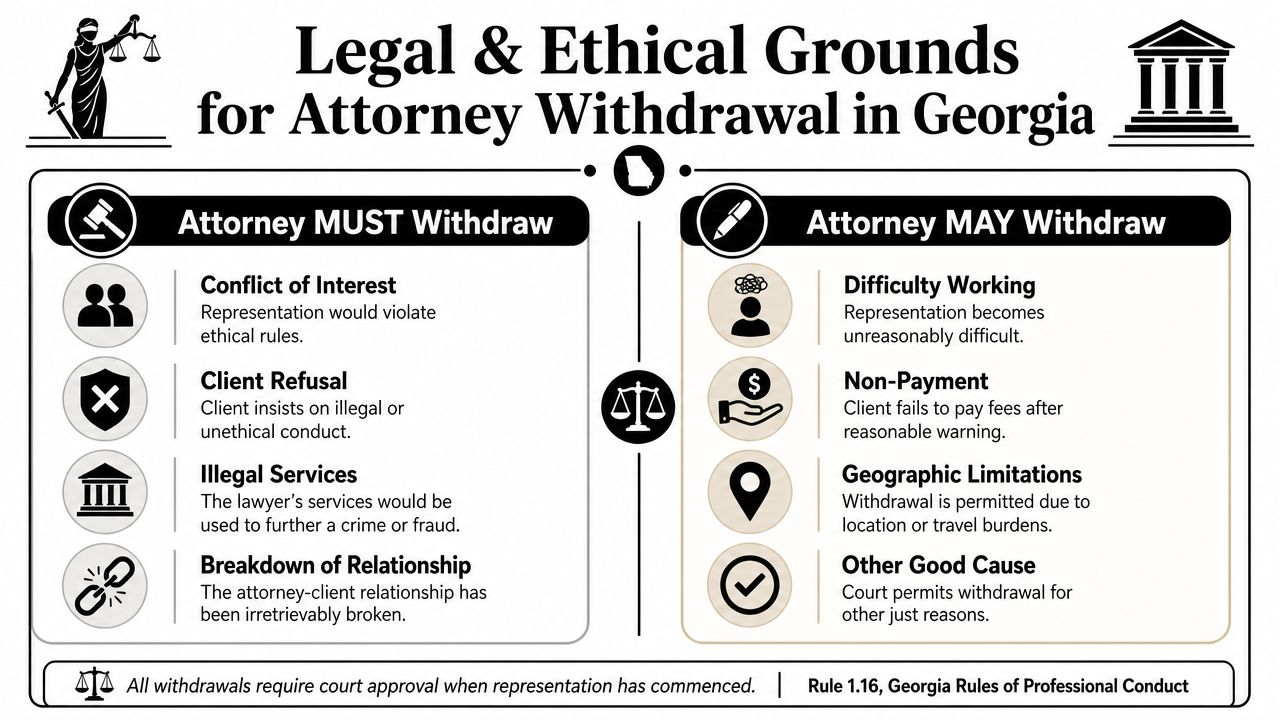
Mandatory withdrawal and permissive withdrawal
Similar to driving rules, some situations are a red light. The lawyer cannot ethically continue. Other situations are more like a legal turn lane. Withdrawal may be allowed, but the court still has to decide whether the timing and circumstances justify it.
A lawyer may face mandatory withdrawal when continued representation would violate ethical duties. A lawyer may seek permissive withdrawal when the relationship has broken down so badly that effective representation is no longer realistic, or when the client has not met important obligations such as payment or cooperation.
Common examples often include:
- Ethical conflict: The representation would put the lawyer in violation of professional duties.
- Client conduct problem: The client insists on a course of action the lawyer cannot ethically support.
- Communication collapse: The relationship has become so strained that the lawyer cannot properly prepare the case.
- Nonpayment after warning: The client hasn't paid and the issue is serious enough that continued work is no longer practical.
Why motions are often vague
Clients are often frustrated that the motion doesn't spell out every detail. There is a reason for that. The strongest modern guidance on withdrawal emphasizes confidentiality. ABA Formal Opinion 519, discussed here, says a lawyer may cite only “professional considerations” unless an exception applies, and it states that the lawyer's “paramount duty is to preserve client confidentiality, even at the risk that the tribunal may deny the motion to withdraw.”
That means a sparse motion is not necessarily suspicious. It may be ethically appropriate.
What a lawyer can and cannot say
If the court wants more detail, the lawyer still has to protect the client's privacy. The same guidance allows disclosure only in limited circumstances, such as client consent, an applicable confidentiality exception, or another rule authorizing a narrow disclosure. Even then, any disclosure should be no broader than reasonably necessary and, where possible, should be handled privately.
A careful withdrawal motion often protects the client more than a detailed one does.
For family law clients in Alpharetta, Cumming, Roswell, and Milton, this point matters because people often read a vague motion and assume the lawyer is hiding something. Sometimes the opposite is true. Ethical rules may require the lawyer to avoid airing private family facts in a public filing.
The Withdrawal Process in Forsyth County and Fulton County Courts
What happens next is usually less dramatic than clients fear, but it is very specific. In Forsyth County Superior Court and Fulton County Superior Court, a withdrawal request is a formal court event. It isn't self-executing, and it isn't something either side should treat casually.
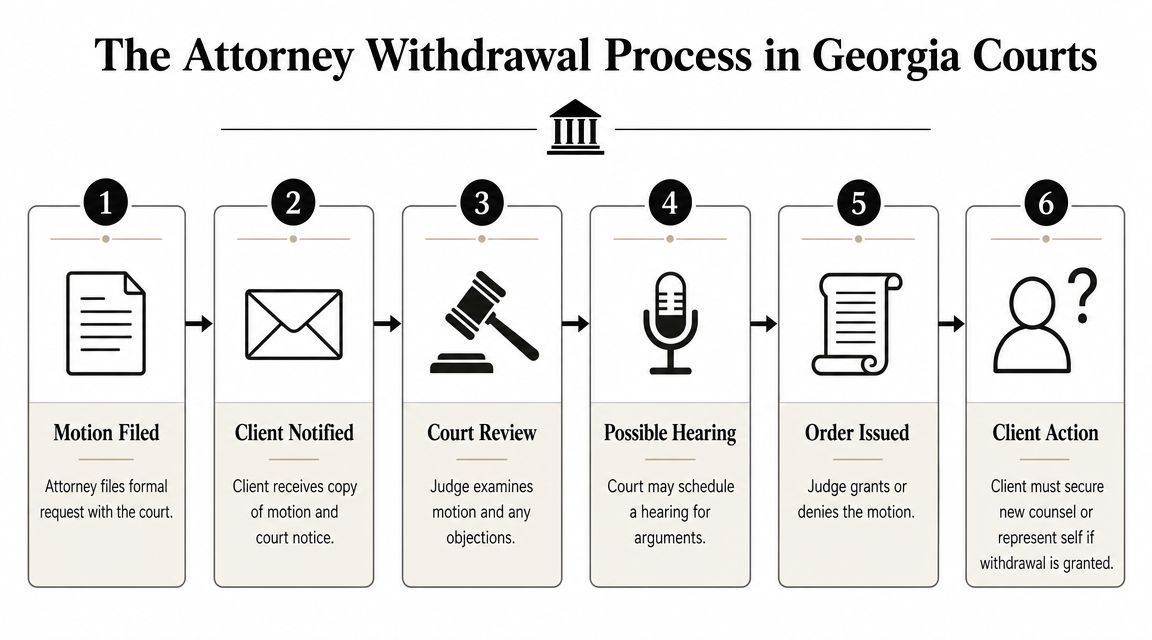
The usual sequence in local family court
The process often looks like this:
- The lawyer files the motion. The filing asks the court for permission to withdraw from the pending divorce, custody, support, contempt, or modification case.
- The client receives notice. This is a major procedural protection. Courts generally want proof that the client knows withdrawal is being requested.
- The court reviews the status of the case. Timing matters. A judge may look closely at upcoming hearings, mediation, trial settings, and whether the client will be left effectively stranded.
- A hearing may be set. Sometimes the papers are enough. Sometimes the judge wants argument.
- The judge enters an order. Until then, the attorney generally remains counsel of record.
Guidance on withdrawal procedure and notice requirements shows why these filings are so notice-heavy. In many jurisdictions, the motion must certify the client received advance notice, such as 14 days' notice, and must provide the client's last known address so the court can continue sending notices.
What judges look for in Forsyth County and Fulton County
In real family law practice, judges usually care about three things.
| Court concern | Why it matters in a family case |
|---|---|
| Notice | The court wants confidence that the client knows what is happening and won't miss a hearing by surprise. |
| Prejudice | If withdrawal would unfairly damage the client's ability to present a custody or support position, the judge may hesitate. |
| Case management | Courts in Forsyth and Fulton need cases to move in an orderly way, especially where mediation, temporary hearings, and trial calendars are involved. |
A useful way to think about it is this. The court is balancing the lawyer's reasons for leaving against the practical effect on the case. In a simple uncontested matter, withdrawal may be easier to manage. In a contested divorce involving children, business interests, or emergency disputes, the judge may be more cautious.
What clients should do while the motion is pending
Don't wait for the signed order before preparing. While the request is pending:
- Confirm the next court date: Temporary hearings and status conferences don't disappear on their own.
- Ask for your file: That includes pleadings, discovery, proposed parenting plans, and prior orders.
- Review the procedural posture: If you're unsure where the case stands, a practical starting point is this guide on how to file for divorce in Georgia, which helps frame where your case may sit in the larger divorce process.
If you're between lawyers, the court still expects someone to protect the deadlines. If that someone is temporarily you, act accordingly.
Client Strategy When Facing a Motion to Withdraw in Alpharetta
If you're in Alpharetta, Johns Creek, Milton, Roswell, or Sandy Springs and you've just been served with a motion to withdraw, the right response is strategic, not emotional. You don't need to solve every problem in one day. You do need to secure the file, understand the deadlines, and decide quickly whether to object or transition counsel.
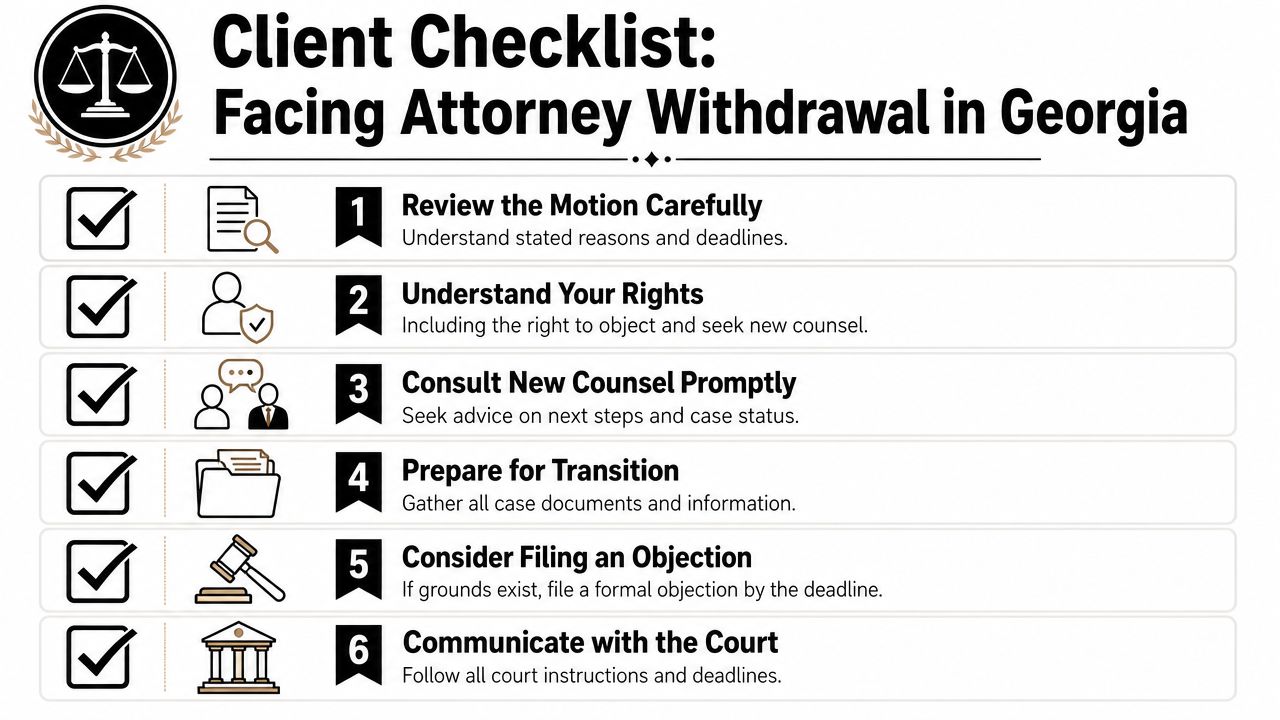
When an objection makes sense
Not every objection is useful. If the relationship is beyond repair, forcing counsel to stay may not help. But there are moments when an objection is worth discussing, especially if withdrawal would cause immediate harm. This court guidance on withdrawal orders and disruption concerns reflects a principle family court judges often care about. The court's focus is often what happens after withdrawal, including missed hearings, pro se status, and whether the change would create undue delay or prejudice.
An objection may be worth evaluating when:
- A major hearing is imminent: Especially a temporary hearing affecting custody, support, or use of property.
- You haven't received the full file: You can't responsibly transition if key documents are missing.
- The motion leaves you unable to participate meaningfully: This can happen in complex cases involving business records, valuations, or serious parenting disputes.
What to gather right away
This is the part clients often underestimate. The transition gets smoother when you gather the case materials immediately, not a week later.
Start with:
- All pleadings and orders
- Financial affidavits and disclosures
- Discovery requests and responses
- Any proposed settlement terms
- Current parenting plan drafts
- Notices of mediation, hearings, and deadlines
When an unstable case necessitates a divorce lawyer near me, don't just ask who is available. Ask who can step into an active Georgia family law matter in North Fulton or Forsyth County and assess the immediate risk. For people in Alpharetta, one practical next step is reviewing options with an Alpharetta divorce lawyer who handles local family court procedure.
The biggest mistake clients make
They assume a short period without counsel won't matter.
In family law, a brief gap can matter a lot. A temporary order can affect parenting time. A mediation position can shape settlement momentum. A missed response can damage bargaining power. In Georgia, where no-fault divorce, equitable division, child custody standards, and required parenting plans all intersect, a quiet week can turn into a costly month.
Why Choose Miles Hansford to Protect Your Interests
A withdrawal motion creates uncertainty. The practical need is stability.
For clients in Cumming, Alpharetta, Forsyth County, and Fulton County, Miles Hansford Law Firm handles family law matters involving divorce, custody, child support, alimony, modifications, contempt actions, mediation, and high-conflict domestic disputes. In a transition case, the work often starts with getting the file, identifying pending hearings, reviewing temporary orders, and making sure there is no avoidable gap in representation.
That kind of handoff is easier when replacement counsel already understands North Georgia family court practice, including local expectations in Forsyth County Superior Court, Fulton County Superior Court, and North Fulton family matters. If you're weighing your next step carefully, this guide on how to choose a divorce lawyer is a useful place to start.
Frequently Asked Questions About Attorney Withdrawal in Georgia
Q: Can my lawyer just quit my divorce case in Cumming, GA?
A: Not usually if the case is already pending in court. In most family law matters, the attorney must ask the judge for permission through a motion to withdraw. Until the court grants it, the lawyer often remains counsel of record in your Forsyth County case.
Q: Can I object to a motion to withdraw in Forsyth County?
A: Yes, you can usually raise an objection if withdrawal would unfairly harm your position. That often matters when a temporary hearing, custody dispute, or mediation is close. In Forsyth County Superior Court, the judge's main concern is whether the case can move forward fairly and orderly.
Q: What happens if the judge grants the withdrawal and I have no new lawyer?
A: You may be treated as self-represented until replacement counsel appears. That can expose you to missed notices, hearing problems, and strategic disadvantage. In Georgia family court, that risk is serious when parenting plans, child custody issues, or temporary financial orders are active.
Q: Will the motion explain why my lawyer wants to leave?
A: Often not in detail. Lawyers may need to keep the public filing vague to protect confidentiality. In family law cases, private facts involving finances, children, mental health, or litigation strategy often should not be laid out in an open court filing.
Q: Can I fire my lawyer first instead of waiting for the motion?
A: In many situations, yes. Clients generally have the right to change counsel, but the court process still matters if a case is pending. The lawyer may need to file paperwork to complete the transition, and you should line up replacement counsel before creating a gap in representation.
Q: Does a withdrawal change Georgia's divorce timeline?
A: It can affect the practical timeline, even though the legal framework stays the same. Georgia still has a mandatory 30-day minimum waiting period for divorce after filing, but contested cases in Forsyth County or Fulton County often last longer if custody, support, property division, or attorney changes complicate the schedule.
Q: Does this matter more in custody cases than in simple divorces?
A: Usually yes. In custody cases, Georgia courts apply the child's best interests standard and require parenting plans. If counsel withdraws during a dispute over school choice, parenting time, relocation, or temporary custody, the effect can be more immediate than in a narrow uncontested divorce.
If your lawyer has filed a motion to withdraw, or you're considering changing counsel in the middle of a divorce, custody, legitimation, modification, contempt, or alimony matter, don't wait for confusion to grow. Miles Hansford Law Firm serves clients in Cumming, Alpharetta, Forsyth County, Fulton County, Johns Creek, Milton, Roswell, Suwanee, Dawsonville, Sandy Springs, and surrounding North Georgia communities. Schedule a consultation, speak with a family law attorney, and protect your parental rights before the next hearing or deadline arrives. Call today.