


Meta Title: Notice of Deposition in Alpharetta, GA Divorce
Meta Description: Notice of deposition in Alpharetta, GA divorce cases. Learn Georgia rules, Forsyth and Fulton County practice, and how to protect your case.
Suggested URL Slug: /notice-of-deposition-alpharetta-ga
Schema Recommendations: Attorney, LegalService, FAQPage
Internal Link Suggestions:
- Divorce and family law services page
- Child custody page
- Alimony page
- Property division page
- Mediation page
- Blog post on temporary hearings in Georgia
- Blog post on parenting plans in Forsyth County
If you live in Alpharetta, GA or Cumming and just received a notice of deposition in a divorce or custody case, it's normal to feel rattled. The document looks formal because it is formal. It usually arrives at a time when you're already managing stress about parenting time, finances, the family home, or what will happen next in Forsyth County Superior Court or Fulton County Superior Court.
A notice of deposition doesn't mean you've done something wrong. It means the case is moving through discovery, which is the part of a lawsuit where each side gathers information under the rules. In Georgia family law, that can affect contested divorce, child custody, child support, alimony, equitable division, contempt actions, and modification cases. The key is responding carefully and early so one procedural mistake doesn't turn into a strategic problem.
If you're searching for a divorce lawyer near me or a family law attorney in Cumming GA because this notice landed on your kitchen counter, start with this: don't guess, don't ignore it, and don't attend unprepared.
Understanding the Notice of Deposition You Received in Alpharetta
A notice of deposition often arrives at the worst moment. You may have just finished reviewing bank records, trying to make sense of a proposed parenting plan, or preparing for a temporary hearing. Then a new document appears, telling you that you'll be questioned under oath.
That emotional jolt is real. In Alpharetta, Johns Creek, Milton, and surrounding North Fulton communities, clients often describe the same reaction. They read the title, see a date, and immediately worry that they're being dragged into a courtroom confrontation. Usually, that's not what is happening.

A deposition is serious, but it's also predictable. In divorce and custody litigation, lawyers use depositions to gather testimony, evaluate credibility, and test the facts before mediation, a temporary hearing, or trial. In a case involving Forsyth County divorce filings or Fulton County custody hearings, the other side may want to ask about parenting schedules, income, separate versus marital property, business records, or communications that affect the children's best interests.
Practical rule: The notice matters, but your first response matters more. Calm, fast review is better than panic.
Georgia family law already asks a lot of people. Georgia is a no-fault divorce state, there is a mandatory 30-day waiting period before a divorce can be finalized, and courts expect parties to address equitable division, custody, support, and parenting plans with real detail. A deposition becomes one more part of that process. Managed well, it can clarify the case instead of derailing it.
What a Notice of Deposition Means in a Georgia Divorce Case
Think of discovery as the fact-gathering stage of a case. Before a judge in Forsyth County or Fulton County can decide disputed issues, both sides try to learn what the evidence will show. A notice of deposition is the formal document telling a party or witness that oral testimony will be taken under oath.
The notice itself is the paperwork. The deposition is the event. During the deposition, the opposing attorney asks questions, a court reporter records the testimony, and the answers can later be used in negotiations, motion practice, or at trial. In a divorce case, that often means questions about property, debt, parenting, employment, spending, or communications between spouses.
Why lawyers use depositions in family law
In North Georgia divorce and custody cases, a deposition can serve several purposes:
- Test the facts: If one spouse claims an asset is separate property, the lawyer may use the deposition to pin down the timeline and source of funds.
- Evaluate custody issues: In a parenting dispute involving Cumming, Roswell, or Sandy Springs, testimony may focus on routines, school involvement, decision-making, and the proposed parenting plan required by Georgia courts.
- Support settlement talks: A strong deposition sometimes moves a case toward mediation because both sides see the strengths and weaknesses more clearly.
If you're also working through broader separation terms outside formal testimony, reviewing examples of personal separation agreements can help you understand how factual issues and negotiated terms often connect. For a plain-English overview of the proceeding itself, this guide on what a deposition is in a lawsuit is a useful companion.
A deposition isn't an accusation. It's a tool. The danger usually comes from sloppy preparation, not from the existence of the notice.
Key Requirements for a Valid Deposition Notice in Alpharetta
A notice of deposition isn't just a letter from opposing counsel. In Georgia, it has technical requirements, and those details matter. If the notice is defective and nobody raises the issue properly, a valid objection can be lost.
Under Georgia Code § 9-11-30(b), the notice must state the time and place for taking the deposition, the means by which testimony will be recorded, and the name and address of each person to be examined. You can review the statutory language in Georgia Code § 9-11-30.
What to check right away in Alpharetta cases
When a client in Alpharetta or nearby Milton sends over a notice of deposition, these are the first things worth checking:
- Date and location: The notice should clearly identify when and where the deposition is supposed to happen.
- Recording method: It should tell you whether testimony will be taken by stenographic, audio, audiovisual, or another stated method.
- Identity of the deponent: The person being deposed should be identified with enough specificity to avoid confusion.
In family law cases, there may also be a request to bring documents. That can matter a lot in high-asset divorce, self-employment income disputes, business ownership cases, or contempt proceedings where financial records are central.
Why timing objections can't wait
Georgia also places a real burden on the receiving party to act promptly. Georgia Code § 9-11-32(d)(1) states that "all errors and irregularities in the notice for taking a deposition are waived unless written objection is promptly served upon the party giving notice." That means if the notice has a defect and no prompt written objection is served, the issue may be gone.
That waiver rule is one reason people get into trouble by trying to handle a notice informally. A phone call may help with scheduling, but it is not the same as preserving a legal objection in writing.
The practical takeaway in Alpharetta family court practice is simple. If the notice looks off, have counsel review it before you assume it can be fixed later.
For corporate or organizational depositions, federal procedure can become even more demanding. Under FRCP Rule 30(b)(6), an organization must designate one or more people to testify on matters described with reasonable particularity, and those witnesses must be prepared to testify about information known or reasonably available to the organization, as described in this discussion of Rule 30(b)(6) depositions. That issue comes up less often in pure family law, but it can matter when a divorce involves business entities or closely held companies.
How to Respond When You Receive a Notice of Deposition
The worst response is silence. If you ignore a notice of deposition, you give the other side room to argue that you were properly notified and chose not to engage. In a divorce or custody case in Cumming, Alpharetta, or Suwanee, that can create avoidable motion practice and put you on the defensive before a temporary hearing or mediation session.
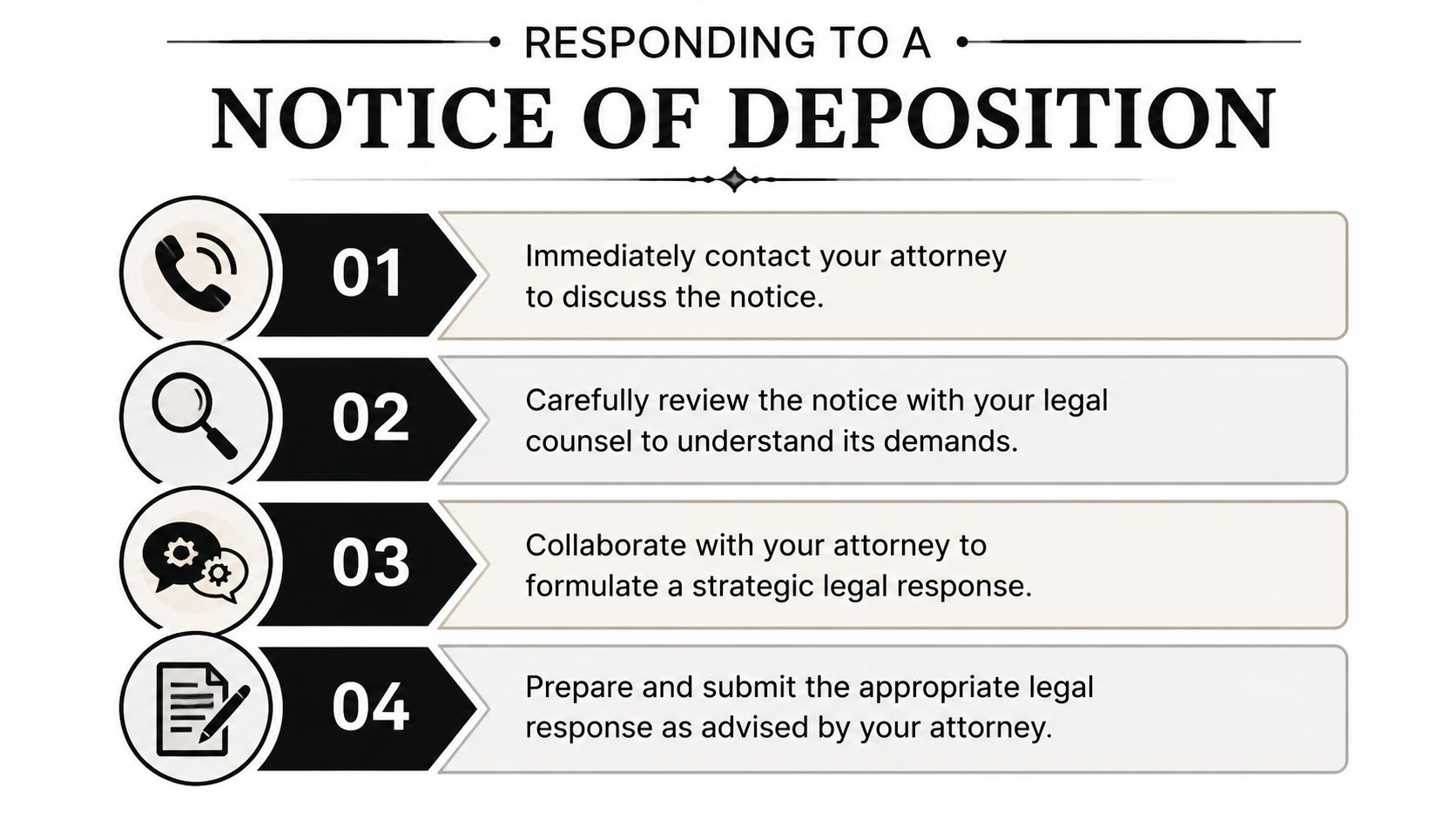
Your first moves matter
Start with a short sequence:
- Send the notice to your lawyer immediately. Don't summarize it from memory. Forward the full document.
- Review the demands carefully. Date, location, recording method, requested documents, and the larger case strategy all matter.
- Decide whether the right response is compliance, objection, negotiation, or court intervention.
If you're already responding to formal written discovery, this resource on how to respond to interrogatories can help you understand how deposition strategy often fits into the broader discovery picture.
Four common response paths
Not every notice should be handled the same way.
- Prepare and attend: If the notice is proper and strategically acceptable, the next step is preparation. That means document review, fact review, and practice on how to answer clearly without volunteering extra information.
- Serve a written objection: If the notice is defective, too vague, or procedurally improper, a written objection may preserve the issue and force correction.
- Work out logistics: Sometimes the right move is practical rather than combative. Lawyers can often agree on a different date, start time, or location if work schedules, travel, or childcare make the noticed setting unreasonable.
- Seek a protective order: When a deposition appears designed to harass, invades privilege, or imposes an undue burden, court involvement may be necessary.
What works and what usually doesn't
A few patterns show up over and over:
| Response | Usually works when | Usually fails when |
|---|---|---|
| Prompt written objection | There is a real defect in the notice | The party waits and complains later |
| Scheduling negotiation | The issue is convenience, not substance | The other side sees delay without reason |
| Protective order request | There is a concrete legal basis | The filing is just an attempt to avoid testimony |
| Unprepared attendance | Rarely | The witness guesses, argues, or overexplains |
The trade-off is straightforward. Aggressive objection practice can protect rights, but weak objections can waste time and annoy the court. Passive cooperation can look reasonable, but over-cooperation without boundaries can expose unnecessary information. Good family law strategy sits in the middle. It protects the client without manufacturing fights.
Some practical guidance on cost planning is still underdeveloped in published material. The discussion at Esquire Solutions about drafting an effective notice of deposition highlights a gap around hidden costs such as re-noticing, rescheduling, and disputes over remote logistics. In real cases, those burdens matter.
Strategic Preparation for Your Deposition in a Cumming Divorce
A spouse in Cumming sits down for a deposition expecting a few routine questions, then gets pressed on bank transfers, parenting exchanges, and statements made in text messages months earlier. By the end of the day, the transcript has given the other side a roadmap for mediation and a preview of trial themes. That is why preparation matters. In a North Georgia divorce, a deposition does not just record testimony. It shapes settlement pressure, custody arguments, and credibility.

Good preparation starts with strategy, not scripts. The goal is to understand what the opposing lawyer is trying to prove, which documents they are likely to use, and where a witness is most likely to get pulled into unnecessary explanations. In Forsyth and Fulton County family cases, those pressure points often involve money, parenting judgment, new relationships, business income, or claims that one parent is less reliable than the other.
A solid prep meeting usually covers the record that already exists. Financial affidavits, account statements, emails, school communications, calendars, social media posts, and prior court filings all matter because any inconsistency can become a negotiation tool later. Clients who want a practical overview of that process can review this guide on how to prepare for deposition.
Strong witnesses also learn pacing. The safest answer is accurate, limited to the question asked, and free of guessing. If a question is unclear, ask for it to be rephrased. If you do not remember, say that. If an objection is made, pause and let your lawyer finish before answering. For clients who want to understand what some of those objections sound like in real life, these practical legal objection examples can help the process feel less unfamiliar.
Preparation in a Cumming divorce should also match the issues that will decide the case. In a custody dispute, I want the client ready for detailed questions about school routines, doctor visits, discipline, extracurriculars, transportation, and communication with the other parent. In a support or property case, I focus more on income sources, expenses, spending patterns, debts, and business records. The right preparation depends on what is contested.
One more point matters. A deposition is often the first time the other side sees how a witness performs under pressure. In high-conflict cases from Cumming to Alpharetta, that can change how hard they push on custody, alimony, or the marital residence. Calm, careful testimony tends to narrow disputes. Loose answers tend to create new ones.
Miles Hansford Law Firm handles deposition preparation in family law and related litigation matters, including document review, witness preparation, deposition representation, and follow-up analysis of the transcript.
What to Expect in Forsyth and Fulton County Court Proceedings
Most depositions in family cases don't happen inside a courtroom. They often take place in a law office conference room in Alpharetta, Cumming, Roswell, or another North Georgia location. Even so, the testimony is under oath, and it should be treated with the same seriousness you would bring to Forsyth County Superior Court or Fulton County Superior Court.
The room is usually more formal than people expect. A court reporter is present. Sometimes the deposition is also video recorded, depending on the notice. The opposing lawyer asks the questions, and your lawyer protects the record by making proper objections and stepping in where the rules allow.
How deposition testimony affects local family court practice
Judges handling Fulton County custody hearings or Forsyth County divorce matters may see deposition testimony in later motion practice, at trial, or during negotiations that narrow disputed issues. That is why consistency matters. If someone says one thing in a deposition and another thing later in a temporary hearing, the conflict can become the story.
Georgia family law also includes local realities that shape strategy. There is a 30-day minimum waiting period before a divorce can be finalized. Courts may require mediation in contested matters. Temporary hearings can set the tone on custody, support, possession of property, and interim financial obligations long before a final trial.
If you want a plain-English look at the kinds of objections lawyers use during testimony, these practical legal objection examples offer a helpful general reference.
A deposition day is usually quiet on the surface. The strategic effect often shows up later, in settlement leverage, hearing preparation, and credibility.
Why Choose Miles Hansford to Handle Your Deposition
A notice of deposition can make people feel exposed. In family law, that feeling is stronger because the questions often reach into parenting, marriage, money, and private communications. The value of counsel isn't just knowing the rule. It's knowing how the rule fits the facts, the judge, the county, and the pressure points of the case.

In Alpharetta, GA, local practice matters. A family law team that regularly works in Forsyth County, Fulton County, and North Georgia understands the rhythm of temporary hearings, mediation expectations, parenting plan disputes, and equitable division fights involving professional income, retirement accounts, real estate, or business ownership. That local context helps shape what should be challenged, what should be negotiated, and what should be prepared for thoroughly.
What clients usually need most
People rarely need theatrics here. They need:
- A fast review of the notice
- A strategy tied to custody, support, or property goals
- Careful deposition preparation
- Protection from waiver mistakes and avoidable testimony problems
That is especially important for parents in Cumming, Alpharetta, Johns Creek, Milton, Suwanee, Dawsonville, Roswell, Sandy Springs, and Canton who are already making decisions about school schedules, exchange logistics, temporary support, and where the children will sleep next month.
The right approach is calm, direct, and strategic. In many cases, the deposition becomes one of the clearest opportunities to present a credible version of events before the case reaches a final hearing.
Frequently Asked Questions About Deposition Notices in Georgia
Q: What is a notice of deposition in a Georgia divorce case?
A: It is the formal document telling you that someone intends to question you or another witness under oath as part of discovery. In a Forsyth County or Fulton County divorce, it can affect custody, alimony, child support, equitable division, and temporary hearing strategy because the testimony may be used later in the case.
Q: Do I have to go if I receive a notice of deposition in Alpharetta, GA?
A: Usually, yes, but the right response depends on whether the notice is valid and whether there are grounds to object or seek court protection. In Alpharetta family court matters, you should have counsel review the notice quickly because defects can be waived if they aren't raised promptly in writing under Georgia procedure.
Q: What has to be included in a valid Georgia deposition notice?
A: Under Georgia law, the notice must state the time and place of the deposition, the means of recording the testimony, and the name and address of the person to be examined. In some cases, it may also request documents. Those details matter in divorce and custody litigation because vague or defective notices can create procedural disputes.
Q: Can I object to a notice of deposition in Forsyth County?
A: Yes. If the notice is defective or improper, a written objection may be appropriate. That needs to happen promptly. In Forsyth County Superior Court family cases, waiting too long can remove an objection that could have been preserved, which is why early legal review is so important.
Q: What happens at the deposition itself?
A: You will be sworn in and asked questions by the other attorney, usually in a conference room rather than a courtroom. A court reporter records your testimony, and your lawyer can object where appropriate. In Fulton County and Forsyth County family cases, that testimony can later affect settlement, mediation, or trial preparation.
Q: Can a deposition affect child custody in Georgia?
A: Yes. In Georgia, child custody decisions turn on the children's best interests, and courts require parenting plans in custody cases. A parent's testimony about routines, communication, decision-making, work schedules, and co-parenting can influence how the other side evaluates the case and how the court views disputed custody issues.
Q: How does a deposition fit into the Georgia divorce timeline?
A: Georgia has a mandatory 30-day waiting period before a divorce can be finalized, but contested cases usually take longer because discovery, temporary hearings, mediation, and court scheduling all affect timing. A deposition often happens during the discovery phase, before final resolution, especially when there are disputes over children or finances.
Q: Should I prepare differently if my case involves business ownership or high assets?
A: Yes. In a high-asset divorce in Alpharetta or Cumming, depositions often focus on income sources, business records, compensation structure, expenses, and asset tracing. Preparation has to be more detailed because small inaccuracies can create larger disputes about valuation, support, or whether property is marital or separate.
If you received a notice of deposition in a divorce or custody case, don't try to sort it out alone. Miles Hansford Law Firm helps clients in Alpharetta, Cumming, Forsyth County, Fulton County, and across North Georgia respond strategically, protect parental rights, and prepare for the next step with clarity. Schedule a consultation to speak with a family law attorney and get a plan in place before the deposition date arrives.