


Meta Title: Parenting Plan Template in Cumming, GA
Meta Description: Parenting plan template guidance for Cumming, GA and Alpharetta families. Learn Georgia custody requirements in Forsyth and Fulton County courts.
Suggested URL Slug: /parenting-plan-template-georgia-cumming-ga
Schema Recommendations:
- Attorney
- LegalService
- FAQPage
Internal Link Suggestions:
- Georgia child custody laws
- Crafting a parenting plan that will work for your family
- What to do to get ready for a child custody case
- Divorce and family law services in Cumming
- Child support modifications in Georgia
- Mediation in Forsyth County and Fulton County
If you're searching for a parenting plan template georgia families can use, you're probably not looking for a generic form. You're trying to keep your child's life steady while your own life feels uncertain.
In Cumming, GA, parents often reach this point during divorce, legitimation, modification, or a custody dispute and realize the court wants far more than a simple agreement about weekends. The good news is that a strong parenting plan can give structure to a hard season. It can reduce confusion, lower conflict, and make daily life more manageable in Forsyth County, Fulton County, Alpharetta, Johns Creek, Milton, Suwanee, Dawsonville, Roswell, Sandy Springs, and Canton.
Georgia family law is local in practice. A parent filing in Forsyth County Superior Court faces a different day-to-day process than a parent handling a case in Fulton County Superior Court or the North Fulton courts, even though the same statutes apply statewide. Georgia is a no-fault divorce state, there is a 30-day minimum waiting period after filing for divorce, and custody issues often take shape early through temporary hearings, mediation, and proposed parenting plans. In many cases, temporary orders influence the final result.
That matters because a parenting plan doesn't sit on the sidelines. It becomes part of how Georgia courts evaluate custody, parenting time, and practical decision-making for your child. If you're handling equitable division, child support, a contested divorce, or even an uncontested divorce, this document can affect far more than pickup times.
If you're searching for a family law attorney near me or trying to understand what Cumming parenting plan requirements look like, start with this: the best plan is detailed, realistic, and written for your real life. Not an imaginary cooperative future.
Why a Detailed Parenting Plan is Crucial in Cumming GA
The fear most parents bring into a custody case is simple. They don't want their child to feel bounced around, confused, or caught in the middle.
In Cumming and throughout Forsyth County, that fear is justified. A vague agreement usually creates more conflict later. A detailed parenting plan does the opposite. It gives your child a clear routine and gives both parents a written structure to follow when emotions run high.

Georgia requires this in every custody case
Under O.C.G.A. § 19-9-1, Georgia requires a parenting plan in every custody case. It isn't optional. According to Modern Family Law's discussion of Georgia parenting plans, over 85% of Georgia custody cases result in joint legal custody, and the same source notes research from the American Psychological Association showing children with predictable co-parenting routines through detailed plans experience 30–45% lower stress levels.
That requirement applies across the kinds of cases parents in Cumming and nearby communities file. Divorce. Custody modifications. Legitimation. Contested matters. Uncontested matters.
The legal point is straightforward. Georgia courts want a child-centered plan that spells out rights, responsibilities, parenting time, and decision-making.
The practical point is even more important. Specificity protects children.
Practical rule: If a schedule can't be followed on a school night in Cumming, a holiday in Johns Creek, or a summer week in Suwanee, it probably isn't ready for court.
Stability is more than a legal concept
Parents often think the parenting plan is just paperwork. It isn't. It's the operating manual for how your child moves between two households.
A good plan answers questions before they become arguments:
- School nights: Which home is responsible on Monday, Tuesday, and Wednesday?
- Weekends: What time does parenting time start and end?
- Holidays: Who has Thanksgiving, Christmas Eve, Christmas Day, spring break, and birthdays?
- Transportation: Who drives, from where, and what happens if one parent is late?
- Decisions: Who handles education, healthcare, extracurriculars, and religion if parents disagree?
Many online templates fail by omitting these essential details. They look easy, but they leave out the details that stop future disputes.
For parents trying to understand their rights before drafting anything, Georgia child custody laws provide a useful starting point.
Families in Cumming need real-world planning
A plan that works in real life accounts for work commutes, school calendars, activity schedules, and the distance between homes. That matters in North Georgia, where one parent may work in Alpharetta, another may live in Dawsonville, and the child may attend school in Forsyth County.
Clear legal information also matters because overwhelmed parents often rely on whatever they can find online. If you're interested in how educational legal content can build trust and help families make better decisions, the role of content marketing in law firms gives helpful context.
The short version is this. The more detailed the plan, the less room there is for conflict. In a divorce or custody case, that can protect both your child and your peace of mind.
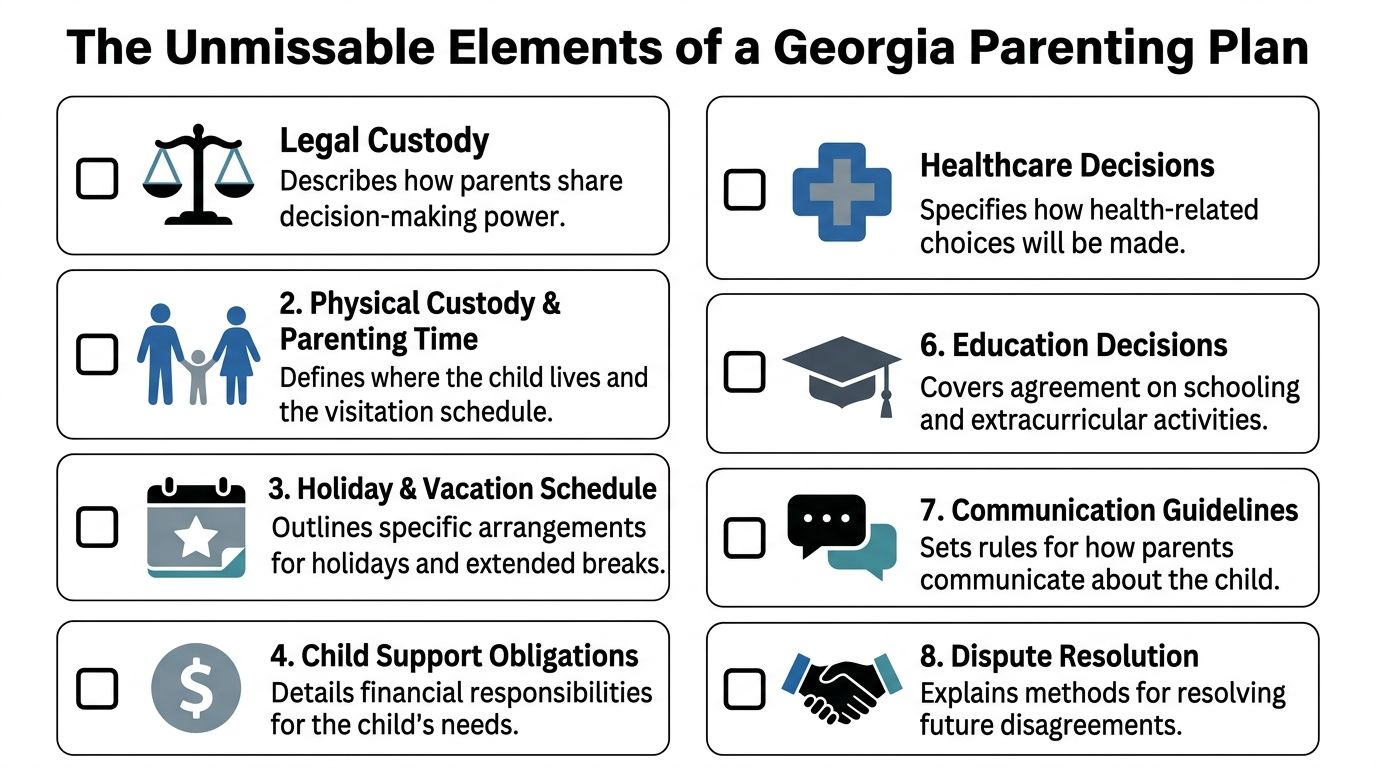
The Unmissable Elements of a Georgia Parenting Plan
A Georgia parenting plan isn't a casual agreement. It's a court document with required parts, and judges in Forsyth County and Fulton County expect those parts to be specific.
If a parent uses broad phrases instead of clear terms, the plan may not survive review. According to All Family Law's review of Georgia parenting plans, Georgia parenting plan templates must include legally required components under O.C.G.A. § 19-9-1, and courts may reject plans that are missing essential elements or order modifications within 10-14 days of filing when the language is too vague.
What the court expects to see
Most plans need to address these core areas in a way the court can enforce:
- Legal custody terms: State whether major decisions are shared or whether one parent has final authority in specific areas.
- Physical custody structure: Identify where the child lives and how regular parenting time works.
- Detailed schedule language: Include school weeks, weekends, summer periods, and transitions.
- Holiday allocations: Spell out who has each major holiday and when the exchange happens.
- Transportation terms: Identify pickup, drop-off, responsibility for driving, and the exchange location.
- Communication rules: Address how parents exchange information about the child.
- Special conditions: Include supervision terms if needed.
- Dispute handling: Give the court a framework for future disagreements.
What often gets missed is that every one of those areas needs enough detail to function without constant back-and-forth.
Words that usually create trouble
Many parents think phrases like "reasonable visitation" or "as agreed by the parties" make a plan flexible. In practice, they often make a plan unenforceable or invite repeated conflict.
A better plan uses concrete language.
The court can't enforce a promise to be reasonable. It can enforce a pickup time, a holiday rotation, and a decision-making rule.
This matters in both uncontested and contested cases. Even cooperative parents need structure because conflict often starts later, after a new relationship, a job change, a move, or a disagreement about school.
The components that deserve extra care in Alpharetta and Cumming
Parents in Alpharetta and Cumming often need more than the minimum because their schedules are rarely simple. One parent may travel. Another may work long healthcare shifts. A child may split time between school, tutoring, sports, and therapy.
Three parts deserve extra attention:
Decision-making authority
Georgia courts expect the plan to state how major decisions get made. If parents share authority, the plan should also address what happens when they don't agree.
Examples include:
- education
- non-emergency healthcare
- extracurricular activities
- religious upbringing
If there is a history of deadlock, a tie-breaker system is often more practical than broad "joint decision-making" language.
Transportation details
Transportation fights are common because they happen often. The plan should identify:
- exchange location
- exact exchange time
- who drives each leg
- what happens if school is not in session
- who is allowed to pick up the child
A clear transportation clause is one of the simplest ways to reduce avoidable conflict.
Holiday definitions
"Christmas break" isn't as precise as many parents think. School calendars differ. Family traditions differ. Travel plans differ.
The better approach is to define the holiday by date, time, and exchange method.
For more practical guidance on building a plan around your family's routine, crafting a parenting plan that will work for your family is a useful reference.
What doesn't work
These plans usually create trouble in court and in real life:
- The generic internet download: It often omits Georgia-specific requirements.
- The handshake agreement: It depends on future cooperation instead of written obligations.
- The revenge draft: It tries to punish the other parent instead of serving the child.
- The perfect-world draft: It assumes work schedules, school demands, and transportation will never change.
A parenting plan should be fair, but it also has to be operational. If a judge reads it and can't tell exactly what happens next Tuesday at 6:00 p.m., it needs more work.
Drafting Your Parenting Plan Section by Section
The hardest part of using a parenting plan template georgia parents find online is knowing what to write in the blank spaces. The form asks for answers. Real life gives you gray areas.
The way to make the document workable is to draft each section as if a third party had to enforce it without either parent standing there to explain what they meant.
Physical custody schedules
The schedule should match the child's age, school routine, and the parents' capacity to handle transitions. A schedule isn't "good" because it's common. It's good if the child can live it without constant disruption.
Here is a practical comparison of common arrangements used in North Georgia.
| Schedule Name | Description | Best For | Potential Challenges |
|---|---|---|---|
| 2-2-3 | The child rotates between homes every few days, with one parent having two days, the other two days, and alternating three-day weekends | Younger children who benefit from frequent contact with both parents | A lot of exchanges. Harder for parents with long commutes between Cumming, Alpharetta, or Roswell |
| 5-2-2-5 | Each parent has the same two weekdays every week, and weekends alternate in longer blocks | School-age children and parents who want consistency in weekday routines | Requires strong organization around homework, activities, and school supplies |
| Week-on week-off | The child spends one full week with each parent, alternating | Older children, teens, and parents who live close to school and can support a stable weekly routine | Long gaps from each parent for younger children. Can be hard if one parent travels frequently |
Sample schedule language that works better
Instead of writing "Father will have liberal parenting time," write terms such as:
- School-year schedule: The child shall reside with Mother from after school on Monday until school drop-off on Wednesday. The child shall reside with Father from after school on Wednesday until school drop-off on Friday. The parents shall alternate weekends from Friday after school until Monday school drop-off.
- When school is not in session: If school is not in session on an exchange day, the exchange shall occur at 9:00 a.m. at the designated exchange location.
- Summer variation: Beginning one week after the last day of school, the parties shall follow the summer schedule stated below.
That language gives the court dates, events, and handoff points. It doesn't leave the schedule floating.
Legal custody and decision-making
Georgia distinguishes between physical custody and legal custody. Legal custody addresses major decisions.
For many parents in Forsyth County and Fulton County, a workable clause is joint decision-making with a defined tie-breaker in one or more categories. That can preserve both parents' roles while reducing paralysis.
Possible approaches include:
Joint authority with one final decision-maker in education
Both parents shall discuss and attempt to agree on educational decisions. If they cannot agree after good-faith discussion, Mother shall have final decision-making authority regarding education.Joint authority with written consultation requirement
The parent seeking a major non-emergency healthcare decision shall provide the other parent notice and a reasonable opportunity to discuss before the decision is made.Sole authority in a limited area
Father shall have final decision-making authority for extracurricular activities that occur primarily during his parenting time, subject to reasonable notice to Mother.
Key point: Joint legal custody without a deadlock rule often creates repeat litigation, especially around school choice, therapy, and high-commitment activities.
A parent who wants sole final authority in a category should be prepared to explain why that allocation serves the child, not the parent's preference.
Holiday and vacation scheduling
Holiday clauses should be specific enough that neither parent has to guess. In Alpharetta, Milton, and Roswell cases, common disputes involve Thanksgiving travel, Christmas division, spring break, and birthdays.
Better language usually does three things:
- defines the holiday by start and end time
- states whether the rotation is odd/even year based
- says whether the holiday overrides the regular schedule
A useful framework looks like this:
- Thanksgiving: In even-numbered years, Father shall have parenting time from school release on the last school day before Thanksgiving until 6:00 p.m. on the Sunday after Thanksgiving. In odd-numbered years, Mother shall have the same period.
- Christmas division: Christmas Eve shall run from 10:00 a.m. on December 24 until 10:00 a.m. on December 25. Christmas Day shall run from 10:00 a.m. on December 25 until 6:00 p.m. on December 26.
- Child's birthday: The parent not exercising parenting time on the child's birthday shall have a video call at an agreed hour or at a set time stated in the plan.
If one parent has extended family in another state, the plan should also address notice for travel and itinerary sharing.
Transportation and exchanges
An exchange clause often determines whether the rest of the schedule is peaceful or tense.
Parents should decide:
- Location: school, daycare, curbside at a residence, or a public place
- Responsibility: receiving parent picks up, or one parent transports both ways
- Timing: exact time, not "evening"
- Delays: what notice must be given if a parent is running late
- Third parties: whether grandparents, nannies, or spouses may transport
For example:
The receiving parent shall pick up the child at the conclusion of the other parent's parenting time. If school is in session, exchange shall occur through school. If school is not in session, exchange shall occur at 6:00 p.m. at the main entrance of the child's school unless the parties agree in writing to another location.
This kind of clause works because it covers the normal case and the exception.
Communication between parents
A good plan doesn't force unnecessary contact, but it should require enough communication to keep the child supported.
Useful terms often include:
- communication in writing for non-emergencies
- emergency notice by phone and text
- access to school and medical information
- direct parent-to-parent communication rather than using the child as messenger
For high-conflict situations, a shared parenting app can help create a cleaner record and reduce misunderstandings.
School and activity language
School routines are where weak plans break down. Homework, early release days, tutoring, sports, and doctor appointments all affect the weekly schedule.
Practical language may include:
- who handles homework on school nights
- who transports to recurring activities
- whether a parent may enroll the child in activities that interfere with the other parent's time
- how school records and notices are shared
A strong draft is rarely short. It is readable, but it is specific.
If you're preparing for court or trying to avoid mistakes before filing, what to do to get ready for a child custody case can help you think through the evidence and documents that support a realistic plan.
Customizing Your Plan for Life in Alpharetta and North Georgia
A standard form is only the starting point. Families in Alpharetta, Cumming, Johns Creek, Milton, Sandy Springs, and surrounding communities often live on schedules that don't fit a simple alternating weekend model.
That isn't a problem if the plan reflects reality. It becomes a problem when the document pretends your life is simpler than it is.

High-asset families need operational detail
In high-asset divorce matters, the parenting issues often get more complicated rather than less. A parent may travel for work, use household staff, or manage a child's demanding extracurricular calendar.
The plan should address questions such as:
- Travel notice: How much notice is required before out-of-state travel?
- Activity commitments: Who pays registration, uniforms, coaching, or tournament travel if those issues aren't handled elsewhere?
- International concerns: What passport or consent procedures apply?
- Caregiver involvement: Can a nanny or grandparent help with exchanges?
A court won't be impressed by a polished lifestyle if the schedule still creates preventable chaos for the child.
Non-traditional work schedules need custom drafting
Parents in North Georgia often work outside the classic Monday-through-Friday pattern. Healthcare workers, business owners, first responders, and tech professionals may have rotating or hybrid schedules.
A static weekly plan may not work. In those cases, the better option may be a plan that uses:
- a repeating cycle tied to known work rotations
- advance monthly scheduling deadlines
- a backup exchange protocol when work obligations change
- clear holiday override language so exceptions don't swallow the rule
A parenting plan should fit the family's real calendar, not punish a parent for having a demanding job.
Hybrid learning changed what practical means
According to recent Georgia parenting plan trend reporting, 35% of K-12 students in Fulton and Forsyth Counties used hybrid learning models as of October 2025, and 28% of recent modifications stemmed from remote work or school conflicts. That matters for Alpharetta family court procedures because many old templates still assume a child is physically in school on a predictable daily schedule.
If your child uses hybrid learning, the plan should answer issues like:
- which home handles remote school days
- who supervises login, assignments, and attendance
- how school equipment travels between homes
- what happens if one parent works from home and the other doesn't
- whether virtual tutoring or therapy affects exchange times
Without those terms, parents often end up back in court over logistics rather than major parenting issues.
North Georgia geography matters too
A plan for a family living five minutes apart in Alpharetta will look different from a plan involving Cumming and Canton, or Dawsonville and Roswell. Commute times, school zones, and after-school activity locations all matter.
A practical draft should account for:
- traffic around school pickup times
- whether exchanges through school are available
- how weather or long-distance driving affects handoffs
- whether children can reasonably participate in activities from both homes
The stronger plan is usually the one that looks a little boring on paper. That's because it has already accounted for the conflict points most likely to arise.
The Parenting Plan Process in Forsyth and Fulton County Courts
In an uncontested case, the process is usually quieter. Parents negotiate one plan, sign it, and submit it to the court for approval as part of the broader family law case.
In a contested case, the process is more strategic. Each parent may have a different view of school choice, holiday time, transportation, or final decision-making authority. The court then looks at competing proposals and decides what serves the child's best interests under Georgia custody standards.

What happens in a contested case
According to Crystal Wright Law's explanation of Georgia's new parenting time formula tool, in contested custody cases Georgia courts require each parent to submit a proposed parenting plan 10-14 days before the initial hearing, and effective January 1, 2026, the state's parenting time formula tool under O.C.G.A. § 19-6-15 will directly link overnights in the plan to child support calculations.
That changes how attorneys and parents should draft schedules. A rough estimate isn't enough. The number of overnights now matters financially.
Why temporary hearings matter in Cumming and Alpharetta
Many families first feel the weight of the parenting plan during a temporary hearing. That's often where the court addresses the immediate structure while the case is pending.
In Forsyth County Superior Court, a parent may need a proposed plan that can be implemented quickly and defended clearly. In Fulton County Superior Court and the North Fulton courts, the same need exists, but local scheduling and courtroom practice can shape how the issue is presented.
A temporary framework can influence later negotiations. If a schedule works for several months, one side may argue it should continue. If it fails, the court will want to know why.
That is why parents shouldn't agree to temporary terms casually.
Mediation and approval
Georgia courts commonly require mediation in contested family law matters before trial. In custody disputes, mediation can be useful because it lets parents refine details the court may not have time to build line by line.
The court still has to approve the final plan. Judges look for a schedule that protects the child's health, safety, and welfare, and they expect something more thoughtful than a copied form.
The best proposed plan usually reads like it has already survived a difficult school year, a holiday dispute, and a transportation problem.
The financial side of precision
The 2026 formula tool makes schedule precision financially important in a more direct way. If your plan says one thing but your actual parenting time works another way, support disputes can follow.
That means a modern parenting plan should be:
- internally consistent
- easy to count by overnights
- clear about holiday overrides
- clear about summer deviations
- tied to real school and work schedules
In both Cumming and Alpharetta matters, that level of clarity helps with negotiation, mediation, and court review.
Why Choose Miles Hansford for Your Cumming Parenting Plan
Parents in Cumming, Alpharetta, Forsyth County, and Fulton County need more than a downloadable form. They need a plan built for local court practice, real scheduling pressure, and the stakes that come with raising a child across two homes.
Miles Hansford serves North Georgia families with the kind of calm, strategic, protective approach that custody cases require. The firm handles divorce, contested divorce, uncontested divorce, legitimation, child support, modifications, mediation, and related family law matters across the North Atlanta area. That includes the practical realities of Forsyth County Superior Court, Fulton County Superior Court, and North Fulton proceedings.
Whether the issue is a temporary hearing, a high-conflict custody dispute, a high-asset divorce, equitable division tied to parenting logistics, or a modification driven by school and work changes, the goal is the same. Protect your parental rights and build a plan that works outside the courtroom.
If you're searching for a divorce lawyer near me, a family law attorney Cumming GA, or guidance on Alpharetta custody planning, this is not the stage to rely on vague language or generic paperwork. Schedule a consultation and speak with a family law attorney before you agree to custody terms that may shape your child's routine for years.
Frequently Asked Questions about Georgia Parenting Plans
Q: Is a parenting plan required in Cumming, GA custody cases?
A: Yes. Georgia courts require a parenting plan in custody-related cases under Georgia law. In Forsyth County Superior Court, that requirement applies whether the matter is tied to divorce, legitimation, or modification. A court won't treat the plan as optional paperwork.
Q: Can I use a generic parenting plan template georgia form I found online?
A: You can start with a template, but a generic form often isn't enough for a real case in Cumming or Alpharetta. The court expects Georgia-specific terms, practical scheduling language, and clear decision-making provisions that fit your family's actual routine.
Q: How does a parenting plan affect child support in Georgia?
A: Beginning with 2026 proceedings, parenting time precision matters even more because overnights in the plan affect child support calculations under Georgia's new formula tool. In contested cases, sloppy schedule language can create both custody and financial disputes.
Q: What happens if parents disagree on the plan in Forsyth County?
A: In a contested case, each parent may submit a proposed plan for the court to review. Temporary hearings, mediation, and later court proceedings can all shape the final result. That's why the proposed plan should be clear, realistic, and supported by facts.
Q: Do parenting plans need to address holidays and school breaks?
A: Yes. In practice, holiday and break language is one of the most important parts of the document. Courts in Forsyth County and Fulton County expect specificity because vague holiday terms often lead to later conflict and modification requests.
Q: Can a parenting plan be changed later in Alpharetta or Cumming?
A: Yes, but not just because one parent is unhappy. A modification usually requires the proper legal basis and updated facts. Parents in Fulton County and Forsyth County often seek changes when work schedules, school arrangements, or the child's needs have materially shifted.
Q: Does Georgia being a no-fault divorce state change custody planning?
A: Georgia's no-fault divorce law means a spouse can seek divorce without proving wrongdoing, but custody still turns on the child's best interests. Parenting plans remain a central part of that analysis, regardless of whether the divorce is contested or uncontested.
Q: How long does a divorce take if custody is involved in North Georgia?
A: Georgia has a 30-day minimum waiting period after filing for divorce, but cases involving custody, temporary hearings, mediation, or disputes over equitable division usually take longer. In Forsyth County and Fulton County, timing depends on court calendars and the complexity of the issues.
If you're facing a custody dispute, divorce, legitimation case, or modification in Cumming, Alpharetta, Forsyth County, or Fulton County, Miles Hansford Law Firm can help you build a parenting plan that protects your child and your parental rights. Speak with a family law attorney, schedule a consultation, and get clear guidance before temporary orders or rushed agreements shape the outcome of your case. Call today if you need a steady, strategic plan for what happens next.