


Meta Title: Physical Custody Definition in Cumming, GA
Meta Description: Learn the physical custody definition in Cumming, GA, how Georgia courts decide custody, and what Forsyth and Fulton County parents should expect.
Suggested URL Slug: /physical-custody-definition-cumming-ga
Schema Recommendations: Attorney, LegalService, FAQPage
Internal Link Suggestions:
- Child custody arrangements page
- Legal custody explainer page
- Child custody decision process page
- Parenting plan page
- Modification of custody orders page
- Divorce and family law services page
If you're in Cumming, Alpharetta, or nearby and someone has just said the words "physical custody," your mind may already be racing. Most parents aren't asking for a legal definition because they're curious. They're asking because they're scared of losing time with their child, scared of making a bad decision, and scared that one line in a court order could change everyday life in ways they don't yet understand.
That worry is reasonable. In Georgia family law, custody language matters, but it often doesn't mean what parents think it means at first glance. A calm, practical explanation usually helps. If you need clarity about your options in Forsyth County Superior Court or Fulton County Superior Court, schedule a consultation before agreeing to terms that may be hard to unwind later.
Understanding Physical Custody When Your Family's Future is on the Line
A parent in Alpharetta or Cumming often starts here with one urgent question: "Does physical custody just mean where my child sleeps?" Partly, yes. But in real life, the physical custody definition is broader than a bed, an address, or whose name appears first on school paperwork.
Under Cornell Law School's explanation of physical custody, physical custody is defined as "the physical care and supervision of a child." That language matters because it captures the day-to-day work of parenting. Meals. School mornings. Bedtime. Transportation. Supervision. Consistency.
For many families in North Georgia, that distinction becomes clear only after separation begins. One parent may think, "I want joint custody, so we should each get half the time." The other may assume that if the child spends more overnights in one home, that parent controls everything. Neither assumption is reliably correct.
What the definition means in real life
Physical custody answers practical questions such as:
- Where the child lives most of the time
- Who handles the daily routine
- How exchanges, weekends, holidays, and school breaks work
- How the child moves between two homes in Cumming, Alpharetta, Milton, Johns Creek, or Roswell
Legal custody is a different question, and that split creates a lot of confusion. If you need a broader look at common arrangements, review these different child custody arrangements.
Practical rule: Parents usually make better custody decisions when they stop thinking in labels and start thinking in school weeks, transportation, homework, and handoffs.
Why worried parents often misunderstand the term
In contested divorce and legitimation matters, people often use "custody" as if it means everything at once. Georgia courts don't treat it that way. They separate parenting into categories because one parent may have more day-to-day time while both parents still remain fully involved.
That matters in local cases from Cumming to Sandy Springs. It also matters early, especially if temporary hearings are coming. Temporary orders can shape routines fast, and routines often influence how the case develops from there.
Physical Custody vs Legal Custody What Alpharetta Parents Must Know
The cleanest way to understand this is to separate care from decision-making. Physical custody deals with the child's daily living arrangement. Legal custody deals with major decisions about the child's upbringing.
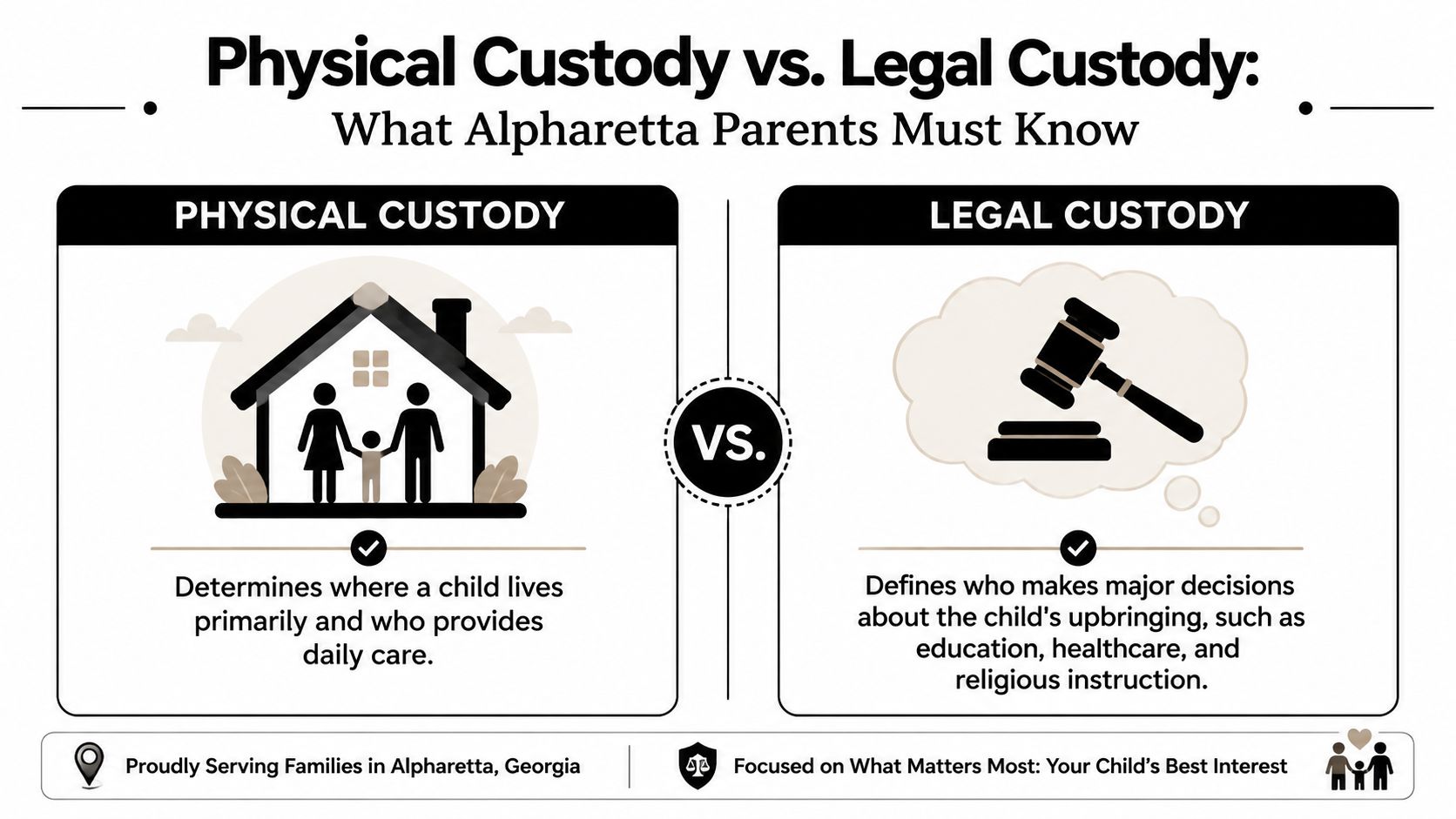
The simplest comparison
| Custody type | Main focus | Typical examples |
|---|---|---|
| Physical custody | Daily care and residence | School-night routine, meals, pickups, bedtime |
| Legal custody | Major long-term decisions | Education, healthcare, religion |
A parent can share one type and not the other. That's where many custody orders become more nuanced than parents expect.
If you want a deeper explanation of decision-making authority, read what it means to be granted legal child custody.
Joint doesn't always mean equal
One of the most common mistakes in Alpharetta and Johns Creek custody disputes is assuming joint physical custody means a perfect half-and-half split. It often doesn't. As explained in this discussion of physical custody versus legal custody, shared physical custody "rarely means a 50/50 split" because work schedules, school demands, and logistics often make exact equality hard to maintain.
That doesn't make the arrangement unfair. It usually means the schedule was built around the child's actual routine instead of a slogan.
Joint physical custody is about substantial time and meaningful involvement, not mathematical symmetry.
Common combinations Georgia parents see
Here are several combinations that show up in real cases:
- Joint legal custody with primary physical custody: One parent has the child most of the time, but both parents share major decisions.
- Joint legal custody with joint physical custody: Both parents share decision-making and substantial parenting time, even if the time split isn't exactly equal.
- Sole legal custody with joint physical custody: Less common, but possible where one parent is better positioned to make major decisions while both remain involved in daily care.
- Primary physical custody with liberal parenting time: Very common in practice because it gives the child stability while preserving frequent contact.
What works and what doesn't
What works is a schedule tied to school location, commute time, extracurriculars, and each parent's actual availability. What doesn't work is forcing a schedule just to claim "50/50" when neither household can execute it consistently.
That issue comes up often for parents commuting between Cumming, Alpharetta, Suwanee, and Canton. A schedule that looks balanced on paper can fall apart within weeks if pickup times, traffic, and after-school care weren't realistically addressed.
How Forsyth and Fulton County Courts Determine Physical Custody
Georgia judges don't decide physical custody based on who argues louder or who feels more wronged by the breakup. They apply the best interests of the child standard, and in Georgia that inquiry is detailed.

According to this Georgia custody overview discussing OCGA 19-9-3, courts evaluate physical custody through approximately 22 factors. Those factors include each parent's willingness to support the child's relationship with the other parent and, for children age 14+, the child's stated custody preference. The same source notes that most Georgia arrangements result in primary physical custody with generous visitation, not true sole custody.
What judges actually look for
In Forsyth County Superior Court and Fulton County Superior Court, the question is usually not "Which parent is better in the abstract?" The question is "Which arrangement serves this child best under these facts?"
Important themes often include:
- Stability: Housing, school continuity, and reliable routines
- Co-parenting conduct: Whether a parent encourages or obstructs the child's relationship with the other parent
- Safety concerns: Substance abuse, criminal history, violence, or an unsafe home environment
- Child-specific needs: Health, temperament, school demands, and emotional ties
If you're trying to understand how courts evaluate those facts, this child custody decision guide is a useful starting point.
Evidence matters more than labels
Parents sometimes walk into litigation saying they want sole custody because communication is bad. Bad communication alone doesn't automatically justify shutting the other parent out. Georgia courts usually want evidence tied to the child's welfare, not just proof that the parents are frustrated with each other.
The parent who stays child-focused usually presents better than the parent who stays grievance-focused.
A calendar, school records, medical information, communications, and testimony about daily involvement often matter more than broad claims like "I'm the stable parent." Judges hear those claims all the time. They respond better to specifics.
Local reality in Forsyth and Fulton County hearings
Judges in North Georgia see many cases where both parents love the child but organize life very differently. One parent may have a steadier weekday schedule. The other may have stronger flexibility for appointments and school breaks. The court's job is to turn those facts into a workable order.
That same practical approach shows up in temporary hearings, mediation, and final trials. If your proposed plan doesn't function on Monday morning, it probably won't persuade the court.
Crafting a Winning Custody Strategy in Cumming GA
A parent in Cumming may walk into my office convinced that a 50/50 schedule settles the custody question. It usually does not. In Georgia, the strategic work is showing why your proposed schedule fits the child's life and how the required primary physical custodian designation should be handled on paper.

Temporary orders shape the case early
Temporary orders often become the first test of each parent's credibility. The judge gets an early look at who brought a realistic plan, who understands the child's weekday routine, and who is still arguing from anger instead of structure.
That matters in Forsyth and Fulton County courts. If a temporary arrangement starts working for school attendance, exchanges, homework, and medical appointments, the other side has a harder time arguing that it should be discarded later. Temporary orders are not final, but they can influence settlement talks and trial strategy in a very real way.
Build the case around the schedule, not the label
Parents often focus on winning the words joint, primary, or sole. Courts focus on how the child will get through the week.
A strong parenting plan usually addresses:
- School week logistics: who handles drop-off, pickup, homework, and after-school care
- Weekends and holidays: how time is divided, when exchanges happen, and how travel is handled
- Communication rules: how parents share school, medical, and activity information
- Tie-breaker problems: what happens when parents disagree about sign-ups, schedule changes, or routine disruptions
Specificity helps. A vague plan creates room for repeat fights over late pickups, missed practices, and holiday confusion.
The 50/50 issue is often misunderstood
Many parents in Alpharetta and Cumming encounter confusion regarding this specific legal requirement. A near equal parenting schedule does not erase the need to designate a primary physical custodian under Georgia law. That designation can affect child support, school enrollment questions, and how the final order is interpreted by third parties such as doctors, coaches, and school administrators.
So the strategy is not just asking for equal time. The strategy is deciding whether equal time works for your child, whether one home should serve as the primary base for school purposes, and how to draft the order so the paperwork matches the family's day-to-day reality.
I often tell parents to separate pride from planning. Some cases are helped by a true 50/50 schedule with a carefully defined primary designation. Other cases are stronger with one parent as the primary physical custodian and generous parenting time for the other parent. The better option depends on distance between homes, school demands, work hours, transportation reliability, and the parents' ability to follow a detailed schedule without constant conflict.
Work flexibility can help, if it is real
Remote or hybrid work can strengthen a custody position because it may allow a parent to handle school pickups, sick-day coverage, and summer scheduling more reliably. Judges care less about the label on your job arrangement than about whether it helps the child.
That point cuts both ways. Working from home does not help much if the parent is on calls all day and still relies on other people for basic care during parenting time. A parent who works outside the home may still present the stronger case if that parent has dependable childcare, a stable routine, and a track record of showing up.
Practical steps that improve a custody presentation
Several steps usually make a custody case clearer and more persuasive:
- Create a usable calendar. Show the judge what Monday morning looks like, not just what you want in principle.
- Track your involvement carefully. Keep school notices, appointment records, activity schedules, and transportation details.
- Draft for conflict points. Spell out exchange times, holiday deadlines, notice requirements, and makeup time.
- Use mediation to solve the hard parts. A detailed mediated plan often holds up better than a rushed courtroom compromise.
- Write messages as if the judge will read them. In custody cases, that sometimes happens.
One option for local guidance is Miles Hansford Law Firm, which handles family law, divorce, custody, modifications, and mediation in North Georgia.
The larger divorce case still affects custody strategy
Custody does not sit in a separate box. Living arrangements, finances, work schedules, and the timing of the divorce can all affect what parenting plan is realistic and what settlement terms are available.
Georgia's no-fault divorce system, the waiting period before a divorce can be finalized, and equitable division of property all influence negotiation dynamics. A parent who understands that broader picture is usually in a better position to protect parenting time and avoid giving up custody terms just to settle the rest of the case.
What to Expect in Forsyth and Fulton County Family Courts
Parents usually feel better once they know what the local process looks like. In Forsyth County Superior Court and Fulton County Superior Court, a custody case often moves through a sequence of filing, service, temporary issues, mediation, and either settlement or final hearing.
The usual path through the case
A typical case may include these stages:
- Initial filing: Divorce, legitimation, modification, or other family law action is filed.
- Temporary issues: One or both parents ask the court for temporary orders on custody, parenting time, support, or use of the home.
- Exchange of information: Financial documents, school records, medical records, and other relevant evidence are gathered.
- Mediation: Many North Georgia family courts require mediation before trial.
- Final resolution: The case settles through agreement or is decided by a judge.
The procedure may seem lengthy from the client's perspective, but every stage influences strategic advantage and results.
The misunderstood 50 50 issue
One of the most important Georgia-specific points is this: a true 50/50 schedule doesn't erase the need for a primary designation. As explained in this Georgia discussion of joint and sole custody, Georgia courts must designate a primary physical custodian under O.C.G.A. § 19-6-15 even when parents share equal parenting time.
That matters for official records, school documentation, and some tie-break situations. In Cumming and Alpharetta cases, many parents get blindsided by this distinction. They negotiate equal time, assume the labels no longer matter, and only later realize that the primary designation still carries practical consequences.
If you're negotiating a 50/50 schedule, pay close attention to the parenting plan language on school enrollment, address use, tie-break authority, and transportation.
Mediation and local courtroom reality
Mediation is often where the best custody solutions get built. A judge can impose an order, but a thoughtful mediated agreement usually handles the details better because the parents know the child's schedule more intimately than the court ever will.
Sometimes the court also appoints a Guardian ad Litem or takes other steps to gather more information. Whether you're in a Forsyth County divorce filing or a North Fulton custody dispute, local procedure matters. So does local presentation. Clean records, realistic proposals, and disciplined communication tend to carry more weight than dramatic accusations.
Why Miles Hansford Is the Partner You Need to Protect Your Parental Rights
Parents in Cumming, Alpharetta, Johns Creek, Milton, and Sandy Springs usually aren't looking for a lecture. They want clear advice, a workable plan, and someone who understands how family cases move through Forsyth County and Fulton County courts.
That matters because custody disputes don't stay theoretical for long. You may be dealing with a temporary hearing, mediation requirement, proposed parenting plan, school registration issue, relocation concern, or a disagreement over who has final decision-making authority. Each of those choices can affect your child's routine and your strategic position in the case.
What experienced local counsel changes
A seasoned family law attorney helps by doing several things at once:
- Clarifying the core issue: Whether the fight is about time, decision-making, school placement, or control
- Drafting for enforceability: Orders need to function after the hearing, not just sound good in court
- Preparing for local procedure: Forsyth County and Fulton County cases have local rhythms, expectations, and practical realities
- Balancing negotiation with readiness: Many cases settle, but settlement works better when the other side knows you're prepared for litigation
The value of steady advice
Family law clients are often making decisions while tired, angry, or frightened. That's when bad agreements happen. A calm legal strategy keeps the focus on what a judge will likely care about, what facts need support, and which demands are worth pressing.
That is especially important in high-conflict custody matters, fathers' rights cases, modifications, and cases involving high-income professionals with demanding schedules. The right legal approach doesn't inflame the conflict just to prove a point. It protects your parental rights while building an order your child can live under.
If you're searching for a family law attorney near me in Cumming or Alpharetta, the next useful step is a consultation focused on your facts, your county, and your child's routine.
FAQs About Physical Custody in North Georgia
Q: Can parents agree on physical custody without a trial in Cumming, GA?
A: Yes. Many parents resolve physical custody through negotiation or mediation instead of a final trial. In Georgia, the agreement still needs to be written clearly and presented in a form the court can approve, especially in Forsyth County cases involving a required parenting plan.
Q: Does joint physical custody mean equal time in Alpharetta?
A: Not necessarily. In Georgia practice, joint physical custody means the child has substantial time with both parents, but the schedule doesn't have to be exactly equal. Alpharetta and North Fulton cases often turn on school, work, commute, and extracurricular logistics.
Q: What is a primary physical custodian if we share 50 50 parenting time?
A: In Georgia, one parent may still be designated the primary physical custodian even with an equal schedule. That designation affects official records and school documentation, so it should be addressed carefully in any parenting plan filed in Forsyth County or Fulton County.
Q: How do I modify a physical custody order in Forsyth County?
A: A modification usually requires showing a meaningful change in circumstances and explaining why the proposed change serves the child's best interests. In Forsyth County Superior Court, preparation matters. Judges want facts, documentation, and a practical schedule, not just complaints about the other parent.
Q: Does the child's preference matter in Georgia custody cases?
A: Yes, sometimes. Georgia courts may consider the child's preference, and for children age 14 and older that preference can carry particular significance. Even then, the court still evaluates the child's best interests in the full context of the case.
Q: What if the other parent lives in another North Georgia city like Dawsonville or Canton?
A: Distance can affect exchanges, school attendance, and weekday feasibility. Courts in North Georgia usually focus on whether the proposed arrangement is stable and realistic for the child. The farther apart the homes, the more important transportation and school-week planning become.
Q: Will physical custody affect child support in Georgia?
A: It can. Parenting time is one factor that may affect child support, but support isn't determined by custody labels alone. Parents in Cumming, Alpharetta, and surrounding communities should avoid assuming that a "joint custody" label automatically produces a particular support result.
Q: How does custody fit into a Georgia divorce case?
A: Custody is often one part of a larger divorce action. Georgia no-fault divorce law, the 30-day minimum waiting period, temporary hearings, mediation, and equitable division issues can all affect the pace and strategy of the case in Forsyth County and Fulton County.
If you're facing a custody dispute in Cumming, Alpharetta, Forsyth County, or Fulton County, speak with a family law attorney before agreeing to terms that may shape your child's routine for years. Miles Hansford Law Firm helps parents address custody, parenting plans, divorce, modifications, and mediation with a practical, protective approach. Schedule a consultation to protect your parental rights and get clear next steps.