


Meta Title: Pour-Over Will Definition in Alpharetta GA
Meta Description: Learn the pour-over will definition in Alpharetta, GA, including probate, guardianship, and estate planning for Forsyth and Fulton County families.
Suggested URL Slug: /pour-over-will-definition-alpharetta-ga/
Internal Link Suggestions:
- Estate planning for families
- What to know about wills and trusts
- How long probate takes in Georgia
- Georgia separation laws
Schema Recommendations:
- Attorney
- LegalService
- FAQPage
If you're a parent in Alpharetta, Cumming, Johns Creek, or Milton, you've probably had the same uneasy thought after signing estate documents: Did we miss anything important? That feeling is common, especially for families balancing school schedules, a growing household, retirement accounts, a home, and the realities of Georgia family law.
A strong estate plan should close loopholes, not create them. It should also protect what matters most if a crisis hits during a divorce, custody dispute, separate maintenance case, or an unexpected death. For families in Forsyth County and Fulton County, the pour-over will often does that quiet but critical work. If you need guidance specific to your family, schedule a consultation and speak with a family law attorney who understands both estate planning and the local court system.
Understanding the Pour-Over Will Definition for Alpharetta GA Families
An Alpharetta couple sets up a revocable living trust. Their home is addressed. Their main accounts are addressed. They feel organized, responsible, and relieved. Then a new account gets opened later, a vehicle title never gets updated, or a refund check arrives in one spouse's individual name. That's where the anxiety starts.
The pour-over will definition matters because even careful families leave assets outside the trust. In practical terms, a pour-over will acts as a safety net. It directs property that wasn't transferred into the trust during life into that trust at death, instead of letting those assets drift into an outcome the family never intended.
For North Georgia families, that safety net isn't just about money. It's about control. It's about making sure one overlooked asset doesn't force confusion for a surviving spouse, children, or the person managing the estate.
Practical rule: A living trust handles what was funded into it. A pour-over will helps catch what was missed.
That combination is especially important for families who want one coordinated plan rather than scattered documents. If you're reviewing your options, the firm's guide on estate planning for families is a useful next step.
In Alpharetta and nearby Roswell, Sandy Springs, and Johns Creek, many families already have the right instincts. They just need the right legal structure to make sure those instincts hold up when the documents are tested.
What Exactly is a Pour-Over Will?
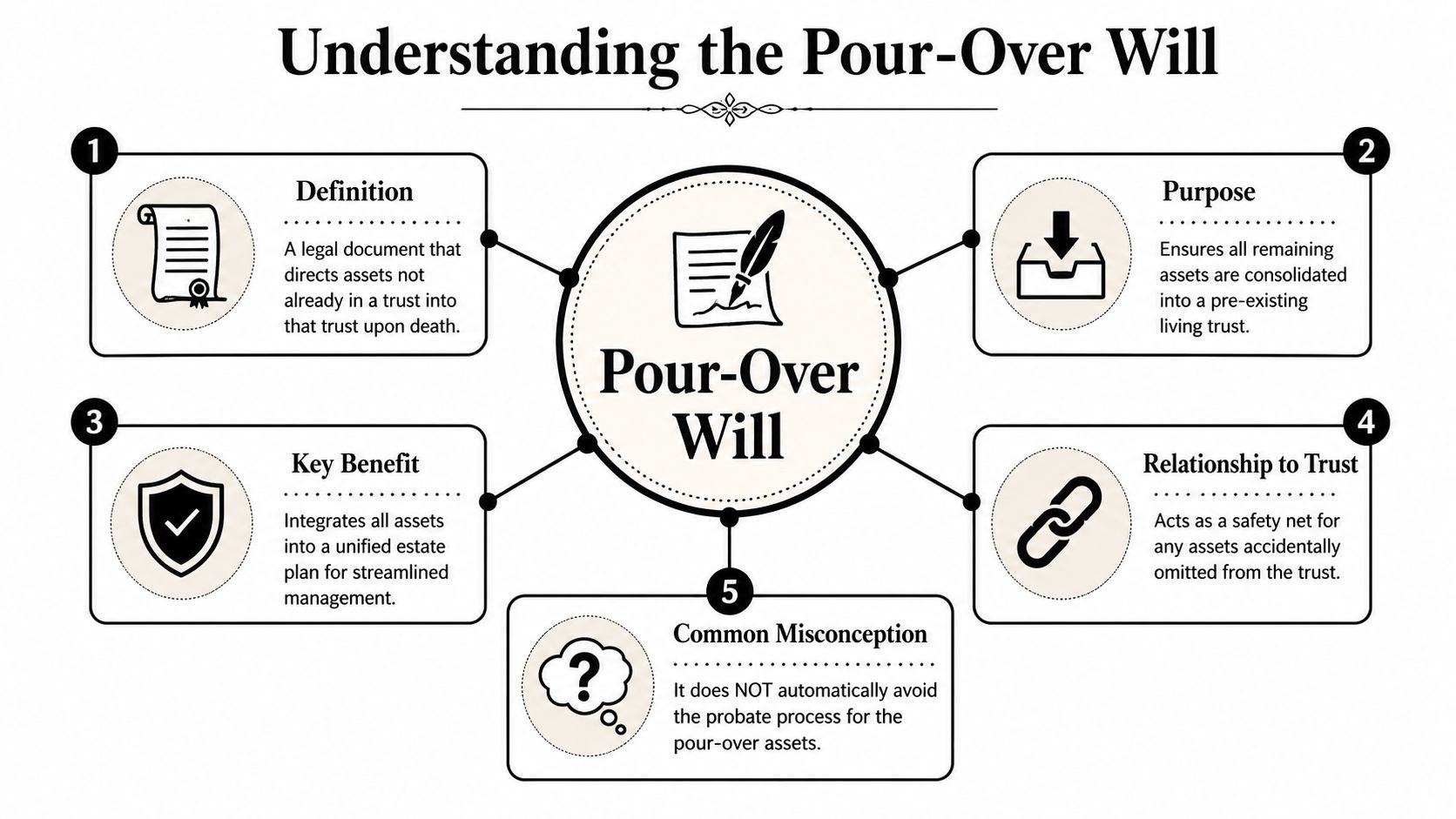
A pour-over will is a will that directs probate assets into a trust after death. Think of it as a funnel. Anything still sitting in the probate estate gets directed into the pre-existing trust so the trust's distribution plan controls what happens next.
Georgia recognizes this tool. A pour-over will is a testamentary device defined under the Uniform Testamentary Additions to Trusts Act, which Georgia has adopted, legally validating the transfer of probate assets into a pre-existing trust upon death, as explained in this discussion of the legal mechanics of pour-over wills.
How it works in plain English
A standard will can list who gets what. A pour-over will does something more targeted. It says, in effect, that the remaining probate estate should be transferred to the trustee of the trust named in the document.
That structure creates a unified plan instead of two competing plans. The trust remains the central operating document, and the will supports it.
For families trying to understand how wills, trusts, and beneficiary designations fit together, what to know about wills and trusts is a helpful place to compare the documents side by side.
Why families in Alpharetta use one
Parents and professionals in Alpharetta, Milton, and North Fulton often want consistency. They don't want one old checking account or newly purchased asset creating a separate distribution problem. They want one set of instructions to govern the estate.
A pour-over will helps with that. It doesn't replace the trust. It supports the trust.
If you're also reviewing whether your insurance and estate plan are aligned, My Policy Quote's article on life insurance without a will gives a useful consumer-level overview of why beneficiary planning and estate planning need to work together.
How Pour-Over Wills Move Through Probate in Cumming GA
The biggest misunderstanding about a pour-over will is also the one that causes the most frustration later. It does not automatically avoid probate for the assets controlled by that will.
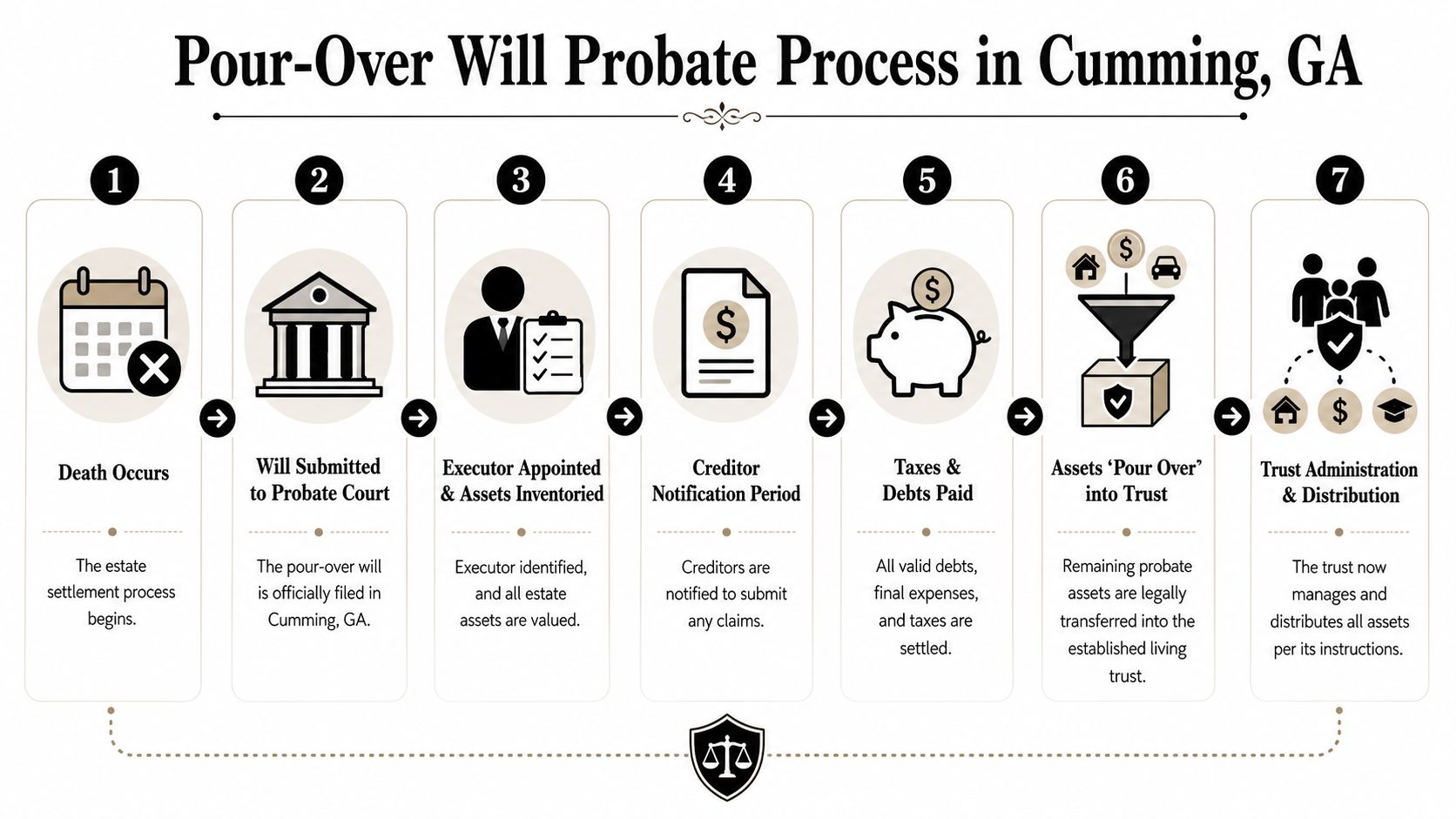
A critical gap in public understanding is that assets poured over must first go through probate court before they can be transferred into the trust, a point emphasized in this attorney video discussing the misconception. This applies to Georgia families in Cumming, Alpharetta, and throughout North Georgia.
What that means in Forsyth County and Fulton County
If the decedent lived in Cumming, the matter may move through the local probate process connected to Forsyth County filings. If the decedent lived in Alpharetta or another North Fulton community, local procedure can differ depending on the facts, the documents, and the court handling the estate-related issues. Families often hear "trust" and assume "no court," but that only applies to assets already titled into the trust.
For the missed assets, someone still has to open the estate, present the will, identify the executor, and complete the transfer process. The court's involvement validates that movement of property into the trust.
What an executor actually does
An executor handling a pour-over estate usually has a narrower mission than in a more fragmented estate plan. The executor must gather probate assets, deal with required administration steps, and then transfer the remaining assets into the trust.
That doesn't mean the process is casual. It still requires attention to procedure, filings, deadlines, and local practice. In and around the Forsyth County Superior Court, Fulton County Superior Court, and North Fulton courts, practical court experience matters because one procedural mistake can slow a family already under strain.
Probate isn't a drafting failure. For pour-over assets, it's the legal path that moves those assets into the trust.
Why this matters in related family law disputes
This is also where estate planning and family law can intersect. A pending divorce, a no-fault divorce filing, a contested divorce based on one of Georgia's recognized grounds, a temporary hearing, or a dispute over equitable division can all affect how a family views ownership, control, and beneficiary planning. Georgia also requires parenting plans in custody matters, and child custody standards focus on the child's best interests. Those are family law issues, but they shape how parents should think about guardianship and coordinated estate documents.
For readers trying to understand timing and court involvement, how long probate takes is a practical resource.
Midway through any plan review, the advice is the same: don't assume a trust document by itself fixes everything. It doesn't.
The Strategic Importance for Alpharetta Families and Minor Children

For many Alpharetta families, the primary value of a pour-over will isn't technical. It's protective. The document helps pull stray assets back into the family's main estate plan, which is important for households with changing accounts, business interests, real estate, and blended family concerns.
But the overlooked issue is often the most important one. Minor children.
Many definitions miss the pour-over will's primary role in establishing guardianship for minor children. Trusts generally can't name guardians, which leaves the will as the critical document for child custody planning, as discussed in this attorney analysis on guardianship and pour-over wills.
Why parents in Alpharetta should care
Parents in Alpharetta, Roswell, Johns Creek, and Milton often assume the trust handles every family protection issue. It doesn't. A trust can manage assets for a child. It can instruct a trustee on how and when money should be used. But if both parents are gone, the question of who raises the child belongs in the will.
That's why the pour-over will matters so much for families with young children. It doesn't just catch property. It gives parents a place to make a legally meaningful guardianship nomination.
Why this matters in real family law terms
Parents in North Georgia don't live in a vacuum. Some are married. Some are divorcing under Georgia's no-fault framework. Some are in contested cases involving custody, support, equitable division, or temporary hearings. Some are working through parenting plan requirements in Fulton County custody hearings or Forsyth County divorce filings. In those situations, naming a guardian isn't abstract. It's part of a broader protection strategy.
A few practical points stand out:
- If you're in a divorce or custody dispute: review your estate plan right away. Temporary orders and parenting arrangements can affect who you want managing your child's care and finances.
- If you're remarried or in a blended family: make your nominations explicit. Assumptions create conflict.
- If you're a high-income parent or business owner: align the trust's management terms with the will's guardianship terms so the person raising your child and the person managing assets aren't working at cross purposes.
The most important sentence in some estate plans isn't about property. It's the sentence naming who will raise the children.
Integrated legal advice is vital in such cases. Families dealing with custody standards, parenting plans, separate households, or high-conflict co-parenting need estate documents drafted with those realities in mind.
Comparing Estate Planning Tools in Forsyth County
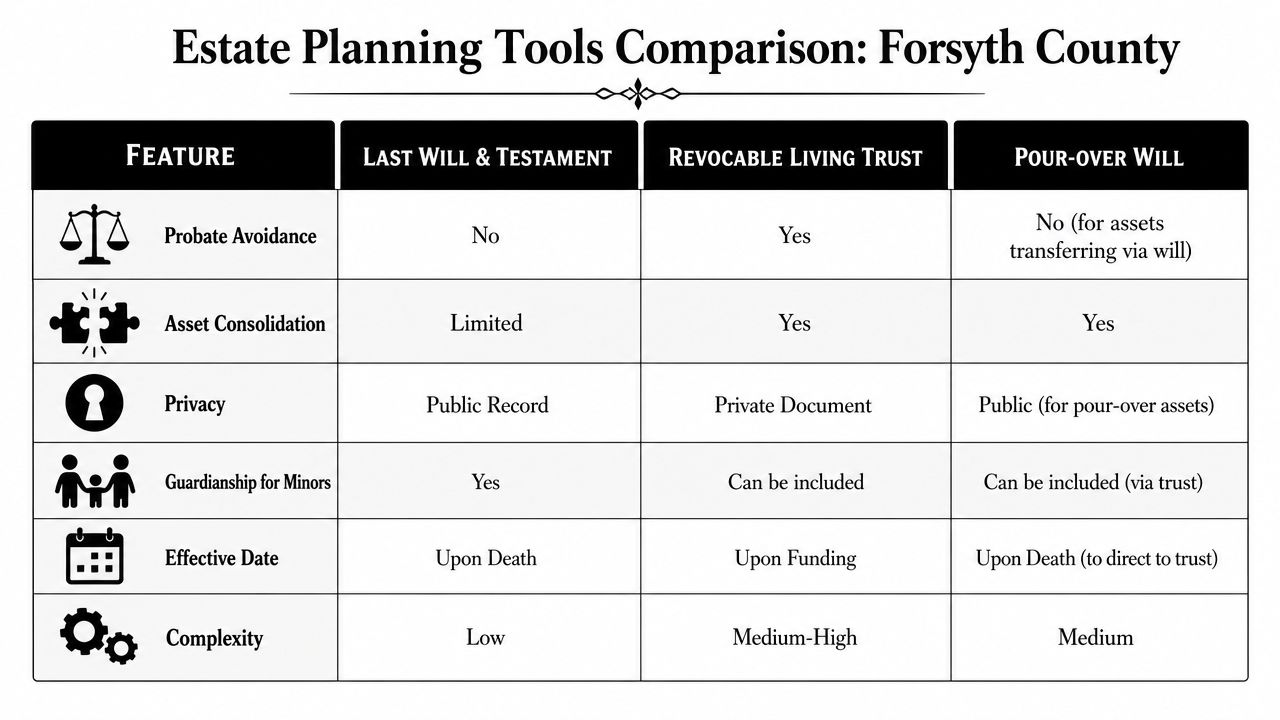
A parent in Forsyth County can have a solid trust on paper and still leave a serious gap if no document clearly nominates who should raise the children. That is one reason estate plans need to be compared by function, not by label. In Cumming, Alpharetta, Suwanee, Dawsonville, and nearby communities, each document solves a different problem.
A side-by-side view
| Feature | Last Will and Testament | Revocable Living Trust | Pour-Over Will |
|---|---|---|---|
| Probate avoidance | No | Yes | No, for assets transferring under the will |
| Asset consolidation | Limited | Yes | Yes |
| Privacy | Public record | Private document | Public for pour-over assets |
| Guardianship for minors | Yes | Can be part of the larger plan, but does not replace a will-based nomination | Yes, while also directing probate assets into the trust |
| Effective date | Upon death | Upon funding | Upon death, directing probate assets to the trust |
| Typical role | Standalone transfer document | Main management document during life and after death | Backup transfer document that supports the trust and handles guardianship nominations |
What each tool actually does
A simple will may be enough for an adult with modest assets and no need for trust administration after death. A revocable living trust gives stronger control over management, privacy, and ongoing distributions. A pour-over will fills the gap by catching assets left outside the trust and, for parents, putting the guardianship nomination in the document the probate court expects to see.
That last point gets missed often.
Families sometimes hear "trust" and assume it handles everything. It does not. If minor children are part of the plan, the will still carries weight because it gives the court a clear nomination of the person you want raising them. The trust can manage money. The pour-over will helps address the child-care side and directs stray assets back into the trust structure.
The weak spots are usually predictable:
- A trust that was never fully funded: some assets stay outside the trust and must be handled through probate.
- A will by itself: property may pass, but the plan may lack detailed management terms for a child, a young adult, or a beneficiary who should not receive assets outright.
- A pour-over will drafted without coordination: the trust terms, beneficiary designations, and guardianship language may not work together.
For many Georgia families, the better approach is to have the trust and pour-over will drafted as one coordinated plan. Miles Hansford Law Firm offers that kind of estate planning work. The benefit is not more paperwork. The benefit is making sure the person caring for the children, the person managing the money, and the documents controlling both are aligned before a crisis forces those questions into court.
Why Choose Miles Hansford for Your Cumming and Alpharetta Estate Plan
A parent can have a solid trust in place and still leave one of the most personal decisions exposed. Who steps in for the children if both parents die. In Georgia, that answer belongs in the will the probate court reviews, which is one reason a pour-over will deserves careful drafting instead of template language.
That is also why estate planning for families in Cumming and Alpharetta should not be handled in isolation from family law realities. Separation, divorce, blended-family tension, child support obligations, and changing custody arrangements all affect how a plan should be written and updated. A guardianship nomination that made sense three years ago may need to be reconsidered after a remarriage, a relocation, or a serious conflict between households.
Miles Hansford Law Firm brings those issues together in one plan. For parents in North Georgia, that coordination matters. The trust may control how money is managed for a child, but the pour-over will is often the document that gives the court a clear guardianship nomination if the unthinkable happens.
What local families should expect
A well-built estate plan for Forsyth and North Fulton families should line up with facts on the ground, including:
- Marital strain before any filing: spouses often delay formal action, but estate documents still need review during that period.
- Divorce timing and temporary orders: pending cases can affect decision-makers, beneficiary choices, and how parents want fiduciary roles assigned.
- Equitable division issues: title and ownership affect what passes under the plan and what may still be disputed.
- Custody and parenting arrangements: guardian nominations should be drafted with real family dynamics in mind, not ideal assumptions.
- Blended family concerns: parents may want one person raising a child and another managing inherited funds, and the documents should say so clearly.
Families looking for a family law attorney in Cumming or a divorce lawyer nearby are often trying to solve an immediate problem. They also need to protect their children if a second crisis follows the first. A law firm that handles family law and estate planning can address those trade-offs directly, especially when the central question is not just where assets go, but who will be there to raise the children.
Frequently Asked Questions About Pour-Over Wills in Georgia
Q: What is the pour-over will definition in Georgia?
A: A pour-over will is a will that directs probate assets into a pre-existing trust at death. In Georgia, it works as a backup device for assets that weren't transferred into the trust during life, helping families in Alpharetta and Cumming keep one unified estate plan.
Q: Does a pour-over will avoid probate in Cumming, GA?
A: No. Assets governed by a pour-over will still go through probate before they move into the trust. In Forsyth County, that means court process, filings, and administration steps still matter for those specific assets, even if other trust assets stay outside probate.
Q: Can a pour-over will name a guardian for my children in Alpharetta?
A: Yes, that's one of its most important jobs. For parents in Alpharetta and Fulton County, the will is the key place to make a guardianship nomination for minor children because the trust usually doesn't control that issue by itself.
Q: Is a pour-over will useful if I already have a living trust?
A: Usually, yes. A living trust only controls assets titled into it. A pour-over will helps capture missed assets and direct them back into the trust, which is especially helpful for busy families in North Georgia whose accounts and property change over time.
Q: What is the downside of a pour-over will in Georgia?
A: The main downside is probate. The residual estate passes through a public court process and can involve court fees and delays that non-probate trust assets avoid, as noted in this explanation of pour-over will probate costs and trade-offs. That makes trust funding during life still very important.
Q: How does a pour-over will relate to divorce and custody issues in Georgia?
A: It can be very important. If you're facing divorce, separate maintenance, custody litigation, or parenting plan disputes in Forsyth County or Fulton County, your estate plan may need updates so guardianship choices and asset control still match your family situation and legal obligations.
Q: Are local court procedures important for these cases?
A: Yes. Fulton County and Forsyth County court procedures affect how related family law matters unfold, including temporary hearings, mediation requirements, and custody issues. Estate planning should reflect those realities, especially for parents who don't want outdated documents working against them.
If your family lives in Cumming, Alpharetta, Forsyth County, or Fulton County, a pour-over will may be the document that closes the gap between a decent estate plan and a reliable one. If you're dealing with children, divorce concerns, separate households, or want to make sure no asset and no child is left unprotected, schedule a consultation with Miles Hansford Law Firm and speak with a family law attorney who can help you protect your parental rights, secure your estate plan, and move forward with clarity. Call today.