


Meta Title: Probable Cause Affidavit in Alpharetta, GA
Meta Description: Probable cause affidavit help in Alpharetta, GA. Learn how Fulton County and Forsyth County warrant challenges work and when to schedule a consultation.
Suggested URL Slug: /probable-cause-affidavit-alpharetta-ga
Internal Link Suggestions:
- Miranda rights and police questioning
- Warrantless search defense
- Bench trial considerations in criminal cases
- DUI and criminal defense overview
- White collar and felony defense pages
Schema Recommendations:
- Attorney
- LegalService
- FAQPage
If you were arrested in Alpharetta, Milton, Roswell, or Johns Creek, or if officers searched your home in North Fulton or nearby Forsyth County, the paperwork can feel like a blur. One document often matters more than people realize: the Probable Cause Affidavit. It may look routine, but it's often the foundation for the arrest, the search, or both.
As a former prosecutor and now a criminal defense attorney in Alpharetta, I look at that document early. If you're in Alpharetta, Cumming, Sandy Springs, Suwanee, Canton, or Dawsonville, understanding what the affidavit says, and what it fails to say, can change the direction of a case. The first step is simple. Get the paperwork, stay quiet about the facts with police, and have counsel review the affidavit closely.
An Unexpected Document After an Arrest in Alpharetta
A common scene plays out fast. Someone is stopped in Alpharetta or Roswell, or officers arrive at a home in Milton or Sandy Springs with a warrant. Hours later, a spouse, parent, or close friend is sorting through papers from the jail or from the search, trying to decode legal terms under stress. Buried in that stack is often the probable cause affidavit.
That document isn't just administrative paper. It's the written explanation law enforcement used to justify action against you. If you've just been arrested or your home was searched in North Georgia, this is one of the first documents a defense lawyer should study.
The confusion is understandable. People usually focus on the charge name, bond amount, or court date. Those matter. But the affidavit often tells you how the case was built, what facts the officer chose to include, and where the weak spots may be.
Why this document matters right away in Alpharetta
In practical terms, the affidavit is where the state tries to connect facts to legal authority. If the facts are thin, vague, or sloppily presented, that can shape motions, negotiations, and suppression issues later. In Fulton County cases, and in matters that touch North Fulton courts, those details can matter more than clients expect.
Immediate priority: Don't assume the affidavit is accurate just because a judge signed off on a warrant.
I've also seen families make an avoidable mistake. They try to organize paperwork themselves, send screenshots around, and piece together timelines from incomplete records. Good document handling matters. Even outside the legal field, systems that reduce errors in document processing show why careful record review matters when one missing detail can change the meaning of a file.
If police questioned you before or after the arrest, it also helps to understand what Miranda rights grant defendants. The affidavit and the questioning often connect, and early review can reveal whether the state's version matches what happened.
The first practical move after an arrest or search
Start with preservation, not explanation.
- Keep every page: Booking sheets, bond papers, warrant copies, inventory sheets, and notices all matter.
- Write down the sequence: Note who arrived, what they said, when the search began, and what property officers took.
- Avoid phone retellings: Repeating facts casually to friends or posting online rarely helps.
- Get local counsel involved early: A lawyer who regularly handles cases in Alpharetta, Cumming, Fulton County, and Forsyth County will know what to request and where to look first.
A lot of panic settles once people understand that the affidavit can be tested. It isn't untouchable. But it does require disciplined review.
What a Probable Cause Affidavit Is and Why It Matters
At this stage, the affidavit is often the paper doing the talking for the officer. Before a prosecutor files charges or stands behind a warrant in court, someone usually reviews that document to decide whether the facts are enough to move the case forward. In Fulton and Forsyth County, that review can be quick or careful, depending on the charge, the court, and how the case arrived. Either way, the affidavit usually shapes the first version of your case long before your lawyer gets full discovery.
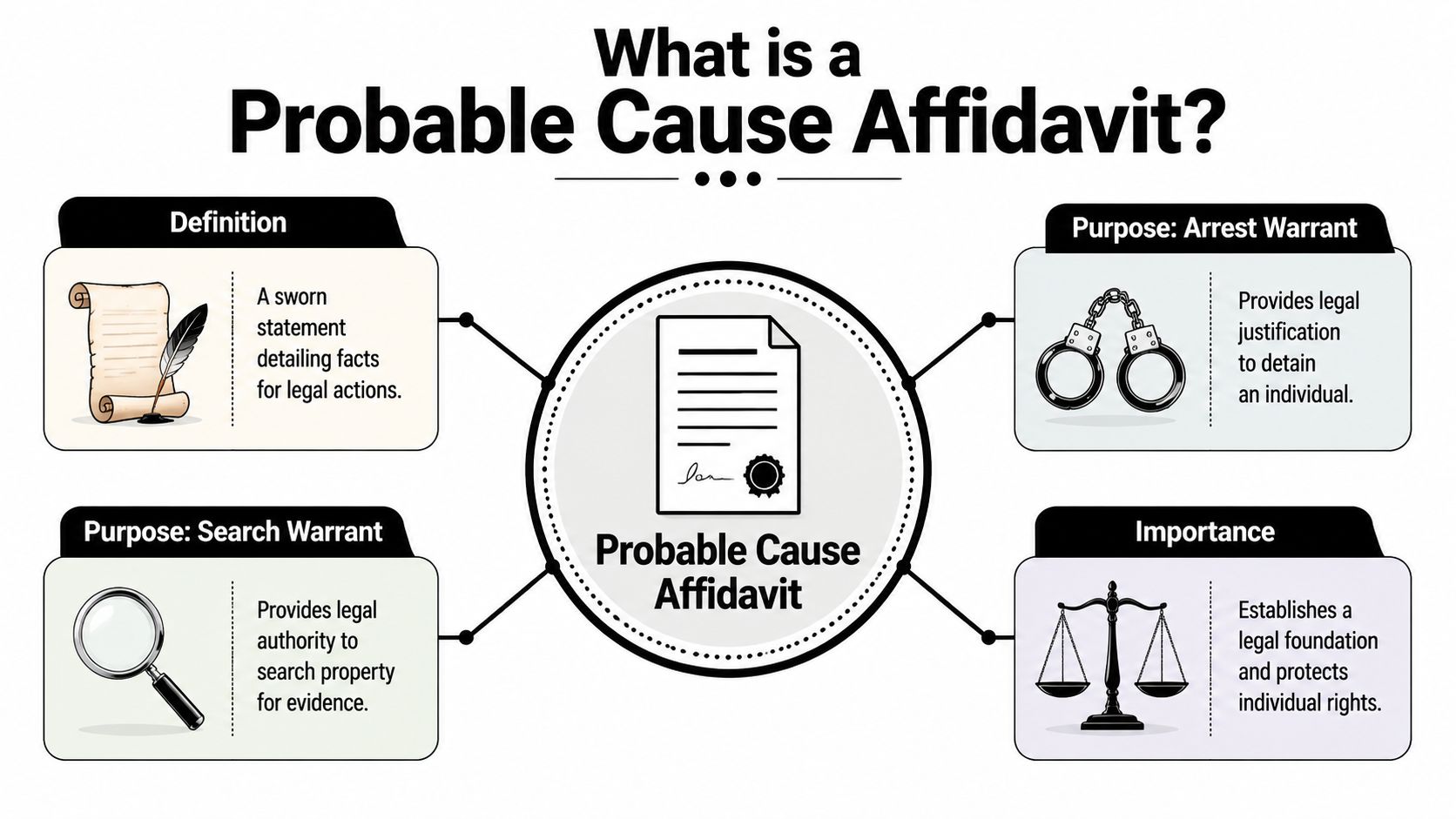
A probable cause affidavit is a sworn statement from law enforcement used to support an arrest warrant, a search warrant, or both. The officer signs it under oath and presents facts that are supposed to justify government action. For a judge, it is the starting record. For the defense, it is often the first document worth testing line by line.
Probable cause is not a percentage test. Courts describe it as a practical, common-sense judgment based on the facts presented, not a fixed level of certainty, as discussed in this legal analysis of probable cause standards. That flexible standard helps the state. It also means weak affidavits sometimes survive if they sound specific enough on first read.
From the prosecution side, the goal is straightforward. The affidavit needs to give a magistrate enough factual detail to sign off without asking many questions. From the defense side, I read it differently. I look for what is missing, what is vague, what depends on hearsay, and whether the officer connected the place searched or the person arrested to the alleged crime.
A usable affidavit usually answers a few basic questions:
- Who the officer claims was involved
- What conduct allegedly occurred
- Where it happened
- When the events took place
- How the officer learned those facts
If the affidavit relies on an informant, the document should give the judge some basis to trust that information. Georgia courts still look for facts showing why the source had knowledge and why the officer treated the source as reliable, a point reflected in the Georgia Code section governing issuance of search warrants. A bare statement that a person was "credible" is harder to defend if the affidavit does not explain why.
That sworn status matters. A signed affidavit is not casual paperwork. If you want to better understand legally binding contracts, the comparison is useful because wording, form, and signatures carry legal consequences in both settings. In a criminal case, the consequence is more immediate. The affidavit can authorize handcuffs, a home search, seizure of phones or firearms, and the filing decision that follows.
One hard truth from local practice. Many people hear that false statements in an affidavit can be challenged and assume the court will quickly grant a hearing. In reality, a Franks hearing is difficult to win in Georgia trial courts, including in and around Fulton and Forsyth. You usually need more than suspicion. You need a concrete showing that the affiant included a deliberate falsehood or left out facts on purpose, and that the problem mattered to probable cause. That is why early review matters so much. The best attacks often start with small inconsistencies, timeline problems, body camera footage, dispatch records, or property sheets that do not line up with the affidavit's story.
A judge does not approve a warrant because an officer sounds confident. The judge signs because the affidavit presents enough sworn facts to clear a relatively low threshold. My job, now on the defense side, is to test whether those facts were complete, accurate, and reviewed as carefully as they should have been before your case ever reached court.
The Anatomy of a Georgia Affidavit The Four Corners Rule
After an arrest or search, clients often assume the judge heard a full explanation from the officer. In Georgia, that is usually not how the decision is made. The magistrate is supposed to decide from the four corners of the affidavit itself. If the missing fact is not written down, the officer usually does not get to repair the problem later by saying, "I knew it" or "I would have explained that in person."
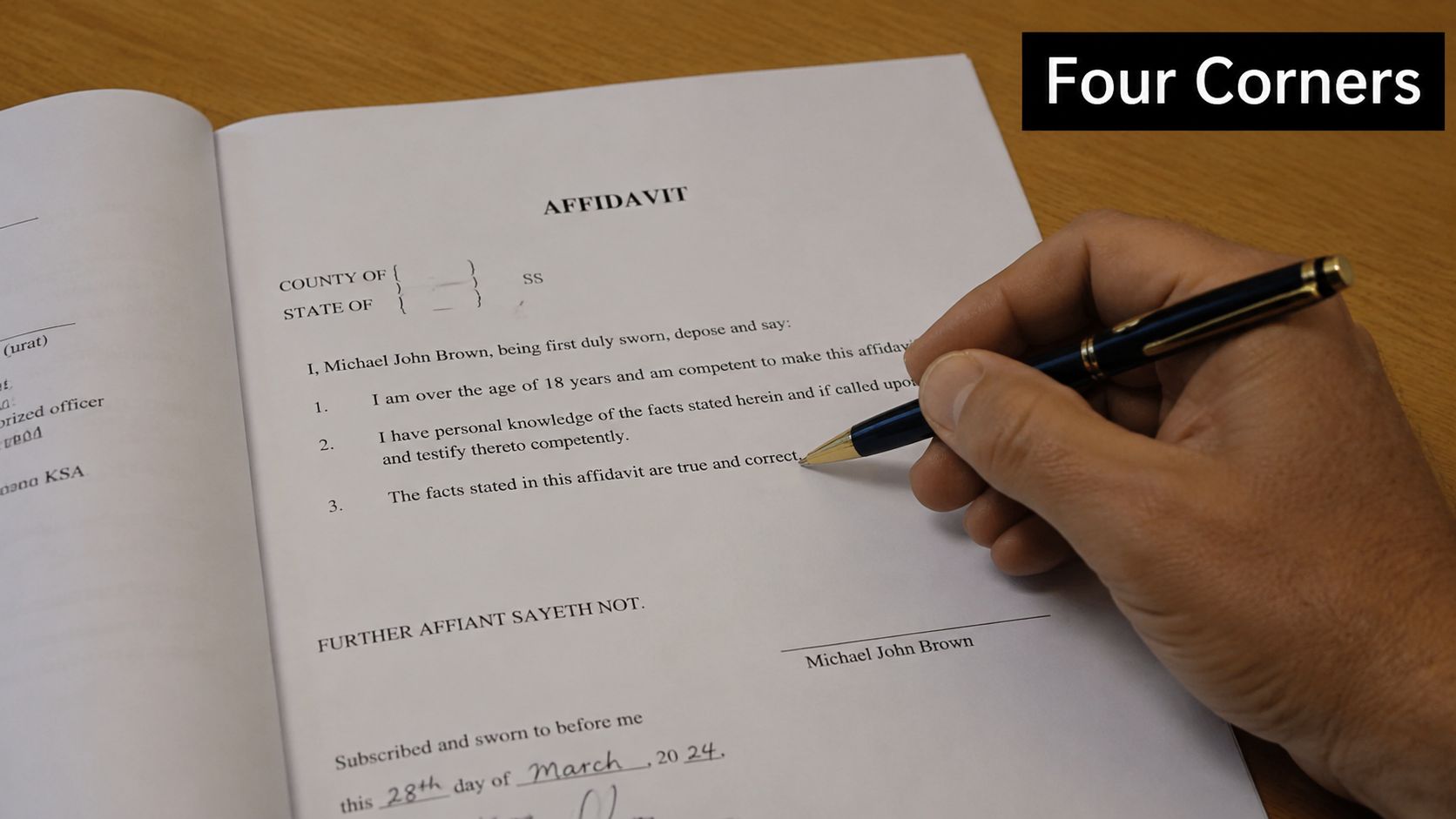
What the four corners rule means
The rule is straightforward. The judge looks at the affidavit's written facts and decides whether those facts establish probable cause. Georgia courts treat the affidavit as the foundation for the warrant, and courts elsewhere describe the same basic principle in warrant review materials such as the North Carolina benchbook discussion of probable cause and affidavit review.
That matters for one reason above all. Sloppy drafting can become a legal issue.
As a former prosecutor, I can tell you the drafting process is rarely as polished as people think. An officer may be writing late, under pressure, after a fast-moving arrest, or with facts gathered from several people. A supervisor or prosecutor may catch weak phrasing before it goes to a magistrate. Sometimes no one fixes it. In Fulton and Forsyth matters, that pre-filing review step can be the difference between a clean affidavit and one that leaves openings for suppression work later.
What belongs in the affidavit
A usable affidavit gives facts, not labels. It should tell the judge who saw what, when it happened, where it happened, and why the officer connects the person or place to the alleged crime.
These examples show the difference:
| Type | Stronger wording | Weaker wording |
|---|---|---|
| Observation | "I observed the suspect place the item in his pocket and leave without paying." | "I believe the suspect intended to steal." |
| Search nexus | "The witness stated the firearm was stored in the bedroom closet at the residence." | "I suspect evidence is inside the home." |
| Time and place | "On the evening in question, officers responded to the apartment in Alpharetta." | "The suspect has been involved in criminal activity." |
Judges see affidavits full of shorthand. "Known drug dealer." "Acting suspiciously." "Fraudulent activity." Those phrases may sound serious, but they do not do much legal work unless the affidavit supplies the underlying facts.
Where affidavits usually weaken
In North Georgia cases, I read these documents with a simple question in mind. Does the affidavit show facts that support the warrant requested, or does it ask the judge to trust the officer's conclusion?
The weak points are often predictable:
- Conclusions instead of facts. "He committed fraud" is an accusation, not a factual basis.
- No source for the information. The affidavit should show whether the officer saw it personally, heard it from a named witness, or relied on another officer.
- A thin connection between the place searched and the evidence sought. This issue comes up often in home-search cases.
- Missing timing. Old information can undermine probable cause if the affidavit does not explain why evidence would still be there.
- Hearsay with no support for reliability. Informant language, secondhand witness statements, and vague references to "information received" deserve close attention.
A careful read here affects more than a suppression motion. It shapes plea discussions, trial planning, and even forum choices later, including whether a client should be thinking early about bench trial strategy in a criminal case.
The practical defense view
The four corners rule helps the defense, but it does not make these fights easy. Trial judges in local courts do not grant Franks hearings just because the affidavit feels incomplete or overstated. The better approach is narrower and more disciplined. Pin down the exact sentence that matters. Compare it to body camera footage, dispatch logs, call notes, chain-of-custody records, screenshots, or witness statements. Then ask whether the affidavit left out a fact or framed it in a way that changed the probable cause analysis.
That is the anatomy of the document. It is a short sworn narrative drafted before charges are fully tested, often reviewed quickly, and then treated as if it were solid. Sometimes it is solid. Sometimes it is only good enough to get signed, which is not the same thing.
How Affidavits Are Used in Fulton and Forsyth County Courts
In real life, the affidavit starts at a desk, in a patrol car, or in a case file. An officer in Alpharetta, Roswell, Sandy Springs, Cumming, or another North Georgia agency drafts the facts. Those facts are then pushed toward a magistrate for review, sometimes with careful scrutiny and sometimes with too much speed.
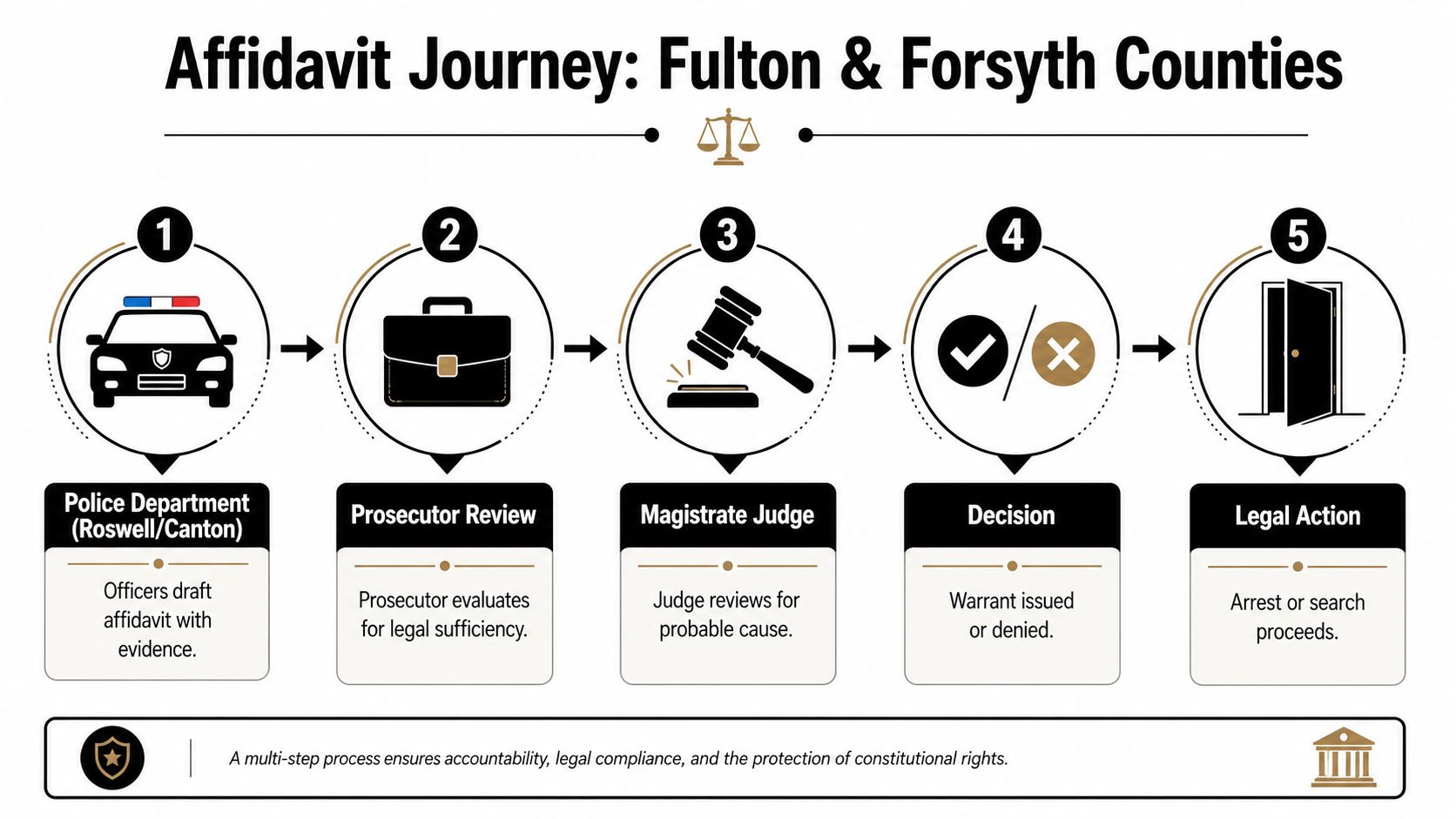
The local path from officer to judge
In Fulton County and Forsyth County, the practical flow usually looks familiar:
- An officer drafts the affidavit after an investigation, traffic stop, complaint, witness interview, or controlled operation.
- A supervisor, senior investigator, or prosecutor may review it for legal sufficiency.
- A magistrate judge reviews the written facts and decides whether probable cause exists.
- A warrant is issued or denied.
- The arrest or search moves forward if the warrant is approved.
That middle step gets overlooked by the public, but it matters. In stronger cases, someone catches missing dates, unsupported leaps, weak informant language, or a gap between the crime alleged and the place searched.
The review step people rarely hear about
As a former prosecutor, I can say this plainly. Pre-filing review is one of the most important quality-control points in the system. It isn't always formal, and it isn't always thorough. But when it's done well, it prevents avoidable warrant problems.
A prosecution can fail solely because an affidavit was "conclusory" and failed to establish probable cause, a mistake that could have been avoided if an experienced investigator or prosecutor had reviewed it before the judge authorized the warrant, as discussed in this analysis of pre-warrant review problems.
That doesn't mean every flawed affidavit leads to dismissal. It does mean rushed review can create opportunities for the defense.
What this looks like in local court practice
In Forsyth County matters, including filings that feed into proceedings near the Forsyth County Superior Court, and in Fulton County matters that may eventually affect proceedings around the Fulton County Superior Court or North Fulton courts, local process matters. The judges, prosecutors, and officers all work within recurring patterns. Some cases arrive neatly prepared. Others show signs of haste.
Common pressure points include:
- Thin narratives: The affidavit says what happened, but not how the officer knows.
- Cut-and-paste language: Generic statements replace case-specific facts.
- Missing chronology: Dates and timing are vague.
- Weak review habits: No one pressed the officer to tighten the affidavit before submission.
If you're weighing whether to resolve a case before trial, understanding local procedure matters as much as understanding abstract law. In some criminal cases, broader strategy questions also include whether you should ask for a bench trial in your criminal case. Those decisions make more sense after the defense has tested the foundation of the warrant paperwork.
Challenging a Probable Cause Affidavit in Alpharetta Cases
A person gets arrested in Alpharetta, bonds out, and finally sees the paperwork that set the case in motion. On paper, the affidavit can look confident and complete. In practice, that first reading often raises the right question. Does this document support what the officer asked the magistrate to approve?
As a former prosecutor, now defending cases in North Georgia, I do not treat affidavit challenges as a routine motion you file on autopilot. In Fulton and Forsyth, prosecutors usually review the case after the arrest and before the case settles into its final charging posture. That review can expose problems, but it can also harden the State's position if the affidavit is stronger than it first appears. The defense has to choose the moment and the theory carefully.
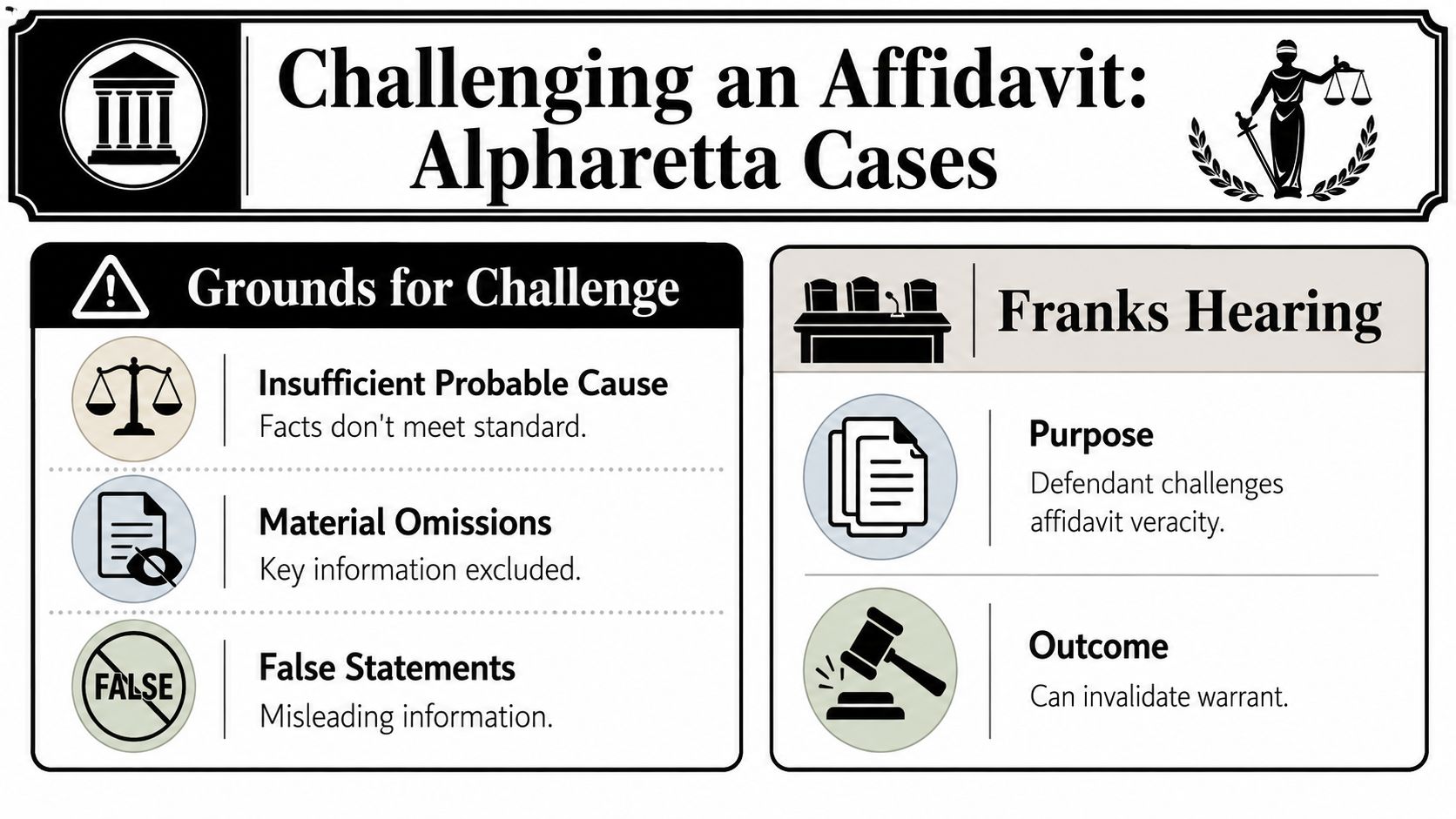
The first challenge is usually the simplest one. Read the affidavit exactly as the judge had to read it. If it is vague, conclusory, missing chronology, or weak on the link between the alleged crime and the place searched, there may be a suppression issue. That review is technical, not emotional. Words matter. Omissions matter too.
A useful affidavit attack often starts with a short set of hard questions:
- Did the officer provide facts, or only conclusions
- Did the affidavit explain how the officer knew each key fact
- Did it tie the person, car, phone, or house to the alleged offense
- Did it explain why an informant should be believed
- Did it leave out facts that would have changed the magistrate's decision
Some cases stop there. If the affidavit fails on its face, the argument is about insufficiency under the four corners of the document. Other cases call for a more serious claim that the affidavit included a false statement or left out a material fact.
That second path leads to a Franks hearing under Franks v. Delaware. Clients deserve a realistic warning about that process. Georgia trial courts do not grant those hearings lightly, and local judges in Fulton and Forsyth generally expect defense counsel to come in with evidence, not suspicion. The rule itself is set out by the Supreme Court in Franks v. Delaware, 438 U.S. 154 (1978).
The practical difficulty is proving state of mind. It is rarely enough to show that the affidavit was inaccurate. The defense usually has to make a substantial preliminary showing that the officer knowingly, intentionally, or recklessly included a false statement, or omitted information in a way that mattered to probable cause. That is a high bar in any court. It is harder still when the affidavit has already been filtered through local police review and then examined again by a prosecutor deciding how to move the case forward.
What tends to help is outside proof that pins the timeline or contradicts a key factual claim. Body camera footage. CAD logs. Dispatch audio. Cell phone records. Property logs. A witness who can account for where someone was and when. In document-heavy cases, lawyers increasingly use systems that prepare legal documents for AI so records can be searched and compared efficiently. That kind of workflow helps spot inconsistencies, but the court still wants admissible proof and a precise theory.
What usually falls short:
- A general claim that police lied
- Minor inconsistencies that do not affect probable cause
- An argument built only on speculation about motive
- A missing detail that does not change the magistrate's decision
What can make the motion stronger:
- A witness statement that directly contradicts a material fact
- Objective records that expose a bad timeline
- Proof that the officer left out information that cuts against probable cause
- A clear explanation of why the affidavit fails even after the challenged language is removed or corrected
I saw this from the prosecution side. Some affidavits were carefully built. Others were assembled fast, then defended later with more confidence than precision. That is why affidavit litigation in Alpharetta cases is strategic. A weak Franks motion can educate the State and get nothing in return. A well-supported motion can change plea negotiations, force testimony under oath, and sometimes knock out the search itself.
If the search happened without a warrant, the defense analysis changes. A separate question becomes whether a warrantless police search is lawful.
The right move depends on the record, the judge, and what the prosecutor is likely to do once the weakness is exposed. Sometimes the best result comes from filing the motion. Sometimes it comes from using the affidavit's flaws to pressure the State before a hearing ever happens.
Why Our Firm's Background Matters for Your Defense
A probable cause affidavit is often treated like a finished product. It rarely starts that way. In Fulton and Forsyth County cases, the affidavit usually reaches the judge after a chain of drafting, review, revision, and filing decisions. A lawyer who has worked on both sides of that process reads the document differently.
As a former prosecutor, now a criminal defense attorney in Alpharetta, I look for two things at once. I look for what the officer was trying to accomplish, and I look for what the prosecutor likely accepted without pressing hard enough. That matters because many affidavit problems are not obvious syntax errors or dramatic falsehoods. They are quieter flaws. A fact stated as a conclusion. A timeline that only works if you assume missing steps. A statement from a source whose reliability was never established. A connection between the alleged crime and the place searched that was asserted, not shown.
That background changes how the defense is built.
Instead of treating the affidavit as a stand-alone police narrative, we read it as a filed work product. We ask where the draft was thin, what a reviewing prosecutor should have questioned before submission, and whether the final version reflects haste, habit, or omission. In local practice, that can matter more than broad textbook arguments about probable cause.
The practical benefit is judgment. Some cases call for a direct attack on the affidavit. Others call for a narrower strategy that uses the affidavit's weak points in negotiations, cross-examination, or a suppression motion grounded in the record you can prove. In Georgia courts, and especially in local courts handling a heavy warrant calendar, judges do not grant Franks hearings just because the defense points out a troubling inconsistency. The showing has to be focused, documented, and tied to a material statement or omission. Knowing how these affidavits are assembled helps us decide whether that fight is worth bringing and how to present it without overreaching.
It also helps us identify what the State may do next. If a weakness is exposed early, the prosecutor may try to narrow the case, rely on an alternative theory, or argue that the defect does not matter because probable cause survives without the challenged language. A defense lawyer who has reviewed warrant materials from the government side can anticipate that response and prepare for it.
Clients need a lawyer who can read the affidavit the way the State should have read it before asking a judge to sign off.
That perspective does not promise a win. It does put you in a better position to spot the critical pressure points, avoid weak motions, and challenge the affidavit in a way that fits how Fulton and Forsyth County cases are handled.
FAQs About Probable Cause Affidavits in North Georgia
Q: What is a probable cause affidavit in Alpharetta, GA?
A: It's a sworn statement from law enforcement used to justify an arrest warrant, a search warrant, or both. In Alpharetta and the broader Fulton County area, the judge reviews the written facts in that document to decide whether legal action is authorized. If the facts are weak or incomplete, that can become a defense issue.
Q: Can a judge consider facts that are not written in the affidavit?
A: Generally, no. Under the four corners rule, the judge's review is limited to the factual averments inside the affidavit itself. That matters in North Fulton courts, Forsyth County proceedings, and warrant litigation throughout North Georgia because missing facts usually can't be patched later by argument alone.
Q: If the affidavit contains a mistake, will my case be dismissed?
A: Not automatically. Some mistakes are minor, and some don't affect probable cause. The stronger question is whether the error was material and whether the remaining facts still support the warrant. In Fulton County and Forsyth County cases, courts usually look at whether the problem undermines the legal basis for the arrest or search.
Q: What is a Franks hearing in a Georgia criminal case?
A: A Franks hearing is the procedure used to challenge a warrant affidavit based on alleged false statements or material omissions. The defendant must make a substantial preliminary showing, and that is a demanding standard. In local practice, these hearings require focused evidence, not just suspicion that the affidavit was unfair.
Q: Why is it so hard to win a Franks hearing in Forsyth County or Fulton County?
A: It's hard because the defense must do more than show an inaccuracy. The court wants proof suggesting the officer acted knowingly, intentionally, or with reckless disregard for the truth. Even then, the court may deny relief if the remaining affidavit still establishes probable cause.
Q: What should I do after a home search in Cumming, GA?
A: Keep the warrant, the inventory of seized items, and every page officers left behind. Write down the timeline while it's fresh. If the matter is tied to Forsyth County procedures or a future Superior Court case, early review of the warrant paperwork can be critical because suppression issues often depend on the original affidavit language.
Q: Does this affect family law, custody, or divorce matters in North Georgia?
A: It can. A criminal arrest or search can affect negotiations, temporary hearings, and parenting disputes under Georgia family law, especially where parenting plans and child custody standards are already under scrutiny. If you're also dealing with Georgia no-fault divorce laws, equitable division, mediation requirements, or a temporary hearing in Fulton County or Forsyth County, the criminal case needs to be handled carefully because facts from one matter often spill into the other.
Q: Should I talk to police or try to explain what really happened?
A: Usually, no. Once an affidavit exists, officers and prosecutors already have a working theory of the case. Volunteering a rushed explanation often gives them more statements to use. The safer move is to speak with counsel first, especially if your case is moving through Alpharetta, Cumming, North Fulton, or Forsyth County courts.
If you or a family member is dealing with an arrest, a warrant, or a home search in Alpharetta, Cumming, Johns Creek, Milton, Roswell, Sandy Springs, Suwanee, Dawsonville, or Canton, speak with counsel before making decisions that affect the case. Miles Hansford Law Firm serves clients across Fulton County, Forsyth County, and North Georgia with strategic criminal defense backed by former prosecutor insight. Schedule a consultation, speak with a family law attorney or criminal defense lawyer as needed, protect your parental rights if your case overlaps with custody issues, and call today before temporary orders, search issues, or early court filings shape the outcome.