


When a loved one passes away in Fulton County, their estate often makes its way through the Probate Court of Fulton County, Georgia. This court serves families across the area, from Atlanta to Roswell and Johns Creek, handling the legal process of validating wills, settling estates, and appointing guardians. Understanding its role is the first step in navigating the responsibilities you may be facing.
What Is the Role of the Fulton County Probate Court?

The Fulton County Probate Court is a specialized court that oversees matters involving a deceased person's estate and the protection of vulnerable citizens. Its primary job is to ensure a person's final wishes are carried out legally and that their assets are distributed correctly to the right heirs and beneficiaries.
The court acts as a neutral authority. It is there to confirm a will is valid, appoint an executor to manage the estate, and provide a legal framework for paying debts and transferring property. This process, called probate, brings legal order to what can otherwise be a confusing and emotional time for a family.
Core Functions of the Court
The court's work extends beyond just dealing with wills. Its primary duties include:
- Probating Wills: This means formally validating a deceased person's last will and testament to confirm it is legally binding.
- Administering Estates: When someone dies without a will, the court oversees the settlement of their estate according to Georgia's intestacy laws.
- Appointing Guardians and Conservators: It establishes legal guardianships for minors who have lost their parents or conservatorships for adults who can no longer manage their own affairs.
- Issuing Licenses: The court also handles other key administrative tasks, like issuing marriage licenses and weapons carry licenses to Fulton County residents.
The Fulton County Probate Court is a cornerstone of our local legal system. To fully appreciate its function, it helps to see it as part of the bigger picture of comprehensive estate management. The court, which was called the Court of Ordinary until 1974, has exclusive jurisdiction over these critical family matters.
Given the significant assets often involved in Fulton County estates, filing everything correctly and on time is crucial to avoid long, frustrating delays. You can learn more about how our firm can help by reading our guide to probate legal services. For more information directly from the source, you can visit the official Fulton County Probate Court website.
What Happens in Probate Court?
When most people hear "probate court," they immediately think of wills and what happens after someone dies. While that is a huge part of its job, the Fulton County Probate Court handles a much broader spectrum of sensitive family matters. It is the legal venue where some of life’s most significant transitions are managed with fairness, order, and in line with Georgia law.
At its core, the court’s mission is to provide legal supervision when settling a person’s final affairs and to protect those who can no longer protect themselves. For families across Fulton County, from Alpharetta to Roswell and beyond, this court is the official place to validate a will, administer an estate when there is no will, and appoint legal guardians or conservators.
Let's break down what the court oversees.
Fulton County Probate Court Core Functions
This table offers a quick look at the main legal issues the Fulton County Probate Court handles and the people typically involved in each process.
| Legal Matter | Primary Purpose | Key Parties Involved |
|---|---|---|
| Probate of Will | To legally validate a deceased person's will and oversee the distribution of their assets. | Executor, Beneficiaries, Creditors |
| Intestate Administration | To manage and distribute the assets of a person who died without a will, following state law. | Administrator, Heirs-at-Law, Creditors |
| Guardianship | To appoint a legal guardian to care for a minor child's personal well being (health, education). | Guardian, Minor Ward, Concerned Relatives |
| Conservatorship | To appoint a legal conservator to manage the financial affairs of an incapacitated adult or minor. | Conservator, Adult Ward, Concerned Relatives |
Each of these functions is crucial for providing structure and legal authority during difficult times, ensuring that responsibilities are clearly defined and carried out correctly.
Validating Wills and Administering Estates
By far, the most common reason you would find yourself dealing with the probate court is after a death in the family. This entire process is often just called estate administration.
Here’s how it works in the two most common scenarios:
-
When a Will Exists (Probate): If your loved one left a valid will, the court's first job is to "probate" it. This is the official stamp of approval that legally recognizes the will as the deceased’s final wishes. The court then appoints the person named in the will, the executor, to carry out those instructions, like paying final bills and ensuring assets get to the right beneficiaries.
-
When There's No Will (Intestate Administration): If someone passes away without a will, they are considered to have died "intestate." When that happens, the Fulton County Probate Court steps in to appoint an administrator. This person, usually a close relative, is granted the legal authority to manage the estate based on Georgia’s intestacy laws, which spell out a specific order for who inherits what.
In both situations, the goal is the same: to make sure assets are transferred in an orderly way while protecting the rights of both heirs and any potential creditors. To get a better handle on the basics, it’s helpful to understand the fundamental principles of probate and how the process generally unfolds.
Appointing Guardians and Conservators
The Probate Court’s role extends far beyond estates. It also has the vital responsibility of protecting vulnerable individuals through guardianships and conservatorships.
A guardianship or conservatorship is a legal relationship created by the court, granting one person the authority to make decisions for another who is unable to do so for themselves.
Imagine a family in Johns Creek with an aging parent who, due to dementia, can no longer manage their own finances. The court can appoint a conservator, often one of their adult children, to handle their financial affairs, paying bills, managing investments, and protecting their assets.
Likewise, if a minor child’s parents were to pass away, the court establishes a guardianship. The appointed guardian becomes legally responsible for the child's well being, making all the important decisions about their schooling, healthcare, and daily life until they turn 18. These proceedings are not about settling an estate; they are about safeguarding the health and financial security of Fulton County residents when they need it most.
The Georgia Probate Process Step by Step
Navigating the probate process in Georgia can feel overwhelming, like being handed a complex map without a compass. But it is a structured journey with a clear beginning, middle, and end.
By breaking it down into manageable stages, families in Fulton County can move forward with confidence instead of confusion. Every step exists for a reason: to make sure the final affairs of a loved one are settled legally and transparently.
The process begins when a family member or a designated representative files a petition with the Fulton County Probate Court. That is the official starting point. From there, the process moves through notifying heirs, settling debts, and finally, distributing what remains.
This chart breaks down the court's three main jobs, which form the foundation of the entire process.
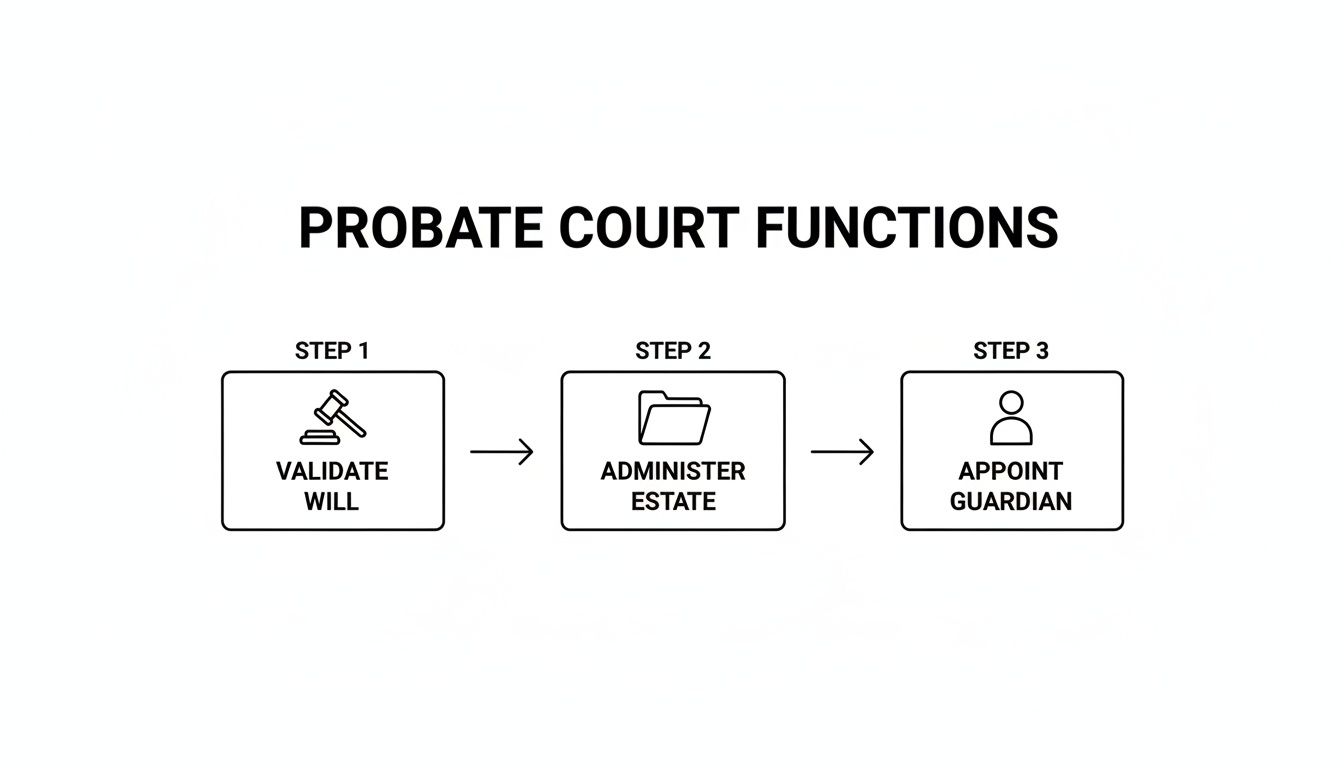
As you can see, validating a will, administering an estate, and appointing a guardian are the core pillars of what the court does. Each one serves a critical role in protecting a family's interests.
Step 1: Filing the Petition to Open the Estate
The first action is filing the correct paperwork, the petition, with the Fulton County Probate Court.
If the person who passed away left a will, you will most likely file a Petition to Probate Will. You must submit the original will along with this petition and a certified copy of the death certificate.
If there is no will, a relative will file a Petition for Letters of Administration. In that scenario, the court appoints an administrator who will manage the estate based on Georgia’s intestacy laws. This initial filing is crucial; it sets the legal groundwork for everything that follows.
Step 2: Appointing an Executor or Administrator
Once the court accepts the petition, it will formally appoint a personal representative to take charge of the estate. If a will exists, this person is called the executor. If there is no will, they are called the administrator.
This individual is then given a document called "Letters Testamentary" (with a will) or "Letters of Administration" (no will). This document is the legal key that grants them the authority to act for the estate, such as accessing bank accounts, communicating with creditors, and managing property.
Step 3: Notifying Heirs and Creditors
Transparency is a huge part of the probate process. The executor or administrator has a legal duty to inform all known heirs and potential beneficiaries that the estate has been opened. This ensures everyone with an interest in the outcome is kept informed.
At the same time, a notice must be published in a local newspaper, like the Fulton County Daily Report. This announcement is for any potential creditors, giving them a specific window of time, usually three months, to come forward and make a claim against the estate for any money they are owed.
This creditor notification period is not optional. Failing to give proper notice can expose the executor to personal liability for the estate’s debts and bring the entire process to a halt.
Step 4: Inventorying Assets and Settling Debts
This is where the real work begins, and it is often the most time consuming part. The executor must find, identify, and value every single asset the person owned at the time of death. This inventory can cover a lot of ground.
- Real Estate: Homes, land, or other property in Fulton County or elsewhere.
- Financial Accounts: Checking and savings accounts, investment portfolios, and retirement funds.
- Personal Property: Cars, jewelry, art, furniture, and other valuable items.
After creating a complete inventory, the executor uses the estate's funds to pay all legitimate debts and final expenses. This includes taxes, funeral costs, and any valid claims filed by creditors. Keeping meticulous records is absolutely essential to provide a clear accounting for the court and the beneficiaries.
If you want to dig deeper into this phase, you can learn more about the steps of estate administration in our detailed guide.
Step 5: Distributing Assets and Closing the Estate
Only after every last debt, tax, and administrative expense has been paid can the remaining assets be distributed to the heirs.
If there is a will, the assets go to the beneficiaries named in the document. If there is no will, the assets are distributed to the legal heirs according to Georgia's laws of succession.
Once everything has been distributed, the executor files a final petition with the Fulton County Probate Court to officially close the estate. This petition includes a final accounting showing all the money that came in and all the money that went out. When the court approves it, the executor is officially relieved of their duties, and the probate process is complete.
Navigating Common Probate Challenges and Disputes
Even when an estate seems straightforward, unexpected hurdles can appear during the probate process. The goal is always a smooth, orderly settlement, but it is not uncommon for families in Fulton County to run into disputes that make things more complicated. Knowing what these potential roadblocks look like is the first step toward getting past them.
This is not meant to be alarming, but to give you a realistic heads up on the complexities of estate administration. Think of these issues as bumps in the road that, with a steady hand and the right strategy, you can navigate. The key is recognizing when a simple family disagreement is turning into a legal battle that needs professional attention.
Contesting a Will in Georgia
In Georgia, the formal legal challenge to a will is called a caveat. This is far more than just disagreeing with who gets what. To successfully contest a will in the Probate Court of Fulton County, an interested party must prove there are valid legal grounds to invalidate the entire document.
Some of the most common grounds for a will contest include:
- Lack of Testamentary Capacity: The argument here is that the person who made the will was not of sound mind when they signed it. Proving this usually requires medical records or testimony showing they did not understand what they owned or who their natural heirs were.
- Undue Influence: This happens when someone pressures or manipulates the person making the will to change it for their own benefit. It essentially claims the will reflects the influencer's wishes, not the true wishes of the person who passed away.
- Fraud or Forgery: A will can be challenged if it was signed based on false information or if the signature itself is a forgery.
- Improper Execution: Georgia law is very strict about how a will must be signed and witnessed. If those specific steps were not followed exactly, the will can be declared invalid.
Resolving these disputes often requires significant evidence and sharp legal arguments. You can learn more about the details involved by reading about the common issues in probate litigation.
Disagreements Among Heirs and Beneficiaries
Disputes are not just about whether the will is valid. Tensions can boil over between beneficiaries, or between the beneficiaries and the executor, often over how the estate is being managed.
For instance, heirs might fight over the value of a house, whether to sell a family business, or how to divide personal items that have deep sentimental value. An executor's decisions can come under fire, leading to accusations of mishandling funds or playing favorites. In these moments, clear communication is everything. When that breaks down, mediation or even court intervention might be the only way forward.
Dealing with Creditor Claims and Hidden Assets
Two other frequent challenges are handling claims from creditors and tracking down all of the estate's assets. The executor has the job of notifying creditors and paying off any legitimate debts. But sometimes, a claim seems questionable, and the executor must decide whether to negotiate a settlement or formally fight it in court.
At the same time, the executor must find and secure every last asset, which can be a real challenge if the deceased was not perfectly organized. This can mean digging through dusty file cabinets or contacting dozens of financial institutions. The history stored within the court itself can be complex. For example, the Fulton County Probate Court recently unearthed 200 year old documents that revealed the painful history of how enslaved people were treated as property in wills and estate papers. Learn more about these historical complexities and the court's findings by exploring the Fulton County government's news release. This discovery is a powerful reminder of how estate documents can hold deep and complicated histories, making the job of an executor both critical and challenging.
Getting the Paperwork Right: Essential Forms and Filing Information
Successfully navigating probate in Fulton County comes down to getting the paperwork right and getting it to the right place. Knowing which forms to use and where to file them can save you a mountain of frustration and prevent needless delays. Let's walk through the practical details you will need to handle the Fulton County Probate Court system.
Your journey starts with choosing the correct petition. Each form is built for a specific purpose and a unique family situation, and picking the wrong one can get your filing rejected, forcing you to start all over.
Key Probate Forms in Fulton County
While no two estates are exactly alike, most probate cases begin with one of a few standard petitions. These are the official documents you use to ask the court to begin the legal process of settling an estate.
- Petition to Probate Will in Solemn Form: This is the primary petition when there is a valid will. It starts a formal process where every heir gets notified before the will is officially accepted by the court. This initial step provides a very strong defense against any challenges down the road.
- Petition for Letters of Administration: When someone passes away without a will (what lawyers call "intestate"), this is the form you will file. It asks the court to appoint an Administrator who will manage and distribute the estate's assets according to Georgia's inheritance laws.
- Petition to Probate Will in Common Form: This is a less formal, faster option that allows an executor to be appointed without immediately notifying all the heirs. The trade off? It leaves the will vulnerable to being contested for up to four years after the fact.
No matter which petition you file, you will need to include specific supporting documents. The two most critical are a certified copy of the death certificate and the original will, if one exists.
Where to File Your Paperwork in Fulton County
Fulton County has a few locations, which is convenient, but you must know which services are offered where. The main courthouse in downtown Atlanta is the hub for all probate matters, while the service centers handle a much more limited set of tasks.
We have put together a quick reference table to help you find the right location for what you need.
Fulton County Probate Court Locations and Hours
| Location | Address | Primary Services | Walk-In Hours |
|---|---|---|---|
| Main Probate Court | 136 Pryor Street SW, Atlanta, GA 30303 | All Probate, Guardianship, Licenses | 8:30 AM – 4:00 PM |
| North Service Center | 7741 Roswell Road NE, Atlanta, GA 30350 | Marriage & Weapons Carry Licenses | 8:30 AM – 4:00 PM |
| South Service Center | 5600 Stonewall Tell Rd, Union City, GA 30349 | Marriage & Weapons Carry Licenses | 8:30 AM – 4:00 PM |
The bottom line is this: if you are starting a new estate, filing petitions, or have a court hearing, you will almost certainly need to go to the main courthouse on Pryor Street. The North and South Service Centers are mainly for things like marriage licenses and do not handle estate administration.
Understanding Filing Fees and Court Costs
When you start a probate case, you will have to pay various court costs and filing fees at the beginning. These costs are considered an administrative expense of the estate, which means you can be reimbursed for them from the estate's assets once you are officially appointed as the executor or administrator.
Filing fees in Fulton County change depending on the petition you are filing and how complex the estate is. A simple petition for a small estate, for instance, will cost less than a formal petition to probate a will. You should also budget for the cost of publishing legal notices to creditors in the local newspaper, which is a required step for most estates.
You can generally expect initial filing fees to be a few hundred dollars, but it is always a good idea to check the court's current fee schedule right before you file to get the most accurate number.
When You Should Partner with a Probate Attorney

While some straightforward estates can be handled without a lawyer, many families find the probate process in Fulton County is far more complex than they first thought. Deciding to hire an experienced probate attorney is a smart, strategic move to protect the estate, the executor, and all beneficiaries from costly errors and needless stress.
Think of an attorney as a professional guide through a very complicated journey. Their job is to bring legal clarity, ensure every step complies with Georgia law, and take the administrative weight off your shoulders. For families in Alpharetta, Roswell, and across North Georgia, that guidance is invaluable during an already difficult time.
Scenarios That Warrant Legal Guidance
Certain situations almost always benefit from professional legal help. If your family is dealing with any of the circumstances below, getting advice early can stop major problems from developing.
These are the red flags we see that often point to a higher risk of disputes, liability, or procedural mistakes that can drag the process out for months, or even years. Having an attorney involved from the start helps manage these risks before they spiral.
You should seriously consider legal counsel in these key situations:
- Contested Wills: If any family member is threatening to challenge the will's validity, you are stepping into a legal fight that demands a skilled hand.
- Complex Assets: Estates that include a family business, commercial real estate, or significant investment portfolios need careful management to protect their value.
- Creditor Disputes: When creditors come forward with questionable claims against the estate, an attorney can step in to validate, negotiate, or formally challenge them.
- Out of State Executors: If you’ve been named executor but live outside of Georgia, keeping up with the local requirements of the probate court fulton county georgia can be nearly impossible without a local legal partner.
An attorney's main goals are to protect the executor from personal liability, ensure assets are distributed fairly and legally, and resolve conflicts before they turn into expensive litigation.
The Value of Experienced Counsel
Ultimately, a good probate attorney provides much more than just legal advice. They offer a steady hand and a clear path forward when things feel overwhelming. They manage the deadlines, prepare and file all the necessary court documents, and communicate with heirs and creditors.
They also provide objective counsel when emotions are running high. This support lets the family focus on grieving and healing, giving you peace of mind that all the legal and administrative details are being handled correctly and efficiently.
Common Questions We Hear About Fulton County Probate
When you are dealing with the loss of a loved one, the last thing you want is a mountain of confusing legal questions. Here are some straightforward answers to the questions we hear most often from families navigating probate in Fulton County.
How long does probate usually take in Fulton County?
An uncontested probate case in Fulton County typically takes between six to twelve months. This timeframe allows enough time for all required steps, such as notifying creditors, inventorying the estate, paying debts, and filing the final paperwork to close the estate. If someone contests the will or if assets are difficult to locate, the process can take much longer.
What happens if there is no will?
When someone dies in Georgia without a will, their estate is considered "intestate." The Fulton County Probate Court will appoint an administrator to manage the estate, and the assets will be divided according to Georgia's intestacy laws. These laws establish a strict hierarchy for inheritance, usually starting with the surviving spouse and children, regardless of what the deceased may have wished.
Can I handle probate myself without a lawyer?
You are legally allowed to represent yourself in a simple probate case. If the estate is small, has no outstanding debts, and all heirs are in complete agreement, it may be possible to manage it on your own. However, the process involves strict deadlines and specific legal forms where small mistakes can cause major delays or even personal liability for the executor. For most estates, especially those with real estate or potential family disputes, working with an experienced probate attorney is a wise decision.
What does an executor have to do?
Being an executor for the probate court fulton county georgia is a significant responsibility with several legal duties. Key tasks include filing the will with the court, creating a detailed inventory of all assets, notifying heirs and creditors, paying all legitimate debts and taxes from estate funds, distributing the remaining assets to beneficiaries as directed by the will, and filing a final report to officially close the estate.
How much does probate typically cost?
The total cost of probate depends on the size and complexity of the estate. Common expenses include court filing fees, the cost of publishing creditor notices, and fees for professional appraisals of property. Attorney fees and compensation for the executor are also factors. Executors are legally entitled to a commission, often around 2.5% of assets coming into the estate and 2.5% of funds paid out. While hiring an attorney is an expense, it often saves the estate money by preventing costly errors.
Working through probate court requires a steady, experienced hand. The team at Miles Hansford Law Firm provides the clear guidance and legal support your family needs to move forward with confidence. To discuss your specific situation, please visit us at https://mileshansford.com.