


Meta Title: Second Marriage Estate Planning Alpharetta GA
Meta Description: Second marriage estate planning in Alpharetta, GA. Protect your spouse, children, and legacy in Fulton and Forsyth County. Schedule a consultation.
Suggested URL Slug: /second-marriage-estate-planning-alpharetta-ga
Schema Recommendations:
- Attorney
- LegalService
- FAQPage
Internal Link Suggestions:
- What is a power of attorney and how can you use it
- What happens when a will is contested
- Estate planning and probate service page
- Family law and divorce service page
- Mediation service page
In Alpharetta, a second marriage often begins with optimism and a quiet worry that never fully leaves. You may be building a life with someone you love while also wondering whether your children from a prior relationship will be protected if something happens to you. That concern is reasonable. It shows you understand that a blended family needs more than a basic will and hopeful assumptions.
For many families in Alpharetta, Johns Creek, Milton, Roswell, and Sandy Springs, the hardest part isn't deciding that everyone matters. It's turning that intent into documents and procedures that work in Georgia. Estate planning after remarriage sits close to family law because property rights, prior divorces, beneficiary forms, and children from different relationships all affect the outcome.
If you're already searching for help near me, the next step is straightforward. Schedule a consultation and speak with a family law attorney who understands how Georgia domestic issues and estate planning risks often overlap. That matters in North Fulton courts and in the practical realities families face after divorce, remarriage, and later probate disputes.
Guidance on Second Marriage Estate Planning in Alpharetta GA
A common Alpharetta scenario looks like this. A couple remarries after difficult divorces, one spouse owns a home before the wedding, both have retirement accounts, and there are adult children on one side and younger children on the other. Everyone wants peace. No one wants a court fight in Fulton County after a death. Yet no one is fully sure whether the old documents still make sense.
That uncertainty can create pressure inside the marriage. One spouse worries about disinheriting children. The other worries about being left financially exposed. Both concerns are legitimate, and both can be addressed with careful second marriage estate planning.
Why the concern is so common in Alpharetta
According to the U.S. Bureau of the Census, more than 40% of married couples in the United States are at least one partner's second marriage, and the same data notes that over 1,000 new stepfamilies are formed daily in the U.S., that blended families account for more than 10% of the total population, and that more than 25% of all children will spend part of childhood in a blended family environment. Those figures point to the same conclusion. This isn't a niche issue. It's a mainstream family planning issue that requires specialized legal strategy.
In practice, the conflict usually isn't about whether a spouse or child should be protected. It's about how to protect both without creating ambiguity.
Practical rule: In a second marriage, "fair" means nothing unless the documents, titles, and beneficiary forms say exactly what happens and when.
The local legal backdrop
In North Georgia, many families first encounter these issues through divorce and post-divorce planning. Georgia no-fault divorce laws, the 30-day minimum waiting period in Georgia, equitable division in Georgia, and alimony or property division terms from a prior case can all affect what a person brings into a second marriage. Parenting plans required by Georgia courts, child custody standards in Georgia, mediation requirements, and temporary hearings often shape the financial obligations that continue after remarriage.
That means estate planning for a remarried client in Alpharetta can't be treated as separate from family law history. A sound plan has to account for prior divorce judgments, support obligations, and the way local practice works in Fulton County Superior Court, Forsyth County Superior Court, and North Fulton courts.
The High Stakes of Remarriage for Your Legacy in Alpharetta
The legal risk starts with Georgia's default rules. If you die with outdated documents or no workable plan, the state applies its own framework. Those rules don't know your family dynamics, your promises to your children, or what you intended for a spouse who joined your life later.
For blended families in Alpharetta and nearby communities like Johns Creek and Milton, that gap between intent and legal effect is where conflict begins.
What Georgia default rules miss
A surviving spouse has legal rights that can disrupt a plan built only on verbal understandings. At the same time, children from a prior relationship may assume they'll inherit certain assets because "that's what Mom wanted" or "Dad always said the house would stay with us." Probate judges don't enforce assumptions. They enforce valid documents, beneficiary designations, and applicable statutes.
A second marriage also raises one issue that surprises many people. In Georgia, stepchildren do not automatically inherit from a stepparent's estate unless they are explicitly named in a will or trust, as explained in this Georgia blended family estate planning discussion. If a client wants a stepchild protected, the plan must say so directly.
Fairness isn't automatic
In a first marriage with shared children, people can often get away with broad language and simple structures. In a second marriage, broad language tends to create ambiguity.
The usual pressure points include:
- The marital home: One spouse wants the survivor to stay there. Children may expect eventual ownership or sale proceeds.
- Separate property brought into the marriage: Inherited assets, premarital investments, and business interests need clear classification.
- Children from prior relationships: They may have emotional expectations but no automatic legal priority unless the documents create it.
- Stepchildren and mutual children: These groups often need different treatment, and the plan has to state that without leaving room for later interpretation.
The fastest way to create a family fight is to leave a blended family with "everyone knows what I wanted."
Why this matters in Alpharetta family planning
Clients in Alpharetta often have layered financial lives. Prior divorce settlements, retirement accounts, jointly titled property, and family support obligations don't fit neatly into a generic estate package. The legal work has to be deliberate, especially where the family may later face proceedings tied to Fulton County or Forsyth County practice.
This local planning also sits beside family law realities. Georgia no-fault divorce laws, equitable division in Georgia, and prior temporary hearings often determine how assets were divided before remarriage. A person may still be operating under support or parenting obligations that affect what can realistically be promised in an estate plan.
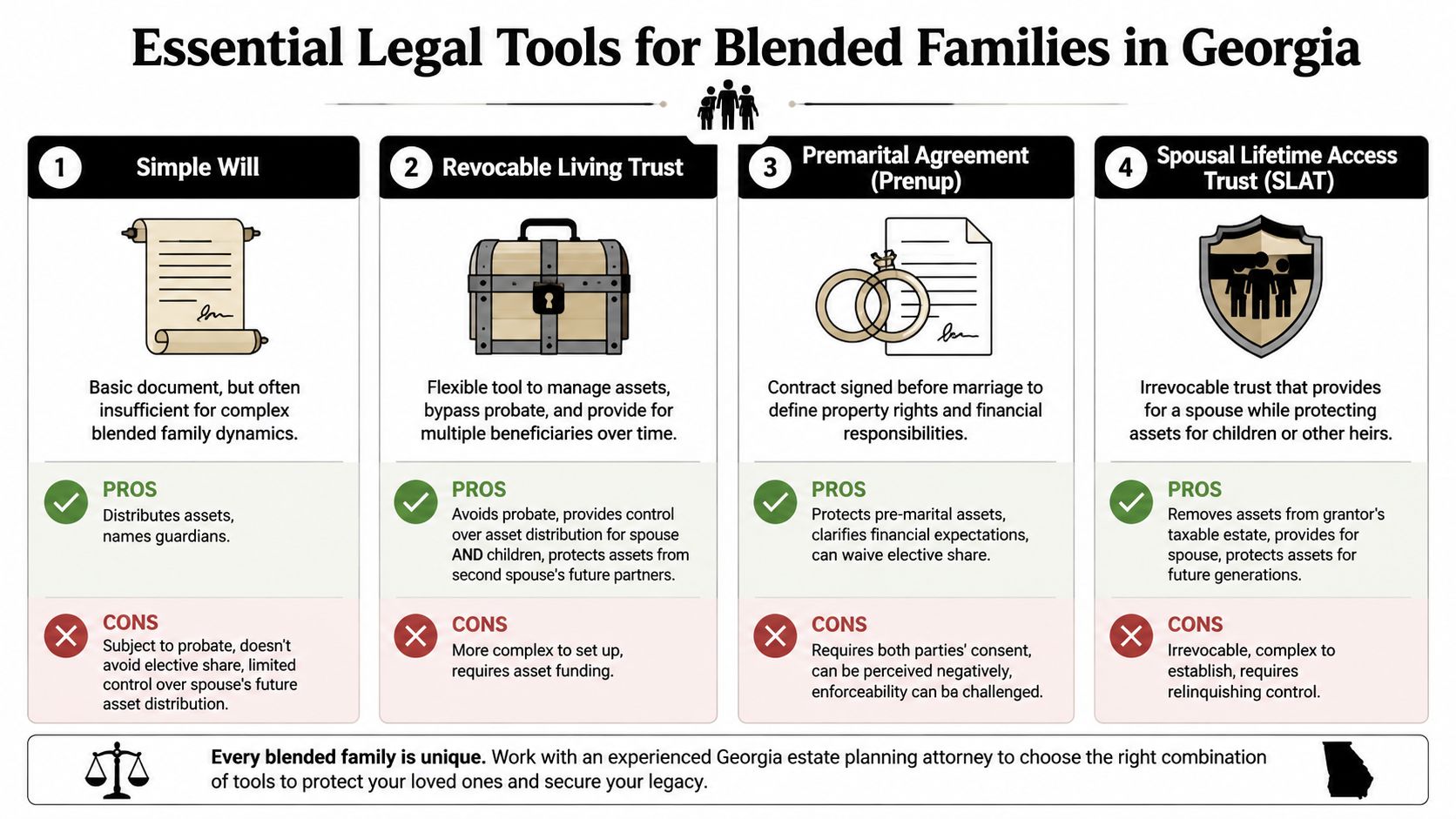
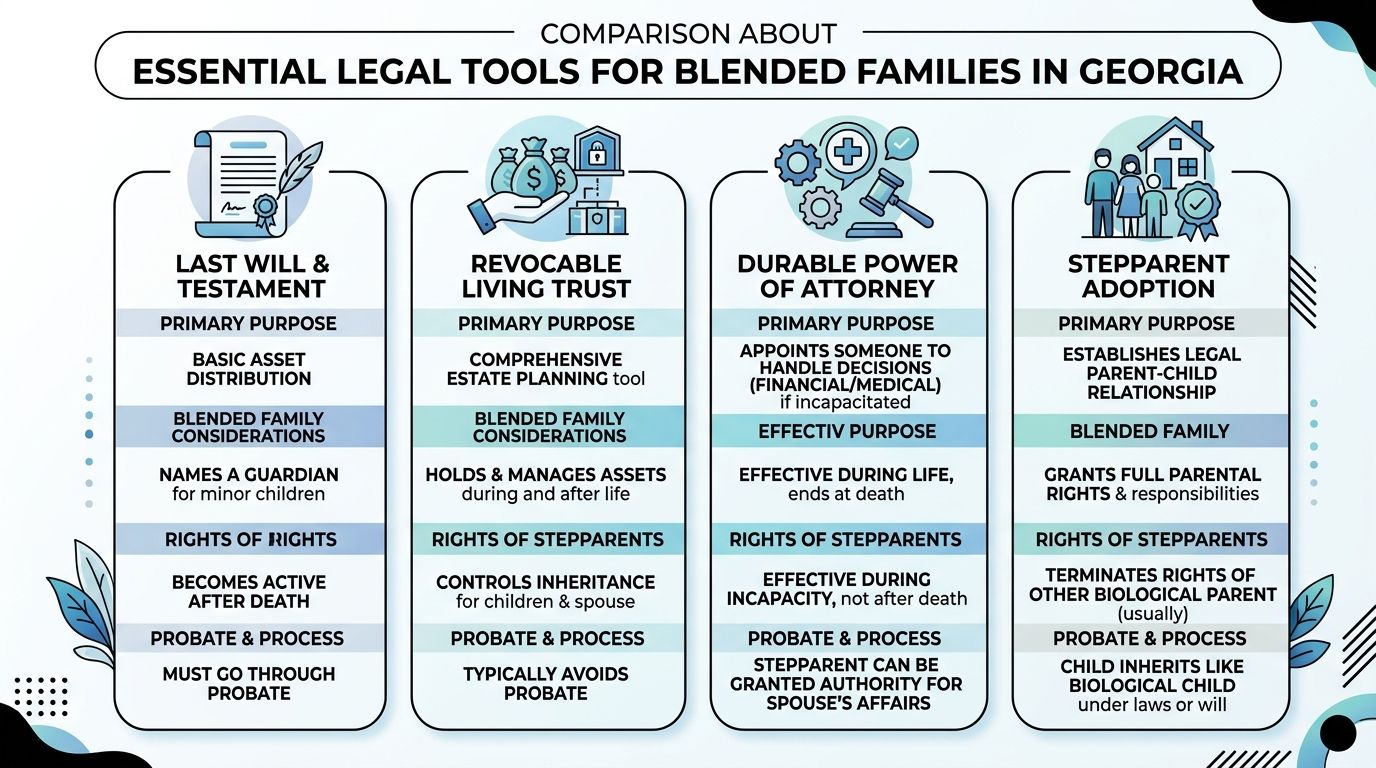
Essential Legal Tools for Blended Families in Georgia
A second-marriage plan often fails in a very ordinary way. One spouse dies, the survivor needs access to cash and the house, and the children from the first marriage assume the paperwork protects what their parent meant for them. Then the family learns the beneficiary forms point one way, the will points another, and the probate file in Fulton or Forsyth County becomes the place where everyone argues about intent.
That result is preventable, but only if the documents are built to work together.
Why a will alone often fails
A will still matters. It names the executor, covers assets that have no beneficiary designation, and gives the probate court a roadmap. In blended families, though, a will rarely carries enough weight by itself.
Retirement accounts, life insurance, payable-on-death accounts, and many jointly held assets pass outside the will. If those designations were never updated after remarriage, divorce, or a refinance, the probate court cannot rewrite them because the family believes a different outcome would be fair. I see this problem often with clients who own property in Alpharetta but whose estate administration may later land in Fulton County or Forsyth County, where clerks and judges expect the paperwork to say exactly who has authority and who receives what.
A second problem is control. Leaving everything outright to a surviving spouse may provide comfort in the short term, but it also gives that spouse legal power to change the final destination of those assets.
How a QTIP trust works in real life
A Qualified Terminable Interest Property trust, or QTIP trust, is often the cleanest answer when one spouse wants to support the survivor and still protect a separate line of inheritance for children from an earlier marriage. The surviving spouse can receive income for life under the trust terms, while the principal stays protected for the beneficiaries named by the first spouse to die. The IRS discusses that structure in its publication on estate administration and QTIP treatment.
Used properly, a QTIP trust solves a specific family problem. The surviving spouse has financial support. The children know the remainder cannot be redirected by a later will, a new marriage, or pressure from other relatives.
The drafting matters. In Forsyth and Fulton probate matters, conflict often starts because the trust says a spouse may live in the house, but never explains who pays taxes, insurance, repairs, or whether the trustee can sell and buy a replacement home. A good plan answers those questions before anyone files a petition.
The tools that need to line up
For blended families in North Georgia, the plan usually includes several separate documents and a procedure for keeping them aligned:
- A custom will that supports the trust plan, names the right executor, and avoids vague gifts that invite objections in probate.
- A trust structure that spells out who benefits now, who inherits later, and how the trustee handles the home, distributions, and final accounting.
- Updated powers of attorney and advance directives so the right person can act during incapacity without forcing the family into an emergency court process. Clients who want the practical mechanics can review how a Georgia power of attorney can be used in real situations.
- Life insurance review to create liquidity, replace an inheritance for one branch of the family, or offset the fact that one child receives a business interest or real estate. Readers comparing policy issues may find The Ephraim Group useful.
- Beneficiary designation review for IRAs, 401(k)s, pensions, annuities, and transfer-on-death accounts, with copies kept with the estate planning file.
One practical layer many families need is a living beneficiary communication protocol. I recommend a controlled process, not an open family debate. That usually means identifying which beneficiaries should receive a summary during your lifetime, what they are told about the role of the spouse, trustee, and children, and where the signed documents and account lists are kept. The goal is not full disclosure of every dollar. The goal is to reduce surprise, which is what drives many probate objections.
Common drafting mistakes that create trouble later
The recurring mistakes are procedural, not dramatic.
A client signs a trust and never retitles the brokerage account. A will names one child as executor, but the financial power of attorney puts a different child in charge during incapacity, and neither child knows the plan. A deed leaves the marital residence in joint tenancy even though the trust says the house should be held for the survivor's use and then pass to the first spouse's children. In court, those mismatches are expensive.
Miles Hansford Law Firm works with second-marriage and blended-family clients on custom estate plans built for these exact issues, including plans that account for future probate administration in North Georgia counties.
What tends to work and what tends to fail
| Tool or approach | Usually works when | Often fails when |
|---|---|---|
| Simple will | Assets are limited and beneficiary designations are already consistent | There are prior-marriage children, real estate questions, or competing expectations |
| QTIP trust | A spouse needs support and the first spouse wants to preserve the remainder for selected beneficiaries | The trust is vague, unfunded, or silent about the house and trustee discretion |
| Direct beneficiary forms only | The asset mix is simple and every form has been reviewed recently | Old forms conflict with the plan or name people who no longer fit the family structure |
| Living beneficiary communication protocol | The family needs clarity without handing over control during life | No one is told anything, or everyone is told something different |
| Verbal family understanding | Rarely | Emotions rise after death and no document proves what was intended |
Proactive Strategies for Asset Protection in Cumming
Second marriage estate planning isn't only about what happens at death. It also has to account for what happens if the remarriage doesn't last. That is why prenuptial and postnuptial agreements matter so much in Cumming, Suwanee, Dawsonville, and other North Georgia communities where clients may bring substantial separate property into a new marriage.
Remarriage carries a higher risk of legal disruption than many couples want to admit.
Why agreements matter before there is conflict
Psychology Today reports that approximately 67% of second marriages end in divorce and 73% of third marriages end in divorce. Those numbers don't mean a marriage is doomed. They do mean wise planning should anticipate the possibility of divorce instead of treating it as too impolite to discuss.
A prenup or postnup can define what is separate property, what becomes marital property, and how certain claims will be handled. For a parent with children from a first marriage, that can protect inherited wealth, premarital business interests, family real estate, or investment accounts that were always intended to pass along a bloodline.
What these agreements can actually do
A useful marital agreement in a blended-family context often addresses:
- Premarital assets: homes, brokerage accounts, retirement savings, inherited funds
- Business ownership: closely held companies, professional practices, partnership interests
- Appreciation and income: whether growth on separate property remains separate
- Waivers and expectations: rights a spouse may agree to limit or define in writing
- Coordination with an estate plan: making sure the agreement and estate documents don't contradict each other
Clients with high-asset divorce histories in Cumming and Alpharetta often already understand how much temporary orders shape the outcome of a case. That same principle applies here. Early documents influence later outcomes.
Strategic point: A prenup isn't a prediction of failure. It's a written record of what both spouses agree is fair before pressure, illness, or litigation changes the conversation.
The family law connection in North Georgia
Local family law experience is particularly relevant. Georgia no-fault divorce laws, equitable division in Georgia, alimony, and property division all affect how courts later evaluate marital versus separate assets. In contested divorce matters, temporary hearings often frame possession, support, and use of property long before a final result. Mediation requirements also influence how these disputes resolve.
For clients searching for a family law attorney near me because they're considering remarriage after a difficult divorce, this overlap is critical. If you want to protect your assets before filing in a future dispute, or protect your legacy before remarrying, the planning needs to start now, not after assets have been commingled.
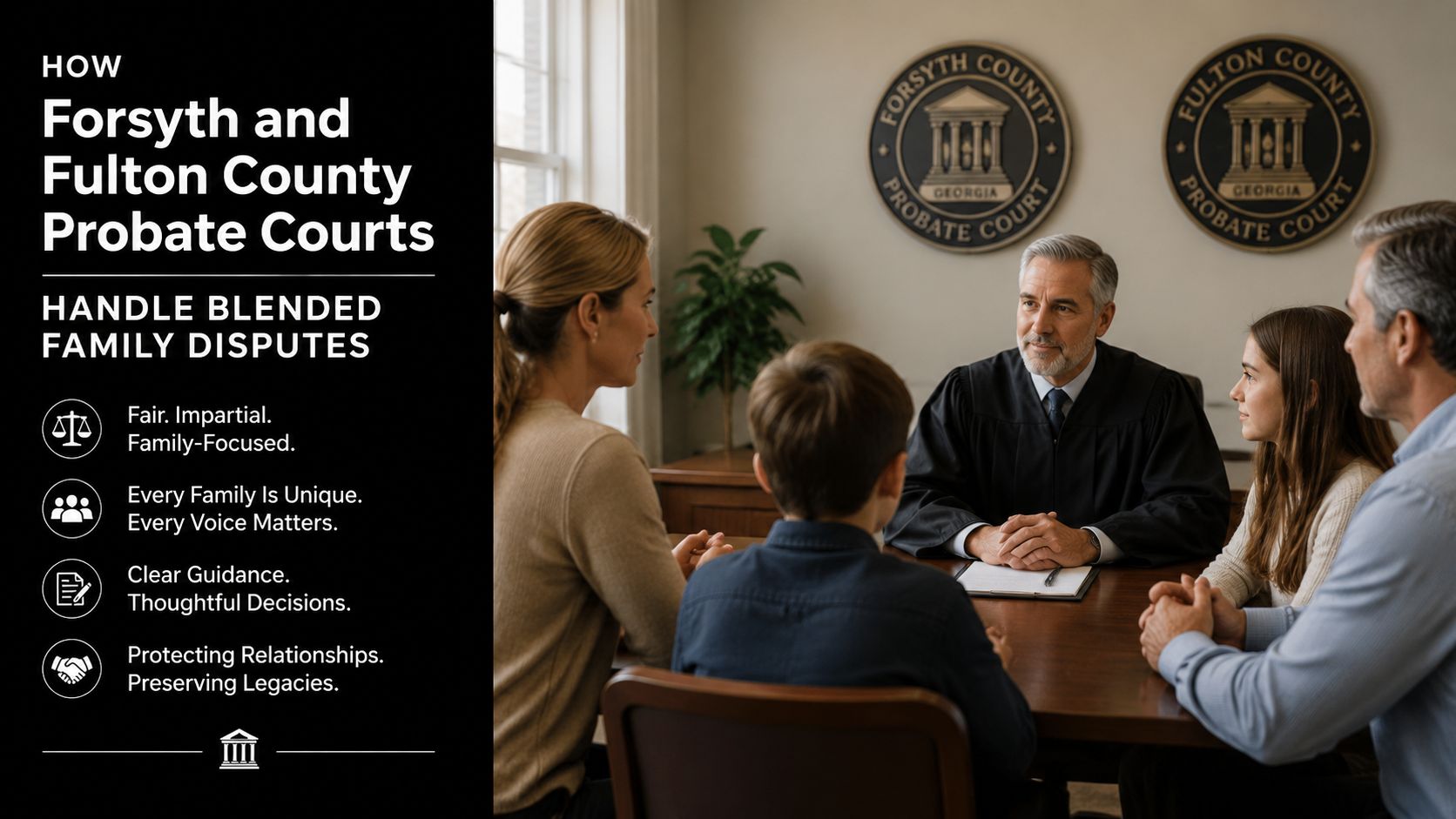
How Forsyth and Fulton County Probate Courts Handle Blended Family Disputes
A common Alpharetta scenario goes like this. A husband in a second marriage dies with a will that leaves his estate to a trust for his current wife during her life, then to his children from the first marriage. Within weeks, the wife learns the IRA still names the former spouse, one son files a caveat because he believes Dad was pressured to change the will, and no one agrees on who can enter the house or remove personal items. By the time the family reaches the courthouse, the legal problem is only part of it.
That is what blended-family probate fights look like in Forsyth and Fulton County. They start with one unclear document, then spread into title questions, beneficiary disputes, access to records, and arguments over who controls the next step.
Where these cases usually break down
In my experience, the first fault line is usually between probate assets and non-probate assets. Clients often assume the will controls everything. It does not. Retirement accounts, life insurance, and some jointly held property pass under their own rules, which is why managing life insurance beneficiaries is not clerical cleanup. It is part of preventing litigation.
Other repeat problem areas include:
- A will that conflicts with beneficiary designations or deed language
- A surviving spouse seeking year's support while adult children argue the request goes too far
- An executor or administrator accused of favoring one side of the family
- A trust that gives a surviving spouse access to funds but does not define limits clearly
- Personal property disputes involving jewelry, firearms, family heirlooms, and items promised informally
- Stepchildren who expected an inheritance but were never legally named
What procedure looks like in Forsyth and Fulton County
Procedure matters here because both counties move families into formal positions quickly. In probate court, the early filings create an advantage. If someone petitions to probate a will in solemn form, heirs receive notice and have a limited window to object. If no one objects in time, later challenges become much harder. If there is no valid will, the fight shifts to who should serve as administrator and how Georgia intestacy rules apply to the surviving spouse and biological children.
Forsyth County cases often feel more personal because the parties know each other, the property is local, and the history is already well known within the family. Fulton County cases can become more layered because families often have assets in multiple counties, prior marriages, and financial accounts spread across institutions. The court process is still manageable, but only if the documents line up and the right evidence is gathered early.
A contested matter may involve:
- A caveat to the will
- A petition for year's support
- A dispute over letters testamentary or letters of administration
- Requests for accountings, inventories, or removal of a fiduciary
- Separate superior court litigation over trusts, deeds, or fiduciary misconduct
Families trying to assess the risk of a challenge should review what happens when a will is contested. The probate file is rarely the whole dispute.
The pitfall many blended families miss
The court can decide who has legal authority. It cannot fix mixed messages left behind by the person who died.
That is why I recommend a living beneficiary communication protocol for second-marriage clients with children on both sides. The protocol is simple and practical. Confirm each beneficiary designation in writing. Match the estate plan to the account paperwork and deed records. Identify who will serve in each role. Decide what the spouse should know now, what adult children should know now, and what should be documented for later. Then keep a dated summary with the estate file. This does not eliminate every dispute, but it removes the most common claim I hear after a death: "That is not what Mom told me."
Why local drafting has to anticipate local procedure
A generic blended-family plan often fails because it was written as if every asset will pass through one clean probate administration. That is not how these cases unfold in Alpharetta, Cumming, Milton, Roswell, or Sandy Springs. One county may handle the probate estate while another county holds records of real property. A prior divorce decree may affect obligations tied to the same asset now being disputed. A surviving spouse may need immediate liquidity while children want preservation and oversight.
Good drafting accounts for those trade-offs before anyone files anything. It names fiduciaries carefully, gives clear distribution standards, coordinates deeds and beneficiary forms, and leaves a record that makes sense to a Forsyth or Fulton County judge reading it for the first time.
Your Second Marriage Estate Planning Checklist
A second-marriage estate plan usually breaks down in a predictable way. The will says one thing, the beneficiary form says another, the deed was never updated, and no one can tell from the file what was intentional. In Forsyth and Fulton County probate matters, that kind of inconsistency invites delay, suspicion, and expensive hearings.

Gather the full record first
Start with paper, not assumptions. Pull the current will, trust, financial powers of attorney, advance directive, deeds, beneficiary designations, retirement account statements, life insurance records, business documents, and any premarital agreement.
Then add the family law file. Prior divorce decrees, settlement agreements, alimony provisions, child support terms, and insurance obligations still matter. I often find the core problem here. A client believes remarriage changed everything, but an older order or beneficiary designation is still controlling part of the outcome.
Work through the checklist in order
- List each asset and how it is titled. Separate premarital property, jointly held property, and assets you want reserved for children from a prior marriage.
- Mark which assets pass outside probate. Retirement accounts, transfer-on-death accounts, payable-on-death accounts, and life insurance usually pass by contract, not by will.
- Check every beneficiary designation against the plan. If the trust protects the children but the account still names one person outright, the form usually wins.
- Review deeds and survivorship language. In North Georgia, families are often surprised to learn the house or another account passes automatically and never enters the estate file the way they expected.
- Decide whether a trust should hold the spouse's benefit. If the goal is support for a surviving spouse and later preservation for children, put that standard in writing with clear trustee instructions.
- Name stepchildren directly if they are meant to receive anything. Georgia law does not add them by implication.
- Confirm who will serve in each role. Executor, trustee, and agent under power of attorney should be chosen for judgment and neutrality, not just family seniority.
- Review liquidity. A surviving spouse may need cash quickly for housing, taxes, and final expenses, while children may want long-term protection of investment or real estate assets.
- Update incapacity documents. In blended families, incapacity disputes often start before any probate filing.
For readers handling the insurance side of this process, this guide to managing life insurance beneficiaries gives a useful overview of the administrative side of beneficiary changes.
Build a living beneficiary communication protocol
Families do better when the plan is explained before a medical crisis or death. That does not require disclosing every account balance. It does require a clear process for sharing the broad structure of the plan with the right people.
A practical protocol should answer four questions:
- Who gets informed: spouse, adult children, trustees, executors, and any child who is being treated differently for a stated reason
- When the conversation happens: after signing, after a major amendment, or after a serious health event
- What is shared: who serves in each role, whether a trust controls distributions, whether certain assets pass outside probate, and whether a prior divorce order affects any property
- How the record is kept: dated summary, signed acknowledgment, attorney memo for the file, or written instructions stored with the estate documents
That record matters. If a dispute reaches probate court in Cumming or Atlanta, a clean file with dated explanations gives the fiduciary something concrete to rely on.
Add two local checks before you sign
First, confirm where each county record sits. A family may open a probate matter in one county while the deed records, business filings, or related court orders sit somewhere else. If real property is in one county and the probate administration is in another, loose drafting creates avoidable friction.
Second, test whether a stranger could administer the file from the documents alone. A Forsyth or Fulton County judge will not know the family history. The paperwork has to show the plan clearly without requiring one child, one spouse, or one lawyer to explain what the decedent "really wanted."
Review on a schedule
Review the plan after remarriage, a home purchase or sale, retirement, a major account change, a death in the family, a move, or a significant shift in relationships. Put the review date on the calendar. Memory is not a system.
Why North Georgia Families Trust Miles Hansford
Families in Alpharetta, Cumming, Johns Creek, Milton, Suwanee, Dawsonville, Roswell, Sandy Springs, and Canton usually aren't looking for a dramatic legal pitch. They want someone who can look at the full picture calmly. That means prior divorce orders, current family dynamics, probate risk, and the practical way a dispute would unfold in Fulton County or Forsyth County.
That need for calm strategy is exactly why blended-family planning has to be handled with care. A second marriage often involves competing but legitimate interests. A spouse may need present security. Children may need long-term protection. Stepchildren may need to be named intentionally. The legal work has to reduce ambiguity rather than add to it.
What clients in North Georgia usually need most
Clients in this situation often need three things at once:
- Clear advice: what works, what doesn't, and where the risks are
- Local judgment: familiarity with Fulton County Superior Court, Forsyth County Superior Court, and North Fulton courts
- Protective planning: a structure that lowers the chance of later litigation inside the family
This is also why experience in family law matters even in an estate planning conversation. Georgia no-fault divorce laws, equitable division in Georgia, custody standards, parenting plans required by Georgia courts, mediation requirements, and temporary hearings shape many second-marriage financial realities long before probate is ever an issue.
If you're in Alpharetta or Cumming and you've been putting this off because the conversation feels delicate, that's normal. It still needs to happen. The right plan doesn't just transfer assets. It protects relationships.
FAQs on Second Marriage Estate Planning in Georgia
| Question | Answer |
|---|---|
| Q: Do stepchildren inherit automatically in Alpharetta, GA? | A: No. In Georgia, stepchildren don't automatically inherit from a stepparent unless they are specifically included in a will or trust. That issue surprises many blended families in Alpharetta and Fulton County, especially when they assumed informal family understandings would control the outcome. |
| Q: Can a will alone handle second marriage estate planning in Cumming, GA? | A: Sometimes, but often not well. In Forsyth County families with prior children, retirement accounts, life insurance, or separate property, a will by itself may leave too much unresolved. Trust planning and beneficiary coordination are often needed to prevent conflict and inconsistent results. |
| Q: What is a QTIP trust under Georgia planning practice? | A: A QTIP trust can provide income to a surviving spouse for life while preserving the remaining principal for beneficiaries chosen by the first spouse to die, often children from a prior marriage. It's frequently used in blended-family planning because it separates support from final control. |
| Q: Why do beneficiary forms matter so much in North Georgia estates? | A: Because those forms often control who receives non-probate assets, even if the will says something different. In Alpharetta and Cumming families, outdated IRA, 401(k), and life insurance designations are a common reason the estate plan on paper doesn't match the actual result. |
| Q: Should a prenup be part of second marriage estate planning in Georgia? | A: In many cases, yes. A prenuptial agreement can clarify what remains separate property and help protect assets intended for children from a first marriage. It also fits with broader Georgia family law concerns involving equitable division, property classification, and future divorce risk. |
| Q: How do local court procedures affect planning? | A: A lot. If a dispute reaches probate or related litigation, local practice in Fulton County Superior Court, Forsyth County Superior Court, and North Fulton courts affects timing, procedure, and cost. Planning with those realities in mind can reduce the chance that your family ends up in court at all. |
| Q: Does family communication really matter in a blended-family estate plan? | A: Yes. Many disputes begin because children or a surviving spouse feel blindsided after a death. A documented communication protocol can reduce suspicion, explain why the plan was structured a certain way, and make later fiduciary administration more manageable for everyone involved. |
| Q: Why mention divorce and custody issues in an estate planning article? | A: Because second marriage planning often starts after divorce. Georgia no-fault divorce laws, the 30-day minimum waiting period in Georgia, equitable division, child custody standards, parenting plans, mediation requirements, and temporary hearings all shape the financial and family landscape a remarried client brings into the estate plan. |
If you're trying to protect a new spouse without cutting out children from a prior relationship, now is the time to put a clear plan in place. Miles Hansford Law Firm helps North Georgia families address the legal and family dynamics that make second marriage estate planning more delicate than a standard will package. Schedule a consultation, speak with a family law attorney, and get practical guidance for Alpharetta, Cumming, Forsyth County, Fulton County, and the surrounding North Georgia communities.