


Meta Title: Separation Laws in Cumming, GA
Meta Description: Learn separation laws in Cumming, GA, including separate maintenance, Forsyth County court process, and strategic next steps for families.
Suggested URL Slug: /separation-laws-in-cumming-ga
If you're in Cumming, Alpharetta, Johns Creek, or Milton and your marriage feels like it's reached a breaking point, you're probably carrying several fears at once. Where will the children stay? Who pays the bills? Whether moving out is a mistake. Whether staying in the same house makes separation impossible. Whether one bad conversation could affect everything that follows.
Georgia family law gives you options, but they aren't always intuitive. Georgia does not recognize formal legal separation the way many people expect. Instead, the law provides a process called separate maintenance, and that distinction matters in real life for families in Forsyth County and Fulton County. It affects support, custody, property issues, and the timing of any later divorce.
This guide is written for people trying to make careful decisions under pressure. If you're searching for answers about separation laws in ga, the goal is clear. Help you understand what protects you, what leaves you exposed, and what steps usually make the most sense in North Georgia courts.
Your Guide to Navigating Separation Laws in Cumming GA
In Cumming, GA, many people start this process believing they need to choose immediately between staying in the marriage or filing for divorce. That isn't always true. Some families need time, structure, and court-enforceable rules before they decide whether the marriage will end.
Georgia law is unusual here. The state does not offer a formal legal separation status. Instead, spouses can seek separate maintenance, which lets them address issues like support, custody, and property division while remaining legally married. That can matter if health insurance, taxes, religious concerns, or immigration issues are part of the picture.
For many families in Forsyth County, the first practical question isn't "Should I divorce now?" It's "How do I stabilize this situation safely and legally?" That usually means slowing down and getting clear on three points:
- Living arrangements: You may still qualify for relief even if you're under the same roof.
- Children and finances: Informal promises often fail when stress rises.
- Court strategy: Early orders can shape what happens later in divorce court.
Practical rule: If custody, support, or access to money is already disputed, waiting too long usually makes the situation harder, not easier.
If you're overwhelmed, that's normal. The next best step is to get clear advice about your specific facts before you agree to custody terms, move assets, or leave the home.
Why Understanding Separation Is Critical for Your Future in North Georgia
In North Georgia, separation isn't just emotional distance. It's often the period when the most important patterns of your case start forming. That includes where the children sleep, who pays which bills, who controls accounts, and whether one spouse starts setting the narrative before the court hears the full story.

The stakes are real in Cumming and Alpharetta
Georgia's projected divorce rate is approximately 3.0 per 1,000 people, and in 2024 divorces in Georgia fell 1.1% to 13,520, alongside 21,653 marriages according to Georgia family law statistics for parents in 2025. That same source notes that over 2,400 divorces occur daily in the United States, 60% involve children under 18, and 25% of custody cases in Georgia proceed to trial despite mediation requirements.
Those numbers matter because they reflect local reality. Separation disputes are common. Child-related conflict is common. And many cases don't stay amicable just because they started that way.
Early choices often become the working status quo
In Forsyth County Superior Court and Fulton County Superior Court, judges often need to make temporary decisions before a final resolution exists. If one parent has been handling most school transportation, medical appointments, or weekday overnights during separation, that pattern can become influential later.
The same is true financially. If one spouse informally pays certain obligations while the other falls behind or starts moving money without oversight, cleaning that up later becomes harder and more expensive.
Consider what usually goes wrong during an unplanned separation:
- People rely on verbal deals: Those agreements may collapse as soon as conflict rises.
- One spouse controls information: That can involve bank access, debt, business records, or parenting schedules.
- The children absorb uncertainty: Inconsistent routines often create avoidable conflict that later spills into custody litigation.
Separation is often the point where a marriage stops functioning, but the legal consequences start accelerating.
A cooling-off period can still be a legal phase
Many people in Roswell, Suwanee, Sandy Springs, and Dawsonville describe separation as a pause. Sometimes it is. But if the pause includes parenting disputes, uneven access to money, or allegations of misconduct, it becomes a legal phase that deserves planning.
Georgia also uses no-fault divorce, and the law requires a 30-day waiting period after filing based on irretrievable breakdown under no-fault grounds, as discussed in this overview of legal separation in Georgia. That doesn't mean the period before filing is legally irrelevant. In practice, it often sets the tone for everything that follows.
If you're searching for a family law attorney near me because things are changing quickly, that instinct is usually right. Temporary decisions can become lasting ones.
The Critical Distinction Legal Separation vs Living Apart in Georgia
The biggest point of confusion in separation laws in ga is this: Georgia does not recognize formal legal separation in the traditional sense. The formal court process is called separate maintenance. Moving into another bedroom, another home, or even another city does not create a court order by itself.
That difference matters because one path gives you structure. The other mostly gives you uncertainty.
What the law allows in Georgia
Under Georgia law, spouses may seek separate maintenance if they intend to live apart, and that can still be true even while sharing a residence. The court can address alimony, custody, child support, and property-related issues while keeping the marriage intact. That overview is explained in this discussion of legal separation versus divorce in Georgia.
For many families in Cumming and Alpharetta, that's the right fit when divorce feels premature but living without court protections is too risky.
Living Apart vs Separate Maintenance in Georgia
| Feature | Informal Separation (Living Apart) | Formal Separate Maintenance |
|—|—|
| Legal status | Still married, with no court order defining rights | Still married, but court can enter enforceable orders |
| Custody and parenting time | Often handled informally and vulnerable to conflict | Can be formally addressed through court orders |
| Child support | No automatic enforceable amount | Court can order support |
| Alimony or spousal support | No enforceable framework unless ordered | Court can address support while spouses remain married |
| Property and debt issues | Informal handling often creates confusion and risk | Court can resolve core financial issues without ending the marriage |
| Health insurance and tax status | Marriage remains intact, but there may be no order protecting day-to-day terms | Marriage remains intact, which can help preserve certain marital benefits |
| Enforcement | Limited if one spouse stops cooperating | Violations can be enforced through the court |
| Future divorce positioning | Weak documentation often hurts later | Clear orders and records usually create a stronger framework |
What works and what usually does not
Living apart can work if both spouses are unusually cooperative, transparent, and consistent. That's not the norm once custody or money becomes contested.
Separate maintenance tends to work better when there is:
- A parenting dispute: Georgia courts expect clarity, not vague understandings.
- A support problem: One spouse needs immediate structure for bills, child expenses, or alimony.
- Asset protection concerns: Informal separation rarely stops bad financial behavior.
- A reason to stay married legally: Insurance, tax filing, or personal beliefs may matter.
What usually fails is the middle ground where spouses act separated but never document expectations. That's where missed payments, parenting conflict, and avoidable accusations tend to grow.
A court order doesn't fix every family problem. It does create rules, deadlines, and consequences. In separation cases, that often makes the difference.
One more point matters. Being "separated" socially is not the same as being in a bona fide legal state of separation. In Georgia, facts matter. Conduct matters. Documentation matters.
How to File for Separate Maintenance in Cumming GA
In Cumming, the process starts in Superior Court. For most local families, that means the Forsyth County Superior Court if venue belongs there. Alpharetta cases may proceed through Fulton County Superior Court depending on where the parties reside. The paperwork and deadlines matter, but the larger issue is strategy. A rushed filing with weak requests can create problems that are hard to unwind.
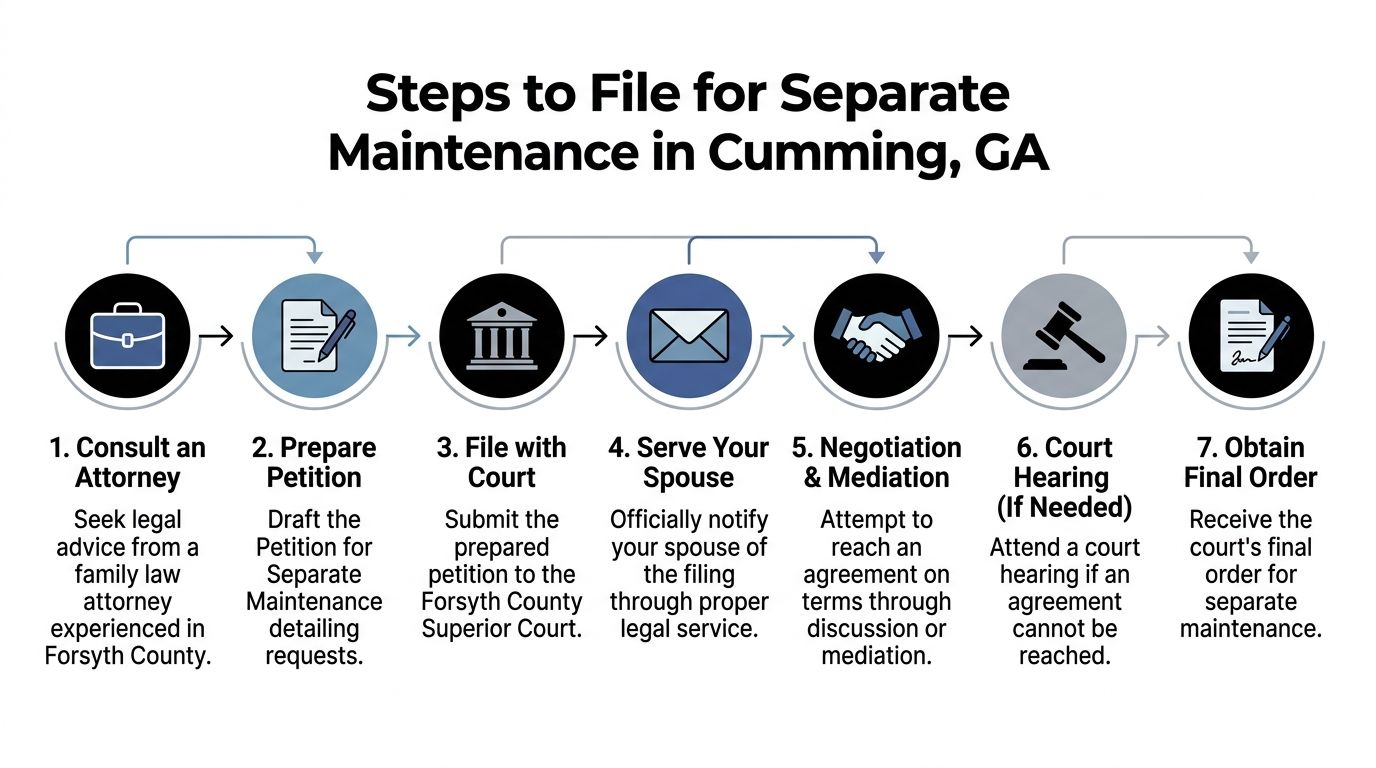
Step one in Cumming GA starts with residency and venue
A separate maintenance case is filed in the Superior Court of the county where one spouse resides. Georgia practice also looks closely at whether there is a real intent to live separately. That does not always require two residences.
You can still meet the concept of living separately while under one roof if the marital relationship has ended in practice. In real cases, that may mean separate bedrooms, separate routines, and no marital relationship even though finances or children make two households impossible right away.
The petition has to be specific
The filing is usually a Petition for Separate Maintenance. It should do more than announce that the marriage is in trouble. It should ask for concrete relief.
That may include:
- Temporary child custody terms: A workable parenting schedule, exchanges, holidays, and decision-making authority.
- Child support relief: Support requests tied to Georgia's child support framework.
- Spousal support: If one spouse needs help maintaining stability during separation.
- Use of property or control of accounts: Especially where one spouse has greater financial access.
- Protective restraints: In cases involving asset movement, harassment, or instability.
A vague petition creates an advantage for the other side. A careful petition frames the case from the start.
Service matters more than many people expect
After filing, the other spouse must be properly served. Until service is complete, the court's power to move the case forward can be limited. This sounds procedural, but it affects momentum.
If your spouse is avoiding service or has already left the area, that issue should be addressed quickly. Delay at this stage often sets off avoidable delay everywhere else.
Temporary hearings are where pressure shows up
Georgia separate maintenance practice mirrors divorce in important ways. Courts can enter temporary orders that deal with support, custody, and protection of assets while the case is pending. The basic framework is described in this Georgia legal separation overview.
Temporary hearings often drive the emotional temperature of the whole case. That's where each side tests the other side's records, credibility, and preparedness.
Bring structure to that stage:
- Gather financial documents early. Income information, account records, debts, insurance information, and recurring expenses matter.
- Build a parenting timeline. School routines, doctor visits, activities, and actual caregiving patterns often matter more than broad claims.
- Stop informal side deals. Text-message arrangements tend to collapse.
- Protect digital and financial access. Preserve records without hiding or destroying anything.
Mediation is often part of the path
In Georgia family cases, mediation is commonly required before trial. That includes many disputes in Forsyth and Fulton. Mediation can be productive, but only when the facts are organized and the temporary situation is understood.
A weak or undocumented position rarely improves just because the parties sit in separate rooms with a mediator.
Bring documents, a proposed parenting plan, and a realistic objective to mediation. Without those, mediation often becomes expensive drift.
What many people misunderstand about filing
People often think filing for separate maintenance means they are choosing against divorce forever. That's not true. It means they are asking the court for structure while the marriage remains legally intact.
For some families in Suwanee, Canton, Roswell, and Alpharetta, that becomes a bridge to reconciliation. For others, it becomes the foundation for a later divorce with cleaner records and fewer surprises.
Strategic Impact of Separation on Your Alpharetta Divorce Case
In Alpharetta, the separation phase often decides more than clients expect. A temporary arrangement can become the baseline that everyone later argues from. That doesn't mean every temporary order becomes final. It does mean the court starts observing patterns, and those patterns are hard to ignore once they settle in.

Child custody and parenting plans in Alpharetta cases
Georgia courts focus on the child's best interests, and courts expect a parenting plan in custody matters. In practice, a temporary schedule often becomes the starting point for final negotiations because it shows what the child has already been living with.
If you agree to a schedule that doesn't reflect reality, or one that sidelines your role as a parent, fixing that later can be difficult. Judges in Fulton County custody hearings want specifics: School-week structure, holiday exchanges, transportation, communication, decision-making. Vague claims like "we'll work it out" usually age badly.
A better approach is to create a plan that reflects actual logistics:
- School and daycare routines
- Medical and therapy appointments
- Holiday and summer allocation
- Pickup and drop-off details
- Methods for parent communication
If the temporary parenting plan is stable and child-centered, it can help. If it's sloppy, one-sided, or impossible to follow, it often becomes a source of conflict.
Child support follows the case early
Under O.C.G.A. § 19-6-10, a judge may issue temporary child support and alimony orders on just three days' notice, as reflected in Georgia Code section 19-6-10. That same authority matters because temporary support can stabilize a household fast.
Georgia child support is tied to the state's support framework, not to rough guesswork. If one parent has been informally paying some expenses, that doesn't mean the amount is appropriate or sustainable.
Support strategy during separation usually turns on documentation:
- income records
- health insurance costs
- childcare expenses
- extraordinary child-related expenses
- proof of who is paying what now
If those records are incomplete, the case becomes harder to present cleanly.
Alimony can be shaped before divorce is filed
Temporary spousal support is one of the clearest examples of why separation is not just a pause. Once the court enters a temporary support structure, both sides start adjusting behavior around it.
Georgia courts consider 16 factors for alimony under the statute discussed in the same Georgia Code source above. Marriage length matters. Financial need matters. Ability to pay matters. Conduct can matter in some cases.
A spouse who needs support should not assume patience will be rewarded. A spouse who may pay support should not assume informal bill-paying will be credited fairly without records. If you're trying to understand how these issues are evaluated in practice, this alimony calculation resource is a useful starting point.
Temporary support often becomes the financial rhythm of the case. Once that rhythm starts, changing it usually requires evidence, not frustration.
Equitable division starts before the final decree
Georgia uses equitable division, not automatic equal division. That means the court looks for a fair result under the circumstances rather than splitting everything down the middle by default.
In separation, this becomes practical very quickly. Who is using the home? Who is paying the mortgage? Whether one spouse is taking on new debt. Whether a business owner is changing compensation patterns. Whether retirement funds or cash accounts are being touched.
Informal separation often creates dangerous assumptions, such as:
- one spouse thinking post-separation debt will be ignored
- one spouse assuming the house payment buys ownership advantage
- one spouse believing separate accounts erase marital concerns
Those assumptions regularly create avoidable litigation.
No-fault divorce does not erase what happened during separation
Georgia no-fault divorce allows a filing based on irretrievable breakdown, and the waiting period after filing is 30 days under no-fault grounds as noted earlier. But no-fault procedure doesn't erase the strategic record built during separation.
Courts still evaluate the facts in front of them. If one parent was disengaged, if one spouse hid records, or if the temporary structure worked well for the children, those facts remain relevant.
This is why strong temporary hearing preparation matters in Alpharetta family court procedures. The separation phase doesn't just preserve the peace. It often defines the battlefield.
Navigating Separation Cases in Forsyth County and Fulton County Courts
Forsyth County and Fulton County both apply Georgia law, but no experienced family law attorney treats them as interchangeable. The pace, court culture, scheduling, and how conflict tends to present can feel different from one courthouse to the next.
Forsyth County cases often reward preparation and focus
A typical separation matter in Forsyth County Superior Court moves best when the filings are organized and the requests are realistic. Judges want usable information. Parenting calendars, income records, and clear proposals carry more weight than emotional summaries.
In Cumming cases, temporary hearings tend to matter because they give the court its first close look at the family's daily functioning. If a parent arrives with a workable school-week plan and clean financial records, that parent is usually in a stronger position than someone relying on general complaints.
Fulton County and North Fulton disputes can require tighter case management
In Fulton County Superior Court, including matters affecting Alpharetta and surrounding North Fulton communities, the volume and complexity of cases can make organization even more important. High-income households, business ownership issues, and more contested financial records often show up here.
Mediation is a major feature in both counties. Georgia courts commonly require mediation before trial, and that pushes many spouses to negotiate earlier than they expected. That's often productive. It can also be risky if one side arrives unprepared.
The local court reality clients need to hear
Some clients expect the court to sort out everything immediately. It won't. Courts move through pleadings, service, temporary issues, mediation, and, if needed, trial. That means delay can hurt if you need support, parenting protections, or restrictions against financial misconduct.
There are also cases where separation overlaps with safety concerns. If family violence, coercive control, or intimidation is part of your situation, legal planning should be paired with safety planning. A useful outside resource is Navigating Family Court in Domestic Violence Cases, which explains practical court concerns survivors often face.
For people trying to decide whether to stay in separate maintenance or move into divorce, this Georgia divorce filing guide helps clarify the procedural shift.
Local practice matters. The same facts can land very differently depending on how well they are documented and presented in the county where your case is pending.
Families in Johns Creek, Milton, Sandy Springs, Roswell, Suwanee, Dawsonville, and Canton often assume the nearest courthouse will treat every issue the same way. The law is statewide. The lived process is local.
Why Choose Miles Hansford for Separation Matters in Alpharetta
If you're facing separation in Alpharetta, Cumming, or elsewhere in North Georgia, you need more than a generic explanation of Georgia family law. You need counsel that understands how these issues unfold in Forsyth County Superior Court and Fulton County Superior Court, and how temporary decisions affect custody, support, and property outcomes later.
Miles Hansford represents clients with a calm, strategic, and protective approach. That matters in separation matters because people are often making decisions while emotionally drained, financially anxious, and unsure whom to trust. A rushed agreement can create lasting problems. A well-planned filing can create stability.
The firm serves clients across Alpharetta, Cumming, Johns Creek, Milton, Roswell, Suwanee, Sandy Springs, Dawsonville, and surrounding communities. That local focus means the advice stays grounded in North Georgia court realities, not generic national content.
Clients often need help with issues such as:
- Parenting plans: Building terms Georgia courts will take seriously
- Temporary hearings: Presenting support and custody issues clearly and fast
- High-asset concerns: Protecting businesses, accounts, and property during separation
- Mediation strategy: Knowing what to resolve and what not to concede
If you're searching online for a divorce lawyer near me or a family law attorney Cumming GA because things are escalating at home, the safest move is usually to get legal guidance before you sign, agree, move, or transfer anything.
Frequently Asked Questions About Separation Laws in GA
Q: Is legal separation recognized in Cumming, GA?
A: No. Georgia does not recognize formal legal separation in the traditional sense. Instead, spouses in Cumming and throughout Forsyth County may file for separate maintenance, which allows the court to address support, custody, and related issues while the marriage remains legally intact.
Q: Can we be separated in Georgia while living in the same house?
A: Yes. Georgia can recognize a bona fide separation even if spouses remain under one roof, so long as the marital relationship has effectively ended and at least one spouse intends to live apart. That issue comes up often in Cumming and Alpharetta where housing costs and children make immediate physical separation difficult.
Q: How long do I have to wait for a divorce in Georgia after filing?
A: Georgia no-fault divorce requires a 30-day waiting period after filing based on irretrievable breakdown. In Forsyth County or Fulton County, the actual timeline depends on whether the case is contested, whether custody is disputed, and how quickly the parties resolve temporary issues and mediation.
Q: Will Forsyth County or Fulton County require mediation in a separation-related case?
A: Often, yes. Georgia courts commonly require mediation before trial in family law disputes. In both Forsyth County and Fulton County, mediation can help resolve parenting plans, support issues, and property disputes, but it works best when each side has organized records and a clear strategy.
Q: Can one spouse force the other to leave the marital home during separation?
A: Not automatically. Moving out, staying put, and exclusive use of the home are all fact-specific issues. In many North Georgia cases, one spouse cannot order the other out without a court order or a separate safety-based legal basis. Get advice before leaving if custody or property is disputed.
Q: Does dating matter during separation in Georgia?
A: Yes, it can. Resuming sexual relations with your spouse may undermine the bona fide separation status, and dating someone else can create fault-based risk later. A Georgia separation and dating discussion notes that a 2024 Georgia Court of Appeals case upheld an adultery finding based on a post-separation affair, which led to a significant asset loss for one spouse.
Q: Can temporary orders really affect the final result?
A: Yes. In both Forsyth County custody hearings and Fulton County divorce cases, temporary orders often create the day-to-day structure the court sees first. Temporary parenting schedules, support arrangements, and financial restraints can strongly influence later settlement discussions and trial positions.
Q: Should I file for separate maintenance or divorce in Alpharetta?
A: It depends on your goals. If you need court-enforceable rules but want to remain legally married for now, separate maintenance may fit. If the marriage is clearly over and final resolution is the priority, divorce may be the better route. The right answer usually turns on children, finances, benefits, and timing.
If you're dealing with separation, custody concerns, support issues, or the first steps toward divorce in Cumming, Alpharetta, Forsyth County, or Fulton County, Miles Hansford Law Firm can help you assess your options and protect what matters most. Schedule a confidential consultation, speak with a family law attorney, and get a clear plan before temporary decisions shape your future. Call today.
Internal link suggestions:
- /what-is-legal-separation-vs-divorce/
- /how-to-file-for-divorce/
- /how-to-calculate-alimony/
- Child custody service page
- Mediation service page
- Contested divorce service page
Schema recommendations:
- Attorney
- LegalService
- FAQPage