


Losing a job can feel unreal for the first few hours. You get called into a meeting, someone from HR is there, a short explanation is given, and suddenly you’re walking out with your desk items in a box and a lot of questions you didn’t get to ask.
If that just happened to you in Cumming or Alpharetta, the most important thing to know is this. Feeling blindsided doesn’t mean you’re powerless. Georgia employers usually have broad freedom to fire employees, but they still can’t fire someone for an illegal reason. If you’re trying to figure out whether you can sue for wrongful termination, the answer depends less on whether the decision felt unfair and more on why it happened and what evidence you can preserve right now.
A person in Forsyth County may be dealing with a termination from a local healthcare employer, construction company, school, dealership, or office in North Fulton. Someone in Alpharetta, Johns Creek, Milton, Roswell, or Sandy Springs may be dealing with a technology company, financial firm, or regional corporate office. The legal question is the same in each setting. Was the firing tied to discrimination, retaliation, or another protected legal issue?
If you need clarity quickly, schedule a consultation with a lawyer who handles employment disputes in North Georgia before you sign anything, miss a filing deadline, or rely on verbal assurances from a former employer.
H1: How to Sue for Wrongful Termination in Cumming, GA A Step-by-Step Guide
In Cumming, GA, people who lose a job often start with the wrong question. They ask, “Was this unfair?” That reaction is understandable, especially when the firing comes after years of solid performance, a medical leave request, a complaint to HR, or a disagreement with management. But the better question is, “Was this illegal?”
Georgia follows at-will employment, and that gives employers a lot of room to make decisions employees may disagree with. In practical terms, that means a company can make a bad management decision without automatically creating a lawsuit. What turns a firing into a legal claim is evidence that the actual reason was unlawful.
That distinction matters in Cumming, Alpharetta, and across Forsyth County and Fulton County. A worker in Suwanee or Dawsonville may be fired after raising safety concerns. A manager in Roswell may be pushed out after requesting an accommodation. An employee in Johns Creek may suddenly be labeled a poor performer after reporting harassment. Those facts are where the analysis begins.
Practical rule: If you think the firing was connected to a complaint, a protected trait, leave, accommodation, or refusal to do something unlawful, treat the situation as a legal matter immediately.
Suing for wrongful termination is rarely one dramatic courthouse moment. It usually starts with preserving records, identifying the legal theory, filing with the right agency when required, and building enough proof to pressure the employer into a serious response.
Here’s the roadmap that matters most:
- Preserve evidence early: save emails, texts, reviews, and the termination notice.
- Match facts to law: identify discrimination, retaliation, contract issues, or public-policy concerns.
- File required administrative claims: many cases can’t go straight to court.
- Prepare for negotiation and litigation: most strong cases are resolved before trial, but only after the employee has credible evidence.
If you live in Cumming, Alpharetta, Canton, Milton, or the surrounding North Georgia area, the details of your timeline and documentation can shape the entire case.
What Wrongful Termination Means in Georgia
Georgia law frustrates a lot of people because it separates what feels wrong from what the law recognizes as wrongful. That’s not a technicality. It’s the central issue in almost every employment consultation.
Georgia at-will employment and the real limit
In Georgia, most employment is at-will. That means an employer can usually end the relationship for a good reason, a bad reason, or no stated reason at all, as long as the reason isn’t illegal. So if a supervisor doesn’t like your style, wants to reorganize a team, or claims the company is “moving in a different direction,” that may not be enough by itself.
What the law prohibits is firing someone because of a protected characteristic, because they engaged in a protected activity, or because the termination violates a legal duty or public policy.
For employers trying to understand the other side of this issue, Understanding Wrongful Termination: A Guide for Employers gives a useful overview of how termination decisions create legal risk when documentation and process break down.
What can make a firing unlawful in North Georgia
A termination may support a claim if it was based on discrimination tied to a protected category such as race, sex, disability, religion, or another protected status under applicable law. It may also be unlawful if it was retaliation for doing something the law protects, such as reporting harassment, raising safety concerns, requesting protected leave, or participating in an investigation.
Some cases also involve promises the employer made in writing or conduct that violates a clear legal obligation. Those cases depend heavily on the documents and facts.
Unfair treatment isn't enough. The evidence has to connect the firing to a protected legal reason.
What workers in Cumming and Alpharetta often misunderstand
Employees in Cumming, Alpharetta, Johns Creek, and Milton often assume the employer must prove it made the right decision. In reality, the employee usually has to show that the stated reason was a cover for something unlawful.
That’s why timing matters so much. If your reviews were positive until you complained, if you were disciplined only after requesting leave, or if managers started documenting issues after you reported misconduct, that pattern may matter more than the final termination meeting itself.
A practical first step is to stop arguing about fairness in general terms and start identifying the facts that show motive. Names. Dates. Emails. Performance history. Comparators. Internal complaints. Those are the building blocks of a real case.
Assessing Your Claim Do You Have a Case in Cumming, GA?
A lot of people in Cumming, GA wait too long because they’re unsure whether what happened “counts.” That hesitation can be costly. According to wrongful termination statistics and claim failure patterns, wrongful termination claims are the most common issue in EEOC lawsuits, about one in five U.S. workers (20%) report having experienced what they believe was wrongful termination, and 80% of claims in some major markets fail within the first 30 days because of inadequate documentation or missed deadlines.
That doesn’t mean your case is weak. It means early action matters.
Signs the termination may have involved discrimination
Start with the simplest question. Did something change after your employer learned, focused on, or commented on a protected trait?
Examples can include being fired after disclosing a disability, after requesting an accommodation, after returning from pregnancy-related leave, or after a supervisor made remarks tied to race, sex, age, religion, or another protected category. In Forsyth County and North Fulton workplaces, this often shows up as a sudden shift in how rules are enforced.
Look for patterns like these:
- Uneven discipline: you were punished for conduct others engaged in without consequence.
- Suspicious timing: negative write-ups appeared only after a protected issue came up.
- Shifting explanations: the company gave one reason at termination and a different one later.
- Replacement questions: you were pushed out and replaced under circumstances that raise concern.
If your situation also involved harassment or unequal treatment before the firing, this overview of handling harassment and discrimination in business litigation may help frame the larger issue.
Retaliation claims often turn on timing
Retaliation cases are common because employers rarely say, out loud, that someone was fired for speaking up. The proof usually comes from sequence and context.
Did you report sexual harassment and then get labeled “not a team player”? Did you complain about safety issues at a job site near Dawsonville and get terminated soon after? Did your manager become hostile after you asked for leave or raised payroll concerns in Alpharetta or Roswell?
The strongest early question is often not “What reason did they give?” It’s “What happened right before they fired you?”
A short self-check for workers in Cumming
Ask yourself these questions:
| Question | Why it matters |
|---|---|
| Did I complain about harassment, discrimination, safety, or unlawful conduct? | That may support a retaliation theory. |
| Did I request leave, an accommodation, or another protected right? | A firing soon after can be significant. |
| Were my reviews positive before a protected event? | Contradictions can expose pretext. |
| Did the employer break its own policy with me? | Inconsistent process may support your claim. |
| Do I have emails, texts, or witnesses? | Cases get stronger when facts don’t depend only on memory. |
If several of those answers are yes, it’s time to have the facts reviewed carefully.
Your First 30 Days Building a Strong Case for Wrongful Termination
The first month after a firing is often where good cases are saved or damaged. People are upset, they want answers, and they sometimes make avoidable mistakes. They sign severance paperwork too quickly, return devices without preserving key communications, or trust that HR will “correct the record later.”
The better approach is controlled and methodical. The step-by-step guide to the wrongful termination lawsuit process emphasizes immediate evidence gathering, including employment contracts, positive performance reviews, emails or texts showing discriminatory intent, the termination letter, and a prompt request for the personnel file to help prevent data loss.

What to collect before memories fade
Don’t focus on collecting everything. Focus on collecting the right things.
- Your personnel history: offer letter, handbook acknowledgments, promotion records, discipline notices, and reviews.
- Messages that show motive: emails, texts, chat messages, calendar invites, and written complaints to HR or management.
- Termination records: the letter, separation paperwork, severance proposal, benefits notices, and any exit explanation.
- Witness details: names, job titles, phone numbers, and what each person saw or heard.
- A timeline: list dates of complaints, leave requests, write-ups, meetings, and the firing itself.
What not to do in Forsyth County and North Fulton cases
Don’t alter documents. Don’t forward confidential company material if you’re not entitled to keep it. Don’t post accusations on social media. Don’t send emotional late-night messages that can later be used against you.
If you’re considering recording conversations, learn the legality of recording calls before doing it. Recording laws can create their own problems if handled casually.
Field note: The employee who writes down events while they’re fresh usually has a far more useful case file than the employee who waits until months later to reconstruct it from memory.
A practical evidence routine
For many clients, I’d suggest a simple routine:
- Create one folder for all termination-related materials.
- Write a chronology the same week the firing happens.
- Save documents in original form where possible.
- List potential witnesses separately with a short note about what each person knows.
- Pause before signing severance terms until a lawyer reviews them.
That work won’t guarantee a claim. It will make any serious evaluation much more reliable.
The Formal Legal Process for Filing a Lawsuit in Georgia
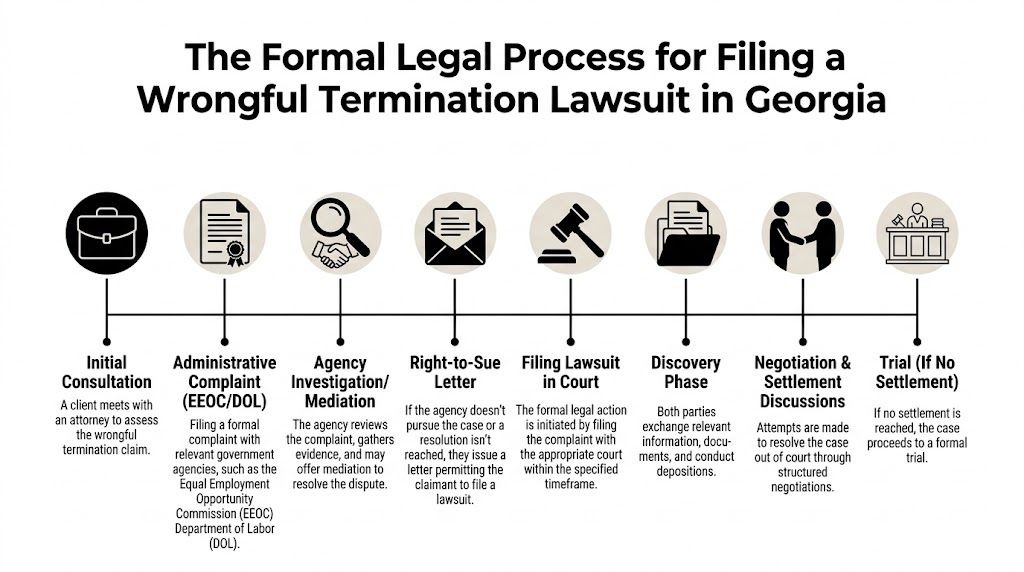
Many employees assume they can go straight to court the moment they believe the firing was illegal. In many wrongful termination cases, that isn’t how it works. Certain claims require an administrative filing before a lawsuit can be filed.
For workers in Cumming, Alpharetta, Sandy Springs, Johns Creek, and nearby communities, that often means dealing first with the EEOC or a related agency process before the courthouse becomes an option.
Filing prerequisites for Alpharetta workers
A discrimination or retaliation case often begins with a charge of discrimination. This is a formal administrative complaint that identifies the employer, explains the basic facts, and states the legal basis for the claim.
The agency may investigate, ask for documents, invite a response from the employer, or offer mediation. If the matter isn’t resolved there, the agency can issue a right-to-sue notice, which is what allows many claims to move into court.
If you want a broader overview of corporate claims and litigation posture before filing, this guide on how to sue a company provides useful context.
The basic sequence in Georgia
One often feels calmer once the process is broken into parts:
Case review
A lawyer identifies the legal theory, likely evidence issues, and whether an agency filing is required.Administrative charge
The complaint is filed with the appropriate agency. Accuracy matters because the wording can affect later arguments.Agency stage
The employer responds. The agency may investigate or offer mediation.Right-to-sue letter
If issued, this opens the path to court for qualifying claims.Lawsuit filing
The complaint is filed in the proper court, usually state or federal depending on the claims.
Missing the administrative step can derail a case before it even begins.
Where local procedure affects strategy
For North Georgia workers, logistics matter. People in Cumming and Forsyth County may think only in terms of local courts, but many employment cases are influenced by federal procedures and agency practice connected to the Atlanta area. Residents of Alpharetta, Roswell, Milton, and North Fulton often deal with employers whose legal departments are already preparing for that process early.
That’s why deadlines, claim framing, and document preservation need attention from the beginning. A lawsuit is not just a narrative about what happened. It’s a procedural path, and one missed step can close important doors.
Navigating Negotiations and Court in Fulton and Forsyth County
Once a case gets past the administrative stage and into litigation, the focus changes. The question is no longer just whether you were wronged. The question becomes whether you can prove it in a way that survives motions, strengthens your position, and puts the employer at real risk.
That phase is where many employees are surprised by how much formal process is involved.
What litigation looks like after filing
The employer usually responds quickly, often by denying wrongdoing and asserting a lawful reason for the termination. Then comes discovery, where both sides exchange documents, written questions, and testimony.
Depositions are a major part of this stage. You may be questioned under oath about your job history, complaints, performance, communications, mitigation efforts, and damages. Supervisors, HR representatives, and coworkers may also be deposed.
Common pressure points include:
- Document production: reviews, internal emails, complaint records, and policy materials.
- Comparator evidence: how the employer treated similar employees.
- Summary judgment motions: efforts by the employer to have the case dismissed before trial.
- Mediation: structured negotiations aimed at settlement.
What to expect in Forsyth County Superior Court and Fulton County litigation
Cases tied to Forsyth County and Fulton County often involve local counsel strategy, mediation practice, and forum decisions that affect strategic advantage. Some employment claims are filed in state court. Others proceed in federal court, including the U.S. District Court for the Northern District of Georgia, which matters to many North Georgia litigants.
Mediation is often a serious event, not a formality. The parties usually exchange positions, test the strengths and weaknesses of the evidence, and try to resolve the dispute without the cost and uncertainty of trial.
According to wrongful termination settlement and trial data, employees win about 10% to 20% of wrongful termination cases that go to trial, while over 90% of disputes resolve through out-of-court settlements. The same source reports that a Nolo survey found 64% of employees who hired a lawyer received compensation, compared with 30% of those who represented themselves.
Cases are often won in the preparation for mediation, not in the mediation room itself.
What works and what usually fails
What works is evidence that narrows the employer’s explanations. Strong timelines, contradictory reviews, documented complaints, inconsistent discipline, and credible witnesses create pressure.
What usually fails is broad outrage without specifics. Courts and mediators don’t award value because a firing felt cruel. They respond to proof that the employer’s stated reason doesn’t hold up.
For employees in Cumming, Alpharetta, Canton, Suwanee, and Sandy Springs, that means the quality of your documentation often matters more than the intensity of your frustration. Both are real. Only one moves a case forward.
Damages You Can Recover in an Alpharetta Wrongful Termination Case
Most clients eventually ask the same question. What is this case worth?
The honest answer is that value depends on liability proof, income loss, mitigation efforts, emotional harm, available statutes, and the employer’s risk tolerance. But there are clear categories of damages that shape settlement and trial discussions.

The main forms of recovery in Alpharetta cases
In an Alpharetta wrongful termination case, damages often start with back pay, which is lost wages and benefits from the firing forward. Some cases also include front pay, which addresses future lost earnings when reinstatement isn’t realistic.
There may also be claims for emotional distress, attorney’s fees where allowed, and in some cases punitive damages if the law and facts support them. Not every case includes every category.
A wage-loss analysis often overlaps with the same practical questions raised in other employment disputes, including Georgia business litigation involving wage disputes and backpay.
Setting realistic expectations in North Fulton and beyond
Headlines distort expectations. Most wrongful termination cases do not end in blockbuster verdicts.
According to settlement guidance discussing Georgia benchmarks, wrongful termination settlements in at-will states like Georgia have a median around $30,000, and the source emphasizes the high bar employees face in overcoming at-will defenses. That same source frames early negotiation as critical to maximizing recovery.
At the same time, verified data in this matter also reflects that some settlements resolve in the tens of thousands of dollars, and trial awards can be much higher in the relatively rare cases that succeed. The practical takeaway is straightforward. Strong cases can carry meaningful value, but value comes from proof, not anger.
| Damage category | What it covers |
|---|---|
| Back pay | Lost wages and benefits from the termination date |
| Front pay | Future earnings loss when returning to the job isn't realistic |
| Emotional distress | Mental and emotional harm caused by the unlawful firing |
| Attorney’s fees | Litigation costs where the law allows recovery |
| Punitive damages | Possible in more serious cases if the law supports them |
Settlement value rises when the employer sees a clear trial risk. It falls when the evidence is thin, inconsistent, or poorly documented.
Why Choose Miles Hansford for Your Wrongful Termination Claim
A wrongful termination claim needs more than general legal knowledge. It requires careful fact development, disciplined strategy, and a lawyer who understands how disputes move through courts and negotiations in North Georgia.
Miles Hansford serves clients in Cumming, Alpharetta, Forsyth County, Fulton County, and the surrounding area with a litigation-focused approach that fits employment disputes well. These cases often involve document-heavy records, competing explanations, witness credibility issues, and negotiation pressure before trial. That is civil litigation work at its core.
The firm’s broader experience in dispute resolution matters because many employment cases don’t turn on one dramatic moment. They turn on whether counsel can identify the strongest theory, protect the client from early mistakes, and strengthen their position through clear evidence and sound procedure.
For workers in Cumming, Johns Creek, Milton, Roswell, Sandy Springs, Suwanee, Dawsonville, and Canton, local familiarity matters too. Cases may involve agency filings, state court practice, federal court strategy, mediation, and negotiations shaped by the realities of North Georgia employers and court systems.
If you believe you may have grounds to sue for wrongful termination, getting a prompt legal review can protect both your claim and your future options.
FAQs About Wrongful Termination in North Georgia
| Question | Answer |
|---|---|
| Can I sue for wrongful termination in Cumming, GA if my employer said I was fired for poor performance? | Yes, possibly. A stated performance reason doesn’t end the analysis. If your prior reviews were positive, the timing is suspicious, or the employer treated others differently in Forsyth County, the performance explanation may be challenged as pretext for discrimination or retaliation. |
| Do I have to file with the EEOC before going to court in Alpharetta? | In many discrimination and retaliation cases, yes. Employees in Alpharetta and North Fulton often must file an administrative charge before filing suit. The timing and wording of that filing matter, so it’s smart to get legal advice before submitting it. |
| How quickly should I act after being fired in Forsyth County? | Immediately. Early days matter because documents disappear, memories fade, and deadlines can start running fast. If you were terminated in Cumming, Dawsonville, or nearby, gather records and get the case reviewed before signing severance or relying on informal HR statements. |
| What evidence helps most in a Georgia wrongful termination case? | The most useful evidence is usually written evidence. Performance reviews, complaint emails, texts, witness names, leave requests, accommodation records, and the termination notice often matter more than general verbal accounts. A clean timeline can also make a major difference. |
| Will my case go to trial in Fulton County or Forsyth County? | Maybe, but many cases resolve before trial. Settlement discussions, mediation, and motion practice usually shape the outcome first. If the case does proceed, it may be in state court or federal court depending on the claims and the employer involved. |
| Can I still bring a claim if I was an at-will employee in Georgia? | Yes. At-will employment does not let an employer fire someone for an illegal reason. If the termination was tied to discrimination, retaliation, or another protected issue, at-will status does not block the claim by itself. |
| Should I sign a severance agreement right away? | Usually not without review. Severance agreements often include release language that can waive claims. If you were fired in Alpharetta, Johns Creek, Milton, or Roswell, have the document reviewed before signing so you understand what rights you may be giving up. |
If you were fired and think the reason may have been illegal, don’t try to sort it out alone. Miles Hansford Law Firm helps clients in Cumming, Alpharetta, Forsyth County, Fulton County, and across North Georgia evaluate employment disputes with clear, strategic guidance. Schedule a consultation to speak with an attorney, protect your rights, and make informed decisions about what happens next.
Meta Title: Sue for Wrongful Termination in Cumming, GA
Meta Description: Sue for wrongful termination in Cumming, GA. Learn Georgia rules, EEOC steps, damages, and what to expect in Forsyth and Fulton County.
Suggested URL slug: /sue-for-wrongful-termination-cumming-ga
Internal link suggestions:
- Handling harassment and discrimination in business litigation
- How to sue a company
- Georgia business litigation wage disputes and backpay
Schema recommendations:
- Attorney
- LegalService
- FAQPage