


A founder in Alpharetta may start the day expecting to review sales numbers and end up dealing with a missed shipment, a disagreement over ownership, and a landlord's proposed lease changes. None of those problems arrives labeled “business law.” Each one involves rights, obligations, risk, and decisions that can affect the company for years.
So, what do business attorneys do? They help owners form, operate, grow, protect, and eventually transition or dissolve a company. The work includes contracts, governance, compliance, financing, commercial real estate, employment matters, mergers and acquisitions, and disputes. In Cumming, Alpharetta, Forsyth County, Fulton County, and throughout North Georgia, effective counsel is usually involved before a problem becomes a lawsuit.
Practical rule: If a decision could change ownership, money, employees, property, customer obligations, or the company's ability to operate, it deserves legal review before anyone signs or acts.
A Typical Morning for a North Georgia Business Owner
Consider a fictional Alpharetta technology-services owner, Maya. Her company serves clients across Fulton and Forsyth counties, and she doesn't have an in-house legal department. At 8:15 a.m., a vendor calls to say a shipment promised for delivery near Haynes Bridge Road won't arrive on time. Maya's customer contract contains a delivery deadline, but she doesn't know whether the delay triggers a refund, a replacement obligation, or a broader breach claim.
The answer depends on the documents, the communications between the parties, and the law governing the transaction. A business attorney reviews the purchase order, master service agreement, delivery terms, notice provisions, and limitations of liability. Counsel may recommend a demand letter, a negotiated cure, or a documented reservation of rights before Maya makes a concession that could weaken the company's position.
At 9:00 a.m., Maya's co-founder objects to the equity split they accepted when the company launched. The disagreement isn't only personal. It may involve the operating agreement, capital contributions, voting rights, distributions, intellectual property, and what happens if the members reach a deadlock. Without clear governance documents, an ordinary disagreement can restrict access to accounts, stall hiring, or prevent a major customer decision.
By 10:00 a.m., the landlord for the company's office wants to renegotiate the commercial lease. The proposed changes may affect rent, common-area charges, repairs, renewal rights, signage, insurance, and the security deposit. Georgia commercial transactions also require careful attention to the written agreement and applicable commercial rules. A lawyer can identify which provisions are negotiable and which changes create operational or financial exposure.
Maya's inbox looks ordinary to her. To business counsel, it contains a vendor dispute, a potential member dispute, and a commercial lease negotiation. Venue may matter too. A business dispute connected to a company operating in Cumming could involve Forsyth County procedures, while an Alpharetta matter may proceed through Fulton County courts depending on the parties, contract, and governing law. A useful explanation of business attorney responsibilities starts with that reality. Much of the work is invisible because it prevents the next crisis.

The Four Core Roles of a Business Attorney
A business attorney's work can be organized into four practical roles. Together, they follow the company lifecycle from formation through growth and, when necessary, dispute resolution.
Formation and governance
Formation work establishes the legal structure and the rules for ownership. Counsel helps compare an LLC, corporation, or another available structure, then prepares the governing documents that explain who owns what, who can make decisions, and how an owner can exit.
For a Cumming startup, that may mean an LLC operating agreement addressing voting, contributions, distributions, intellectual property, and member deadlock. For an established Alpharetta company, it may mean updating bylaws, shareholder agreements, board minutes, or written consents after a change in ownership.
Contracts and transactions
Contracts define the company's relationships with customers, vendors, employees, contractors, landlords, lenders, and strategic partners. Business counsel drafts, reviews, and negotiates terms involving payment, performance, confidentiality, ownership of work product, indemnity, insurance, termination, and dispute resolution.
A technology firm may need a master service agreement and customer terms. A restaurant group may need vendor agreements, employment documents, and leases. Clear transaction design makes obligations and remedies easier to understand before a disagreement develops, as discussed in this overview of business attorney work.
Regulatory and operational compliance
Compliance advice turns legal requirements into operating practices. Counsel may review employee policies, licensing, wage and hour issues, privacy practices, industry permits, sales-tax processes, and restrictions on the use of confidential information.
The goal isn't to create paperwork for its own sake. The goal is to help management recognize risk while a practical response remains available.
Disputes and litigation
When a conflict escalates, counsel investigates the facts, preserves evidence, sends or responds to demands, negotiates, mediates, and litigates when necessary. A dispute lawyer may handle a vendor breach, member deadlock, commercial lease claim, collection matter, or emergency request for court relief.
The strongest relationship often begins before litigation. A lawyer who understands the contract, ownership structure, and business objectives can address a dispute with more context than counsel brought in after the first filing.

How the Role Has Expanded Beyond the Courtroom
A business attorney still handles lawsuits, but owners in Alpharetta and Cumming often need legal judgment weeks or months before a dispute reaches court. The U.S. Bureau of Labor Statistics projects about 44,200 lawyer openings each year from 2024 through 2034 and reports a median annual wage of $151,160 in May 2025 across the lawyer occupation. Those figures describe the profession broadly, not the expected result for a particular attorney or firm. The BLS lawyer overview shows how lawyers serve employers and organizations in many settings.
The shift toward internal business support is also documented. The analysis of corporate counsel and the legal services market reports that 10% of American lawyers were in-house in 1980 and that in-house legal departments grew 7.5 times faster than law firms from 1997 to 2017. Corporate counsel now works alongside operations, finance, human resources, sales, and technology teams. The practical effect is a focus on decisions such as whether a proposed lease protects the company, whether a sales term creates avoidable exposure, and whether a planned expansion fits the ownership and financing structure.
The same law review analysis reports that the value of legal services tied to corporate counsel work rose from $10.9 billion in 1972 to $146.9 billion in 2000, with a 9.75% compounded growth rate over that period. These figures help explain why business legal work increasingly resembles ongoing management support rather than isolated courtroom representation.
For a local owner, the workload usually changes as the company grows. Early work may center on reviewing customer agreements and documenting decisions. Later, counsel may coordinate recurring contract reviews, prepare for financing, assess a commercial lease, or help address a shareholder dispute before positions harden. The available evidence supports that qualitative shift, not a precise percentage split among practice areas.
Administrative help can keep this work organized. A company evaluating a virtual legal assistant may use that resource to organize documents, track routine requests, and maintain workflow records. The licensed attorney remains responsible for legal analysis, advice, negotiations, and decisions requiring professional judgment.
Formation, Governance, and Contracts in Practice
The first legal choices shape how a North Georgia company raises money, distributes profits, makes decisions, and handles conflict. Formation isn't filing an entity record with the state. It requires a structure that matches the owners' tax advice, liability objectives, management model, financing plans, and anticipated exit.
An Alpharetta founder may begin with an LLC because flexible management and membership arrangements fit the business. Another company may evaluate an S corporation or C corporation because its tax planning, capital needs, or investor expectations point in a different direction. Georgia tax treatment, franchise-tax considerations, ownership restrictions, and future financing goals should be reviewed with appropriate legal and tax professionals rather than selected from an online checklist.
Governance documents create operating rules
After selecting an entity, counsel helps build the documents that make the structure usable:
- Operating agreement: Sets rules for an LLC's ownership, voting, contributions, distributions, transfers, and member exits.
- Bylaws: Establish corporate governance procedures, including officer and director roles.
- Shareholder agreement: Addresses ownership transfers, buyouts, voting arrangements, and restrictions.
- Board minutes and resolutions: Record significant corporate decisions and authorized actions.
- Initial consents: Document formation decisions, bank authority, appointments, and approved contracts.
For a Cumming company with two founders, the operating agreement should address what happens if one owner stops contributing, wants to sell, becomes disabled, or disagrees with the other. That conversation can feel uncomfortable at formation. It becomes much harder after the company has customers, employees, equipment, and valuable intellectual property.
Contracts should match the actual business
Business attorneys also prepare the documents owners use every week. A mixed-use commercial lease in Alpharetta may require careful review of build-out obligations, signage, maintenance, insurance, renewal rights, and common-area charges. A vendor agreement should define delivery, quality, payment, confidential information, and termination. A software company may need SaaS terms, licensing provisions, data obligations, and customer restrictions.
Before signing, counsel should compare the contract to the business reality. Can the company meet the service levels? Does the indemnity provision shift an uninsured risk? Does the confidentiality clause protect the right information? Does the agreement explain what happens after termination?

Clean documents won't prevent every disagreement, but they give owners a clearer framework for solving one. Generic templates often fail because they don't address the company's ownership, industry, property, or actual negotiation.
Compliance, Transactions, and Strategic Advisory Work
Operational counsel is not a single annual checkup. It follows the business as employees join, products change, locations open, and owners consider a sale or restructuring.
Georgia employers commonly need advice on at-will employment, wage and hour obligations, employee handbooks, hiring documents, discipline, termination, workplace conduct, and confidentiality. Restrictive covenants require particular care because Georgia law places limits on how noncompete and related provisions may be drafted and applied. A clause copied from another state may not fit a Georgia employer or the employee's role.
Licensing and permitting can differ by business activity and location. An owner opening in Alpharetta may need to address city requirements, sales-tax processes, data privacy expectations, and industry-specific obligations. A Cumming operator may face a different local administrative process. Counsel helps identify which requirements apply instead of assuming that a document used in one city works everywhere.
Ongoing Legal Touchpoints for North Georgia Small Businesses
| Area | Typical Deliverable | Why It Matters |
|---|---|---|
| Employment | Handbook, offer letter, confidentiality terms | Gives managers a consistent framework and reduces avoidable disputes |
| Commercial real estate | Lease review or purchase documentation | Allocates repair, insurance, renewal, and build-out responsibilities |
| Data and technology | Privacy terms, vendor review, security provisions | Clarifies how information is collected, used, stored, and returned |
| Ownership changes | Transfer documents, consents, updated governance records | Keeps legal records aligned with the actual ownership structure |
| Transactions | Asset purchase, stock purchase, or merger documents | Defines what is acquired, assumed, retained, and disclosed |
A transaction may involve a commercial purchase on North Point Parkway, a lease in downtown Cumming, an asset sale, a membership transfer, succession planning, or a middle-market acquisition. Counsel coordinates due diligence, identifies liabilities, drafts the agreement, negotiates representations and indemnities, and manages closing conditions.
Strategic advice also appears in quieter decisions. A lawyer may help a board evaluate risk, restructure a partnership, respond to a serious employee issue, or decide whether a proposed investment supports the company's long-term objectives. Owners handling sensitive records should also establish secure document-retention practices, including careful vetting of an IT disposal vendor before old devices or storage media leave the business.
Disputes, Litigation, and Protecting the Business
A vendor dispute can start with one missed delivery in Fulton County. Counsel reads the agreement, checks notice requirements, preserves emails and purchase records, and identifies the remedy the owner needs. A demand letter might seek performance, replacement goods, payment, or a negotiated resolution. Filing immediately can damage a valuable relationship, so the business objective should guide the first move.
An Alpharetta LLC may face a different problem when founders disagree about spending authority and refuse to approve a major contract. The attorney reviews the operating agreement, voting provisions, fiduciary duties, record-access rights, and any buyout or deadlock process. Negotiation or mediation may preserve the company. If those efforts fail, commercial litigation counsel can develop claims for breach of contract, fiduciary misconduct, or other available relief.

A commercial lease conflict in Forsyth County may involve repairs, common-area charges, renewal rights, a build-out deposit, or an alleged default. The attorney compares the notice with the lease, evaluates cure rights, communicates with the landlord, and prepares for court if resolution fails. Temporary relief may matter when a lockout, disclosure, transfer, or other immediate event threatens operations.
The work before and inside court
Georgia civil litigation can include pre-suit negotiation, mediation, discovery, motion practice, and trial preparation in state or federal court. Counsel may handle commercial debt recovery, lien filings involving commercial property, injunction requests, and judgment enforcement. The proper sequence depends on the contract, available evidence, urgency, and the owner's business objective.
Before sending a heated email, preserve the contract, payment records, invoices, messages, and relevant business files. A careless statement can become evidence.
Dispute-resolution terms drafted before a conflict can reduce uncertainty. Mediation and arbitration provisions may provide alternatives to trial. Exit rights and buy-sell provisions can give owners a defined path through deadlock without forcing the company to collapse.
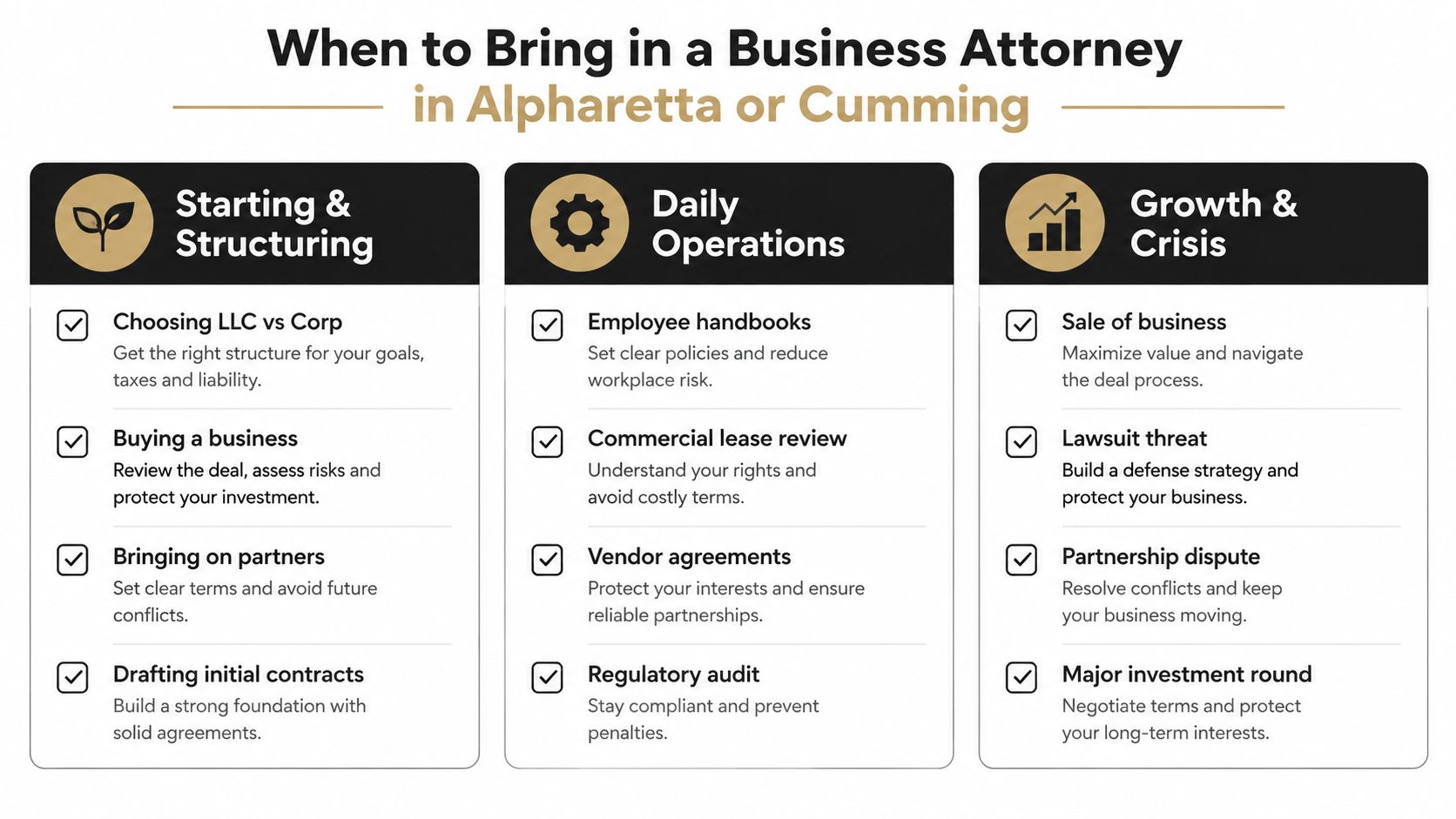
A business attorney may coordinate with litigation counsel, accountants, insurance professionals, and operations staff. The goal is to protect cash flow, ownership, property, customer relationships, confidential information, and the company's ability to keep operating.
When to Bring in a Business Attorney in Alpharetta or Cumming
Owners don't need to wait for a lawsuit. Twelve moments should prompt a call to counsel.
Formation and funding
- Creating the company: The choice between an LLC and corporation affects governance, ownership, tax coordination, and future changes.
- Adding an investor: Equity documents should explain control, information rights, dilution, and exit expectations.
- Bringing on a partner: A written agreement can address contributions, authority, compensation, and deadlock.
- Signing a commercial lease: A lease for an Alpharetta or Cumming location can affect build-out costs, deposits, repairs, renewal rights, and personal guarantees.
Operations and growth
- Hiring the first W-2 employee: Offer terms, classification, confidentiality, workplace policies, and payroll practices should match the role.
- Drafting employment policies: A handbook gives managers a consistent process for attendance, conduct, leave, discipline, and termination.
- Onboarding a major vendor: The agreement should define delivery, performance standards, payment, ownership, insurance, and termination.
- Entering another state: Expansion can trigger new registration, licensing, employment, tax, and contract questions.
Trouble signs
- Receiving a demand letter: A response can preserve defenses, avoid admissions, and create a path to resolution.
- Missing payroll-tax obligations: Prompt advice can help the owner understand exposure and organize a corrective response.
- Facing shareholder or member deadlock: Delay can block banking, hiring, contracts, and strategic decisions.
- Being sued in Fulton County Superior Court or receiving a lease-default notice: Deadlines may affect defenses, emergency relief, possession, and settlement advantage.
A practical desk checklist is simple:
- Before signing: Send leases, vendor agreements, financing documents, and customer contracts for review.
- Before changing ownership: Update the governing records and obtain the required approvals.
- Before terminating someone: Confirm the decision, documentation, policy, and payment process.
- After receiving a threat: Preserve records and contact counsel before responding.
- Before expanding or selling: Start due diligence early, while the business can still correct gaps.

The cost of early advice isn't the only consideration. The trade-off is between paying for informed review now and accepting the harder, narrower choices that follow a default, ownership fight, or court filing.
Choosing Local Counsel and Taking the Next Step
Local familiarity can affect how efficiently counsel handles a business problem. A lawyer serving Alpharetta and Cumming should understand how a contract dispute may proceed in the Forsyth County Superior Court, Fulton County Superior Court, North Fulton courts, Georgia state courts, or federal court. Familiarity with the Northern District of Georgia in Atlanta also helps explain filing requirements, scheduling, litigation logistics, and differences between state and federal procedure.
The right fit depends on the work. An Alpharetta transactional boutique may efficiently handle a focused contract or deal. A Cumming general practice may suit an owner who needs several related services. A larger Atlanta firm may fit a complex acquisition or regulated transaction, while a ten-employee company should confirm that the staffing model and fees match the assignment.
Questions for the first consultation
Bring formation documents, operating agreements, current contracts, leases, notices, and a short timeline. Ask:
- What is the immediate legal risk?
- Which documents control?
- What should management stop doing?
- Would a fixed fee, budget, or hourly arrangement fit the work?
- Who will perform the work and communicate with the owner?
- What written next steps will follow?
A useful consultation should produce a decision path, not vague advice. Miles Hansford Law Firm handles business and corporate law, contracts, shareholder matters, civil litigation, dispute resolution, and related needs for clients in Alpharetta, Cumming, Forsyth County, Fulton County, and North Atlanta. You can also review the firm's Brian A. Hansford attorney photo when evaluating local counsel.

Miles Hansford Law Firm can review formation documents, ownership arrangements, commercial contracts, a lease, or a pending dispute and identify the next practical step. Visit Miles Hansford Law Firm to schedule a consultation, bringing the documents that matter most to your company's future.