


If you're facing a legal charge in Cumming, GA, one of the first and most critical decisions you'll make is how to plead. You've likely heard of "guilty" and "not guilty," but a third option often causes confusion: a "no contest" plea. Making this decision without a clear understanding of the local court system can feel overwhelming, but you don't have to navigate it alone.
Legally known in Georgia as nolo contendere, this plea isn't an admission that you did anything wrong. Instead, you're telling the court that you won't fight the charge and will accept the punishment. It’s a choice that carries significant consequences, especially if a civil lawsuit or a sensitive family law matter is connected to your case. The attorneys at Miles Hansford are here to provide the calm, strategic guidance you need. Schedule a consultation to protect your rights.
Why Your Plea Matters in a Cumming, GA Court
Walking into the Forsyth County Superior Court or another North Georgia courtroom can be intimidating. The legal terms alone are enough to overwhelm anyone, and one of the most misunderstood is "no contest." Understanding what this plea actually means is the first step toward protecting your rights and future.
Your plea is your official answer to the charge brought against you. In Georgia, you have three main options.
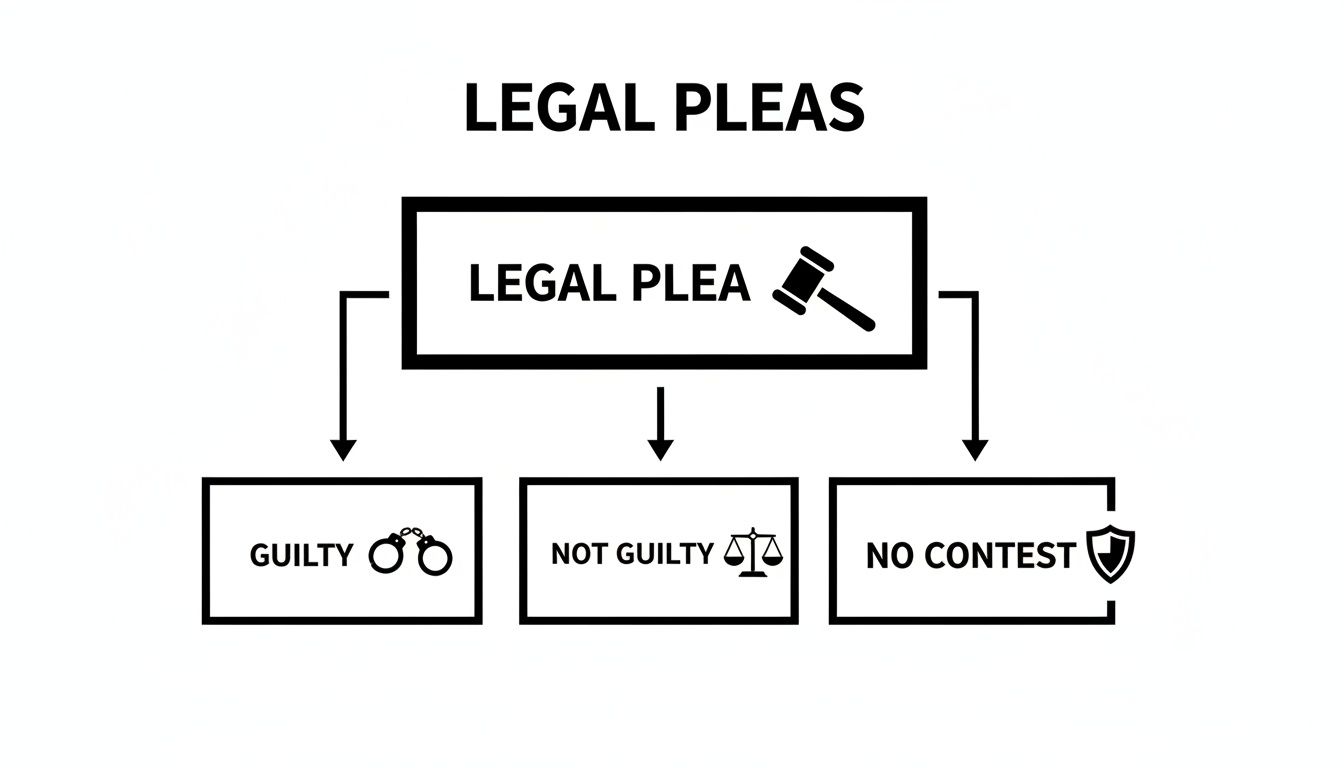
While a guilty plea is a direct admission and a not guilty plea is a denial, a "no contest" plea serves a very specific strategic purpose—it allows you to resolve the criminal case without admitting fault.
Guilty vs. Not Guilty vs. No Contest: A Georgia Court Comparison
To grasp the real-world differences between these pleas, it helps to see them side-by-side. The choice you make in a Forsyth County or Fulton County court directly impacts both your criminal case and any potential civil action that might follow, including sensitive family law matters like a custody dispute.
| Plea Type | What It Really Means | Impact in Your Criminal Case | Impact in a Related Civil Lawsuit |
|---|---|---|---|
| Guilty | "I did it." You are admitting you committed the crime. | The case proceeds directly to sentencing. You will be found guilty. | Can be used against you as an admission of fault, making it extremely difficult to defend yourself in a civil claim. |
| Not Guilty | "I didn't do it." You are formally denying the charges. | You are exercising your right to a trial. The prosecutor must prove your guilt beyond a reasonable doubt. | Has no impact. The civil case proceeds separately, and the other party must prove your liability from scratch. |
| No Contest | "I'm not fighting it." You aren't admitting guilt, but you accept the court's punishment. | The case proceeds directly to sentencing. You will be found guilty for sentencing purposes. | Generally cannot be used against you as an admission of fault in a civil case in Georgia. |
The key takeaway is how the plea affects other legal matters. For instance, if a car accident in Suwanee leads to a DUI charge and a personal injury lawsuit, a guilty plea on the DUI can be devastating for your civil defense. A no contest plea, however, helps create a protective firewall between the two cases.
The Lasting Impact of Your Plea in North Georgia
The plea you enter does more than resolve the criminal charge. Its effects can ripple out, impacting your finances, professional licenses, and even child custody arrangements for years. It’s crucial to understand that in Georgia, a conviction resulting from a "no contest" plea still goes on your criminal record.
There is no one-size-fits-all answer. The right choice depends on a careful analysis of your specific situation, the evidence against you, your criminal history, and—most critically—the risk of being sued or having it used against you in a divorce proceeding.
For more on the mechanics of this process, our guide on understanding pleas and plea deals in a criminal matter provides additional detail. Choosing how to plead is your first opportunity to take control of the outcome and begin protecting your future.
The Strategic Shield: A No Contest Plea in Cumming and Alpharetta
The primary advantage of a “no contest” plea is its power to shield you from civil liability. Imagine you're in a car wreck on GA-400 near Alpharetta. That single incident can create two separate legal issues: the traffic ticket (a criminal matter) and a potential personal injury lawsuit (a civil case).
If you plead guilty to the traffic violation, that plea can be used against you as an admission of fault in the civil lawsuit, making the other person's case much easier to win. A no contest plea works differently. Since you aren't admitting guilt, it generally can’t be used against you in that separate civil case.

Building a Legal Firewall in Alpharetta, GA Cases
Think of a no contest plea as a firewall between the criminal charge and the civil lawsuit that might follow. The criminal court in Alpharetta will still impose a sentence—fines, community service, or probation—just as if you had pleaded guilty.
The key difference emerges later. When the other driver sues you in a Fulton County civil court, your nolo contendere plea is typically not admissible as evidence that you were at fault. This forces the other side to prove their case from the ground up, without the shortcut of using your own plea against you. For our clients in Cumming, Johns Creek, and Milton, this is often a critical factor when a criminal charge could trigger a lawsuit.
A guilty plea can be used against you in civil court, but a no contest plea usually can't because you're not admitting fault. It's a distinction that can make a huge difference for people in North Georgia facing charges like DUI or assault, where a civil claim is a real possibility.
Protecting Your Future Beyond the Criminal Courtroom
A criminal conviction can have consequences that reach far beyond the courtroom. For a professional in Roswell or Sandy Springs, a public admission of guilt could damage their reputation or jeopardize a professional license. For a parent navigating a divorce, pleading guilty to certain charges could be used against them in a custody battle in Forsyth County.
Entering a no contest plea can help limit some of this collateral damage. The conviction will still appear on your record, but because there is no formal admission of guilt, it can make a real difference in these other related issues. It is a strategic choice meant to contain the fallout from a criminal charge. Do not make this decision without speaking with an attorney.
Limitations and Important Considerations in Cumming, GA
While a no contest plea offers a powerful shield, it’s not a magic wand. For example, the consequences of a DUI in Georgia remain severe, even with a nolo contendere plea. It won’t stop an administrative license suspension from the Department of Driver Services.
Georgia law also limits how often you can use this plea. For many traffic offenses, you can only plead no contest once every five years to avoid points on your driver's license. Furthermore, a judge in Cumming, Dawsonville, or Canton has the final say and can choose to reject a no contest plea. This is why having an experienced attorney who practices locally is so important—we know how to present the request to the Forsyth and Fulton County courts to give you the best chance of acceptance.
The Legal Process: How a No Contest Plea Works in Forsyth and Fulton County Courts
Considering a no contest plea in a Georgia court? It’s not as simple as just telling the judge your decision. This isn't an automatic right—it's a strategic move that the judge must approve. How that request is made can make all the difference, especially in local courts across Forsyth and Fulton Counties.

Whether your case is in the Forsyth County Superior Court in Cumming or the Fulton County Superior Court in Alpharetta, a judge won't accept a nolo contendere plea without careful consideration. Their job is to protect the public's interest, so they evaluate several factors before granting your request.
The Judge's Considerations in a Cumming, GA Plea Hearing
When your attorney proposes a no contest plea, the judge assesses the entire situation. This is not a rubber-stamp approval. They are weighing whether allowing you to avoid a formal admission of guilt serves the interests of justice.
Key factors a judge will consider include:
- The Seriousness of the Charge: A no contest plea is more likely to be accepted for a minor misdemeanor, like a first-time traffic violation, than for a serious felony.
- Your Criminal History: A clean record makes a judge more willing to accept the plea. Conversely, a history of similar offenses makes it a much harder sell.
- The Public Interest: The judge must decide if allowing this plea is fair to the community and to any victims involved.
This is where having an attorney who regularly practices in Cumming and Alpharetta becomes invaluable. We know the local judges, what they look for, and how to frame the request persuasively.
Georgia’s Specific Rules for a No Contest Plea
Georgia has its own set of rules limiting when a no contest plea can be used, which is why handling this alone is so risky. One of the most common rules relates to traffic tickets. Under Georgia law, you can generally use a nolo contendere plea once every five years to prevent points from being added to your driver's license.
However, that benefit has limits. It does not apply to more serious driving offenses. For a charge like a DUI, a no contest plea will not stop the automatic license suspension, even if the judge accepts it for the criminal portion of the case. These are the kinds of critical details where professional legal guidance is non-negotiable.
The Plea Hearing Process in Forsyth and Fulton County Courts
During a plea hearing, your attorney will make the formal request for a no contest plea to both the judge and the prosecutor. The prosecutor will have an opportunity to object. If they do, your lawyer must argue on your behalf, explaining why the plea is appropriate in your specific situation.
If the judge accepts the plea, the case moves directly to sentencing. You will be found guilty for sentencing purposes, and the judge will impose a penalty—fines, probation, community service—just as they would with a guilty plea. If the judge rejects the plea, you are back at square one: you must either plead guilty or plead not guilty and prepare for trial. An attorney familiar with court procedures in communities from Johns Creek to Roswell can help you prepare for any of these outcomes.
What to Expect: No Contest Pleas in Action Across North Georgia
Legal theory is one thing; seeing how a no contest plea plays out in the real world is far more helpful. Understanding how this unique plea can be used in situations you might face here in our community demonstrates its power as a strategic tool.
Let's walk through a few scenarios common to our local courts in places like Cumming and Alpharetta.
These examples highlight the required strategic thinking. Every case is unique, and an experienced attorney must weigh the specific facts, understand the dynamics of the Forsyth or Fulton County court involved, and, most importantly, consider your long-term goals.
Example 1: The DUI Case in Alpharetta
Imagine a driver is involved in a minor fender-bender on North Point Parkway and is arrested for a first-offense DUI. The evidence is not airtight, but a trial feels like a huge gamble. The driver’s primary concern isn't the criminal sentence; it's the expensive personal injury lawsuit they know the other driver is planning to file.
The Strategic Play:
By entering a no contest plea in the Alpharetta Municipal Court, the driver can accept the criminal penalties—like fines and probation—without formally admitting they were at fault for the crash. This distinction becomes incredibly important when that civil lawsuit is filed in Fulton County Superior Court.
- In the Criminal Case: The court finds the driver guilty for sentencing purposes, and they face the DUI penalties.
- In the Civil Case: The other driver's attorney cannot use the no contest plea as proof of negligence. They must start from square one and prove fault, which is a much taller order.
This plea essentially builds a firewall, helping to protect the driver's personal assets from what would have been a much easier civil claim.
Example 2: The Simple Battery Charge in Roswell
Consider a heated argument between two neighbors in a Roswell subdivision that ends in shoving. The police are called, and one neighbor is charged with simple battery. The person charged wants to resolve the criminal issue quickly but is well aware the other party is likely to sue for damages.
The Strategic Play:
Pleading guilty would be the equivalent of handing the neighbor a signed confession, making their civil lawsuit a slam dunk. A no contest plea offers a way out. It allows the defendant to close the book on the criminal case in a North Fulton court without providing a key piece of evidence for a lawsuit. The defendant agrees to accept the punishment, but they never have to say, "I did it." This is about damage control—resolving the immediate legal headache while undercutting a future lawsuit.
The Evolution of the No Contest Plea
The concept behind the no contest plea, or nolo contendere, has a long, practical history in American law. It developed as a shield for defendants, allowing them to resolve a criminal charge while protecting themselves in civil court. Since its official recognition in the 1944 Federal Rules of Criminal Procedure, it has become a vital tool. A judge must approve its use, but it offers a huge advantage: unlike a guilty plea, a no contest plea usually can’t be used to prove liability in a related civil case, like a personal injury claim in Fulton County following a DUI. You can read more about the history and application of this unique legal plea to see how it has shaped court proceedings.
Example 3: The MIP Charge in Cumming, GA
A college student, home for the summer in Cumming, receives a ticket for Minor in Possession (MIP) of alcohol. This is their first encounter with the law, and they have ambitions for graduate school and a professional career. They want to be accountable but are deeply concerned about how a formal admission of guilt might appear on background checks for school or work.
The Strategic Play:
For a minor charge like this in Forsyth County, a no contest plea can be a perfect fit.
- The student accepts the court's punishment, demonstrating they take the matter seriously.
- Crucially, they do not have to make an official statement admitting they committed the act.
Although the conviction will be on their record, not having a direct admission can make a real difference when explaining the situation to an admissions board or licensing body. It helps frame the incident as a legal outcome they accepted, rather than a misdeed they confessed to.
Our Strategy: When a No Contest Plea Is NOT the Right Choice in Georgia
A no contest plea can be a powerful strategic tool, but a skilled lawyer knows when a particular strategy is not the right fit. While it has its advantages, it is far from a one-size-fits-all solution. Understanding when not to use it is just as crucial as knowing its benefits, especially when you're in court in Cumming or Alpharetta.
It is absolutely essential to understand this: for sentencing purposes, a no contest plea is treated exactly the same as a guilty plea. A judge in Forsyth County or Fulton County will impose a sentence—whether it's fines, jail time, or probation—based on the crime charged, not the type of plea entered. If your primary goal is to avoid a specific penalty, a no contest plea offers no more leverage than a guilty plea.
When the Plea Offers No Strategic Benefit in Alpharetta
Under Georgia law, there are clear situations where a nolo contendere plea simply won’t deliver the results you're hoping for. An experienced attorney can identify these red flags immediately and help you avoid a serious mistake.
A no contest plea is likely the wrong choice in these scenarios:
- Serious Traffic Offenses: For charges like reckless driving or fleeing from an officer, judges are far less likely to accept a no contest plea due to the clear risk to public safety.
- When You Have a Strong Defense: If the prosecutor's case is weak, filled with holes, or built on shaky evidence, why accept any form of punishment? Taking your case to trial might be the better path to a full acquittal.
- Prior Use of the Plea: As covered, Georgia law only allows you to use a nolo contendere plea for most traffic offenses once every five years. If you've used it recently, the option is off the table.
Over 90% of all convictions in the United States result from plea bargains, making your choice of plea one of the most critical moments in your case. You can read more about the issues surrounding plea deals in our post about the concerns raised about excessive plea bargains.
The Conviction Remains on Your Record
One of the biggest myths about a no contest plea is that it keeps the charge off your criminal record. This is completely false. A conviction resulting from a no contest plea is still a conviction. It will appear on background checks for jobs, housing, and professional licenses. The decision of which plea to enter, or whether to plead at all, requires a full analysis of the evidence and your personal circumstances.
Why Choose Miles Hansford for Your Case in Cumming, GA
Knowing the textbook definition of a no contest plea is one thing. Understanding how, when, and if it should be used in a specific North Georgia courtroom is another matter entirely. That’s where our firm’s hands-on experience in the local communities of Cumming and Alpharetta makes a real difference.
When you’re facing a criminal charge, you need advice grounded in the reality of our local courts. Our attorneys are fixtures in the Forsyth County Superior Court and Fulton County Superior Court. We are familiar with the local prosecutors, judges, and their unique procedures. That firsthand knowledge provides a tangible, strategic benefit to your defense.
A Calm, Strategic, and Protective Approach
At Miles Hansford, our philosophy is calm, strategic, and protective. We understand the stress you’re under and offer direct, professional guidance. Our objective is to protect you from the long-term consequences of a charge, whether that means using a no contest plea to shield you from a civil lawsuit or advising another path entirely. We regularly help clients across North Georgia, including in Canton, Dawsonville, Johns Creek, and Milton.
Our firm's integrated practice in criminal defense, DUI, and family law is a major advantage. This gives us a 360-degree view of your legal situation. For example, a criminal charge in Alpharetta could have serious, unintended effects on a divorce case in Fulton County. Our team can anticipate these potential conflicts and ensure a decision in one case doesn't create a new problem in another. Our focus is always on finding the best resolution for your entire life, not just one isolated legal issue.
If you are facing a charge and trying to decide on a plea, you should not make that choice alone. The right next step is to get clear, experienced advice specific to the North Georgia courts. Schedule a consultation with our team today, and let us begin building a strategy to protect you.
FAQs: No Contest Pleas in Cumming & Alpharetta, GA
Walking through the legal system often brings up more questions than answers. We hear many of the same concerns from our clients across North Georgia, from Cumming to Alpharetta, about what a no contest plea really means for them. Here are some straightforward answers.
Q: Can I plead no contest to a DUI in Forsyth County, GA?
A: Pleading nolo contendere for a DUI in Georgia is possible, but it comes with strict limitations. You can generally only use this plea for a DUI once every five years. Even then, the Forsyth County judge makes the final decision. Crucially, a no contest plea does not stop the Department of Driver Services from moving forward with an administrative license suspension.
Q: Will a no contest plea show up on a background check in Georgia?
A: Yes. A no contest plea results in a conviction, and that conviction becomes part of your permanent criminal record. It will appear on background checks for employment, housing, and professional licensing. For those concerned about their digital footprint, understanding how to remove court records from the internet is an important related topic.
Q: Is a no contest plea better than a guilty plea in Alpharetta, GA?
A: It depends on your specific case. A no contest plea is often the better strategic choice if you could face a related civil lawsuit—think a car accident in Johns Creek or a physical altercation in Milton. If there’s no risk of a civil suit, the outcome in your criminal case is usually identical to a guilty plea. An attorney familiar with the Alpharetta Municipal Court can help you decide.
Q: Does a no contest plea affect my family law case in Fulton County?
A: It absolutely can. While a nolo plea is not a confession, the resulting conviction can still be introduced in a Fulton County divorce or child custody hearing. A judge can consider a conviction for family violence or a DUI when making decisions about parenting time and alimony. This is why you need a cohesive legal strategy from a firm that understands both criminal defense and family law.
Q: Can a no contest conviction be expunged in Georgia?
A: It depends. Georgia's expungement laws, now called "record restriction," are complex. Some misdemeanor convictions resulting from a no contest plea may be eligible for restriction after a certain period, but many are not. It is critical to discuss this with an attorney, and you can learn more by reading about whether you can expunge a misdemeanor in Alpharetta.
The choices you make in a criminal case can follow you for years. You shouldn't have to face this complex process alone. The experienced attorneys at Miles Hansford, P.C. are here to offer the calm, strategic guidance you need. We will protect your rights and help you choose the best path for your future. Call us today to schedule a consultation.