


Meta Title: What Does a Subpoena Mean in Cumming, GA
Meta Description: What does subpoena mean in Cumming, GA? Learn how Georgia subpoenas affect divorce, custody, and court strategy in Forsyth and Fulton County.
Suggested URL Slug: /what-does-subpoena-mean-cumming-ga
Schema Recommendations:
- Attorney
- LegalService
- FAQPage
Internal Link Suggestions:
A subpoena can rattle anyone. You open the envelope, see court language, and your mind goes straight to the worst-case scenario. If you're in Cumming, GA, Alpharetta, or elsewhere in North Georgia, the first thing to know is simple. A subpoena usually means someone wants information, records, or testimony. It does not automatically mean you've done something wrong.
In family law, subpoenas often show up in the middle of divorce, child custody, child support, alimony, contempt, or modification disputes. They can target bank records, employment files, school records, medical records, or testimony from a third party. The right response depends on what was requested, who issued it, and whether the request goes too far.
North Georgia cases also move through a local court system with its own practical rhythms. A subpoena tied to a divorce in Forsyth County Superior Court may become important at a temporary hearing, in mediation, or later at trial. In Fulton County Superior Court, the same document can affect how financial issues, parenting plans, and equitable division disputes are evaluated.
What Does a Subpoena Mean in Cumming, GA?
A subpoena means the law is formally requiring action. In plain English, it is a court-backed demand that a person either appear to testify or produce evidence. If you've been served in Cumming, that document deserves immediate attention, but not panic.
The word itself comes from the Latin "sub poena," meaning "under penalty," and the subpoena has been part of Anglo-American legal systems since the 14th century, used to compel testimony or the production of evidence, as explained in this overview of subpoena meaning and history. That history matters because it helps explain why courts treat subpoenas seriously.
In daily practice, people in Forsyth County often receive subpoenas during stressful family law events. A parent in a custody fight may get one for school or counseling records. A spouse in a contested divorce may see a subpoena sent to an employer or bank. A small business owner may learn that company records are being requested because income is disputed.
Practical rule: Read the subpoena carefully before you respond to anyone about it. The date, location, issuing attorney, and type of demand all matter.
If you're searching what does subpoena mean because you've just been served near me in Cumming or Dawsonville, the safest first move is to slow down and identify what the document requires. Some subpoenas ask only for documents. Others require a live appearance. That difference changes everything.
Why a Subpoena Matters in Your Cumming Family Law Case
In Georgia family law, a subpoena is often how one side gets records that the other side hasn't produced voluntarily. That makes it a pressure point in divorce and custody litigation. It can shape negotiations, mediation, temporary hearings, and trial preparation.

Where subpoenas show up in Cumming family law
In Cumming, GA, subpoenas commonly matter in disputes involving:
- Divorce finances where one side wants pay records, bank statements, or business documents
- Child support and alimony where income is disputed or incomplete
- Custody cases where school, medical, or counseling records may become relevant
- Contempt and modification actions where the court needs a clearer record of what changed
Georgia is a no-fault divorce state, and it also uses equitable division rather than automatic equal division. That means financial proof matters. A subpoena can become the tool that pulls hidden or incomplete information into the case.
Why timing matters in Forsyth County and nearby courts
Forsyth County divorce and custody cases often turn on what can be proven quickly. Temporary hearings happen early, and those early rulings can influence parenting time, support, use of the marital home, and financial restrictions while the case is pending. If subpoenaed records arrive late, are incomplete, or are produced carelessly, the damage can be hard to unwind.
Parents in Alpharetta, Johns Creek, Milton, Suwanee, and Roswell run into the same problem. Georgia courts require parenting plans in custody matters, and they decide custody based on the child's best interests. If a subpoena touches attendance records, communications, or financial stability, it can affect how the judge sees the bigger picture.
A subpoena is rarely just paperwork in a family law case. It's often a move designed to prove, pressure, or narrow the disputed facts.
What doesn't work is ignoring it, assuming it's optional, or handing over everything without review. Both mistakes can hurt your position.
The Subpoena Process in Georgia Explained
You open an envelope in the middle of a divorce or custody case and see a command to appear, produce records, or both. In Forsyth and Fulton County family court, that usually means the case has moved from general allegations to proof. Deadlines get short fast, and the details on the face of the subpoena matter.
Georgia law recognizes two main subpoena functions under Georgia Code § 24-13-21, as stated in the text of Georgia's subpoena statute. One compels testimony. The other compels documents or other evidence.
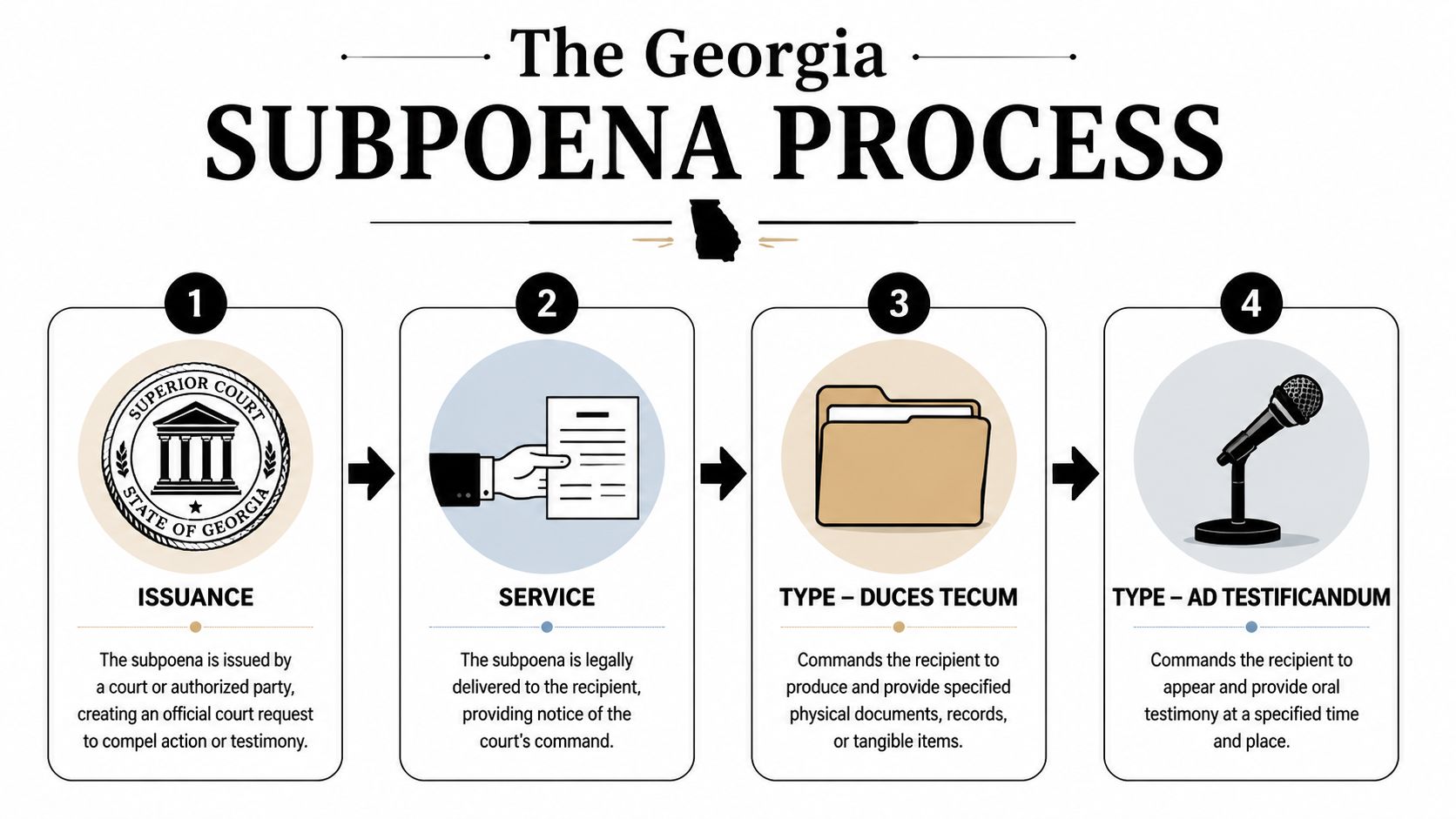
The two subpoena types that matter most
The labels can sound more complicated than they are.
| Type | What it requires | What it means for you |
|---|---|---|
| Witness subpoena | You must appear and testify | You may need to show up in court, at a hearing, or for a deposition if service was proper |
| Subpoena for production of evidence | You must provide documents or other evidence | You may be able to comply by producing records without appearing in person |
A production subpoena is often called a subpoena duces tecum. A testimony subpoena is often called a subpoena ad testificandum. In a Cumming or Alpharetta family law case, that difference affects time, cost, privacy, and how much disruption the subpoena causes.
How the process usually works in a Georgia family law case
The sequence is usually straightforward. A lawyer issues the subpoena in an existing case, arranges service, and sets a date for testimony, document production, or both. Then the receiving party has a short window to decide whether to comply, object, or ask the court for protection.
Service is not a technical footnote. It often decides whether the subpoena can be enforced. A witness subpoena generally requires personal service. A records subpoena may allow production without requiring someone to sit in a courtroom hallway waiting to be called.
That distinction matters in family law. If the issue is income, a lawyer may subpoena payroll, bank, or business records. If the issue is contested parenting conduct, the subpoena may seek live testimony from a teacher, counselor, or other witness with firsthand knowledge.
What to check immediately after service
Start with the face of the document and the timing.
- Read what the subpoena commands. Testimony, documents, or both.
- Confirm the response date, hearing date, or deposition date. Missing the deadline creates avoidable problems.
- Identify who was subpoenaed. You, your employer, your bank, your child's school, or another third party.
- Review the categories requested. Narrow requests are handled differently from broad requests covering years of records.
- Preserve responsive material. Do not delete texts, emails, account statements, calendars, or files after service.
- Get legal advice before producing sensitive records. That includes counseling records, medical information, business data, and communications that may be privileged.
In practice, family law subpoenas often intersect with the broader discovery process in litigation. The subpoena is one tool among several, but it is often the fastest way to get records from non-parties.
Practical points that matter in Forsyth and Fulton County
Local court practice shapes how subpoenas play out. Temporary hearings can arrive early in a divorce or custody case, so lawyers often use subpoenas to pin down income, school records, treatment history, or account activity before the court makes an initial ruling. If the subpoena is too broad, poorly timed, or directed to the wrong custodian, it can create delay without producing useful evidence.
I also pay close attention to who is receiving the subpoena. A bank, employer, school, or medical office may respond very differently from an individual witness. Some institutions have set procedures for legal requests, and some use outside vendors or staff trained around service logistics. For businesses that deal with that side of legal delivery, this overview of process serving firm marketing solutions shows how that niche presents its services.
A subpoena is a command backed by the court. It is also a pressure point in a family law case. The right response starts with identifying exactly what was requested, how it was served, and whether the demand fits the issues before the judge.
Strategic Responses to a Subpoena in Alpharetta
A parent in Alpharetta opens a subpoena on Thursday afternoon and has a temporary hearing set for the following week. The request asks for bank records, counseling records, emails, and business documents. At that point, the question is not whether the paper feels aggressive. The question is what needs to happen before too much information is handed over, or a deadline is missed.

You may be able to narrow or challenge the demand
A subpoena does not automatically mean every requested record must be produced exactly as written. In Georgia family law cases, the first step is to read the command closely and compare it to the actual issues in dispute. In a custody case, for example, a request tied to school attendance or treatment history may have a clear connection to the court's decision. A demand for years of unrelated private records may not.
Courts can limit or reject subpoenas that reach too far. Legal grounds can include privilege, undue burden, and overbreadth. Cornell's subpoena overview discussing privilege and motions to quash gives the general rule, but the practical problem in Alpharetta family cases is usually narrower. The subpoena asks for some records that matter, mixed with many that do not.
That issue comes up often in divorce and custody matters involving:
- Business records that also contain confidential internal material
- Attorney-client communications buried inside broader document files
- Medical or counseling records with private information unrelated to the dispute
- Electronic requests drafted so broadly that they sweep in years of messages and account data
A subpoena is a court command. It is not a blank check.
Practical responses usually work better than panic
The strongest response is often a fast, measured one. If the subpoena is partly valid but drafted too broadly, counsel can often narrow the date range, identify the right custodian, limit the categories of documents, or set a realistic production date. That approach can protect a business owner in Alpharetta from disrupting payroll or operations while still showing the court a good-faith response.
Silence creates problems. So does sending an incomplete pile of records without review. In Forsyth and Fulton County family cases, judges usually care less about frustration and more about whether the recipient acted reasonably, objected specifically, and preserved any legitimate confidentiality concern.
If a subpoena calls for privileged material, protect the privilege on purpose and in writing.
Privilege and testimony require planning
Privilege issues are easy to mishandle in family law. Spouses often assume a private conversation is automatically protected. Business owners often assume company documents are off limits because they are internal. Those assumptions can create damage fast if records are produced before anyone reviews them carefully.
If the subpoena also requires testimony, preparation should start early. A witness who has to appear for questioning needs the same disciplined review used for document production. This guide on preparing for a deposition in a Georgia case is a useful starting point because the same habits apply. Know what was requested, what is privileged, what can be answered directly, and where the risks are.
In practice, I look at four questions first:
- Was the subpoena served properly
- Does the request relate to the divorce or custody issues before the court
- Would compliance create unnecessary burden or disclose far more than needed
- Do privilege, privacy, or confidentiality concerns require an objection, limitation, or protective order
That analysis often changes the outcome. In a Cumming or Alpharetta family law case, the right response can protect parenting claims, financial privacy, and business records without putting the client in the position of ignoring a court command.
Navigating Subpoenas in Forsyth and Fulton County Courts
You may receive a subpoena on a Tuesday and be standing in court by Friday, trying to explain why bank records were not produced, why a school file was incomplete, or why a witness did not appear. In Forsyth and Fulton County family law cases, that timing pressure is real. The court expects a prompt, organized response.

What the court usually wants to see
In Forsyth County Superior Court, subpoena disputes often show up in the middle of temporary relief fights over custody, support, possession of the home, or access to financial accounts. In Fulton County Superior Court, including cases centered in Alpharetta, Roswell, and Johns Creek, the same dispute may be folded into a tighter discovery schedule, a mediation deadline, or a specially set hearing. The rule may be statewide, but the pressure points are local.
Judges usually focus on a few practical questions. Was the request tied to the issues before the court? Did the receiving party act quickly? Was there a reasonable effort to narrow the request instead of turning a family law case into a document dump? A vague objection rarely helps. A specific objection, backed by dates, correspondence, and a workable proposal, usually puts you in a better position.
That matters because subpoena compliance can be expensive. A small business owner in Cumming may need staff time to pull payroll, QuickBooks entries, contracts, or account statements. A parent in Alpharetta may need school, counseling, or medical records that involve privacy concerns and third-party delays. Courts understand burden, but they expect you to show it clearly and early.
How subpoenas affect family law decisions locally
In Georgia divorce and custody cases, subpoenaed records often shape the parts of the case that matter most:
- Temporary hearings, where early financial and parenting evidence can set the tone for months
- Mediation, where missing or damaging records can change settlement value fast
- Custody and parenting disputes, where school attendance, counseling records, or communication logs may support or weaken a parent's position
- Property division and support issues, where income, debt, cash flow, and business records are often contested
Testimony creates a separate layer of risk. If the subpoena is tied to sworn questioning, review what a notice of deposition in a Georgia case means before the hearing date gets close. In my experience, families get into trouble when they treat testimony and document production as separate problems. Courts do not.
For parties in Cumming, Alpharetta, and the surrounding North Georgia courts, subpoena practice is not a side issue. It can affect what evidence the judge sees, how credible a party looks under pressure, and how much control you keep over private financial and parenting information.
Why Choose Miles Hansford for Your Cumming Case
A subpoena can hit at the worst possible moment. You're already dealing with divorce stress, parenting fears, financial exposure, or a business you need to keep running. The legal question may look narrow on paper, but the consequences rarely stay narrow.
In North Georgia family law, the right response is usually measured, not dramatic. Someone needs to read the subpoena against the facts of your case, the Georgia rules that apply, and the local court where the dispute is pending. That includes whether the issue may affect a temporary hearing, mediation posture, parenting plan terms, child custody arguments, equitable division claims, or compliance deadlines in Forsyth County or Fulton County.
For people searching for a family law attorney near me in Cumming, Alpharetta, Johns Creek, Milton, or Roswell, experience matters most when the decision is not obvious. Sometimes the right move is prompt compliance. Sometimes it's negotiation. Sometimes it's a focused objection or a motion asking the court to limit the request.
Georgia family law also has broader pressures that make early advice important. Divorce cases carry a 30-day minimum waiting period in Georgia, but contested issues involving custody, support, business valuation, and property division can keep moving long before a final decree. Early evidence decisions often shape later outcomes.
If your subpoena is connected to divorce, child custody, child support, alimony, legitimation, modification, mediation, or a contempt action in Cumming or Alpharetta, don't guess. Treat it like a strategic event in the case, because that's what it is.
Frequently Asked Questions About Georgia Subpoenas
| Question | Answer |
|---|---|
| Can I ignore a subpoena in Cumming, GA if I think it doesn't apply to me? | No. A subpoena isn't something to ignore because you disagree with it. In Forsyth County cases, the safer response is to review the document with counsel, determine whether it requires testimony or production, and raise any valid objection properly rather than staying silent. |
| Does a subpoena mean I'm being sued in a divorce or custody case? | Not necessarily. In Georgia family law, a subpoena often means someone wants records or testimony connected to an existing case. Third parties in Cumming, Alpharetta, or Johns Creek are frequently subpoenaed even though they are not parties to the divorce or custody action. |
| Can I object to a subpoena for business records in Alpharetta? | Yes, sometimes. If the request is overly broad, burdensome, or seeks privileged material, your attorney may be able to object, negotiate narrower terms, or ask the court for relief. That is especially important in high-asset divorce cases involving closely held businesses or sensitive internal records. |
| Do I have to appear in person if the subpoena only asks for documents? | Not always. Under Georgia law, a subpoena for production of evidence may allow compliance by providing the requested documents in advance. Whether personal attendance is required depends on the language of the subpoena and how it was issued in the specific Forsyth County or Fulton County matter. |
| How do subpoenas affect child custody cases in Forsyth County? | They can affect custody significantly if the records relate to the child's best interests. School records, medical records, counseling information, employment schedules, and other evidence may influence parenting plan disputes, temporary hearing arguments, and final custody determinations in Georgia courts. |
| What if the subpoena asks for private communications with my lawyer? | That raises a privilege issue and should be reviewed immediately. Attorney-client communications are a common basis for challenging part of a subpoena. The correct move is usually a formal objection or request for protection, not casual refusal or broad disclosure. |
| Will Georgia witness fees cover my time away from work? | Not necessarily. In practice, witness fees may not fully offset the disruption of missed work, travel, document collection, or business interruption. That's one reason people in Fulton County and Forsyth County often try to narrow the scope, adjust timing, or resolve production issues through counsel. |
| Should I talk to a lawyer before responding to a subpoena near me? | Yes, especially if the subpoena involves financial records, medical information, business documents, or custody issues. Early legal review helps you avoid overproducing, missing deadlines, waiving objections, or mishandling privileged information in a North Georgia family law case. |
If you've received a subpoena connected to a divorce, custody dispute, support case, or other family law matter in Cumming, Alpharetta, Forsyth County, or Fulton County, speak with Miles Hansford Law Firm. A calm, strategic review early on can help protect your parental rights, your financial interests, and your position in court. Schedule a consultation to speak with a family law attorney and get clear guidance on what to do next.