


Meta Title: Custody Hearing in Cumming, GA | What to Expect
Meta Description: Learn what happens at a custody hearing in Cumming, GA, including Forsyth and Fulton County court process, temporary hearings, strategy, and next steps.
Suggested URL Slug: /custody-hearing-cumming-ga
Schema Recommendations:
- Attorney
- LegalService
- FAQPage
Internal Link Suggestions:
- /how-to-prepare-for-custody-hearing/
- /how-is-child-custody-decided/
- /what-is-a-guardian-ad-litem/
- /child-custody/
- /family-law/
If you're reading this in Cumming, GA or Alpharetta, there's a good chance you're staring at a court date, a stack of messages, and a lot of fear about what a judge is going to do with your child's schedule. That reaction is normal. A custody hearing puts your parenting, your home, and your judgment under a microscope. For many parents, it feels personal in the worst possible way.
It also helps to know this. A custody hearing is not chaos. It's a structured legal process. The judge isn't there to reward the louder parent or punish the more emotional one. The judge is there to make decisions under Georgia family law, based on evidence, credibility, and the child's best interests.
In North Georgia, that process often starts shaping the case much earlier than parents expect. In Forsyth County Superior Court and Fulton County Superior Court, temporary hearings can influence the final outcome in a major way. If you're facing one, your next move matters. You don't need to know everything today, but you do need a plan before you walk into court.
Facing a Custody Hearing? You Are Not Alone
A parent will often sit in my office and ask the same question in different words. What if I freeze. What if the other parent lies. What if the judge gets the wrong impression in a few minutes and that becomes my child's life.
Those fears are common, especially for parents in Cumming and Alpharetta who are also trying to keep work, school pickup, and a household running while a family case moves through court. A custody hearing can arrive during a divorce, after a separation, during a legitimation case, or in a modification when the current order no longer works.
What helps is shifting your focus from fear to preparation. What happens at a custody hearing is more predictable than many anticipate. The court will review specific issues. Each side will have a chance to present evidence. The judge will evaluate parenting decisions, stability, and how each parent handles conflict.
Practical rule: The parent who looks organized, child-focused, and credible usually starts from a stronger position than the parent who arrives angry and scattered.
If you're dealing with a temporary hearing, an emergency issue, or a final custody dispute in Forsyth County or Fulton County, get clear legal guidance early. Temporary orders can affect parenting time, decision-making, and negotiating position in mediation long before a final trial.
Why Your Custody Hearing Matters in Cumming
A custody order does much more than decide where your child sleeps on school nights. It can shape school zoning, extracurricular schedules, holiday routines, travel, medical decision-making, and how much day-to-day influence each parent has. For families in Cumming, Johns Creek, Milton, Suwanee, and Dawsonville, those details affect real life fast.

A custody order reaches into everyday life
If one parent lives near the child's school in Cumming and the other lives farther away in Roswell or Sandy Springs, the parenting schedule may affect transportation, attendance, and after-school consistency. If a parent wants to relocate, that issue can become central. If one parent has handled most medical appointments, tutoring, or therapy, that history can matter.
Georgia courts also require a parenting plan in custody cases. That plan usually addresses physical custody, legal custody, parenting time, holidays, transportation, communication, and decision-making. A vague agreement creates future conflict. A careful plan protects your child from constant uncertainty.
Temporary hearings can shape the final result
Many parents assume the final hearing is the only one that counts. In practice, the temporary stage often sets the tone. A temporary order can establish who keeps the child in the marital home, who handles school-week routines, and what the judge sees as the current status quo.
That matters in divorce cases because Georgia no-fault divorce law allows a divorce to move forward even when spouses disagree about fault, but children still need immediate structure while the case is pending. Georgia also has a 30-day minimum waiting period after filing for divorce before a final divorce can be granted. During that period, and often well beyond it in contested cases, temporary hearings can decide who has the upper hand.
The first court order in a custody case often becomes the arrangement everyone must live under while the case is being litigated, mediated, or prepared for trial.
You're part of a very large group of parents facing this issue
According to the U.S. Census Bureau, over one-quarter of all children under 21 have a parent living outside their household, representing nearly 22 million children (Modern Family Law summary of Census data). That doesn't make your case less personal, but it should tell you this. You are not facing some rare legal problem. Courts in Georgia handle these issues constantly, and they expect parents to come prepared.
For that reason alone, parents searching for a family law attorney near me in Cumming or Alpharetta shouldn't treat a custody hearing like an informal meeting. It is a legal event with long consequences.
The Legal Process for a Georgia Custody Hearing
Custody hearings in Georgia usually begin because a case has already been filed. That may be a divorce, a separate custody action, a legitimation case, a contempt action, or a modification. Once the case is active, the court can schedule hearings to handle immediate or disputed issues.

How the case gets to a hearing
One parent files. The other parent is served. Then the court process starts moving through pleadings, motions, financial disclosures, and scheduling. In many family law cases in Forsyth County and Fulton County, the court may enter standing rules or scheduling requirements that control conduct while the case is pending.
A hearing is often requested when parents disagree about:
- Temporary custody and parenting time
- School and decision-making authority
- Child support tied to temporary custody terms
- Emergency safety concerns
- Changes to an existing order
Georgia courts commonly require mediation in contested domestic cases before final trial. Mediation can resolve parenting plans, holiday schedules, and related financial issues. If mediation fails, the case proceeds toward a judge's decision.
Temporary, emergency, and final hearings are not the same
A lot of confusion comes from treating every hearing as if it serves the same purpose. It doesn't.
| Hearing type | Main purpose | Typical focus |
|—|—|
| Temporary hearing | Set rules while the case is pending | Parenting time, temporary custody, support, use of property |
| Emergency hearing | Address immediate risk or urgent harm | Safety, abuse allegations, removal risk, urgent restrictions |
| Final hearing or trial | Enter lasting orders | Permanent parenting plan, final custody, support, related claims |
A temporary hearing often happens early. The judge doesn't expect a full life history. The judge wants usable facts, documents, and a clear proposal.
An emergency hearing is different. If there are serious allegations involving safety, the court may act quickly and narrowly until more evidence can be reviewed.
A final hearing is where the court enters lasting custody terms if the parents haven't reached an agreement.
What else may be happening at the same time
Custody issues often travel with other family law issues. In a divorce, the court may also be dealing with equitable division in Georgia, temporary support, debt allocation, or possession of the home. In high-asset cases in Alpharetta or Milton, business ownership and finances can affect scheduling, residence stability, and credibility.
In modification cases, the court looks at whether a change is justified and whether the new arrangement serves the child. In legitimation matters, a father's legal rights may need to be established before the court reaches full custody and parenting questions.
A hearing works best when your evidence matches the specific legal issue in front of the judge. Parents lose focus when they try to tell the whole relationship story instead of proving the point the court must decide that day.
What to Expect Inside a Forsyth or Fulton County Courtroom
When parents haven't been in court before, they usually imagine something much more dramatic than what happens. A custody hearing in Forsyth County Superior Court or Fulton County Superior Court is usually formal, but not theatrical. The room may feel tense. The process itself is orderly.
If you're appearing in Cumming for a Forsyth County matter, or in North Fulton courts for a family law issue tied to Alpharetta, Roswell, or Sandy Springs, you can expect the same core setup. The judge sits at the front. The lawyers sit at counsel tables. A court reporter records the hearing. The parties wait to testify. Sometimes a guardian ad litem, evaluator, or witness is present.
Who is in the room and what each person does
The cast of people matters because each role is different.
- The judge decides what evidence comes in, listens to testimony, and issues the ruling.
- Your attorney presents your side, questions witnesses, objects when necessary, and makes legal arguments.
- The other parent's attorney does the same for the other side.
- The court reporter creates the record.
- Witnesses may include teachers, counselors, family members, coaches, or others with direct knowledge.
- A guardian ad litem may be appointed in some cases to investigate and advise the court. If you're not sure what that role involves, this overview of a guardian ad litem in Georgia custody cases is a useful starting point.
The child usually does not sit in the courtroom for an ordinary contested hearing.
What the hearing usually feels like
You arrive early. You go through security. You wait in the hallway or courtroom. Your lawyer may speak briefly with opposing counsel before the case is called. Sometimes that hallway conversation resolves a narrow issue. Sometimes it doesn't.
Once the hearing starts, the judge may ask what issues are being presented. Then each side begins putting on evidence. In a temporary hearing, the court often moves quickly. That doesn't mean the hearing is unimportant. It means the judge expects direct answers and relevant proof.
A typical sequence looks like this:
- The case is called and lawyers announce their appearances.
- The judge identifies the issue being heard.
- One side presents testimony and exhibits.
- Cross-examination follows.
- The other side presents its evidence.
- Lawyers make short legal arguments.
- The judge rules from the bench or takes the matter under advisement.
What judges tend to notice immediately
Judges see patterns fast. They notice whether a parent answers the question asked, whether the parent interrupts, and whether the parent seems focused on the child or on punishing the other side.
A few courtroom habits matter more than people realize:
- Arrive early: Rushing into court flustered is a bad start.
- Dress plainly and professionally: You want attention on your testimony, not your outfit.
- Address the judge respectfully: "Yes, Your Honor" and "No, Your Honor" go a long way.
- Don't argue with the other parent across the room: Even facial expressions matter.
- Pause before answering: Especially during cross-examination.
If you don't understand a question, ask for it to be repeated. A careful answer is stronger than a fast answer.
What usually goes wrong for parents
Most parents don't damage their case because they care too much. They damage it because they present that care in an unhelpful way.
The common mistakes are predictable:
| Mistake | How it lands in court |
|---|---|
| Talking over the judge or lawyers | Looks impulsive and hard to co-parent with |
| Using the hearing to attack character | Makes the case sound personal instead of child-focused |
| Bringing disorganized screenshots and papers | Weakens credibility |
| Ignoring prior orders or schedules | Suggests poor judgment |
| Acting as if temporary terms don't matter | Misses a strategic opening |
In both Forsyth County custody hearings and Fulton County custody hearings, the parent who presents a stable, workable plan usually does better than the parent who only complains.
Understanding Georgia's Best Interest of the Child Standard
At a custody hearing, the judge is asking a practical question. What arrangement serves this child best, based on the facts in front of the court today?
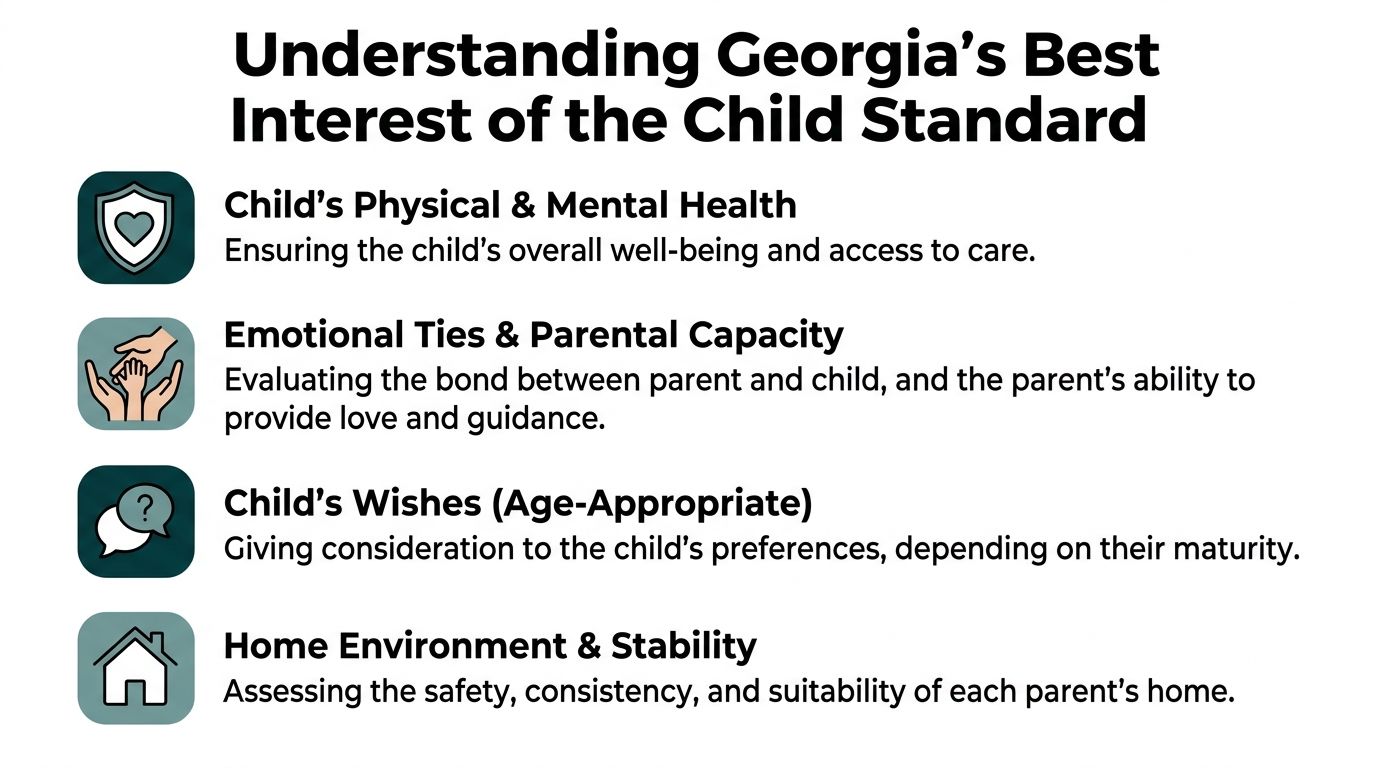
Georgia applies the best interest of the child standard under O.C.G.A. § 19-9-3. In Forsyth and Fulton County courtrooms, that analysis is not abstract. Judges look at how your child is living, who has been meeting day-to-day needs, what risks are present, and which parenting plan looks stable enough to put in place now. That last point matters more than many parents realize, because a temporary custody hearing often sets the pattern the court sees for months while the case is pending.
What the court is evaluating
Judges review the statutory factors, but in real hearings they tend to focus on facts that answer a smaller set of questions quickly and clearly.
They want to know:
- Who has been handling the child's routine care: school mornings, homework, meals, medical appointments, activities, and bedtime.
- Whether each parent can provide a stable home: steady housing, reliable transportation, supervision, and follow-through.
- How the child is doing in the current environment: performance at school, attendance, behavior, health, and adjustment to the home and community.
- Whether either parent has issues that affect parenting: untreated mental health concerns, substance abuse, family violence, unsafe partners, or criminal conduct.
- How each parent supports the child's relationship with the other parent: within reasonable safety limits.
- Whether the child is old enough for a preference to matter under Georgia law: and whether that preference appears thoughtful rather than coached.
For a fuller explanation of how child custody is decided in Georgia, it helps to review how these factors fit together under state law.
Why temporary hearings carry so much weight
Parents often assume the final hearing is where the main custody case gets decided. In practice, the temporary hearing can shape the entire case.
If one parent leaves a temporary hearing with primary parenting time, decision-making authority, or a schedule that starts working reasonably well, judges are often hesitant to disrupt that arrangement later without a strong reason. Courts care about stability. Once a child has been living under a temporary structure for several months, that structure can start to look like the safest default.
That is why I tell parents to treat the temporary hearing as a major custody event, not a warm-up. In both Forsyth and Fulton, the parent who presents a child-focused, workable plan early often enters the final stage of the case from a stronger position.
Evidence the court can use
Judges do not award custody based on who sounds more upset. They use evidence tied to the child's welfare.
Useful proof often includes school records, attendance reports, medical records, counseling records when properly available, calendars, texts or emails showing parenting conduct, and testimony from teachers, relatives, or other witnesses with firsthand knowledge. The strongest evidence usually comes from ordinary life, created before the lawsuit sharpened everyone's language.
Safety concerns need the same discipline. If abuse, neglect, substance abuse, or unsafe household members are part of the case, bring records that can be verified. Police reports, medical records, DFCS records when available, photographs with dates, and witness testimony carry more weight than suspicion alone. If a parent has concerns about who is around the child, public records and lawful ways to conduct background checks may help identify facts worth discussing with counsel before the hearing.
What usually helps, and what usually hurts
A good custody presentation connects facts to the child's daily life. It shows the judge what schedule makes sense, who can carry it out, and what problems need guardrails.
The arguments that usually fall flat are familiar:
- Claims without examples: saying you are the better parent without showing what you do.
- Character attacks untied to parenting: personal resentment rarely answers a custody question.
- General allegations of danger without records or witnesses: serious claims need support.
- A schedule that sounds fair in theory but does not fit school, distance, or work realities: judges notice logistics.
- Trying to win by excluding the other parent for weak reasons: unless safety is at issue, courts usually prefer a structure that protects the child's relationship with both parents.
Strong custody cases are built around specifics. Who gets the child to school. Who attends appointments. What schedule fits the child's life. What risk, if any, must be addressed right away.
Strategic Preparation for Your Cumming Custody Hearing
The parents who do best at temporary custody hearings usually are not the loudest or the angriest. They are the ones who walk in with a clear file, a workable plan for the child, and testimony that holds together under pressure. In Forsyth and Fulton County courts, that early hearing often sets the pattern for the rest of the case. If the temporary order creates a schedule the judge views as stable and workable, changing it later can be difficult without a strong reason.

Build a file that shows the judge how your proposal works
Judges do not have time to sort through a disorganized stack of screenshots and photos. A clean, chronological file makes your position easier to follow and easier to trust.
A useful preparation file usually includes:
- Parenting calendar: Mark overnights, exchanges, missed visits, school events, and medical appointments.
- School records: Attendance notices, grades, teacher communications, and activity schedules.
- Medical records: Appointment summaries, prescriptions, therapy recommendations, and who attended.
- Relevant communications: Texts or emails that show cooperation, refusal, threats, schedule changes, or decision-making problems.
- Photos with context: Use images tied to a date, event, or condition that matters.
- Proposed parenting plan: A practical schedule for school weeks, summers, holidays, transportation, and decision-making.
Temporary hearings reward preparation that is specific. If you want the court to give you weekday time because you handle school mornings better, show the school records, your work schedule, the commute, and the routine you already follow. If safety is in dispute, gather records carefully. Some parents also choose to conduct background checks when a new partner, caregiver, or household member becomes part of the child's environment. That does not replace formal discovery or court-approved investigation, but it can help identify issues worth raising with counsel before the hearing.
Prepare your testimony for the judge you have
Custody testimony needs discipline. Parents often come to court ready to explain every hurt, every betrayal, and every argument. That approach usually wastes time and weakens good facts.
Good testimony usually has these traits:
| Effective testimony | Weak testimony |
|---|---|
| Specific examples | Broad accusations |
| Calm delivery | Sarcasm or visible anger |
| Focus on the child's routine | Focus on adult grievances |
| Direct answers | Long speeches |
| Admits small flaws | Claims perfection |
I tell parents to practice answering the hard question directly, then stop. In Forsyth and Fulton, judges hear custody disputes every week. They can tell when a parent is answering to inform the court and when a parent is performing for the room.
Mock questioning helps. Direct examination lets you organize the important facts. Cross-examination shows where you get defensive, argue with the question, or add details that create new problems. A hearing notebook with tabs for exhibits, witness names, dates, and likely problem areas can keep you steady. For a more detailed checklist, review this guide on how to prepare for a custody hearing. Parents also sometimes work with therapists, coaches, or a local family law attorney for hearing prep. Services like those offered at Miles Hansford Law Firm often include document review, witness planning, and courtroom presentation practice.
Control stress before stress controls your testimony
Stress changes how people answer questions. A parent with strong facts can still lose ground by interrupting, guessing at dates, or sounding more focused on the other parent than the child.
Treat emotional control as part of trial preparation. That is especially true for temporary hearings, where the court gets an early impression of your judgment. In close cases, that impression can shape mediation, later negotiations, and the final custody outcome.
A few habits help:
- Practice short answers: Clear answers are easier for the judge to rely on.
- Review a timeline of key dates: Refresh your memory without trying to memorize every document.
- Sleep, eat, and arrive early: Fatigue and hunger make testimony less precise.
- Write down your three main points: Keep your focus on the child, the schedule, and the reason your proposal works.
- Use a grounding technique before court: Slow breathing and a brief pause before answering can prevent impulsive testimony.
Prepare for the temporary hearing as if it will matter at the final one. In many Cumming custody cases, it does.
How a Cumming Family Law Attorney Protects Your Rights
A custody hearing is one of the worst places to improvise. The legal issues move fast. Objections matter. The way evidence is introduced matters. The judge's patience is limited. A parent representing himself or herself often doesn't realize a problem until the hearing is already going badly.
A lawyer does more than speak for you
In a hearing, a family law attorney protects your position by narrowing the case to what the judge must decide. That includes choosing the right exhibits, objecting to improper evidence, preparing you for difficult questions, and making sure your requests line up with Georgia custody law.
That work is especially important when the custody dispute sits inside a larger divorce. Georgia no-fault divorce, equitable division, temporary support, and custody often interact. A proposed parenting schedule may affect child support. Possession of the home may affect school continuity. Mediation strategy may depend on what happened at the temporary hearing.
Local court knowledge changes strategy
Forsyth County and Fulton County are both Georgia courts, but local practice still matters. Scheduling, judicial preferences, mediation timing, temporary hearing procedures, and document expectations can differ. A lawyer who regularly handles family law matters in Cumming, Alpharetta, and North Fulton can prepare the case with those practical realities in mind.
That local experience also helps in related matters such as:
- Modifications when a current custody order no longer fits the child's needs
- Contempt actions if the other parent isn't following court orders
- Legitimation for fathers seeking enforceable parental rights
- High-asset divorce where business ownership, income structure, or property issues complicate custody litigation
The biggest advantage is strategic discipline
Parents are often tempted to fight every point. That's rarely the best use of a hearing. The stronger approach is to decide what must be proved now, what can wait for discovery or mediation, and what facts directly support the parenting arrangement you're asking the judge to enter.
A good attorney keeps the case child-centered, evidence-based, and realistic. That protects your credibility, which is one of the most valuable assets you have in any custody case.
Frequently Asked Questions About Custody Hearings in North Georgia
Q How long does a custody hearing take in Cumming, GA
A temporary custody hearing in Forsyth County Superior Court is often much shorter than parents expect, but the exact length depends on the issues, witnesses, and the judge's calendar. A final contested custody trial takes longer. Even a short hearing can have major consequences if temporary parenting terms are entered.
Q Will the judge hear from my child in Forsyth County or Fulton County
Sometimes, but not automatically. Georgia law allows a child's views to matter in some cases depending on age and circumstances, but that doesn't mean a child will walk into open court and choose. Courts are careful about how children's preferences are presented and weighed.
Q What should I bring to a custody hearing in Alpharetta or Cumming
Bring organized documents, not a pile of unsorted papers. That usually means your proposed parenting plan, relevant messages, school or medical records, calendars, prior orders, and any exhibits your lawyer has prepared. Bring only material tied to the issue the judge is deciding that day.
Q Are temporary hearings important if my case will go to mediation later
Yes. In Georgia family law, temporary hearings often shape the negotiation dynamics for mediation and can influence how the case develops afterward. If a temporary order sets a schedule that appears workable, changing it later may be harder. That's why temporary hearing preparation matters in both Forsyth and Fulton County cases.
Q Do Georgia courts require a parenting plan in custody cases
Yes. Georgia courts require a parenting plan in custody matters. The plan should address physical custody, legal custody, parenting time, holidays, transportation, and decision-making. In Cumming parenting plan disputes, vague proposals tend to create more conflict, not less.
Q Can a custody hearing happen during a Georgia divorce before the divorce is final
Yes. Georgia has a 30-day minimum waiting period after filing for divorce, but custody issues often need to be addressed well before a final decree. Temporary hearings are the usual method for creating structure while the divorce is pending in Forsyth County or Fulton County.
Q What if the other parent lies at the hearing
Stay calm and respond with evidence. Judges in Fulton County custody hearings and Forsyth County custody hearings hear conflicting stories regularly. The stronger response is usually documentation, consistent testimony, and credible witnesses. Visible anger often hurts more than the accusation itself.
Q Should I go to a custody hearing without a lawyer if I'm searching for an attorney near me
You can, but it's risky. Custody hearings involve evidence rules, legal standards, parenting plans, and local court procedure. If the other parent has counsel, the imbalance is even greater. Before agreeing to custody terms or appearing alone, speak with a family law attorney who handles North Georgia cases regularly.
If you're facing a custody hearing in Cumming, Alpharetta, Forsyth County, or Fulton County, speak with a family law attorney before temporary orders lock in a schedule that affects your child for months or longer. Miles Hansford Law Firm helps parents prepare for hearings, build parenting plans, respond to emergency issues, and protect their parental rights in North Georgia courts. Schedule a consultation if you need a clear strategy before your next court date.