


Meta Title: What Happens If You Get a DUI in Cumming GA
Meta Description: Arrested for DUI in Cumming, GA? Learn what happens next, the 30-day Georgia license deadline, and what to expect in Forsyth County courts.
Suggested URL Slug: /what-happens-if-you-get-a-dui-cumming-ga
Seeing blue lights on GA-400, Bethelview Road, or Peachtree Parkway can turn an ordinary night into a crisis in minutes. Those who search what happens if you get a dui are not looking for abstract law. They want to know what happens tomorrow, what happens to their license, whether they'll go to jail, and how to keep one mistake from reaching into work, family, and the rest of their future.
If you were arrested in Cumming, Alpharetta, Johns Creek, Milton, Suwanee, Roswell, Sandy Springs, Dawsonville, or elsewhere in North Georgia, the first thing to understand is this. A DUI is serious, but it is not hopeless. The worst move is to freeze, miss deadlines, and assume the court process will sort itself out. It won't. In Forsyth County and Fulton County, early decisions matter.
A DUI Arrest in Cumming Does Not Have to Define Your Future
You get home after midnight with a citation packet in your hand, your car left behind, and one question running through your head. What happens now?
In Georgia, two separate problems start the moment of a DUI arrest. One is your license. The other is your criminal case. They do not run on the same schedule, and they are not handled by the same decision-maker.
That distinction matters more than many people realize.
A driver arrested in Cumming, Alpharetta, or anywhere in North Georgia can lose ground fast by focusing only on the court date printed on the ticket. The Georgia Department of Driver Services has its own administrative process, and the criminal case in Forsyth or Fulton County moves on a separate track. If you miss the DDS deadline, the license consequences can start before your court case is resolved.
Practical rule: Treat the first days after a DUI arrest as two deadline problems. One with DDS, one with the court.
The panic people feel after an arrest is real. They are worried about getting to work in Roswell or Sandy Springs, explaining the arrest at home, picking up children, or standing in front of a judge. I have seen that first wave of fear many times. The clients who put themselves in the best position act quickly, get clear on which deadlines control, and stop guessing.
Police and prosecutors take DUI cases seriously, and judges do too. That does not mean your arrest was proper, your stop was lawful, or the officer's conclusions will hold up under close review. A DUI case can involve bad driving allegations, field sobriety testing issues, an implied consent dispute, a blood or breath testing question, and a license suspension fight at the same time. For a closer look at how roadside testing often becomes a defense issue, see our page on field sobriety tests in Georgia DUI cases.
Some people want broader context after an arrest, especially if they are comparing how other states split up license and criminal consequences. This Guide to Florida DUI charges is one example of how that separation can work in another state.
A DUI charge is serious. It does not decide your future by itself. Early action often makes the difference between reacting to the case and controlling it.
The DUI Stop and Arrest Process in Forsyth County
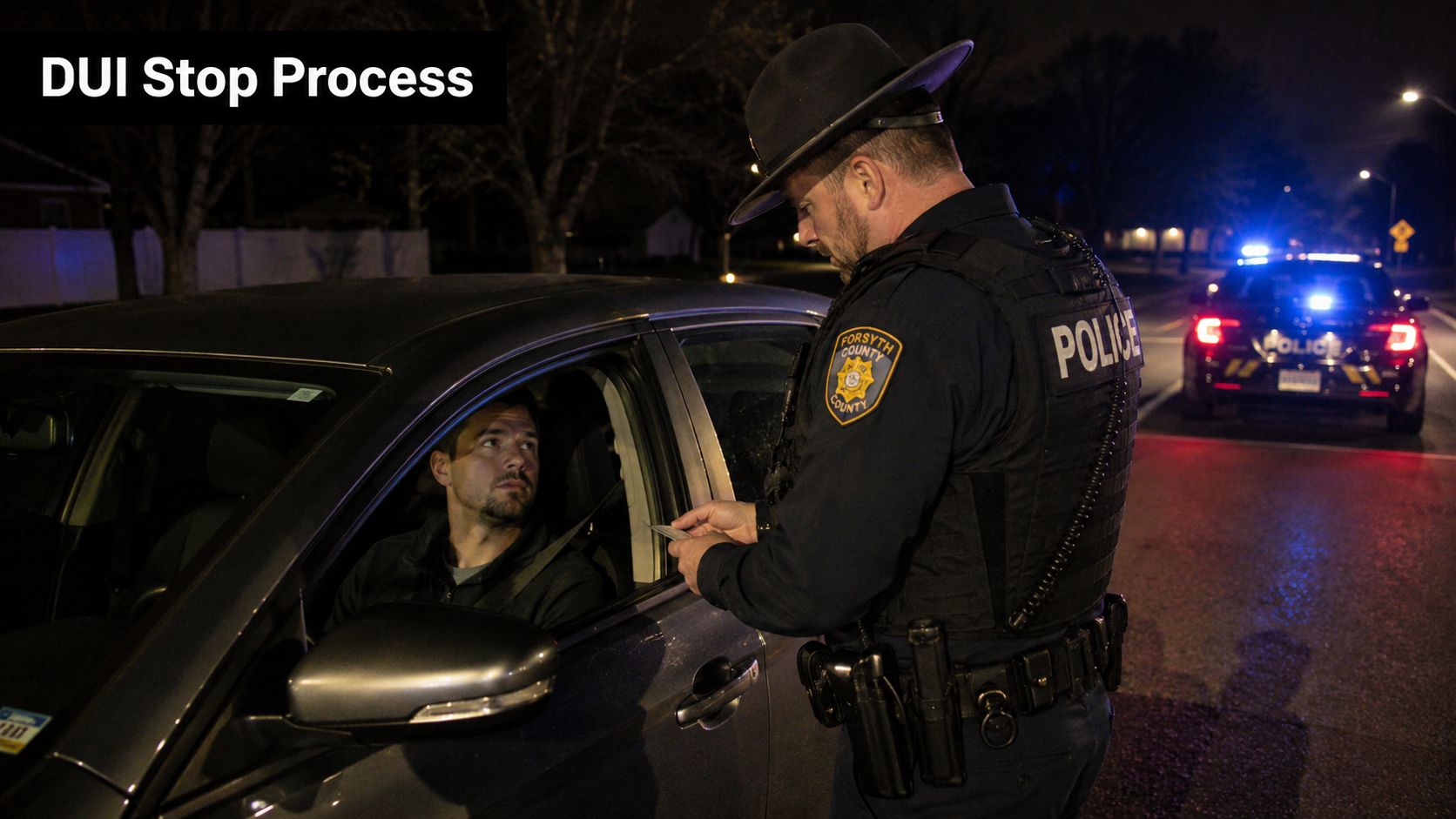
Blue lights hit your rearview mirror on GA-400 at night. By the time the officer reaches your window, the case has already started.
In Forsyth County, a DUI investigation usually begins with an alleged lane violation, speeding, failure to maintain lane, or some other driving behavior the officer says justified the stop. In Cumming, that often means an arrest that starts on GA-400, Highway 20, Bethelview Road, or a local road near downtown. The same pattern shows up in nearby parts of North Fulton.
From that first contact, the officer is building a record. Where your car stopped. How you handled your license and insurance. Whether there was an odor of alcohol or marijuana. Whether your eyes appeared watery or bloodshot. Whether your answers were direct, delayed, confused, or inconsistent. Those details often matter as much as any chemical test because they become the narrative the prosecutor reads first.
What happens on the roadside
The roadside phase is designed to produce evidence quickly. The officer may ask where you were coming from, whether you drank, what time you had your last drink, and whether you will perform field sobriety tests. You do have the right to remain silent, and in many cases calm, respectful silence is the safer choice than trying to explain the night away.
Field sobriety tests are not neutral screening tools. They are part of the case-building process. Officers use them to justify an arrest and later to support their testimony in court. If you want a clearer sense of how these tests are challenged, read our page on field sobriety tests in Georgia DUI cases.
A Forsyth County roadside investigation often includes:
- Questioning at the window: Officers are listening for admissions and looking for signs of confusion or divided attention.
- Field sobriety testing: Balance, instructions, footwear, lighting, medical conditions, age, weight, anxiety, and road surface can all affect performance.
- Portable breath testing: The handheld device on the roadside is an investigative tool. It is not the final legal issue in the case.
- Arrest and transport: Once the officer decides there is probable cause, you are taken into custody and the focus shifts to post-arrest testing and booking.
Volunteering extra details rarely helps. It usually gives the state more statements to sort through later.
Why officers handle DUI stops aggressively
Police treat suspected impaired driving as a public safety threat because alcohol-related crashes kill thousands of people each year, as noted earlier in this article. That context helps explain the officer's approach, but it does not excuse a weak stop, poor testing, or overstated observations. In every case, the state still has to prove the stop was lawful and the evidence is reliable.
What happens after the arrest
After an arrest, the officer may read Georgia's implied consent notice and request a state-administered breath, blood, or urine test. The exact wording, timing, and response can become major issues later. I look closely at that part of the encounter because mistakes there can affect both the evidence and the separate license consequences that start outside the criminal case.
Then comes booking. Your paperwork, officer narrative, video, test request, and timing start to matter in a very specific way. A DUI arrest in Forsyth County is not just one event. It is the starting point for two separate tracks, one with the Georgia DDS and one in criminal court, and the facts created during the stop often affect both.
What a defense lawyer reviews
A good DUI review is narrower than asking, “Were you arrested?” The better questions are:
- Was there a lawful reason for the stop
- What did the officer observe before asking you out of the car
- Were the field tests explained and administered correctly
- What do the body camera, dash camera, and dispatch times show
- Was the implied consent notice read properly
- Do the report, video, and test records match
That review is where many defenses begin. In my experience, the arrest report often sounds cleaner than the video. Timing problems show up. Instructions get shortened. Claimed clues do not always appear on camera. Those details can make a real difference in how the case is handled.
Georgia's Two-Front War Your License and Your Liberty
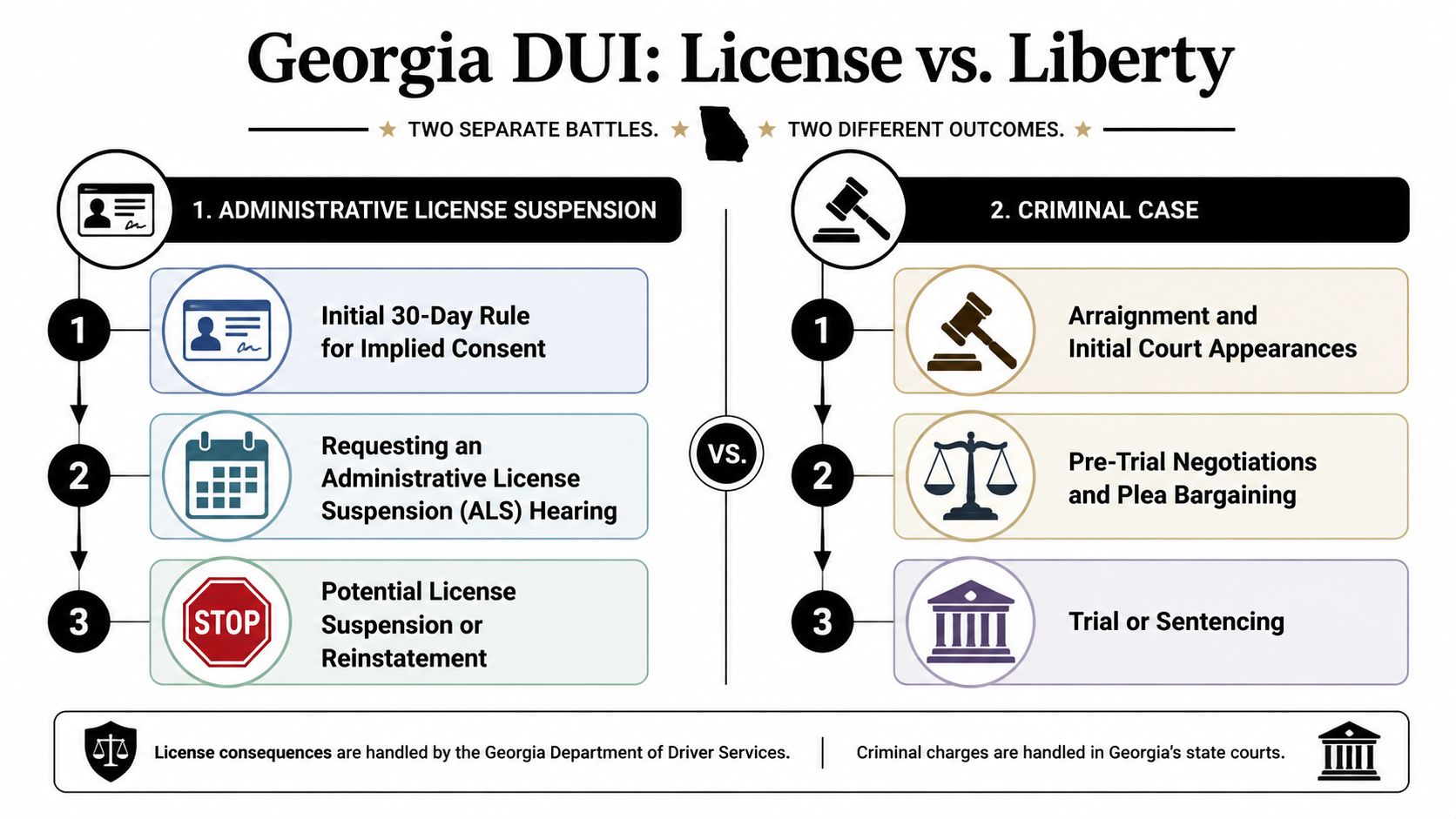
A DUI is often perceived as one case. In Georgia, it usually means two separate fights moving at the same time. One concerns your driver's license. The other concerns the criminal charge in court.
That distinction matters in Cumming and Alpharetta because the deadlines are different, the forums are different, and the consequences are different.
Clock one is your Georgia license
The administrative side moves first. A DUI triggers two parallel proceedings: the criminal case and the administrative license action. The Georgia DDS can suspend your license administratively just 30 days after arrest, often before your criminal case is heard, making a fast request for an ALS hearing operationally critical, as summarized in this discussion of administrative DUI license action timing.
If you miss that deadline, you can lose driving privileges before you have any meaningful chance to contest the criminal allegation in court.
That is why one of the first strategic questions after a DUI arrest is whether to pursue the administrative hearing route or evaluate other available license options. Cases involving an alleged refusal raise their own set of problems, which is why many people need to understand what happens if you refuse a breathalyzer in Georgia.
Clock two is your criminal case in Forsyth or Fulton County
The second track is the criminal prosecution. Depending on where the arrest occurred, that may run through a local court in Forsyth County, a North Fulton court, or another Georgia court with jurisdiction. This process includes court dates, evidence review, motions, negotiations, and possibly trial.
The criminal case asks different questions than the administrative license action, including:
- Was the stop lawful
- Was the arrest supported by probable cause
- Are the officer's observations reliable
- Are any breath or blood results admissible
- Can the state prove impairment beyond a reasonable doubt
Missing the license deadline does not mean you lose the criminal case. But it can create immediate damage to your daily life while that case is still pending.
Why people get hurt by treating this as one problem
The most common mistake after a DUI arrest in North Georgia is assuming the court date on the citation controls everything. It doesn't. By the time many people start looking for help, the license clock has already been running.
If you're asking what happens if you get a dui in Cumming, this is the answer that matters first. You do not have one file. You have two timelines, two forums, and two separate risks.
Georgia DUI Criminal Penalties From First Offense to Felony
Georgia law treats DUI consequences as escalating. Prior history matters. Alleged BAC can matter. Refusal allegations can matter. Child passengers, injuries, and other aggravating facts can make the case much worse.
The broad rule is straightforward. Georgia law creates escalating penalties for repeat offenses within a 10-year lookback period, and factors like a high BAC of 0.15+, a child passenger, or prior convictions can trigger harsher treatment, as reflected in this discussion of how DUI penalties escalate with BAC and prior history.
A practical look at the penalty structure
Because Georgia DUI outcomes depend heavily on the exact charge, record, and facts, the most honest way to think about penalties is by category, not by assuming every first case ends the same way.
| Penalty | 1st Offense | 2nd Offense | 3rd Offense (Misdemeanor) |
|---|---|---|---|
| Jail exposure | Possible misdemeanor jail exposure | Higher exposure than a first offense | More severe misdemeanor exposure |
| Fines and court costs | Financial penalties can apply | Higher financial penalties are common | Penalties increase further |
| License consequences | Suspension risk and related restrictions | Longer or harsher licensing consequences | Revocation risk becomes more significant |
| Conditions of sentence | Education, supervision, and other court-ordered conditions may apply | Courts often impose more demanding conditions | Conditions usually become more restrictive |
| Case posture | Sometimes treated as a manageable first case | Prosecutors usually view as a repeat-risk case | Often treated as a major warning sign |
That table is intentionally general. Specific penalties can turn on facts that are not obvious from the citation alone.
What pushes the case into more dangerous territory
Some factors change the risk fast:
- High alleged BAC: A higher reading can make it easier for prosecutors to seek tougher treatment.
- Child passenger allegations: These facts change how the court views the case.
- Prior DUI history: Repeat cases are judged much more harshly.
- Refusal claims: Refusal can affect both license issues and how the state presents the case.
- Injury-related facts: Once a case involves harm to another person, the stakes rise sharply.
For many clients, the actual question is not “What is the standard penalty?” It is “What facts is the prosecutor going to use to make this look worse than it is?”
If you are trying to understand whether your charge could move beyond a standard misdemeanor, this page on when a DUI can become a felony is a useful starting point.
Requirements beyond fines and jail
A DUI case often carries requirements beyond the sentence itself. People are frequently ordered to complete education or treatment-related conditions as part of getting back on track with driving and court compliance. For a practical overview of one common requirement, this guide to Georgia DUI requirements explains the DUI school process many Georgia drivers encounter.
A first offense does not automatically mean a minor outcome. A repeat offense does not automatically mean the case is unwinnable. What matters is how the facts are developed and challenged.
The Hidden Costs of a DUI Conviction in North Georgia

For many people in Alpharetta, Cumming, Suwanee, Roswell, and Milton, the courtroom penalty is only part of the damage. The longer-term fallout usually hits in daily life. Driving. Employment. Licensing. Insurance. Immigration concerns.
A DUI conviction creates a significant financial chain reaction. Beyond court fines, auto insurance rates increase an average of 72% after a DUI, and the conviction appears on background checks, potentially affecting current and future employment, according to State Farm's summary of the real consequences of drunk driving.
Where people feel it first
The first pressure point is often transportation. In North Georgia, losing a license can disrupt everything from commuting on GA-400 to taking children to school or making a shift change in Fulton County.
The next problem is work. A background check may reveal the conviction. Employers who require driving, security clearance, or high levels of trust may react strongly. For regulated professionals, the issue may not just be embarrassment. It may be mandatory reporting and disciplinary review.
Professional and immigration risks
Certain jobs carry added risk after a DUI, especially when a professional board or licensing agency expects disclosure. Nurses, pilots, commercial drivers, and real estate professionals often need more than a criminal defense strategy. They need a collateral-damage strategy.
Immigration consequences also require careful attention. A DUI is not automatically a deportable offense, but federal guidance recognizes that it can become much more serious when paired with aggravating factors such as repeat conduct, drugs, injury, or evidence of a substance-use disorder, as explained in this overview of DUI collateral consequences involving immigration and licensing.
A plea that looks manageable in court can still create a licensing or immigration problem outside the courtroom.
The practical trade-off
Some resolutions look efficient because they close the criminal case quickly. That does not always mean they are good outcomes. If you live in Cumming or Alpharetta and your livelihood depends on driving, a clean background check, or a professional credential, the right strategy often involves balancing speed against long-term fallout.
That is why DUI defense is not only about avoiding the harshest sentence. It is also about protecting the parts of your life that a standard court calendar does not measure.
Building a DUI Defense Strategy for Your Cumming Case
A strong DUI defense is built by pulling the state's case apart piece by piece. The question is not whether the arrest report sounds convincing on paper. The question is whether the state can prove its case with reliable, admissible evidence.
Many people do not realize how often prosecutors rely on aggravating details to increase pressure. An experienced attorney analyzes the state's evidence to challenge a high BAC allegation, an alleged refusal, or prior convictions used to seek harsher treatment, as reflected in this overview of factors that can make a DUI case more serious.
What gets examined first
The first line of defense is often the stop itself. If the officer lacked a lawful reason to pull you over, the whole case can shift.
After that, the focus turns to the investigation:
- Roadside testing: Were the instructions clear, fair, and properly demonstrated?
- Officer observations: Do the body camera and report match?
- Breath testing records: Was the machine maintained and used properly?
- Blood evidence: Was the sample handled correctly from draw to lab?
What works and what usually does not
Good DUI defense is detail work. It is not built on dramatic speeches about fairness. It is built on video review, timing, procedure, and cross-examination.
What usually does not work:
- Minimizing the case early: That often leads to missed deadlines and weak preparation.
- Assuming a first offense will be forgiven: Courts do not treat DUI casually.
- Accepting the officer's report as the full story: Video, records, and witness context often matter more.
The arrest is the state's opening version of events. It is not the final one.
For readers comparing defense approaches in other states, this resource on understanding Minnesota DUI laws shows how experienced lawyers in another jurisdiction also focus on stop validity, testing, and procedural errors. In Georgia, the same disciplined review often makes the difference between a rushed outcome and a strategic one.
If you want a local option for that review in Cumming or Alpharetta, Miles Hansford Law Firm handles DUI defense by evaluating both the administrative license issue and the criminal case at the same time.
Why Choose Miles Hansford for Your DUI Defense
A DUI case in North Georgia is local in all the ways that matter. The roads are local. The officers are local. The prosecutors, judges, and court habits in Forsyth County and Fulton County are local too.
That matters because DUI defense is not just about knowing statutes. It is about knowing how cases move through real courtrooms, how quickly to act on the license issue, what facts tend to drive negotiations, and when a case should be pushed harder rather than wrapped up quickly.
What local representation changes
A lawyer familiar with Cumming, Alpharetta, North Fulton courts, and Forsyth County practice can often identify the practical issues early:
- Court expectations: How your case will likely be scheduled and handled.
- Evidence focus: Which parts of the state's case deserve immediate attention.
- Risk management: Whether to prioritize license preservation, trial preparation, or collateral consequence control.
The firm's background also matters. A team that includes former prosecutors brings useful perspective to a DUI case because they understand how the state organizes proof, where prosecutors tend to push, and what weaknesses may matter in negotiation or litigation.
Calm, protective, strategic
People charged with DUI do not need panic from their lawyer. They need judgment. They need someone who can tell them what is urgent, what can wait, and what choices will affect work, family, and reputation in Cumming, Alpharetta, Johns Creek, Milton, and the surrounding North Georgia communities.
If you are looking for a DUI attorney near me after an arrest in Forsyth County or Fulton County, local experience and fast action are the two things that matter first.
Frequently Asked Questions About DUI in Cumming and Alpharetta
Can I still drive after a DUI arrest in Cumming, GA
Sometimes, but only for a short window unless you act quickly. The immediate problem is the separate DDS license process, which can move faster than your criminal case in Forsyth County or Fulton County. Waiting for your first court date is usually a mistake.
What happens if I refused a breath test in Alpharetta
A refusal can create serious license and litigation problems. It may affect the administrative side right away and can become a major issue in the criminal case. Refusal cases need quick review because timing and paperwork matter.
Will a first DUI in Forsyth County mean jail
Not always, but jail exposure is real even on a first offense. The outcome depends on the facts, the court, prior history, and whether there are aggravating features such as a high alleged BAC or child passenger.
Can a DUI be reduced in North Georgia
Sometimes, but not automatically. Reductions depend on weaknesses in the state's proof, legal issues with the stop or testing, and the overall posture of the case. Early preparation gives you more room to pursue a better result.
Will a DUI affect my job in Fulton County
It can. A conviction may appear on background checks, affect driving-related work, and create trouble for licensed professionals. That is one reason the defense strategy should address collateral consequences, not just the court sentence.
How soon should I hire a DUI lawyer near me
Immediately. The administrative license deadline can arrive before the criminal case is meaningfully underway. Fast action often protects options that are hard or impossible to recover later.
If you were arrested for DUI in Cumming, Alpharetta, Forsyth County, or Fulton County, act before the license deadline closes off options. Miles Hansford Law Firm represents people facing DUI charges across North Georgia and can help you evaluate both the DDS license issue and the criminal case. Schedule a consultation if you need clear advice, a practical defense plan, and a steady path forward.
Internal Link Suggestions:
- Field Sobriety Tests in Georgia
- What Happens If You Refuse a Breathalyzer
- Is a DUI a Felony
- Criminal Defense Overview
- DUI Defense in Georgia
Schema Recommendations:
- Attorney
- LegalService
- FAQPage