


Meta Title: What Is a Cease and Desist Letter in Cumming, GA
Meta Description: What is a cease and desist letter in Cumming, GA? Learn how it works in Forsyth and Fulton County disputes and what to do next.
Suggested URL Slug: /what-is-a-cease-and-desist-letter-cumming-ga
Schema Recommendations:
- Attorney
- LegalService
- FAQPage
Internal Link Suggestions:
- /is-a-competitor-defaming-your-business/
- /how-to-respond-to-a-lawsuit/
- /how-to-handle-breach-of-contract-situations/
- Related family law pages on mediation, custody, contempt actions, and divorce in Cumming and Alpharetta
If you live in Cumming, GA or Alpharetta and a formal legal letter just landed in your mailbox or inbox, your first reaction is usually the same. Your stomach drops. The tone sounds severe. The allegations may feel unfair, exaggerated, or completely unexpected.
That reaction is normal.
A cease and desist letter often arrives in the middle of a stressful conflict. Sometimes it's tied to a business dispute in Forsyth County. Sometimes it grows out of online posts, harassment between former partners, a contract problem, or statements made during a family law conflict in Fulton County. Whatever triggered it, the right response isn't panic. It's strategy.
People searching what is a cease and desist letter usually need more than a dictionary definition. They need to know how serious it is, whether they must respond, what happens if they ignore it, and when they should call a local attorney near me before saying anything at all.
Receiving a Strange Letter? What to Do First
A common local scenario starts like this. A business owner in Alpharetta gets a certified letter accusing the company of unfair competition. A parent in Cumming receives an email from a lawyer demanding that social media posts come down immediately. Someone in Johns Creek or Milton is told to stop contacting an ex-spouse, a co-parent, or a former business partner.
The document feels official because it is official in one sense. It is a formal legal demand. But it is not a final judgment against you.
That distinction matters.
A cease and desist letter is usually the first serious move in a dispute, not the last. The sender is saying, in effect, "Stop this conduct now, or the next step may be court." In North Georgia, that next step could mean litigation in Forsyth County Superior Court, Fulton County Superior Court, or another court with jurisdiction over the dispute.
Getting a letter like this doesn't automatically mean the sender is right. It does mean the matter should be treated carefully from the start.
Many people hurt their position in the first few hours after receipt. They fire off an angry reply. They call the other side directly. They delete posts, texts, or emails without thinking through the consequences. In family conflict, that kind of reaction can spill into divorce, custody, contempt, or protective-order issues under Georgia law.
A calmer approach works better. Save the letter. Stop talking publicly about the dispute. Get legal advice before you answer. That is often the move that protects you, your business, and your long-term options in Cumming, Alpharetta, Suwanee, Roswell, Sandy Springs, and the surrounding North Georgia area.
What Is a Cease and Desist Letter?
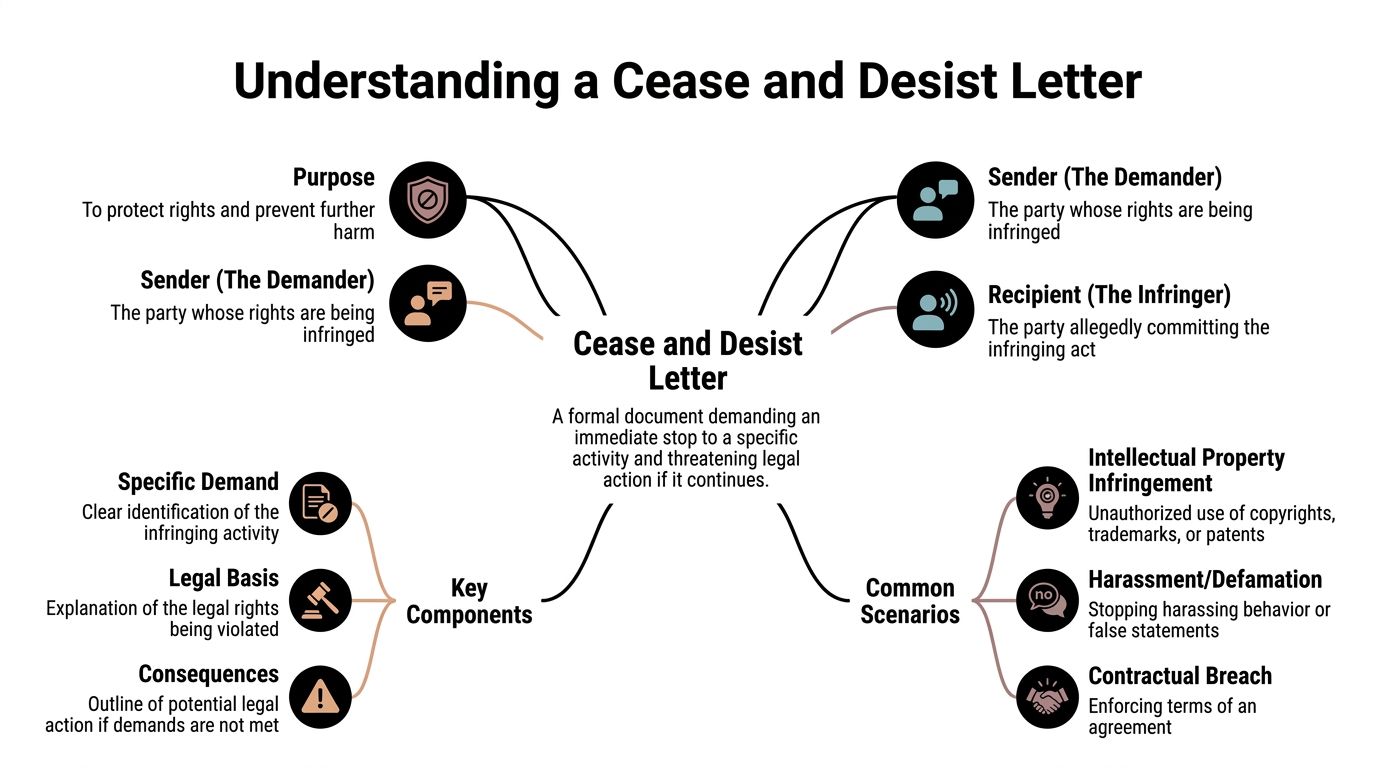
A cease and desist letter is a formal, non-binding notice demanding that a person or business stop alleged wrongful conduct. It commonly appears in disputes involving intellectual property, contract issues, harassment, defamation, and similar conflicts. Although it is not legally enforceable by itself, practitioner surveys from the International Trademark Association show that these letters resolve 60-75% of cases without further legal action according to Rosenberg Law's discussion of cease and desist actions.
What the letter is actually doing
Think of it as a formal warning. The sender claims you are doing something unlawful or harmful, tells you to stop, and warns that a lawsuit may follow if the conduct continues.
Most letters include a few core parts:
- The parties involved so there's no confusion about who is sending the demand and who must respond
- A description of the alleged conduct such as a statement made online, use of a business name, breach of an agreement, or repeated unwanted contact
- The legal basis for the complaint which may reference statutes, contract terms, or established rights
- A clear demand telling the recipient what must stop, be removed, returned, corrected, or preserved
- A deadline for compliance or response
- A warning about next steps if the matter isn't resolved voluntarily
What it is not
It is not a court order.
A judge has not heard evidence. No one has ruled against you. The sheriff is not coming because you got a letter in the mail. That said, the letter is still serious because it puts you on notice and often becomes part of the dispute record.
Practical rule: Treat the letter seriously without treating it as automatic proof that you did anything wrong.
Why lawyers use them before filing suit
Litigation is expensive, disruptive, and slow. A cease and desist letter gives the sender a chance to stop the conduct without filing immediately. In the right case, that can reduce damage, preserve evidence, and create a path to settlement.
For a recipient in Alpharetta or Cumming, this means two things at once. First, you shouldn't ignore the letter. Second, you shouldn't assume your only choice is surrender. Sometimes the right answer is compliance. Sometimes it's a targeted rebuttal. Sometimes it's negotiation with language that protects your rights.
Common Scenarios for Cease and Desist Letters in Alpharetta
In Alpharetta, these letters show up in more situations than is commonly expected. They are not limited to trademark fights between large companies. They often appear in ordinary disputes involving local businesses, former spouses, co-parents, neighbors, and professionals across Fulton County and nearby communities.

Business conflict in Alpharetta and Johns Creek
A local company may believe a former employee took confidential information, copied marketing language, contacted clients in violation of an agreement, or made false claims about the business. In that setting, a cease and desist letter can demand that the conduct stop immediately and that certain records or materials be preserved.
This tool can be useful. It can also backfire if drafted carelessly. A 2025 American Bar Association study found that 28% of recipients of baseless letters countersued for abuse of process, as noted in Callahan Law's discussion of cease and desist letters. That is one reason a threatening DIY letter copied from the internet is often a mistake.
Online defamation in Milton, Roswell, and North Fulton
A business owner in Milton may discover a stream of false online accusations from a competitor or former customer. A professional in Roswell may face damaging posts that spread through neighborhood groups and review platforms. A family law dispute in North Fulton courts can also spill online, with one party posting statements that affect work, parenting, and reputation.
In those cases, the first legal question is not only whether the statements are offensive. It is whether they are actionable, provable, and worth addressing by letter before filing suit. If your concern involves false statements harming your company, this resource on is a competitor defaming your business is a useful next read.
Pre-divorce harassment and family-related conflict in Cumming
Not every cease and desist matter is commercial. A person preparing for divorce in Cumming may deal with repeated unwanted messages, interference with family relationships, publication of private allegations, or contact aimed at causing pressure before filing. In emotionally charged cases, people often say too much, too publicly, too early.
Georgia family law has its own framework for divorce, custody, parenting plans, temporary hearings, and mediation. Georgia is a no-fault divorce state, there is a 30-day minimum waiting period after filing, and disputed cases often involve temporary orders that shape daily life while the case is pending. A cease and desist letter won't replace court relief, but it can sometimes create boundaries before a divorce, custody, or contempt action begins in Forsyth County Superior Court or Fulton County Superior Court.
Contract and property disputes in Suwanee and Dawsonville
Small businesses and individuals in Suwanee or Dawsonville also use these letters in contract disputes. One side says the other side is soliciting restricted customers, withholding property, interfering with a deal, or violating an agreement. The letter becomes a way to demand compliance before the matter turns into a lawsuit.
What works in these cases is precision. What doesn't work is theatrics, overstatement, or empty threats.
The Legal Weight of a Cease and Desist Letter in Georgia
The most important legal point is simple. A cease and desist letter has weight, but not the same kind of weight as a court order.
According to Wikipedia's explanation of cease and desist practice, letters are non-binding warnings, while cease and desist orders are issued by a court and are legally enforceable with penalties like fines or jail time. A letter often serves as the first step before a court will consider granting that kind of enforceable relief.
Why it still matters in Forsyth County and Fulton County
If a dispute later lands in Forsyth County Superior Court or Fulton County Superior Court, the letter may help show several things:
| Issue | Why the letter matters |
|---|---|
| Notice | It can show the recipient knew about the complaint |
| Reasonableness | It may show the sender tried to resolve the matter before suing |
| Timing | It can establish when the dispute became formal |
| Preservation | It may put the recipient on notice to preserve evidence |
That doesn't mean the sender wins because they sent a letter. It means the paper trail begins there.
How Georgia recipients should think about risk
If you receive a letter and do nothing, you may lose the chance to control the early framing of the dispute. If you overreact, you can create new problems. The smart approach is usually measured and documented.
In many disputes, the primary question is not "Is this binding?" The fundamental question is "How will my next move look if a judge reads it later?"
That is why the distinction between a warning and a binding legal instrument matters. If you want a plain-language refresher on what makes a document legally binding, that overview is helpful for understanding why some signed documents create enforceable obligations and some do not.
A cease and desist letter isn't self-executing. Its power comes from notice, strategy, and what may happen next if the dispute continues.
In family and civil matters, local context matters
In North Georgia, disputes often overlap. A business disagreement can affect divorce property division. A harassment claim can affect custody communication. Georgia courts apply equitable division in divorce, evaluate custody under the best interests of the child standard, require parenting plans, and frequently use mediation and temporary hearings to manage disputes.
Because of that, a letter that seems narrow on the surface may have consequences that reach well beyond one accusation. Local counsel helps identify those downstream risks before a response goes out.
I Received a Letter in Cumming GA What Are My Next Steps?
If you received a cease and desist letter in Cumming, GA, don't answer it in anger and don't assume silence is always safe. The first day matters.

Start with control, not reaction
Read the letter carefully. Then stop.
Don't call the sender to "clear it up." Don't post about it. Don't text mutual friends or business contacts about how outrageous it is. If the dispute has any tie to divorce, custody, or ongoing family conflict in Forsyth County, public reactions can create unnecessary evidence.
A practical first-response checklist
Save everything
Keep the envelope, email headers, attachments, screenshots, texts, contracts, and any related messages. If the claim involves online content, preserve what was posted before anything changes.Don't destroy documents or data
Deleting posts, emails, files, or account data can make a manageable problem much worse. Even if the accusation is weak, destruction of evidence is rarely viewed kindly later.Separate allegation from fact
A lawyer's letter often sounds confident. That does not make every statement in it true. Some letters overstate the law, omit context, or demand more than the sender is entitled to receive.Review the deadline
Deadlines matter, but they aren't always immovable. Counsel can often ask for additional time while evaluating the claims.Talk to a Georgia attorney before responding
One's response can often protect or damage their case. A short response written in frustration can admit facts that were never necessary to admit.
Immediate advice: Preserve evidence first. Speak second.
What a lawyer is looking for
An attorney will usually evaluate the claim from several angles:
- Whether the sender has a valid legal basis
- Whether the facts are disputed
- What evidence exists on both sides
- Whether a response, negotiation, or silence is the best move
- Whether the matter could escalate into litigation in Forsyth County or Fulton County
Sometimes a concise rebuttal is enough. Sometimes limited compliance makes sense. Sometimes the issue is serious enough that your response should be written as if a judge may read it later.
If you suspect the matter could become a formal case, this guide on how to respond to a lawsuit helps explain the mindset you should have from the start.
For family-related disputes, think beyond the letter
In Cumming and Alpharetta, some cease and desist issues arise just before or during family litigation. Georgia divorce cases may involve temporary hearings, mediation requirements, parenting disputes, and financial disclosures. Choices made in the pre-suit phase can affect credibility later.
If the conflict touches parenting, property, or a pending separation, don't agree to anything quickly just to make the pressure stop. Review it with counsel first.
Sending a Letter Proactively Protecting Your Rights in Forsyth County
Sometimes you're not the recipient. You're the one being harmed.
A business in Forsyth County may need a competitor to stop using protected material. A parent may need unwanted contact to stop before a custody case escalates. A professional may need false accusations removed before they spread further across Cumming, Alpharetta, Canton, or Sandy Springs.
Why a well-drafted letter still matters
Pre-litigation warnings have been part of legal strategy for decades. By 1980, with amendments to federal law, cease and desist letters had become standard in 90% of IP enforcement actions, reducing court filings by an estimated 65%, according to Cornell Law's cease and desist letter overview. The broader principle carries into civil disputes today. A serious letter can force attention before a judge ever sees the case.
DIY letters usually fail for predictable reasons
People often draft their own letters after finding a template online. Those letters tend to go wrong in familiar ways:
- They overclaim and threaten legal remedies that don't fit the facts
- They underspecify the conduct, so the recipient can pretend not to understand
- They escalate emotionally instead of strategically
- They ignore local procedure and the realities of Forsyth County and Fulton County practice
A stronger letter states the facts carefully, identifies the conduct that must stop, preserves future claims, and avoids saying more than necessary.
Strategic value in contract and business disputes
In business cases, the letter should fit the larger dispute strategy. If the matter involves a vendor relationship, restrictive covenant issue, unpaid obligation, or broken agreement, the right pre-suit demand can frame the case effectively from the start. For readers dealing with that kind of conflict, this guide on how to handle breach of contract situations is a useful companion.
A strong letter isn't loud. It's specific, credible, and written by someone prepared to follow through if the conduct continues.
That is what gives the document force in practice.
Why Choose Miles Hansford for Your Alpharetta Civil Dispute
In Alpharetta, civil disputes often sit close to other legal problems. A business conflict can affect a divorce. Harassment allegations can touch custody and parenting issues. A defamation problem can disrupt a professional reputation, settlement advantage, and family stability all at once.
That overlap matters.
Miles Hansford serves clients across Alpharetta, Cumming, Forsyth County, Fulton County, Johns Creek, Milton, Roswell, Suwanee, Dawsonville, Sandy Springs, and Canton. The firm's work in civil litigation, mediation, business disputes, and family law gives clients a practical advantage when a cease and desist issue isn't isolated from the rest of life.
The approach is calm and strategic. The objective is to solve the right problem, not just send the loudest letter.
For clients who value organization and responsiveness in complex matters, it also helps to understand how modern firms use systems to track deadlines, documents, and communications. This overview of legal practice management software offers useful background on the kinds of tools that support disciplined case handling.
If your dispute may reach Forsyth County Superior Court, Fulton County Superior Court, or involve North Fulton courts, local experience matters. So does judgment.
Frequently Asked Questions About Cease and Desist Letters in Georgia
Q: Do I have to respond to a cease and desist letter in Cumming, GA?
A: Not always. A cease and desist letter is generally non-binding, but ignoring it can be risky if the sender is prepared to file suit in Forsyth County or another Georgia court. A lawyer can help you decide whether to respond, negotiate, or preserve silence strategically.
Q: Is a cease and desist letter the same as a court order in Alpharetta?
A: No. A letter is a formal warning, not a court command. A court order comes from a judge and is enforceable. In Alpharetta and Fulton County disputes, that difference matters because your obligations depend on what legal process has occurred.
Q: Can a cease and desist letter be used in family law disputes in Georgia?
A: Yes. It can arise in harassment, online statements, unwanted contact, or related pre-divorce conflict. It does not replace formal family court relief, but it can be part of a broader strategy involving mediation, temporary hearings, custody issues, or contempt concerns.
Q: Should I delete posts or messages after receiving one?
A: Usually, no. Preserve them first. Deleting materials can create separate problems, especially if the matter later becomes litigation in Forsyth County Superior Court or Fulton County Superior Court. Have counsel review the situation before changing anything.
Q: Can I send my own cease and desist letter near me?
A: You can, but that doesn't mean you should. A poorly drafted letter may be ignored, escalate the dispute, or create avoidable risk. In North Georgia business and family-related conflicts, careful drafting usually matters more than aggressive wording.
Q: How does this fit with Georgia divorce and custody cases?
A: It depends on the facts. Georgia divorce law includes no-fault grounds, a 30-day minimum waiting period, equitable division, child custody standards focused on the child's best interests, parenting plans, mediation, and temporary hearings. A pre-suit letter can affect how those later issues unfold.
If you're dealing with a cease and desist letter in Cumming, Alpharetta, Forsyth County, or Fulton County, get clear advice before you respond. The attorneys at Miles Hansford Law Firm help individuals, families, and businesses assess risk, protect evidence, and choose the right next move. Schedule a consultation today to speak with a family law attorney or civil litigation lawyer who can help protect your rights.