


Have you wondered what a living trust is and why so many people talk about them in estate planning? At its core, a living trust is a private legal document that holds your assets—like your home, bank accounts, or investments—for your benefit while you're alive. When you pass away, those assets are then transferred directly to the people you've chosen, completely bypassing the public and often slow court process known as probate.
It’s a powerful tool for maintaining control, ensuring privacy, and creating a smooth transition for your legacy. At Miles Hansford, our attorneys help families across Forsyth and Fulton Counties create clear, effective estate plans.
Understanding the Foundation of a Living Trust

The easiest way to think about a living trust is to picture it as a private container you create to hold your most important assets. While you're living and well, you manage everything inside it just like you always have. Nothing really changes day-to-day. The true power of the trust kicks in later, providing a clear and efficient roadmap for your estate.
This simple yet effective tool helps families right here in North Georgia communities like Alpharetta and Cumming protect what they've worked so hard to build. It ensures your property is managed and distributed exactly how you want, without unnecessary court delays. To understand how it works, you need to know the three key players involved.
The Key Players in Your Trust
Every living trust revolves around three essential roles. In the beginning, you will likely wear more than one of these hats.
Here is a quick breakdown of who does what:
| Role | Description |
|---|---|
| Grantor | This is you. You're the one creating the trust and putting your assets into it. You set all the rules. |
| Trustee | This is the manager. Initially, you will almost always be your own trustee, keeping full control over your assets. |
| Beneficiary | These are the people or charities who will inherit the assets from the trust after you're gone. |
As long as you are the Grantor and Trustee, your daily life remains unchanged. You can still buy, sell, and manage your property just as you see fit. You will also name a successor trustee—a trusted person or institution who will step in to manage the trust for your beneficiaries after your death or if you become unable to manage things yourself.
A living trust, specifically a revocable living trust, is one of the most popular estate planning tools. It allows individuals to maintain full control over their assets during their lifetime while seamlessly transferring them to beneficiaries upon death without the delays and costs of probate court.
This is a significant benefit. In the U.S., probate can drag on for months and consume a percentage of an estate's total value in fees. Living trusts sidestep this process entirely, saving your heirs time, money, and stress. For families in our area, this means avoiding the probate courts in Fulton County or Forsyth County.
By creating a clear set of private instructions, a living trust removes the guesswork and empowers your successor trustee to settle your affairs privately and efficiently. This is a fundamental difference from a will, which is essentially a letter to the probate judge and must go through the public court system. There are many different types of trusts used in estate planning, each designed to meet specific family goals.
Revocable vs. Irrevocable Trusts: Which Path Is Right for You?
When you decide to create a living trust, one of the first and most critical decisions you'll face is whether to make it revocable or irrevocable. These are not just legal terms; they represent two fundamentally different approaches to managing your assets. The right choice for you will hinge entirely on your personal financial situation and what you hope to accomplish for your family.
Getting this part right is the cornerstone of an effective estate plan.
The Power of Flexibility with a Revocable Trust
Think of a revocable trust as an estate plan written in pencil. As the creator, you have complete freedom to change your mind.
While you are alive and well, you can amend the terms, add or remove property, or even cancel the entire trust if you want to. You stay in the driver's seat, usually acting as your own trustee and managing the assets just as you did before.
This incredible flexibility is why the revocable living trust is the go-to choice for most families here in Georgia. Life is unpredictable—marriages, divorces, new grandchildren—and your estate plan needs to be able to adapt. For most people in communities like Johns Creek and Roswell, a revocable trust is the best tool for avoiding probate while keeping control over their assets.
Its primary jobs are to:
- Avoid Probate: Assets in the trust pass directly to your heirs, bypassing the often lengthy and public court process in Fulton or Forsyth County.
- Plan for Incapacity: If you ever become unable to manage your finances, your chosen successor trustee can step in immediately without needing a court order.
- Keep Your Affairs Private: Unlike a will, which becomes a public record, a trust keeps your family's financial matters confidential.
When Permanence Provides Greater Protection
Now, let's talk about the irrevocable trust. This one is like a plan etched in stone. Once you create it and transfer assets into it, you generally cannot take them back or change the terms. You are intentionally giving up control and, in a legal sense, ownership of that property.
So, why would anyone willingly give up that much control? An irrevocable trust is a powerful, specialized tool designed for very specific goals that a revocable trust simply cannot achieve. People turn to this option when they need a higher level of protection.
While the trusts and estates industry has grown into a $290.1 billion market, a staggering 55% of Americans have no estate plan at all. Among those who do, revocable living trusts are overwhelmingly the most popular choice for maintaining control and bypassing probate. You can see more on these trends in the 2025 Trust & Will Report insights.
This type of trust is most often used for:
- Asset Protection: By moving assets out of your personal ownership, you can shield them from the reach of potential future creditors or lawsuits.
- Minimizing Estate Taxes: For those with substantial wealth, an irrevocable trust can remove assets from your taxable estate, which can significantly reduce or even eliminate estate tax liability.
- Qualifying for Government Benefits: In long-term care planning, it can be used to lower your "countable" assets to help you qualify for programs like Medicaid.
To help you see the differences more clearly, here is a straightforward comparison of the two.
Comparing Revocable and Irrevocable Living Trusts
| Feature | Revocable Living Trust | Irrevocable Living Trust |
|---|---|---|
| Flexibility | Highly flexible. Can be changed or canceled by the creator at any time. | Permanent. Cannot be easily changed or canceled once created. |
| Control | Creator retains full control over assets and acts as trustee. | Creator gives up control and ownership of assets to the trustee. |
| Probate Avoidance | Yes. Assets pass directly to beneficiaries outside of court. | Yes. Assets are not part of the probate estate. |
| Asset Protection | No. Assets are still considered yours and are vulnerable to creditors. | Yes. Provides strong protection from future creditors and lawsuits. |
| Estate Tax Reduction | No. Assets are included in your taxable estate. | Yes. Can remove assets from your taxable estate to reduce taxes. |
| Best For | Most families seeking probate avoidance, privacy, and incapacity planning. | Individuals needing asset protection, estate tax planning, or help qualifying for benefits. |
The choice between a revocable and irrevocable trust is a major one with long-term consequences. A revocable trust offers the adaptability you need for life's inevitable changes, while an irrevocable trust provides a permanent shield for very specific financial goals.
For a more detailed breakdown, we invite you to read our guide on how revocable and irrevocable living trusts differ. The best way to know for sure which path aligns with your family’s needs is to sit down with an experienced attorney.
How a Living Trust Helps You Avoid Georgia Probate Court
One of the biggest reasons families in Georgia set up a living trust is simple: to stay out of probate court. Probate is the formal, court-supervised process for wrapping up an estate after someone dies. While it has its place, it is rarely fast, private, or cheap.
For anyone living in Forsyth County or Fulton County, going through probate means the will is filed with the local court, making it a public document. Anyone can walk into the courthouse in Cumming or Atlanta and look up the details of your estate—including what you owned and who received it. For families who value their privacy, this public exposure is a major drawback.
The Slow and Public Path of Probate
When an estate is probated in Georgia, a judge oversees every single step. That includes validating the will, appointing an executor, tracking down creditors, inventorying all the assets, and, finally, distributing the property to the heirs.
This is not a quick process. It can easily drag on for months. If the estate is complex or if there are family disagreements, it can stretch out for a year or even longer. All the while, your family's inheritance is effectively locked up, and legal fees and court costs can steadily reduce the estate's value.
The Private and Efficient Path of a Living Trust
A living trust charts a completely different course, all thanks to a straightforward legal concept. While you are alive, you simply move your key assets from your individual name into the name of the trust. Your house in Alpharetta, your investment portfolio, and other major property are now legally owned by the trust—an entity you still have complete control over as the trustee.
Because you do not technically own those assets in your name when you pass away, there is nothing for the probate court to manage. Your estate, at least for probate purposes, is essentially empty.
A living trust is a private document that allows your chosen successor trustee to manage and distribute your assets according to your instructions, completely outside the supervision of a court. This bypasses the time, expense, and public nature of the probate process.
When you're gone, the successor trustee you named—a trusted family member, friend, or professional—steps right in. They follow the private instructions you left in the trust document to pay off any final debts and distribute the assets to your beneficiaries. There are no court filings, no mandatory waiting periods, and no public record. It is all handled privately and efficiently. A primary benefit of a living trust is learning how to avoid probate court and its related headaches.
A Clear Comparison
It really boils down to two very different experiences for your family.
Here is a simple look at the two paths:
- With a Will (Probate): Your will is filed in court and becomes public. A judge supervises a process that can take months, creating legal fees and causing delays for your heirs.
- With a Living Trust (Trust Administration): Your successor trustee privately follows your instructions. Assets get to your heirs efficiently, without any court interference or public disclosure.
By creating a living trust, you are giving your family the gift of a simpler, faster, and more private transition. Instead of getting bogged down in a complex court system during an already difficult time, they can focus on what matters most. You can learn more in our guide on how to avoid probate in Georgia.
The Practical Steps to Create and Fund Your Living Trust
Putting a living trust together is an intentional, two-step process. Many people think that once you sign the trust document, you are all done. That is a common mistake. The second step, what we call funding the trust, is what actually makes it work. An unfunded trust is essentially an empty box; it cannot protect anything.
Simply signing the papers gives you a plan, but funding it puts that plan into action. Let's walk through what it really takes to create a living trust and make sure it does its job for your family here in North Georgia.
Designing Your Trust Agreement
The first phase involves sitting down with an experienced attorney to draft the trust agreement. Think of this document as your private set of instructions for everything you own. This is where you will make the big decisions that shape your entire estate plan.
You'll need to figure out a few key things:
- Choose a Successor Trustee: This is the person or institution you will hand the keys to. They will manage the trust's assets and make sure your instructions are followed if you become incapacitated or pass away. It needs to be someone you trust implicitly.
- Name Your Beneficiaries: These are the people or organizations who will receive the assets from your trust. You can be as specific as you want about who gets what and when they get it.
- Outline Your Instructions: This is where you can set the rules. For example, you might decide that a beneficiary can only use the funds for college tuition, or that they will not receive their full inheritance until they reach a certain age.
The Critical Process of Funding Your Trust
After the trust agreement is signed and notarized, the real work begins: funding. This is the process of legally re-titling your major assets from your own name into the name of your trust. You are essentially moving your valuables from your personal pockets into the secure legal container you just created.
This is not something that happens automatically. It requires you to take specific actions to place each asset under the trust's umbrella.
Here are a few common examples of what funding looks like:
- Real Estate: You will need to prepare and record a new deed to transfer your home or other properties into the trust. Whether it is a house in Roswell or a piece of land in Dawsonville, the new deed must be filed with the county clerk.
- Bank Accounts: Your checking and savings accounts will need to be re-titled into the name of the trust.
- Investment Accounts: Non-retirement brokerage accounts also need to be updated to show the trust as the legal owner.
- Business Interests: If you own part of a business, your ownership interest has to be formally assigned to the trust.
This funding step is what turns your estate plan from a piece of paper into a powerful tool that works. A fully funded trust is the only way to ensure your estate can sidestep the public, often lengthy, process of probate court.
This graphic really shows the difference between the two paths your estate can take.
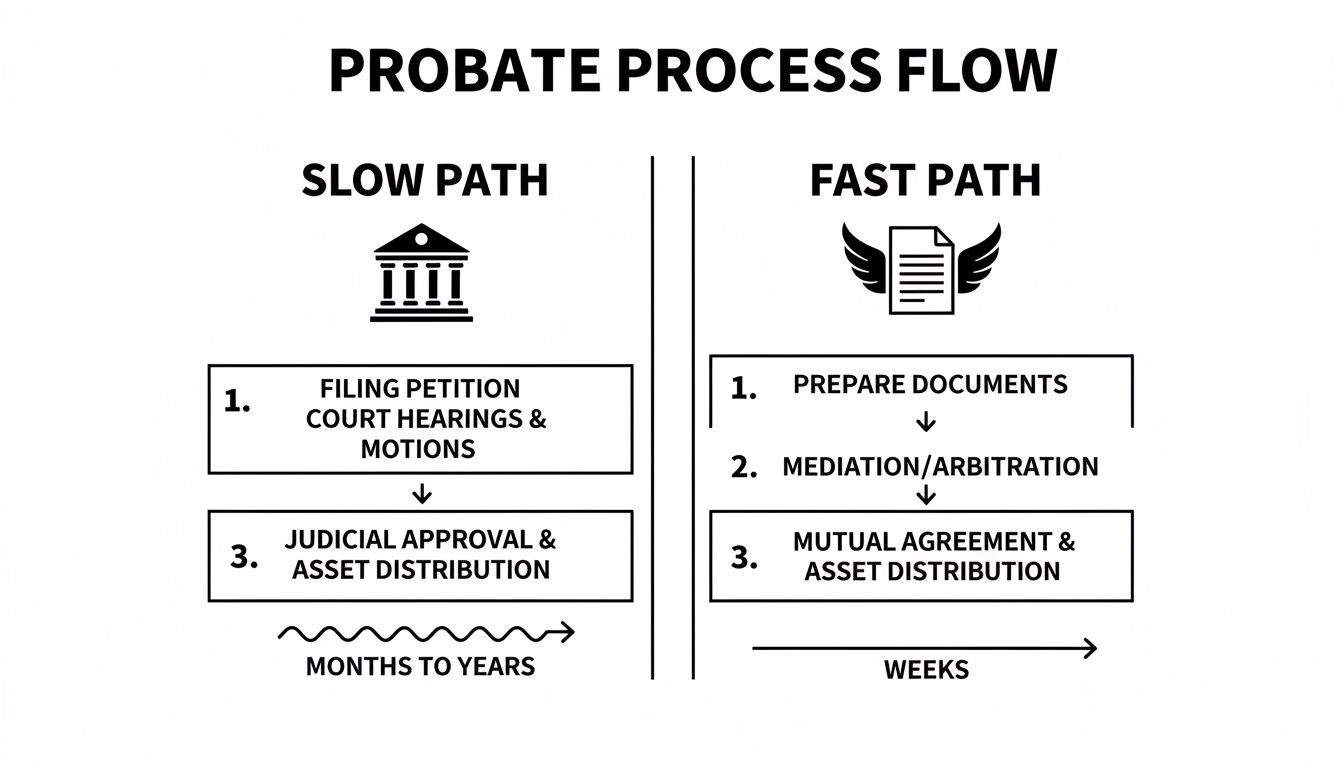
As you can see, a trust-based plan gives your family a direct, private path. The alternative often gets bogged down in a slow, public court system. When you properly fund your trust, you are making sure your family stays on that faster, more efficient track.
The Advantages and Disadvantages of a Living Trust
A living trust is an incredibly useful estate planning tool, but it is important to look at it from all angles before deciding if it is the right move for your family. Understanding both the good and the bad helps you make a confident, well-informed decision that truly fits your long-term goals.
For many families here in North Georgia, the benefits far outweigh the initial work required.
Clear Advantages of a Georgia Living Trust
The main perks of a living trust really boil down to control, privacy, and efficiency. They offer a significant amount of peace of mind for both you and your loved ones.
- Complete Avoidance of Probate: This is the most significant benefit. Assets held inside a properly funded trust completely bypass the probate court process in Georgia. That saves your family time, money, and stress.
- Total Privacy: Once a will is filed with the probate court in counties like Forsyth or Fulton, it becomes a public record. A living trust, on the other hand, is a private document. It keeps your financial situation and family inheritance details confidential.
- Seamless Incapacity Planning: A living trust lets you name a successor trustee who can step in immediately to manage your finances if you become ill or unable to handle them yourself. This helps your family avoid going to court for a conservatorship, which can be an expensive and emotionally draining ordeal.
- Greater Control Over Asset Distribution: You can lay out specific rules for how and when your beneficiaries get their inheritance. For example, you could set up the trust to release funds when they reach certain ages or for specific purposes, like buying a first home or paying for college.
A living trust offers a private, efficient path for managing your legacy. It empowers the people you choose to act on your behalf without court supervision, ensuring your wishes are carried out exactly as you planned.
This degree of control and privacy is a major reason so many people in communities from Marietta to Dahlonega opt for a trust-based estate plan.
Potential Disadvantages to Consider
While the benefits are strong, a living trust is not a one-size-fits-all solution. There are some practical matters and costs you need to think about.
The initial setup of a living trust takes more work and a bigger financial investment upfront than a simple will. This is a key point to weigh as you plan.
The Upfront Cost and Effort
Creating and properly funding a living trust is just a more involved process than writing a will. The legal fees for drafting the trust document are higher because it is a more complex legal instrument.
On top of that, the most important step—funding the trust—takes time and administrative legwork. You have to retitle assets like your house, bank accounts, and investment accounts into the name of the trust. This paperwork is absolutely essential; an unfunded trust provides no protection and will not help your estate avoid probate.
What a Revocable Trust Does Not Do
It is also really important to understand what a standard revocable living trust cannot do, as there are a few common myths.
- No Creditor Protection: During your lifetime, a revocable trust does not protect your assets from your own creditors or from lawsuits. Because you still have full control over everything in it, the law still sees those assets as yours.
- No Estate Tax Savings: A revocable living trust, by itself, does not lower your estate taxes. The assets inside it are still counted as part of your taxable estate when you pass away.
For most families, these are not deal-breakers. The main goals are usually avoiding probate and planning for incapacity, and a revocable trust handles those things perfectly. But for anyone with specific worries about asset protection or potential estate tax issues, other, more advanced planning tools might be needed.
An honest conversation with an attorney can help you weigh the significant long-term benefits of control and privacy against the upfront administrative tasks and costs.
How We Guide North Georgia Families Through Estate Planning

We understand. The world of estate planning can feel overwhelming, full of complex terms and intimidating documents. It does not have to be a stressful journey. Our entire approach is built on steady professional guidance and clear communication for families and business owners from Dawsonville to East Cobb.
We believe in breaking down legal tools like living trusts into plain English, so you can make informed decisions about your future with total confidence.
A Clear and Methodical Approach
A solid estate plan does not happen by accident; it is a careful and methodical process. It always starts with us listening. We take the time to understand your unique goals, whether that means protecting a family home in Forsyth County or making sure a business in Alpharetta has a smooth leadership transition.
Only then do we walk you through your options. We will guide you through the essential steps, from drafting the trust document to, just as importantly, funding it correctly. An improperly funded trust can completely undermine your goals, which is why we oversee the process to ensure every asset is titled properly. As part of this, understanding the distinction between a beneficiary vs dependent is essential to ensure your wishes are carried out exactly as planned.
Working with an experienced local attorney ensures your living trust is correctly drafted, fully funded, and perfectly aligned with your family’s unique circumstances and long term objectives.
Your Partner in Building a Secure Future
Think of us as the calm, steady hand helping you build a secure plan for what matters most. We handle all the legal complexities so you can stay focused on protecting your legacy.
At Miles Hansford, our commitment is to provide the clarity and support you need. We are here to help North Georgia families put a thoughtful plan in place that brings peace of mind for years to come.
Frequently Asked Questions About Living Trusts
When you're first exploring what a living trust is and how it fits into your estate plan, it is natural to have questions. Here are a few of the most common ones we hear from our clients across North Georgia.
Do I Still Need a Will If I Have a Living Trust?
Yes, you do. An attorney will almost always recommend creating a special kind of will, known as a pour-over will, to go along with your living trust. Think of it as a safety net. This document is designed to catch any assets you might have forgotten or did not get a chance to transfer into your trust before you passed away. Upon your death, the will simply "pours" those assets into the trust, ensuring everything is handled privately under one roof.
Does a Living Trust Protect My Assets from Lawsuits?
A standard revocable living trust does not offer protection from your personal creditors or lawsuits. Because you keep full control of the assets—meaning you can put things in, take them out, and change the terms anytime—the law still sees them as your personal property. As a result, they can be reached to satisfy your debts. If your goal is serious asset protection, you would likely need to explore an irrevocable trust with your attorney.
How Much Does It Cost to Set Up a Living Trust in Georgia?
The cost depends on how complex your estate is and what you are trying to accomplish. While a trust costs more to set up initially than a simple will, it often ends up saving your family a significant amount of money and stress down the road. By keeping your estate out of the probate court system, you sidestep court fees and other administrative expenses that can reduce the inheritance you leave for your loved ones. An attorney can provide a clear explanation of fees during a consultation.
Can I Name a Trustee Who Lives Out of State?
You certainly can. There is no law in Georgia that says your successor trustee has to be a resident of Forsyth County, Fulton County, or anywhere else in the state. The bigger question is a practical one, as managing an estate from far away can be challenging. The most important qualities in a trustee are trustworthiness, organization, and the responsibility to carry out your wishes.
Can I Put My Business Into a Living Trust?
Yes, transferring ownership of a business into a living trust is a common strategy for business succession planning. For owners of an LLC, S-Corp, or partnership in areas like Cumming or Alpharetta, this ensures a smooth transition of management and ownership without court interference. The process involves formally assigning your ownership interest to the trust, which is a critical step an experienced business attorney can help you handle correctly.
Planning your estate is one of the most important steps you can take to protect your family's future. If you have more questions about what a living trust is or need clear guidance on creating one, the team at Miles Hansford, P.C. is here to help. Contact us to schedule a consultation and build a plan that provides security and peace of mind.