


Meta Title: No-Fault Divorce in Alpharetta, GA | Georgia Guide
Meta Description: Learn what a no-fault divorce state means in Alpharetta, GA, and how Georgia divorce law works in Fulton and Forsyth County courts.
Suggested URL Slug: /no-fault-divorce-alpharetta-ga
Schema Recommendations: Attorney, LegalService, FAQPage
Internal Link Suggestions:
- Grounds for Divorce
- How to File for Divorce
- Uncontested Divorce
- Child Custody
- Alimony
- Property Division
- Mediation
- Legitimation
If you're in Alpharetta, Cumming, Johns Creek, Milton, Roswell, Sandy Springs, Suwanee, Canton, or Dawsonville and your marriage is breaking down, your first questions are usually practical. Can I file without proving cheating or cruelty? Do I have to fight about blame? What happens in Fulton County Superior Court or Forsyth County Superior Court if we have children, a house, retirement accounts, or a business?
Those questions are normal. People rarely start by asking, “what is a no fault divorce state.” They start by wondering how to protect their children, income, privacy, and future.
Georgia gives you options, but the right option depends on your facts. A no-fault divorce can reduce conflict and move a case forward without turning the court file into a record of every painful detail. In other cases, fault still matters strategically. That choice affects settlement posture, temporary hearings, mediation, and sometimes the way the court views alimony, property issues, or custody concerns.
Facing Divorce in Alpharetta Answering Your First Questions
A typical client in Alpharetta calls after weeks or months of living in uncertainty. One spouse has moved into a guest room. The children know something is wrong. Financial tension is rising. Someone has searched “divorce lawyer near me” late at night and found a flood of terms that don't feel clear or helpful.
That confusion gets worse when legal phrases start piling up. No-fault divorce, equitable division, temporary orders, parenting plans, mediation. If you're in North Fulton or Forsyth County, those terms aren't academic. They shape what happens to your home, your schedule with your children, and your cash flow during the case.
For many people, the first relief comes from realizing this. You usually don't need to prove that your spouse was the bad actor to start a divorce in Georgia. That one point often lowers the temperature enough to begin making smart decisions instead of emotional ones.
There is still a legal process, and it still matters how you handle it. But once you understand the difference between no-fault and fault grounds, the next steps become more manageable.
Practical rule: The earlier you get clear on grounds, filing strategy, and temporary issues, the less likely you are to make a rushed decision that hurts you later.
The emotional side matters too. Legal planning and personal recovery often need to happen at the same time. If you're trying to steady yourself while making decisions about divorce, these strategies for healing after breakups can be a useful non-legal resource alongside legal advice.
If you're weighing whether to file in Alpharetta, Cumming, or elsewhere in North Georgia, a consultation can help you sort out what applies to your family before you commit to a path.
What No-Fault Divorce Means Under Georgia Law
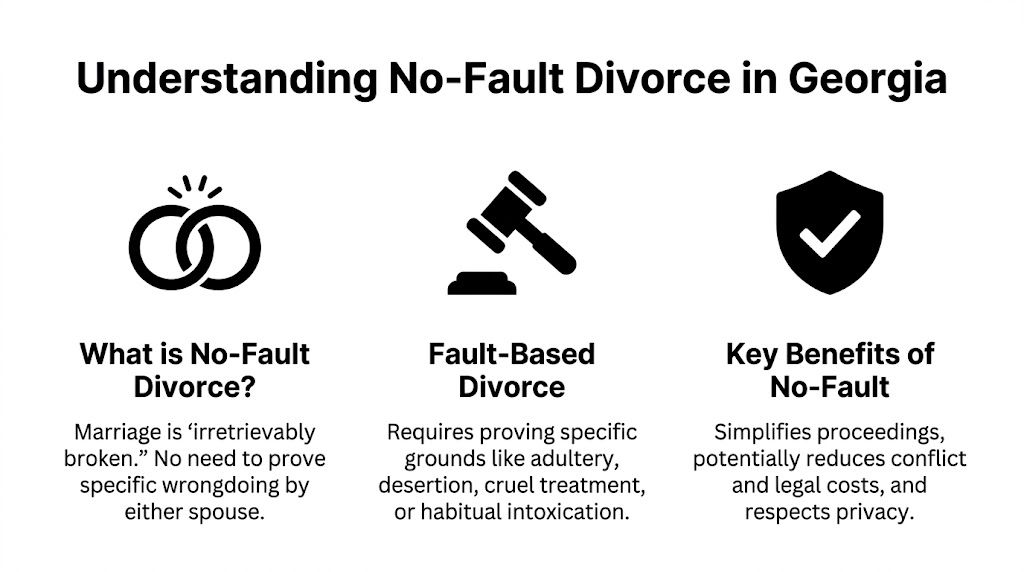
In simple terms, a no-fault divorce means you ask the court to end the marriage because it is irretrievably broken. You don't have to prove adultery, cruel treatment, desertion, or another form of misconduct to get the divorce granted.
Georgia is not a true no-fault only state
If you've searched what is a no fault divorce state, the answer gets more specific once you look at Georgia. All 50 states permit no-fault divorce, but only 17 are “true no-fault states” where fault grounds are unavailable. Georgia is a hybrid state, allowing petitioners to choose between a no-fault claim (“irretrievably broken”) or one of 12 fault-based grounds according to this overview of no-fault divorce law.
That matters because Georgia doesn't force you into one lane. You can pursue a no-fault divorce, or you can allege fault if the facts support it and doing so serves a legal purpose.
A practical way to think about it is this:
| Approach | What you must show | Why people choose it |
|---|---|---|
| No-fault | The marriage is irretrievably broken | Lower conflict, more privacy, simpler path to resolution |
| Fault-based | Specific misconduct such as adultery, cruel treatment, desertion, or habitual intoxication | Strategic leverage where misconduct may affect contested issues |
The difference between a reason and a strategy
Many people assume fault grounds are about moral vindication. In court, they are more often about strategy. Filing on fault doesn't automatically produce a better outcome. It can create more litigation, more evidence disputes, and more expense.
No-fault, by contrast, often keeps the case focused on the core issues:
- Property division
- Alimony
- Child custody
- Parenting time
- Child support
- Temporary living and financial arrangements
If you want a fuller breakdown of Georgia's available grounds, Miles Hansford provides a useful page on Georgia grounds for divorce.
Think of no-fault as taking the question of “who caused the breakup” out of the doorway so the parties and the court can deal with the consequences of the breakup.
Why the distinction matters in Alpharetta and Cumming
In Fulton County and Forsyth County, the label you choose at filing can influence tone from day one. A no-fault filing often supports an early settlement posture. A fault filing can signal that evidence, credibility, and conduct will be part of the case.
That doesn't mean one is always better. It means the choice should be deliberate. In Georgia family law, grounds are not just paperwork. They are part of the case strategy.
Why This Matters for Your Divorce in Alpharetta
For families in Alpharetta, Milton, Johns Creek, Roswell, and nearby communities, a no-fault divorce often works because it protects attention, energy, and money for the issues that need resolution. Spending months proving painful facts that both spouses already know happened offers little benefit.
Less conflict helps children and parents
When children are involved, blame-based litigation often spills into parenting. Georgia courts decide custody based on the best interests of the child, and parents must submit a parenting plan. If the case becomes a running fight over fault, it can harden positions on school schedules, holidays, transportation, communication, and decision-making.
A no-fault approach doesn't erase conflict. It often makes the conflict more manageable. That can be especially important in Cumming parenting plan disputes and Alpharetta custody matters where both parents still need to communicate after the divorce ends.
Privacy matters more than many people expect
People are often surprised by how exposed they feel once litigation starts. Fault-based claims can invite detailed accusations into pleadings, affidavits, discovery, and hearings. For professionals, business owners, and parents in tight local communities like Milton, Johns Creek, and North Fulton, privacy isn't a small concern.
No-fault often keeps the public court record cleaner. It doesn't eliminate disclosure requirements, but it usually avoids turning the case into a public airing of the marriage's worst moments.
A workable settlement usually comes from disciplined focus, not from proving every personal grievance.
Efficiency usually beats vindication
In practice, no-fault is often the more efficient route in Alpharetta and Cumming divorces. It puts attention where it belongs. Identifying assets and debts, preparing a support position, building a parenting plan, and getting ready for mediation or a temporary hearing if needed.
What doesn't work well is using fault allegations only to vent anger. That can increase attorney time, widen discovery, and delay resolution without changing the final result in a meaningful way.
A no-fault filing is especially useful when:
- Both spouses want closure: They may disagree on terms, but not on ending the marriage.
- Children need stability: Parents need temporary schedules and a practical parenting plan quickly.
- Sensitive facts exist: A spouse wants to preserve privacy and avoid unnecessary escalation.
- Assets need protection: The focus should stay on documentation, valuation, and settlement structure.
For many North Georgia cases, the smartest move is not the loudest move. It's the one that maintains advantage while reducing avoidable damage.
The Georgia No-Fault Divorce Process in Fulton and Forsyth County
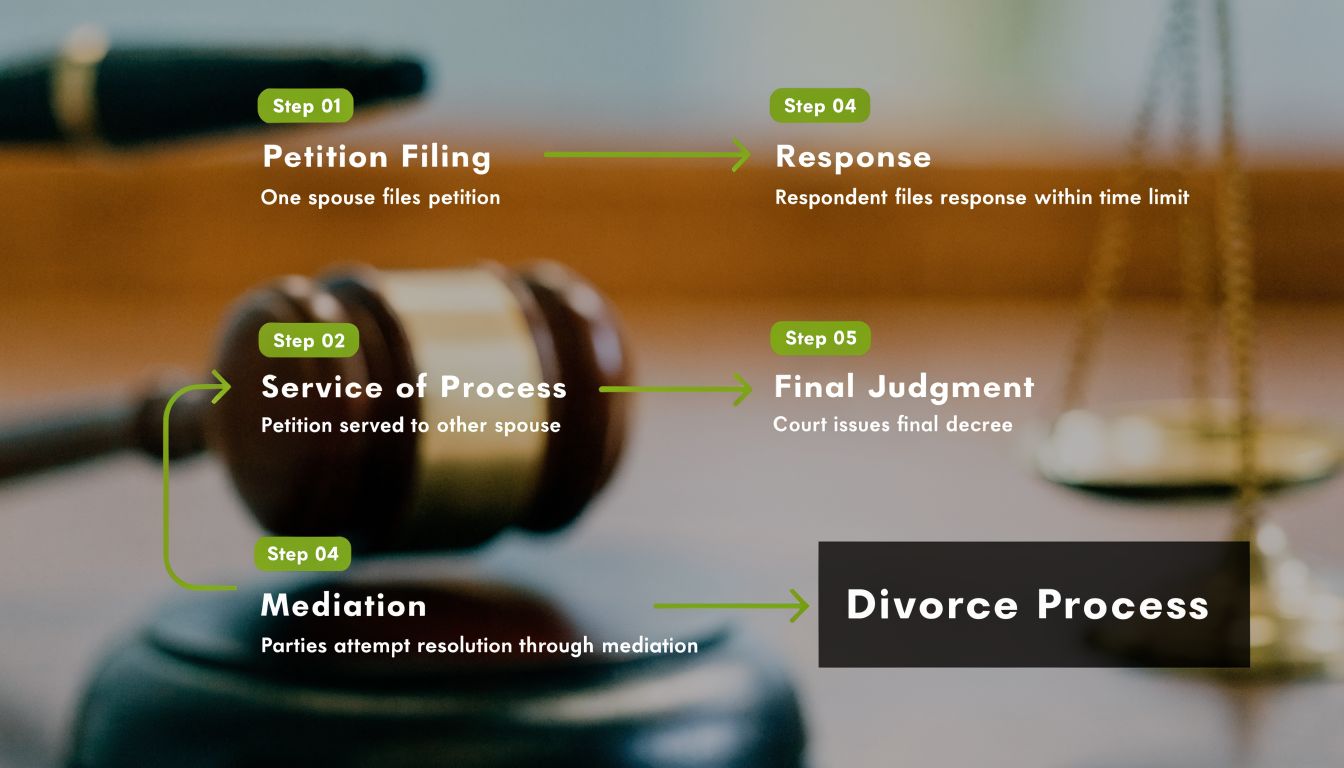
The process becomes less intimidating once you see it in sequence. Whether your case is filed in Fulton County Superior Court or Forsyth County Superior Court, the path is similar, though local scheduling and procedure can affect timing.
Step one starts before filing
Before anyone files, the first questions are usually residency, children, property, and immediate risk. Georgia law requires residency, and your attorney will confirm where the case should be filed. That filing decision matters because local courts have their own calendars, standing orders, and expectations.
This is also the point to collect the documents that shape outcomes. Bank statements, retirement records, mortgage information, tax returns, pay records, business documents, and anything relevant to parenting schedules.
If you need a basic filing roadmap, this page on how to file for divorce in Georgia is a useful starting point.
Filing and service move the case into court
A no-fault case begins with a petition stating that the marriage is irretrievably broken. Other opening documents may address children, property, support, and procedural requirements.
After filing, the other spouse must be formally served unless service is acknowledged. Service matters because it starts the legal timeline and gives the court jurisdiction to move the case forward properly.
Once service is complete, the case is no longer just a private family problem. It is now a court matter with deadlines and consequences.
Georgia's waiting period sets the earliest finish line
Georgia requires a 30-day minimum waiting period before a divorce can be finalized. That doesn't mean every case finishes in 30 days. It means the court cannot grant the final divorce before that period has passed.
In an uncontested no-fault case, that waiting period is often the shortest legal barrier. In a contested case, it is only the beginning. Disputes over custody, support, or property can extend the process because the court may need temporary hearings, mediation, additional filings, or a final hearing.
Settlement, mediation, and parenting plans do most of the work
Most divorces are not decided by a full trial. The important work usually happens in negotiation and mediation. In Georgia cases involving children, the parenting plan is critical. It should address living arrangements, holidays, school breaks, transportation, communication, and decision-making authority.
A strong no-fault case usually moves through these practical questions:
- What happens to the home and major assets
- How debts will be assigned
- Whether alimony is requested or opposed
- How parenting time will function week to week
- What temporary arrangements are needed while the case is pending
A case can be uncontested and still require careful drafting. A weak agreement often creates future conflict, especially around parenting schedules and financial obligations.
Temporary orders often shape the day-to-day reality of a divorce long before the final decree is signed.
Finalizing the divorce
When all issues are resolved, the parties submit the needed documents for the court's approval. In some cases, one brief hearing is required. In others, the paperwork may be sufficient depending on the county and case posture.
The final order is the Final Judgment and Decree of Divorce. That order doesn't just end the marriage. It puts enforceable rules in place for custody, parenting time, support, and property division.
For people in Alpharetta, Cumming, Johns Creek, Milton, or Roswell, the value of an organized no-fault approach is simple. It gives the court a clean path to grant the divorce while keeping attention on the terms that will govern your life afterward.
Strategic Decisions When No-Fault and Fault Grounds Are Options
No-fault is often the right starting point. It is not always the only smart option. In Georgia, the harder question is not whether no-fault exists. It does. The harder question is when a fault allegation creates real legal value rather than just more litigation.

When fault may matter
A fault claim can matter when the alleged conduct connects to one of the actual issues before the court. In Georgia, that can include disputes tied to alimony, financial misconduct, or child-related safety concerns.
The decision is often most significant in cases involving:
- Adultery and alimony disputes
- Cruel treatment or family violence concerns
- Substance abuse affecting parenting
- Abandonment with financial consequences
- High-asset cases where misconduct overlaps with spending or concealment issues
A fault allegation should answer a strategic question. What does proving this change?
Abuse allegations are not just pleading choices
Domestic violence changes case strategy. Women initiate approximately 70% of divorces in the U.S., and domestic violence is reported as a key reason for divorce by 23 to 25% of individuals, as discussed in this article on challenging the no-fault divorce regime. In a Georgia case, alleging fault based on abuse can affect how custody, temporary possession of the home, and financial issues are addressed.
That doesn't mean every abuse-related case should be framed the same way. Safety comes first. Evidence matters. Temporary protective measures may be more urgent than the ultimate ground listed in the complaint.
If abuse is part of your case, the first strategic goal is protection, not elegance in pleading.
What works and what usually doesn't
Some choices consistently help. Others usually create expense without benefit.
What often works
- Using no-fault to move quickly: This can keep the case focused when the main disputes are custody schedules, support, or property terms.
- Using fault selectively: If misconduct directly affects alimony, parenting, or financial fairness, fault may be worth pleading and proving.
- Building evidence early: Texts, financial records, school records, calendars, and witness information matter more than broad accusations.
- Preparing for temporary hearings: Early orders on custody, support, exclusive use of property, and conduct can frame the rest of the case.
What often fails
- Filing fault out of anger alone: Courts don't reward emotional escalation by itself.
- Assuming misconduct guarantees a better financial result: It may matter, but only if it connects to a legally relevant issue.
- Ignoring the cost of proof: Fault cases can require more discovery, more witness preparation, and more hearing time.
- Treating social media as evidence strategy: Public posting usually creates more problems than solutions.
For spouses who agree on every material issue, a page on uncontested divorce in Georgia can help clarify whether a simpler path is realistic.
The Alpharetta and Cumming reality
In Fulton County and Forsyth County, judges want focused evidence and practical proposals. If you're alleging fault, the case still has to answer basic questions. What parenting plan do you want? How should property be divided under Georgia equitable division laws? Is alimony sought, and why? What temporary relief is needed now?
That is why strategy matters more than labels. A no-fault filing can be strong. A fault filing can be strong. Either one can also be handled poorly if it is not tied to the outcome you need.
Navigating the North Fulton and Forsyth County Courthouses
Local court practice matters. A person filing in Forsyth County Superior Court in Cumming needs more than a generic understanding of Georgia law. The same is true in Fulton County Superior Court for families in Alpharetta, Roswell, Sandy Springs, and the North Fulton area. Procedure, scheduling, and presentation all affect how efficiently a case moves.

Temporary hearings shape the case early
A temporary hearing is often the first major court event in a contested divorce. It can address who stays in the home, temporary parenting time, temporary child support, temporary alimony, use of vehicles, and who pays which bills while the case is pending.
For many clients, this is the point where the divorce becomes real. Temporary orders create a working structure. They also influence the advantage in later settlement talks because once a routine is in place, changing it can take effort.
Mediation is not a formality
In local practice, mediation is often required before a final trial. That matters because many cases settle there, not in the courtroom. In Georgia's hybrid no-fault system, pre-file mediation resolves an estimated 70% of property disputes more efficiently than fault-based trials, and an uncontested no-fault filing can potentially reduce litigation costs by 30 to 50% based on the summary cited earlier in the article's legal overview. For Alpharetta and Cumming clients, that practical point is often more important than abstract debates about fault.
A useful approach to mediation includes:
- Knowing your documents: Asset and debt records need to be organized.
- Understanding your priorities: Not every issue has equal value.
- Separating positions from outcomes: “I want the house” is a position. Stability, liquidity, and school continuity are outcomes.
- Drafting workable parenting terms: Vague agreements create post-divorce conflict.
Parenting plans are mandatory and need real detail
Georgia courts require parenting plans in cases involving children. In Fulton County custody hearings and Forsyth County divorce filings, weak parenting plans cause avoidable trouble.
A sound parenting plan usually needs to address:
| Issue | Why it matters |
|---|---|
| Regular schedule | Prevents weekly conflict over exchanges |
| Holiday and school break schedule | Avoids repeat disputes during the year |
| Decision-making authority | Clarifies education, healthcare, and activities |
| Transportation and exchange details | Reduces conflict and missed handoffs |
| Communication rules | Helps parents and children maintain consistency |
The court expects specifics. “We'll work it out later” is not a parenting plan.
Local experience changes how cases are prepared
The difference between a paper-ready uncontested divorce and a contested case heading toward trial often comes down to preparation. Lawyers who regularly appear in North Fulton courts and Forsyth County Superior Court know which issues need immediate attention, what judges expect in a temporary hearing, and how to draft agreements that are more likely to hold up in practice.
For people in Alpharetta, Cumming, Johns Creek, Milton, and surrounding North Georgia communities, local procedure isn't a side issue. It's where strategy becomes action.
Why Choose Miles Hansford for Your Alpharetta Divorce
If you're searching for a divorce lawyer near me in Alpharetta or Cumming, what you likely need isn't more generic information. You need a lawyer who understands how Georgia no-fault divorce works in real life, in local courtrooms, with local procedures, and with the financial and parenting issues that drive outcomes.
A useful divorce attorney does more than file papers. The job is to identify the right ground for divorce, prepare for temporary hearings, protect your position in equitable division, and build a parenting plan that fits your children's lives. In North Georgia, that means understanding how cases move through Fulton County Superior Court and Forsyth County Superior Court, and how mediation, settlement posture, and courtroom presentation affect results.
For some people, the right path is a straightforward no-fault filing with a negotiated agreement. For others, especially in high-asset divorce, business ownership disputes, alimony claims, or custody conflicts, the strategic question is whether fault should be alleged and proved. That is where local family law judgment matters.
Miles Hansford Law Firm handles family law matters in Alpharetta, Cumming, Forsyth County, Fulton County, and the greater North Atlanta area, including divorce, contested divorce, uncontested divorce, custody, support, alimony, property division, modifications, contempt, legitimation, and mediation.
If you're dealing with a marriage that is ending, don't wait until temporary orders, parenting terms, or financial positions are already taking shape without your input. Schedule a consultation, speak with a family law attorney, and make decisions with a clear plan for your family, your finances, and your next chapter.
Frequently Asked Questions about No-Fault Divorce in Georgia
Q: Is Georgia a no-fault divorce state?
A: Yes. Georgia allows no-fault divorce based on the marriage being irretrievably broken. Georgia is also a hybrid state, which means fault-based grounds are still available. That choice can matter in Alpharetta and Cumming cases involving alimony, financial misconduct, or serious custody concerns.
Q: How long does a no-fault divorce take in Alpharetta, GA?
A: Georgia has a 30-day minimum waiting period after filing before a divorce can be finalized. In Fulton County Superior Court, an uncontested case may resolve relatively quickly after that period. If the case involves custody, property disputes, or temporary hearings, it will usually take longer.
Q: Do I have to prove my spouse did something wrong to get divorced in Cumming?
A: No. In Forsyth County, you can file on no-fault grounds and state that the marriage is irretrievably broken. You don't need to prove adultery, cruelty, or another fault ground just to obtain a divorce. Whether fault should still be alleged is a separate strategic question.
Q: Can fault still matter in a Georgia divorce if I file no-fault?
A: Yes, it can. Even in a no-fault case, conduct may still affect contested issues depending on the facts. In North Georgia divorces, the more important question is whether the conduct connects to alimony, equitable division, or child custody concerns that the court must decide.
Q: What court handles my divorce if I live in Alpharetta or Johns Creek?
A: Many Alpharetta and Johns Creek divorces are handled through Fulton County Superior Court, while Cumming and much of Forsyth County file in Forsyth County Superior Court. Venue depends on residency and other case-specific facts, so filing location should be confirmed before the petition is submitted.
Q: Will I have to go to mediation in Fulton County or Forsyth County?
A: In many contested family law cases, yes. Mediation is a routine part of resolving disputes before trial. It is often where property division, parenting schedules, and support terms get negotiated. Good preparation for mediation can save time, reduce conflict, and improve the quality of the final agreement.
Q: How does child custody work in a no-fault divorce in Georgia?
A: Custody is decided under the best interests of the child standard, not by whether the divorce is labeled no-fault or fault-based. Georgia courts also require parenting plans. In Fulton County custody hearings and Forsyth County family cases, detailed and realistic parenting terms matter.
Q: Should I choose no-fault or fault grounds in my Georgia divorce?
A: It depends on what proving fault would change. If no-fault will get you to a fair resolution efficiently, that is often the better path. If misconduct directly affects alimony, safety, or parenting, fault may deserve serious consideration. This is one of the most important strategy calls in a divorce case.
If you're facing divorce in Alpharetta, Cumming, Forsyth County, or Fulton County, Miles Hansford Law Firm can help you understand your options and build a practical strategy. Schedule a consultation to speak with a family law attorney, protect your parental rights, and make informed decisions before temporary orders or settlement terms start shaping your case.