


A parenting plan is the court-approved framework that assigns decision-making and parenting time after separation or divorce, and more than 90% of custody cases are resolved outside court, so this document usually becomes the primary rulebook for your family's future. In Georgia, it isn't optional in custody cases. It's the detailed roadmap that tells everyone how your child will be raised after the relationship ends.
If you're in Cumming, GA or Alpharetta right now, you may be staring at a divorce filing, worrying about where your child will sleep, how school pickup will work, and whether one rushed agreement will follow you for years. That fear is justified. Temporary choices in family court have a way of turning into long-term realities, especially in Forsyth County Superior Court and Fulton County Superior Court.
A good parenting plan gives you structure when life feels unstable. It protects your child's routine, protects your voice as a parent, and reduces the chances that you'll be dragged back into court over preventable disputes. If you're searching for a family law attorney near me because you need a clear next step, get legal advice before you agree to custody terms that sound simple but are written badly.
Navigating Child Custody in Cumming GA Your First Step Toward Clarity
In Cumming, parents usually come to this issue at the worst possible moment. The marriage is breaking down. The children are confused. One parent wants to “keep things flexible,” and the other already feels pushed to the edge. Flexibility sounds nice until school starts, holidays arrive, or one parent stops cooperating.
In Georgia, a parenting plan is a legally required document in divorce and custody cases involving children. It lays out how parents will share time, make decisions, handle exchanges, and solve disagreements after separation. That matters because Georgia child custody standards focus on the child's best interests, not on what feels easiest for either parent in the moment.
What a parenting plan actually does
A parenting plan is more than a custody label. It tells the court, and the other parent, how daily life will work.
It should answer practical questions like these:
- Where the child lives: Weekdays, weekends, school breaks, and summer.
- Who makes major decisions: Education, healthcare, activities, and other important issues.
- How exchanges happen: Time, place, transportation, and what happens if someone is late.
- How parents communicate: Text, email, parenting app, emergency contact, and notice requirements.
For a useful overview of Georgia custody rules, review Georgia child custody laws.
A weak parenting plan doesn't reduce conflict. It postpones it.
Why this matters in Cumming and Alpharetta
Parents in Cumming, Alpharetta, Johns Creek, Milton, and Suwanee often balance school districts, long commutes, activities, and two-household logistics. A vague agreement breaks down fast in real life. If one parent lives in Forsyth County and the other works in North Fulton, every exchange, practice, and doctor appointment needs clarity.
Georgia is also a no-fault divorce state. You can file without proving misconduct. But no-fault doesn't mean low-stakes. If your case includes custody, the parenting plan is one of the most important documents you'll file.
Schedule a consultation before you sign anything. Protect your parental rights early.
Why a Detailed Parenting Plan Matters for Cumming Families
Most parents underestimate this document. That's a mistake.
More than 90% of custody cases are resolved outside of court, which means the parenting plan you agree to is not a temporary placeholder. It is the foundational document that will govern your parental rights and responsibilities for years to come, according to this custody statistics overview.
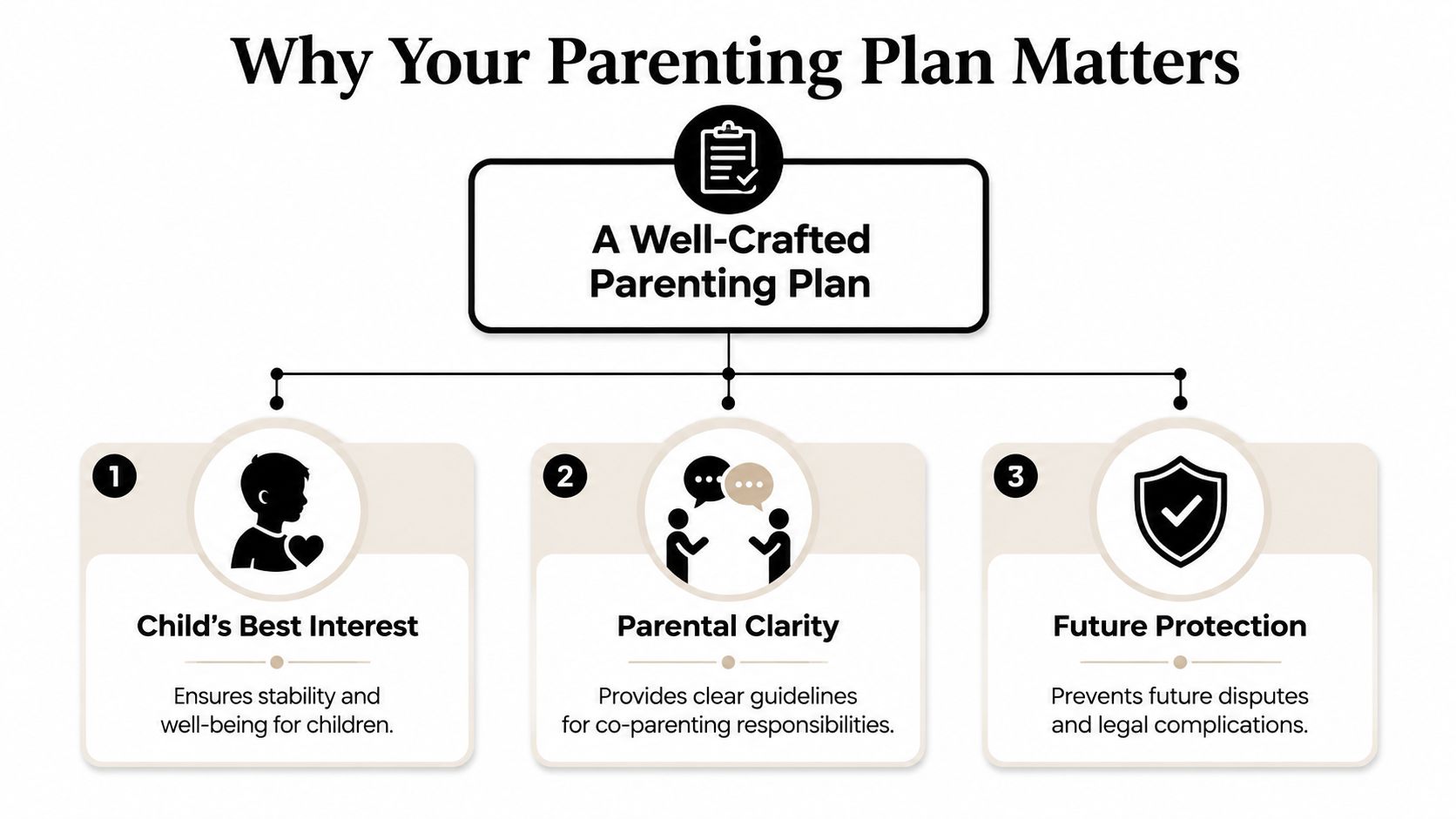
The real job of this document
A detailed parenting plan does three things at once. It creates stability for your child. It creates boundaries for both parents. It creates a paper trail the court can enforce if cooperation collapses later.
That matters in Cumming and Alpharetta because local families often deal with packed calendars and cross-county parenting. If your child attends school in Forsyth County but one parent lives closer to Roswell or Sandy Springs, transportation and timing can become recurring conflict points unless the order is precise.
Common fights a strong plan can prevent
A carefully drafted plan can prevent disputes over issues like:
- School decisions: Which district, who attends conferences, who handles tutoring, and how records are shared.
- Holiday conflict: Thanksgiving, Christmas, spring break, birthdays, and summer travel.
- Medical treatment: Which parent schedules appointments, who carries insurance information, and who gets notified after urgent care visits.
- Activity expenses: Sports, lessons, uniforms, travel teams, and who must agree before a child is enrolled.
Practical rule: If a disagreement is predictable, put the answer in writing now.
Why local court practice matters
Forsyth County custody hearings and Fulton County custody hearings aren't abstract legal exercises. Judges want workable plans. They don't want broad promises that parents will “cooperate.” They want terms they can approve and enforce.
That's why I tell parents the same thing every time. Don't negotiate only for the next month. Draft for the next several years. Children change schools. Parents change jobs. New partners enter the picture. A plan built only for today won't protect you tomorrow.
If you're looking for a divorce lawyer near me or a family law attorney Cumming GA, ask one direct question. Will this lawyer help me build an enforceable parenting plan, or just fill in a form? The difference matters.
Essential Components of a Georgia Parenting Plan
A legally sufficient parenting plan in Georgia cannot be vague. It must specify how decisions about education, healthcare, extracurriculars, travel, and communication will be handled, and include a method for resolving future disputes, as reflected in court guidance on parenting plan requirements.
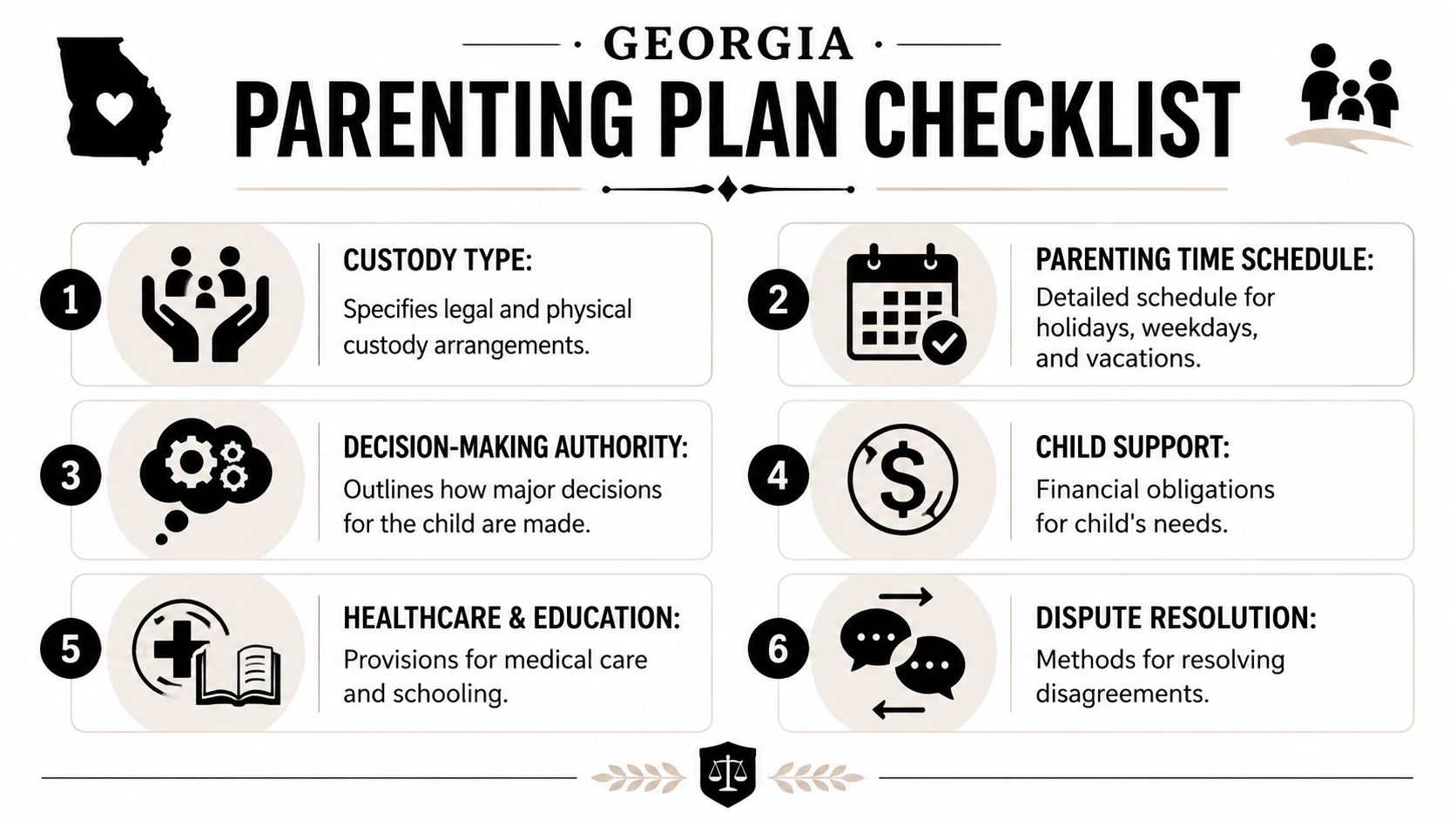
If you're asking what is a parenting plan in practical terms, this is the answer. It's an operating manual.
Legal custody and physical custody
Georgia parents need to address both legal custody and physical custody.
Legal custody covers major decisions. Physical custody covers where the child is with each parent. Some parents share both. Some share one and allocate the other differently. The point is not the label. The point is whether the terms work on a Tuesday during the school year.
A strong draft should identify:
- Decision authority: Joint, divided by subject, or one parent having final authority after consultation.
- Residential schedule: Regular weekday and weekend routine.
- Tie-breaking language: What happens if parents disagree after discussing an issue.
Parenting time schedules that work in real life
A schedule shouldn't be aspirational. It should match the child's age, school location, commute realities, and each parent's actual availability.
For some families, alternating weekends works. For others, a repeating shared schedule is better. If you want examples of how different arrangements are structured, a shared custody schedule guide can help you compare common options before you negotiate final language.
Here's a simple planning table parents often find helpful:
| Issue | Bad drafting | Better drafting |
|---|---|---|
| Weekday time | “Reasonable parenting time” | Specific pickup and drop-off days and times |
| School breaks | “Parents will share holidays” | Holiday rotation listed by holiday |
| Summer | “Parents will work it out” | Deadline for vacation notices and selection rules |
Holidays vacations and school breaks
Holiday language is where many agreements fall apart. Parents think they can sort it out later. Then later arrives, and both want the same travel week.
Your plan should address:
- Major holidays: Alternate yearly or split by fixed schedule.
- School breaks: Fall break, winter break, spring break, and teacher workdays.
- Summer vacation: Notice deadlines, travel details, and conflict rules.
- Special dates: Birthdays, Mother's Day, Father's Day, and family events.
If you leave out holiday language, you're almost guaranteeing a future argument.
Education healthcare and extracurricular decisions
This part needs detail, not broad statements about “co-parenting.”
Spell out who can make routine decisions, what requires joint input, and how notice must be given. If your child attends private school in Alpharetta, receives specialized services in Fulton County, or has regular treatment providers in North Georgia, the plan should name the process for keeping each parent informed.
Consider including terms for:
- School enrollment and records access
- Doctor, dentist, and therapy appointments
- Prescription updates and emergency contact rules
- Activity enrollment and cost approval
- Out-of-state travel notice
For parents who want a starting point before attorney review, this Georgia parenting plan template can help you organize the issues that need to be addressed.
Transportation exchange logistics and communication rules
Consumer articles usually fail people here. They discuss custody and visitation, then stop.
Many online templates and guides focus only on custody schedules, but a protective plan must include operational details like transportation logistics, holiday rotations, dispute-resolution steps, and communication rules. These are the details that prevent future conflict, as explained in this parenting plan checklist guidance.
For North Georgia families, exchange terms should cover practical realities such as travel between Alpharetta and Johns Creek, or between Roswell and Canton after school activities.
Use direct language on points like these:
- Exchange location: School, curbside, police precinct, or neutral public place.
- Transportation duty: Which parent drives at the beginning or end of each visit.
- Late arrival rules: Waiting period, notice method, and consequences.
- Child communication: Calls, video contact, and privacy rules while with the other parent.
- Parent communication: How updates are shared and what channel must be used.
Dispute resolution and future changes
Every parenting plan should answer one hard question. What happens when you disagree later?
That usually means including a dispute-resolution process before either parent runs back to court. In Forsyth County Superior Court and Fulton County Superior Court, mediation is often part of family law practice, especially when parents need help narrowing contested issues.
A useful clause can require:
- Written notice of the dispute.
- A deadline to discuss it.
- Mediation before filing, unless there is an emergency or safety issue.
- A rule for temporary decision-making if no agreement is reached quickly.
If there are safety concerns, substance issues, or a history of intimidation, the plan may need tighter restrictions, supervised exchanges, or limited contact terms.
The Legal Process for Filing a Parenting Plan in Forsyth and Fulton County
The legal process feels intimidating until you see it for what it is. It's a sequence. If you handle each step correctly, you keep control. If you wing it, the court takes over more of your life.
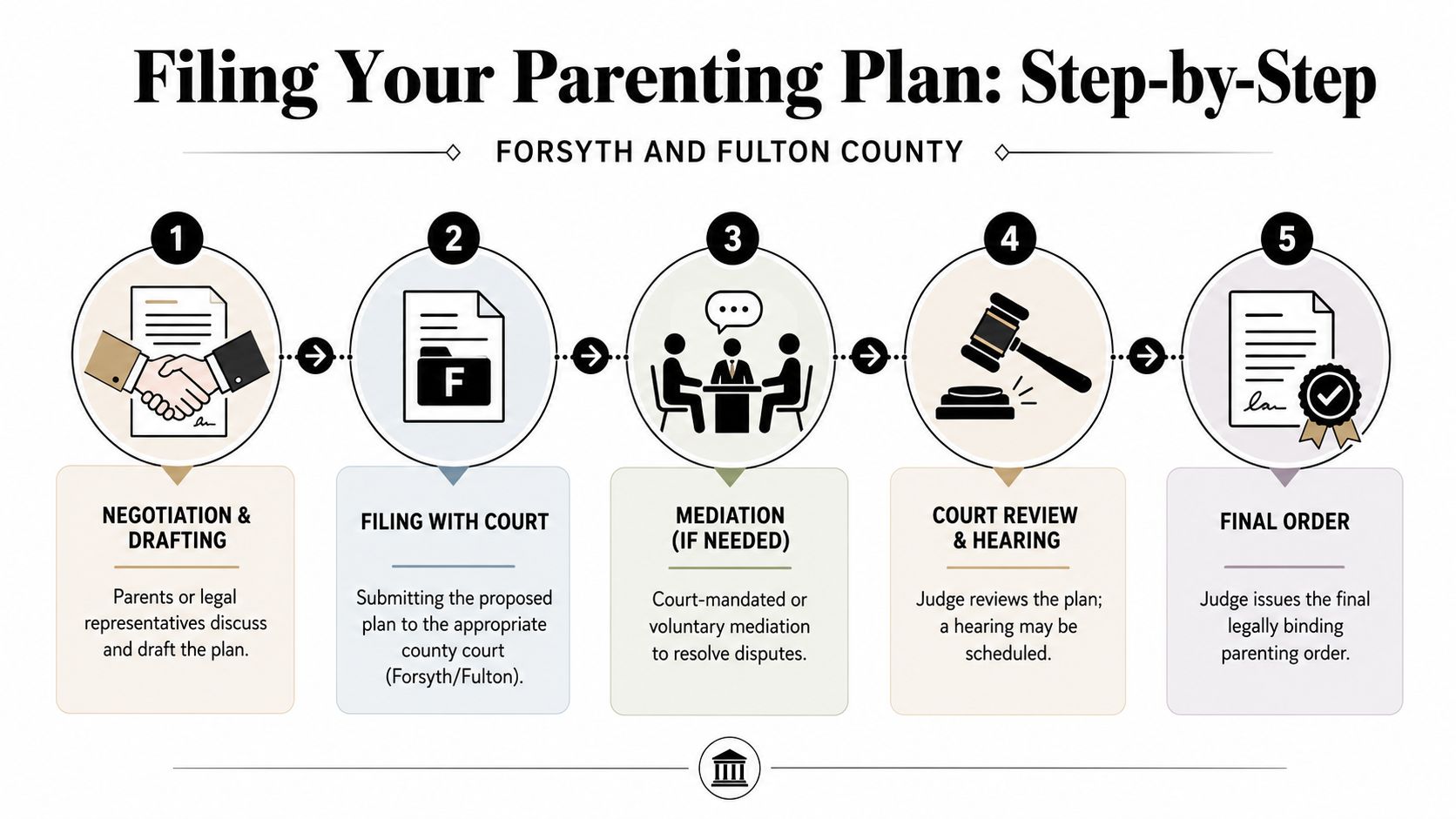
Step one through step three
In Georgia, divorce starts with filing. Georgia also has a 30-day minimum waiting period before a divorce can be finalized. During that broader divorce timeline, the parenting plan is negotiated, drafted, revised, and filed as part of the custody portion of the case.
The usual path in Forsyth County and Fulton County looks like this:
- Case filing: A divorce, legitimation, modification, or custody action begins.
- Initial drafting: Parents exchange proposed parenting plan terms, often through counsel.
- Temporary issues: If parents can't agree on time with the children right away, the court may address temporary custody and parenting time at a hearing.
Temporary hearings matter. A temporary arrangement can shape momentum in the case. If you need help preparing, review this guide on how to prepare for a custody hearing.
Mediation and court approval
Many family law cases in North Georgia move through mediation before trial. That's especially common in contested divorce matters involving custody, parenting time, child support, equitable division, and related disputes. Mediation gives parents a chance to settle detailed terms instead of asking a judge to impose them.
After negotiation or mediation, the proposed parenting plan is filed with the court. If the parents agree, the court reviews it as part of the final paperwork. If they don't, the judge can hear evidence and decide what parenting arrangement serves the child's best interests.
Judges approve enforceable plans. They don't rewrite vague ones for you.
What to expect locally
In Forsyth County Superior Court, timing and procedure depend on the case posture and whether temporary relief is requested. In Fulton County Superior Court and North Fulton courts, scheduling can also turn on whether the case is contested and whether mediation resolves key issues.
If you live in Cumming, Alpharetta, Dawsonville, Milton, or Johns Creek, the right strategy is usually the same. Get the plan drafted early. Don't wait until a hearing is already set.
Strategic Tips for Drafting Your Cumming Parenting Plan
At first, a proposed parenting plan can look harmless. Then school starts, one parent is late to exchanges, a holiday falls on a travel weekend, and nobody agrees on who gets to decide. That is when vague language turns into conflict, missed time with your child, and expensive trips back to court in Forsyth or Fulton County.

A good parenting plan answers problems before they happen. If a term can be argued about, rewrite it. Judges want workable terms they can enforce. Parents need rules they can follow on a Tuesday night in Cumming, not broad promises about cooperation.
Start with precision.
- Set exact exchange terms: Name the day, time, location, and which parent handles transportation.
- Write a full holiday schedule: Cover school breaks, summer, birthdays, Mother's Day, Father's Day, and long weekends.
- Assign decision-making clearly: State who decides education, non-emergency medical care, religion, activities, and how tie-breakers are handled.
- Require notice in writing: Spell out deadlines for travel, schedule change requests, extracurricular sign-ups, and school events.
- Create a dispute procedure: Say whether parents must confer first, use mediation, or follow a default schedule until a disagreement is resolved.
Do not stop at custody labels. “Joint legal custody” and “parenting time as agreed” are not enough. In North Georgia cases, the primary disputes usually involve pickup logistics, sports schedules, private school decisions, tutoring, camp costs, passports, and unreimbursed medical expenses. If your child's life includes those issues now, your plan should address them now.
Parents in Forsyth and Fulton County also need to draft for distance, traffic, and school boundaries. A plan that works for two parents living ten minutes apart may fail fast if one parent relocates to another part of metro Atlanta. Include terms on commute responsibility, exchange points, and how school-night parenting time works if travel becomes harder.
If you are a father pursuing legitimation, be especially careful. Parenting time that depends on goodwill is weak. Put your rights, your schedule, and your access to school and medical information in writing so you are not asking for permission later.
Keep your child's routine at the center of every decision. A judge will. If a proposed term makes life easier for a parent but creates instability for the child, it is a bad term and you should reject it.
Your parenting plan should read like a set of enforceable instructions.
Some parents choose to have a firm such as Miles Hansford Law Firm review proposed language before they sign. That can help catch vague terms, missed contingencies, and local issues that matter in Forsyth and Fulton County practice.
Do not sign a parenting plan because it sounds reasonable in the moment. Sign one because it will still work when communication gets strained. That is how you protect your child and protect your parenting time.
Why Choose Miles Hansford for Your Alpharetta Family Law Case
If your case is in Alpharetta, Cumming, Forsyth County, or Fulton County, local experience matters. Court procedure matters. Judicial expectations matter. A lawyer who works in these courts regularly will draft differently than a lawyer using generic national forms.
Families in Milton, Roswell, Sandy Springs, Johns Creek, and Suwanee often need more than a simple custody schedule. They need strategy around temporary hearings, mediation, equitable division in Georgia, modifications, contempt issues, and the practical realities of co-parenting across two households.
The right legal help should feel calm, not theatrical. You need someone who can reduce noise, identify risk, and put enforceable terms on paper. That's especially important if you're dealing with a contested divorce, a high-conflict custody case, a father's rights issue, or a modification after circumstances change.
If you're searching for a family law attorney near me in Alpharetta or Cumming, schedule a consultation before the other side locks in a bad status quo. Call today and protect your child's future with a plan built for real life in North Georgia.
Frequently Asked Questions about Georgia Parenting Plans
Q: Do we need a parenting plan in Cumming if we already agree?
A: Yes. Agreement does not replace the paperwork Georgia courts require. In Forsyth County, the judge still expects a written parenting plan that clearly states parenting time, legal custody, transportation, and how decisions will be made. If your agreement is vague, you are leaving room for conflict later.
Q: Can a parenting plan be modified in Forsyth County later?
A: Yes, if there has been a material change affecting the child or the parenting arrangement. Judges in Forsyth County do not rewrite custody orders because one parent is frustrated or wants a better schedule. You need a legally sufficient reason and facts that show the proposed change serves the child's best interests.
Q: What happens if my ex violates the parenting plan in Alpharetta?
A: Start documenting the problem immediately. Save texts, emails, missed exchange dates, school notices, and any pattern of denied parenting time. In Fulton County, enforcement often means filing a contempt action or another request for relief, and your records will matter far more than your accusations.
Q: What does best interest of the child mean in Georgia?
A: It means the court is focused on the child, not on either parent winning. Georgia judges look at stability, school routine, the child's relationships, each parent's ability to follow through, and whether the schedule works in real life. In Forsyth and Fulton County courtrooms, a parent who sounds reasonable, organized, and child-focused usually stands on stronger ground than a parent who is trying to score points.
Q: How do parenting plans work for unmarried parents in Cumming?
A: The plan can be just as important for unmarried parents as it is in a divorce. The legal issue is often whether the father has completed legitimation and has enforceable rights to seek custody or parenting time. Once the case is properly before the court, the parenting plan sets the rules for time-sharing, decision-making, exchanges, and communication.
Q: Is 50 50 custody automatic in Fulton County?
A: No. Georgia courts do not hand out equal parenting time by default. A judge will look at the child's needs, the parents' work schedules, school logistics, distance between homes, and each parent's history of involvement. If you want a true shared schedule, draft for it carefully and make sure the terms match how your family lives day to day.
Q: How does a parenting plan fit into a Georgia divorce timeline?
A: It becomes part of the custody and final divorce paperwork, and it often affects the entire pace of the case. Temporary hearings, mediation, negotiations, and proposed orders usually shape the final version long before trial. In Forsyth and Fulton County, parents who deal with the parenting plan early usually make better decisions than parents who wait until the court is forcing deadlines.
If you are facing divorce or a custody dispute in Cumming, Alpharetta, Forsyth County, or Fulton County, Miles Hansford Law Firm can help you put clear, enforceable terms on paper before a bad draft becomes a court order. Schedule a consultation and get advice before you agree to terms that could control your family's routine for years.