


Many people use the terms DUI and DWI as if they mean the same thing. While they are often used interchangeably in conversation, it is important to know that Georgia law officially uses the term DUI, which stands for Driving Under the Influence.
The critical distinction for our clients is not about a criminal definition. It is about understanding how a DUI on someone's record—the only term that legally matters here in Georgia—can create serious issues in your civil life. That is where our focus lies.
Understanding the Impact of a DUI in Georgia Civil Cases
When someone is dealing with the aftermath of a DUI in Georgia, the criminal case is just one piece of a much larger puzzle. The other, often overlooked, side is how that event affects personal and professional life. This is especially true in family law and business matters.
Our firm does not handle criminal defense. Instead, we represent clients in Alpharetta, Cumming, and across Fulton and Forsyth Counties who are dealing with the civil fallout. A DUI can quickly become a critical factor in a divorce, a child custody battle, or even a business dispute.
This concept map helps illustrate how a single DUI event connects to Georgia's legal system and the civil cases that frequently spin off from it.
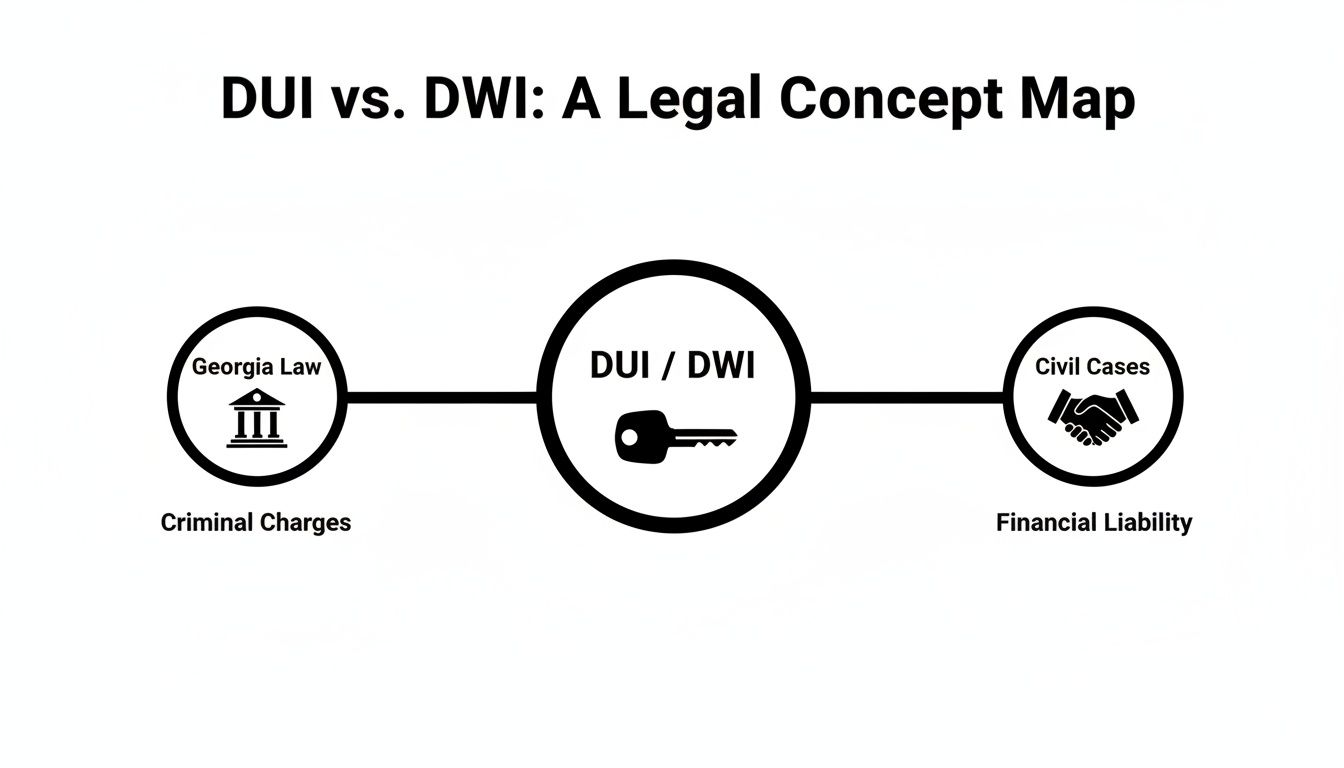
As you can see, while the state prosecutes the criminal aspect, the personal consequences often land you in civil court, requiring completely separate legal guidance.
Terminology in a Civil Context
Although most people use DUI and DWI interchangeably, the perception of these terms can carry weight in a civil courtroom. Some states use DWI to indicate a higher level of impairment, while others, like California, make no legal distinction at all. The push for enforcement has a long history; arrests for these offenses skyrocketed by nearly 223% between 1970 and 1986, while the number of licensed drivers only grew by 42%.
To clear up any confusion, the table below breaks down how we approach these terms within the scope of our civil law practice.
DUI vs. DWI Terminology in a Civil Law Context
This quick reference table clarifies how these terms are understood in Georgia and their direct relevance to civil court proceedings.
| Term | Common Meaning | Relevance in Georgia Civil Cases |
|---|---|---|
| DUI | Driving Under the Influence of alcohol, drugs, or other intoxicants. This is the official legal term used in Georgia. | This is the primary term used in family law and civil litigation. An official DUI record is what directly impacts a case. |
| DWI | Driving While Impaired or Intoxicated. This term is common in other states but is not the legal standard in Georgia. | While not an official Georgia term, clients from other states often use it. We treat it as synonymous with DUI for civil purposes. |
Ultimately, whether you call it a DUI or a DWI, the civil implications remain the same. If you need help managing the consequences of an impaired driving issue in a civil matter, our firm is here to help. You can learn more about how we handle the civil side of DUI cases in our detailed guide.
How a DUI Impacts Georgia Divorce Proceedings
When a couple decides to part ways, Georgia law requires an equitable, or fair, division of marital property. A recent DUI on a spouse's record can throw a major wrench into what might have otherwise been a straightforward process. The costs that come with a DUI—legal fees, hefty fines, court-ordered treatment programs—are often paid from shared marital funds, and that can quickly become a serious point of conflict in divorce negotiations.
If one spouse used money from a joint account to deal with their DUI, the other spouse has grounds to argue that those funds were essentially wasted. In legal terms, this is called the dissipation of marital assets. The argument is simple: that money was spent irresponsibly on a personal legal problem, draining the resources that should have belonged to the marital estate.

While Georgia law doesn't distinguish between a DUI and a DWI, the behavior that led to the incident can certainly influence how things play out in a civil case like a divorce. It all comes down to how that conduct is framed in court.
Arguing for an Unequal Division of Assets
Georgia courts generally start from a 50/50 split of marital assets, but they have the power to move away from that standard if one person’s actions justify it. A DUI is a perfect example of conduct that can be used to argue for an unequal division of property.
The spouse without the DUI can show the court exactly how the incident hurt the family’s finances. This includes evidence of:
- Legal Defense Costs: Attorney fees for the criminal case that were paid from a joint account.
- Fines and Court Fees: Payments made to the court that reduced shared savings.
- Treatment or Education Programs: Money spent on mandatory classes or rehabilitation services.
- Increased Insurance Premiums: Higher car insurance rates that put a strain on the family budget.
To make this argument stick, you need to present a well-documented account of every dollar spent. We often help clients in Fulton and Forsyth County track down the financial records needed to build a strong case for getting that money back during the property settlement.
In a divorce, a DUI isn't just a personal mistake—it's a financial event. A judge has the discretion to adjust the asset division to compensate the non-offending spouse for the marital funds spent as a direct result of the other spouse's conduct.
Influence on Alimony and Spousal Support
A DUI can also factor into decisions about alimony, or spousal support. The court's primary considerations are one spouse's financial need and the other's ability to pay, but the judge is allowed to consider the conduct of both parties.
If the DUI resulted in a job loss or a lower earning capacity, it could seriously weaken that person's argument for receiving alimony. On the flip side, if the spouse asking for alimony is the one with the DUI, the court might see their financial problems as self-inflicted. This could lead to a lower award or a shorter duration of support. For our clients in Alpharetta, Roswell, and Johns Creek, understanding these realities is crucial for setting realistic expectations as they navigate their divorce.
Navigating Child Custody and Parenting Plans After a DUI
When parents separate, Georgia courts have one guiding principle above all else: the best interest of the child. A recent DUI on a parent's record can throw a major wrench into these proceedings, raising immediate questions about a parent's judgment and ability to provide a safe home.
Whether the incident is called a DUI here in Georgia or a DWI from another state, the core issue for a family law judge is the same—potential child endangerment. This is especially true in Fulton and Forsyth County courts, where judges take child safety extremely seriously. A DUI becomes a piece of evidence used to argue a parent might pose a risk, particularly when it comes to driving with the kids.

Our job isn't to defend the DUI itself. Instead, we provide calm, professional guidance on managing these sensitive issues within your family law case. We focus on solutions that protect your parental rights while directly addressing the court's legitimate concerns.
How Courts May Respond to a DUI
A judge in Cumming or Alpharetta has several tools to ensure a child's safety when a parent has a DUI on their record. These measures are not meant to be punitive; they are designed to be protective. The court might consider a few different options when creating a parenting plan.
Some common protective provisions include:
- Supervised Parenting Time: The court could order that a neutral third party be present during visitation, at least for a while.
- Restrictions on Driving: A judge might prohibit the parent with the DUI from driving with the child in the car.
- Substance Abuse Evaluations: The court can require a professional assessment to find out if there is an ongoing problem.
- Alcohol Monitoring: In some situations, a parent may be ordered to use a device that monitors their alcohol consumption.
None of these outcomes are automatic. The best way to avoid them is to be proactive, demonstrate responsibility, and show the court this was an isolated mistake—not a pattern.
A DUI creates a hurdle in a custody case, but it does not have to be a permanent barrier. The key is to address the court's safety concerns head-on with a clear, responsible strategy that prioritizes the child's well being.
Crafting a Proactive Parenting Plan
Instead of waiting for a judge to impose restrictions, a much better approach is to suggest parenting plan terms that tackle the issue directly. Doing so shows accountability and a real commitment to your child's welfare.
Courts are often worried about repeat offenses. Statistics reveal that drivers in fatal crashes with a BAC of 0.08 or higher are six times more likely to have a prior DWI conviction than sober drivers. Understanding this judicial perspective is crucial for crafting an effective solution. You can discover more about these findings on repeat DUI offenses.
By working with an experienced family law attorney, you can negotiate specific terms that protect your relationship with your child. This might mean agreeing to use a breathalyzer before driving or attending co-parenting classes. Taking these steps can go a long way in reassuring the court and the other parent, helping you stay in your child's life in a meaningful way. For more details, check out our guide on what to do to get ready for a child custody case.
Business and Professional Consequences in Civil Litigation
The fallout from a DUI doesn't stop with family matters; it often spills over into the business and professional world, creating serious problems. For business owners and licensed professionals here in North Georgia, a DUI is far more than just a personal mistake. It’s a major liability that can put an entire livelihood and the stability of a business at risk.
This is particularly true when business contracts are in play. Many partnership agreements, shareholder documents, and even executive employment contracts include something called a "morals clause." This is a provision that prohibits any conduct that might tarnish the reputation of the individual or the company. A DUI is frequently viewed as a clear violation of that clause, giving business partners or employers a legal basis to take action.

Breach of Contract and Partnership Disputes
When a DUI triggers a morals clause, it can quickly escalate into a formal breach of contract dispute. The consequences could be severe, leading to a forced buyout, termination of employment, or in the worst-case scenario, the dissolution of the company. Our civil litigation attorneys are experienced in these complex situations, focusing on resolving the dispute while protecting the business's assets and future. We manage the contractual fallout that arises from a business owner’s personal conduct in communities like Alpharetta and Johns Creek.
A DUI can transform a trusted business partner into a perceived liability overnight. The resulting civil disputes require a legal strategy that separates the personal issue from the professional obligations to protect the business itself.
Reputational Damage as Civil Litigation Leverage
Beyond direct contract breaches, the damage to a professional reputation can be used as a powerful weapon in other civil cases. For instance, during a high-asset divorce, a DUI might be used to argue that a business owner's judgment is compromised, which could impact a business valuation. A spouse could claim the DUI has damaged the company's goodwill, thereby lowering its value and affecting how assets are divided. You can learn more about navigating the complexities of what to do with your family business during divorce in our guide.
While laws have helped reduce impaired driving incidents over the decades, the societal view of such behavior remains strong. From 1991 to 2017, DUI-related fatalities in the U.S. dropped by half, yet thousands of lives are still lost annually. Understanding the gravity of these statistics is key to grasping why a DUI can so heavily influence a judge or jury in a civil case. Discover more insights about U.S. impaired driving statistics.
How a DUI Can Affect Your Civil Court Case
When a DUI becomes relevant in a civil lawsuit, it is crucial to be upfront and honest. Trying to hide or minimize the incident will almost certainly backfire, causing far more damage to your credibility than the issue itself. The best path forward involves working closely with your civil attorney to frame the situation correctly from the very start.
Our firm makes sure clients are prepared for the realities of civil litigation. This includes depositions, mediations, and courtroom appearances where a past DUI could be brought up. We develop a strategy that presents the DUI as a past mistake that has been handled responsibly, preventing the other side from using it to paint a false picture of your character.
Framing the Narrative in Your Favor
In any civil dispute, whether it is a divorce in Fulton County or a business conflict in Forsyth County, the opposing counsel will look for any leverage they can find. A DUI, no matter how old, is often seen as an easy target. Our job is to neutralize this tactic before it can gain any traction.
We walk clients through how to discuss the matter with accountability and composure. The goal is to show the court you’ve taken the necessary steps to move forward, such as completing court-ordered programs and maintaining a clean record. This approach highlights maturity and responsibility.
An experienced civil attorney can keep a past DUI from having an outsized influence on your current case. The strategy is not to deny the mistake, but to show it is a closed chapter that has no bearing on the civil matter at hand.
Protecting Your Interests in Court
It is essential to have a plan for when a DUI is raised in a civil court setting. We help our clients anticipate these questions and prepare clear, concise answers that acknowledge the situation without getting sidetracked from the primary legal issue. Whether your case is in Alpharetta or Johns Creek, your response must be consistent and truthful.
This preparation is vital for a few key reasons:
- Maintains Credibility: It demonstrates to the judge that you are not hiding from your past.
- Keeps Focus: It helps steer the conversation back to the relevant facts of the civil case.
- Reduces Anxiety: Knowing how you will respond helps you stay calm and confident under pressure.
By confronting the issue with a well-planned strategy, we reinforce your standing as a credible party in your divorce, custody, or business dispute. We work to ensure a past error does not define your future.
Frequently Asked Questions About Civil DUI Consequences
It is one thing to understand the legal differences between a DUI and a DWI, but the real-world consequences often hit hardest outside of a criminal courtroom. Here are some of the most common questions our clients in Fulton and Forsyth County ask us about how a DUI can impact their lives long-term.
Can a past DUI be used to increase my alimony payments in a Georgia divorce?
A past DUI on its own will not automatically result in higher alimony payments. However, Georgia courts look at the conduct of both spouses during the marriage, and that is where things can get complicated.
If the behavior connected to the DUI involved wasting marital assets—like spending thousands from a joint account on legal fees and fines—a judge could factor that into their decision. In a divorce, every dollar is scrutinized. A DUI can easily be framed as a major financial blunder and a breach of responsibility to the family, which can shift the scales during negotiations over property division and spousal support.
For instance, if you drained a shared savings account to pay for legal defense, those funds are gone. A judge in an Alpharetta courtroom might see that as a loss to the non-offending spouse and adjust how assets are divided to make things right.
Will I automatically lose custody of my children because of a DUI in Forsyth County?
No, you will not automatically lose custody, but a DUI is a huge red flag for the court. A judge's number one priority is always the best interests and safety of the child.
Because of a DUI, a judge might order certain protective measures, like supervised visitation, an alcohol monitoring device, or mandatory parenting classes to ensure the child is safe. The key to protecting your parental rights is to get ahead of the problem. Instead of waiting to defend yourself against accusations, be proactive. This might mean voluntarily suggesting terms for your parenting plan, like agreeing not to drive with the kids for a certain period or completing a substance abuse assessment on your own.
Showing the court that you recognize the seriousness of the issue and have taken concrete steps to address it is the most effective way to mitigate the impact of a DUI on your custody case. It shifts the narrative from one of risk to one of responsibility.
By taking control of the situation, you show the judge that you are a responsible parent who made a mistake but is committed to making sure it never happens again.
My business partner got a DUI. Can this affect our company?
Yes, it certainly can. The impact really depends on the fine print in your partnership agreement. Many business agreements include a “morals clause” or a "key person" clause that a DUI could violate, potentially giving grounds for a buyout or even dissolving the company.
The fallout from a partner's DUI can create major operational and reputational headaches. Clients may lose confidence, lenders could get nervous, and trust within the company can quickly disappear. It is critical to handle the situation professionally and swiftly to keep the business stable. A business attorney should review your contracts right away to figure out the best way forward.
How should I address a past DUI if it comes up in my civil case?
You and your civil attorney need a careful strategy for this. The best approach is to be upfront, show you have taken accountability, and frame the DUI as a one-time mistake that does not define who you are today as a parent or professional.
Trying to hide or minimize a past DUI is a terrible idea; it will only make you look untrustworthy to the court. The goal is to demonstrate that it is a resolved issue from your past that has no bearing on the current case.
Your attorney will work with you to prepare direct, concise answers for a deposition or court hearing. The focus should be on what you learned from the experience and the positive steps you have taken since. This strategy allows you to acknowledge what happened without letting it derail your current legal matter.
When the civil consequences of a DUI threaten your family or business, you need clear, experienced legal guidance. Contact Miles Hansford Law Firm to discuss your case and learn how we can help you protect your interests in Fulton County, Forsyth County, and the surrounding North Georgia communities.